
The Long Aftermath
1826–1856: The Debate That Outlasted the Epidemic
THE question of yellow fever's origin and treatment was not resolved by Rush's death in 1813 or Currie's before him. The disease returned to American coastal cities throughout the first half of the nineteenth century — Baltimore, New York, Norfolk, Savannah, New Orleans — and with it came the same arguments, the same therapeutic choices, the same institutional conflicts. The Philadelphia controversy of the 1790s had been the first and most intensely documented episode; it would not be the last.
By 1826, a Savannah physician named William Coffee Daniell had spent enough time watching yellow fever patients treated with aggressive purgatives and mercurials — the Rush protocol, still in use thirty years later — that he had concluded the treatment was more dangerous than the disease. His Observations upon the Autumnal Fevers of Savannah represents the anti-Rush therapeutic position transplanted to the antebellum South, with three additional decades of clinical evidence behind it. The collection holds two copies, with slightly different imprints for different regional markets.
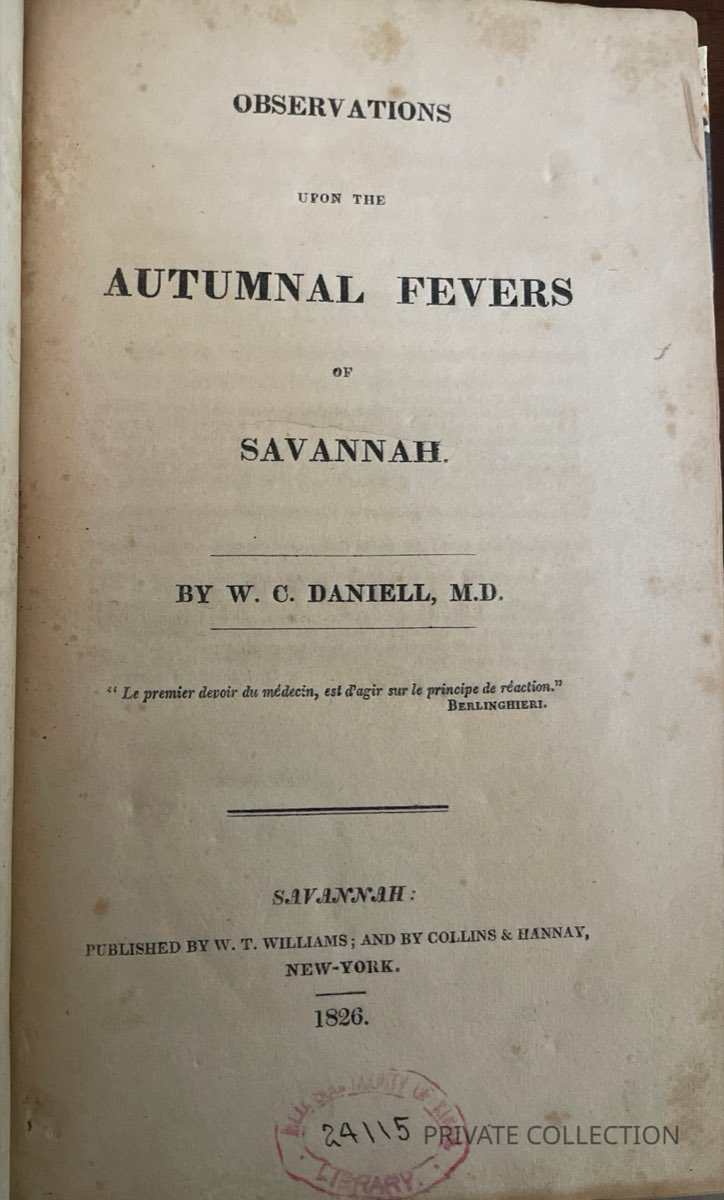
Observations upon the Autumnal Fevers of Savannah
A University of Pennsylvania graduate, associated with Dr. Nathaniel Chapman in Philadelphia before settling in Savannah, arguing against the very treatment protocol that Philadelphia's most famous physician had published in a popular almanac thirty years before. "Purgatives and mercurials" had not been abandoned; Daniell's Observations represents the continuing counter-argument, still necessary in 1826.
Observations upon the Autumnal Fevers of Savannah — Second Copy, New York Imprint
Two copies of this scarce work with different imprints for different regional markets: the Savannah issue for Southern readers, the New York issue for Northern ones. The bibliographic distinction — different title pages, different spellings of the author's name — makes these technically separate entries. The collection holds both, allowing direct comparison of the variant imprints.
In 1855, yellow fever killed approximately a third of Norfolk, Virginia's population. It was the worst epidemic in American history since Philadelphia in 1793 — which is to say, the question that Rush and Currie had disputed so fiercely over so many decades was still unanswered. Physicians in Norfolk in 1855 were still arguing about importation versus domestic origin. The quarantine question was still unsettled. The treatment question was still contested.
George D. Armstrong was a Presbyterian clergyman in Norfolk who stayed through the epidemic, ministering to his congregation as they died. The epidemic took his wife and his child. He wrote about it afterward in a series of letters to a friend, and those letters became a book: a chronicle of catastrophe that is equal parts pastoral record, community history, and personal grief. It is the epidemic's human aftermath, sixty-two years after Philadelphia.
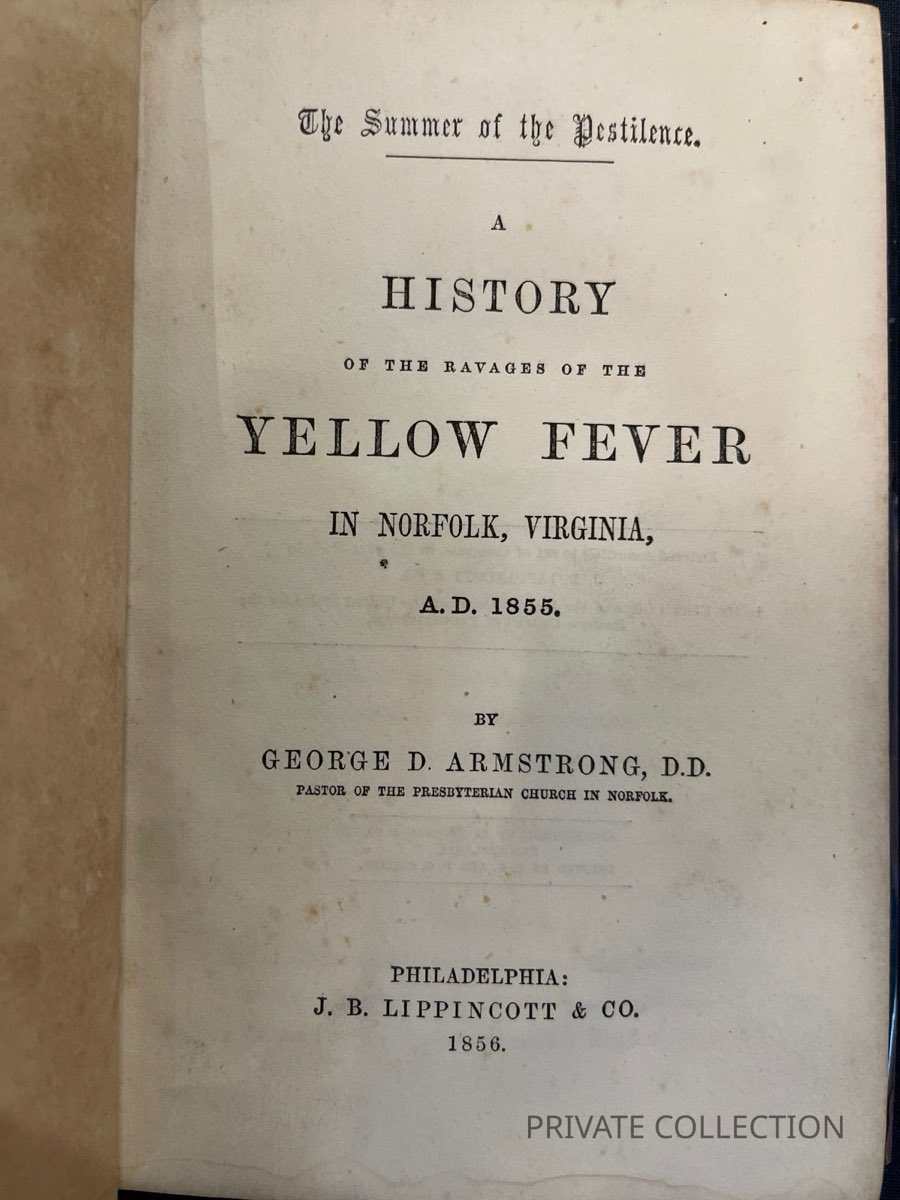
The Summer of the Pestilence: A History of the Ravages of the Yellow Fever in Norfolk, Virginia, 1855
The Rush-Currie controversy of the 1790s was still alive, in attenuated form, in 1855. Physicians were still arguing about importation versus domestic origin, still without the vector biology that would explain everything. Armstrong's book is the epidemic's human cost as personal testimony — the format that Rush's letters and Cresson's meditations had established for the 1793 crisis, now applied to 1855. It would not be resolved until Walter Reed's Cuba experiments in 1900 demonstrated mosquito transmission.