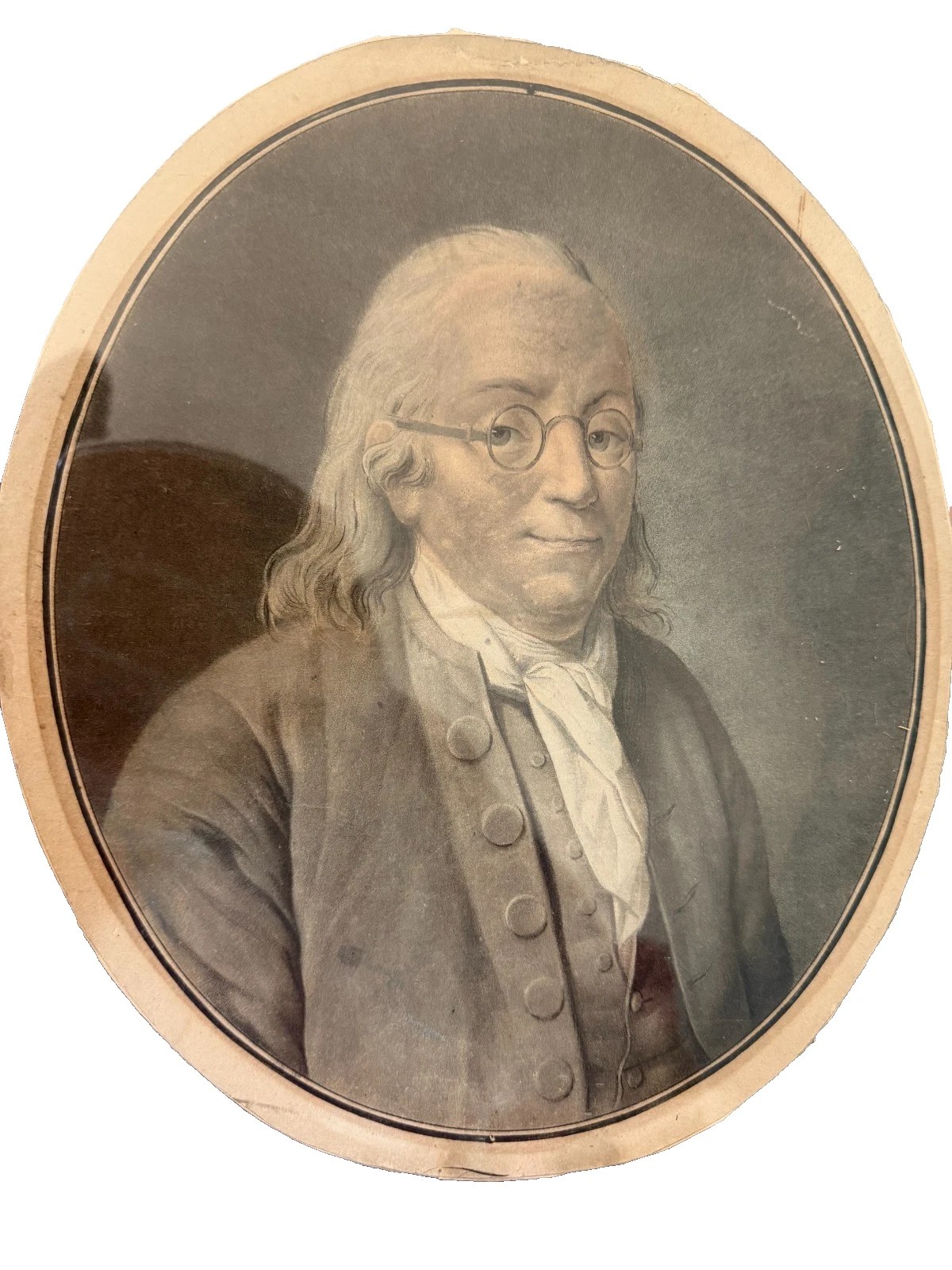
The oval print with its paper margin.
Benjamin Franklin, after Charles Philippe Amédée Van Loo
Aquatint printed in colour and finished by hand, oval. Paris, circa 1790. Image 9¾ by 8¼ inches (24.9 by 20.7 cm)
Franklin sat for Van Loo in Paris while he served as American commissioner and then minister to the court of Louis XVI, between 1777 and 1785. The painted original, now at the American Philosophical Society, shows him in a fur coat. The print dresses him instead in a plain grey coat with cloth-covered buttons, a change Charles Coleman Sellers read as a concession to revolutionary taste. The round spectacles, the loose grey hair and the faint smile are all there.
Paris could not get enough of Franklin’s likeness, and its printsellers supplied it in every size and technique. This one was issued by Marie François Drouhin, a Paris publisher and printer.
This copy has been trimmed from the shape in which these prints normally appear, and the publisher’s imprint is gone with the cut. The title at the foot typically misspells his name as “Francklin.” Only a small remnant of the F survives here.
Complete impressions of this portrait typically sell for $3,000 to $3,500, and this copy is priced accordingly.
Good condition, with a short tear in the upper part of the image. Reference: Sellers, Benjamin Franklin in Portraiture, pp. 391 to 394.
Inquire about this item
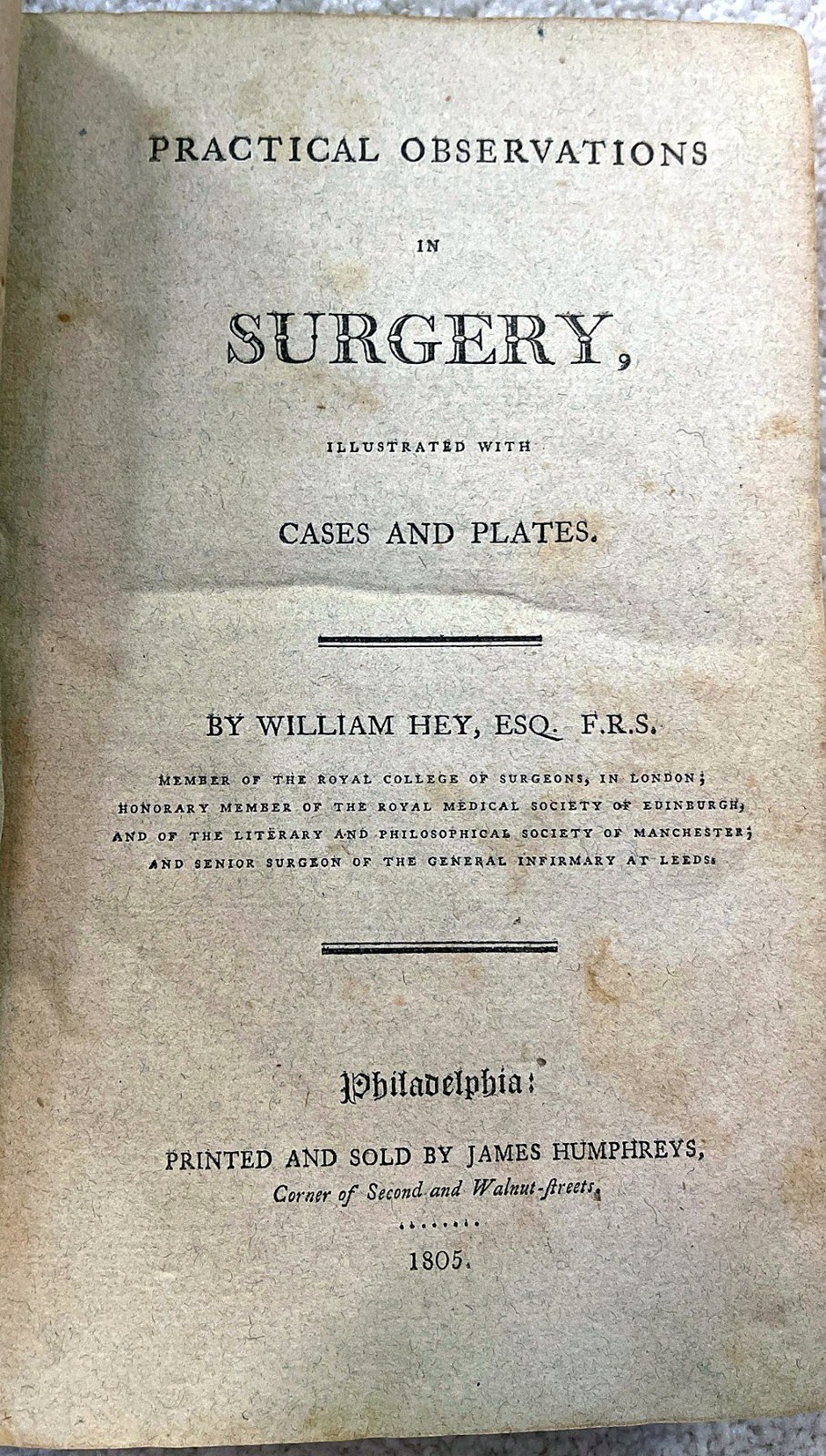
Title page.
William Hey, Practical Observations in Surgery
First American edition, octavo. Philadelphia: James Humphreys, 1805
Hey was senior surgeon at the General Infirmary at Leeds and a Fellow of the Royal Society. His Practical Observations appeared in London in 1803, and Humphreys had it reprinted in Philadelphia within two years. This is the American first edition, and the first to carry plates cut by the Philadelphia engraver Benjamin Tanner.
The book is where Hey's name enters the surgical record. It describes the partial amputation of the foot through the tarsometatarsal joint that still bears his name, and the falciform edge of the saphenous opening known as Hey's ligament. It gives an account of subacute osteomyelitis of the tibia ahead of Brodie, and it is the source of the phrase internal derangement of the knee, applied to injuries of the cartilages of the joint.
Contemporary tree calf with a leather label. 332 pages and nine preliminary leaves, with ten engraved plates. References: Garrison-Morton 4308; Austin 904; American Imprints 8610.
Inquire about this item
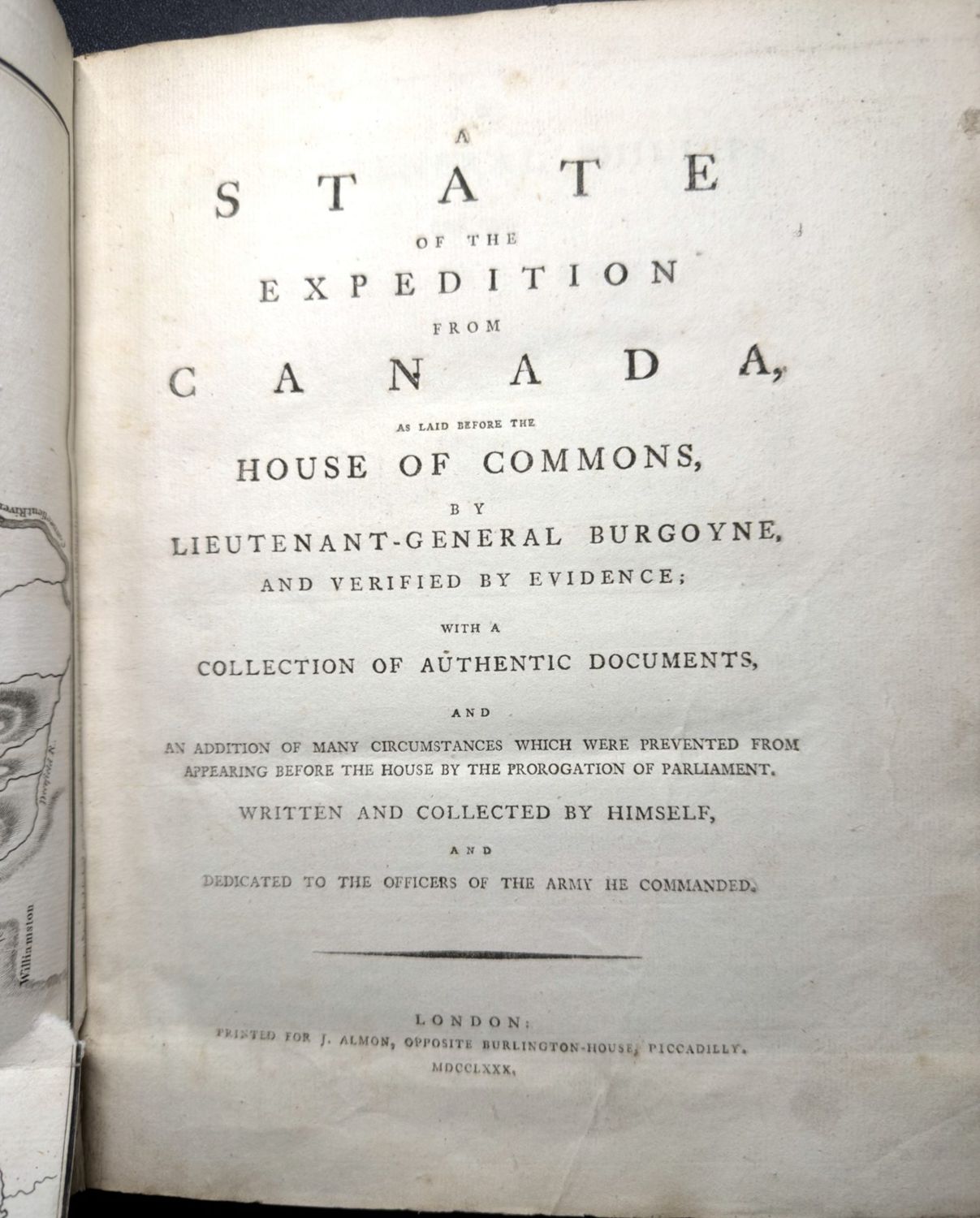
Title page.
Burgoyne, A State of the Expedition from Canada, as Laid Before the House of Commons
First edition, quarto. London: printed for J. Almon, 1780
Burgoyne marched south from Canada in 1777 to take the Hudson valley and cut New England off from the rest of the continent. He got as far as Saratoga, where the force he was to meet never came, and on 17 October he surrendered his whole army of some five thousand eight hundred men to Horatio Gates. It was the turning point of the war, and it brought France in on the American side.
This is his defence, laid before the House of Commons and then printed by himself, with the evidence of his officers, his correspondence with Germain and Howe, and an addition of the circumstances the prorogation of Parliament had kept out of the record. He dedicated it to the officers of the army he had commanded.
Complete with all six folding engraved maps by William Faden, hand-coloured: Medcalfe's map of the country, the action at Huberton, Baum's position at Walmscock near Bennington, the encampment at Swords House near Stillwater, the encampment at Braemus Heights, and the position at Saratoga where the army stood until the Convention was signed. The Swords House and Braemus Heights plans retain their hinged overlay flaps, which show the shift in positions and are the first thing usually lost from this book.
Inquire about this item
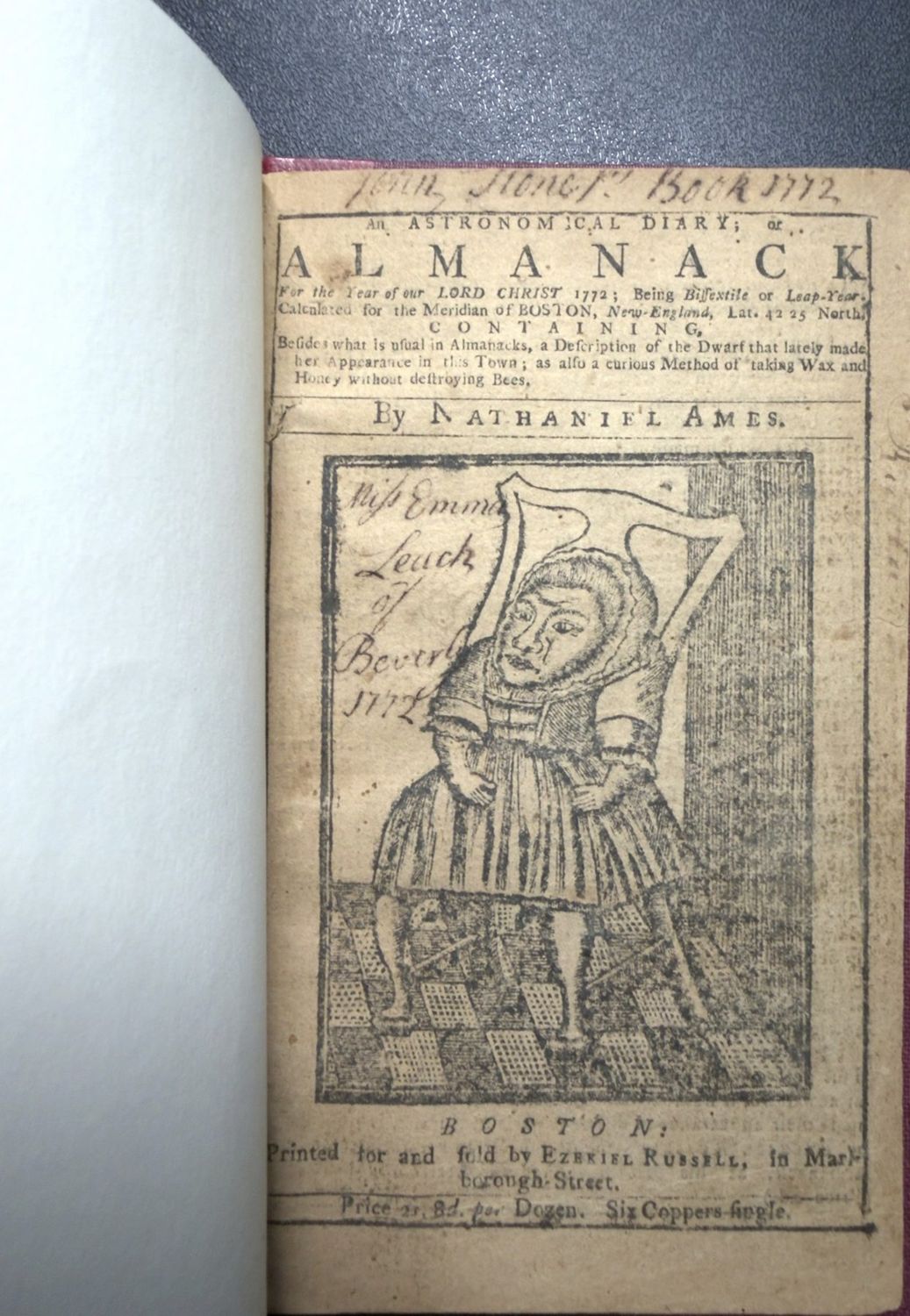
The first page, with the first of the three engravings.
Nathaniel Ames, An Astronomical Diary, or Almanack for the Year 1772, with three engravings by Paul Revere
Boston: printed for and sold by Edward Russell in Marlborough Street, [1771]
An Ames almanac carrying three engravings by Paul Revere. The first stands on the opening page. The second is The Patriotic American Farmer, his portrait of John Dickinson of Philadelphia, whose Letters from a Farmer had put the colonial case against Parliamentary taxation into language every farmer could follow, shown with a bust of Cato and the lines beneath on stemming tyranny and raising the thoughts of a degenerate age. The third is Catharine Macaulay, the English republican historian whom the American opposition read, quoted and corresponded with.
Almanacs were the most widely owned printed thing in the colonies, bought new every year by households that owned no other book. That is what made them worth engraving for. A political print in an almanac reached a farmhouse in a way a pamphlet never did, and Revere understood it before almost anyone.
With an early ownership signature at the head of the first page.
Inquire about this item
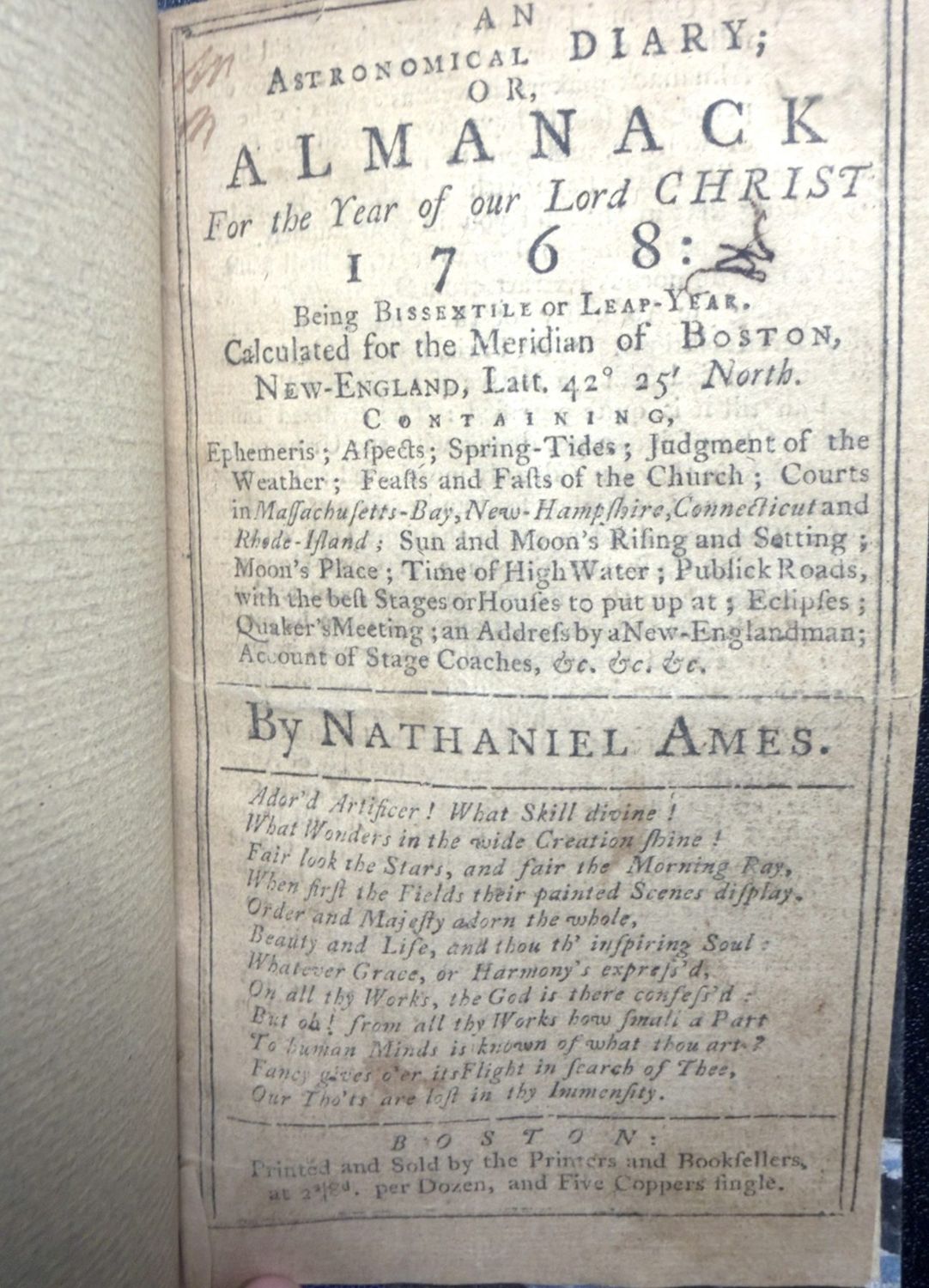
Title page for 1768.
Nathaniel Ames, An Astronomical Diary, or Almanack for the Year of our Lord Christ 1768
Boston, [1767]
This is the number that carries the letter urging readers to save your money and save your country. It was printed in the thick of the non-importation agitation that followed the Townshend duties, when the argument in every colonial town was whether to buy British goods at all, and it put that argument on the wall of every farmhouse in New England.
Calculated for the meridian of Boston, with the eclipses, the aspects, the spring tides, the judgment of the weather, the feasts and fasts of the church, the courts, the roads, the rising and setting of the sun and moon, the high water, and verses running through the calendar. The Ames almanacs sold in tens of thousands a year and were the most widely read printed thing in New England.
The same trade Franklin worked in Philadelphia. The collection holds an Ames almanac for 1771 with the first printing of Franklin's epitaph.
Inquire about this item
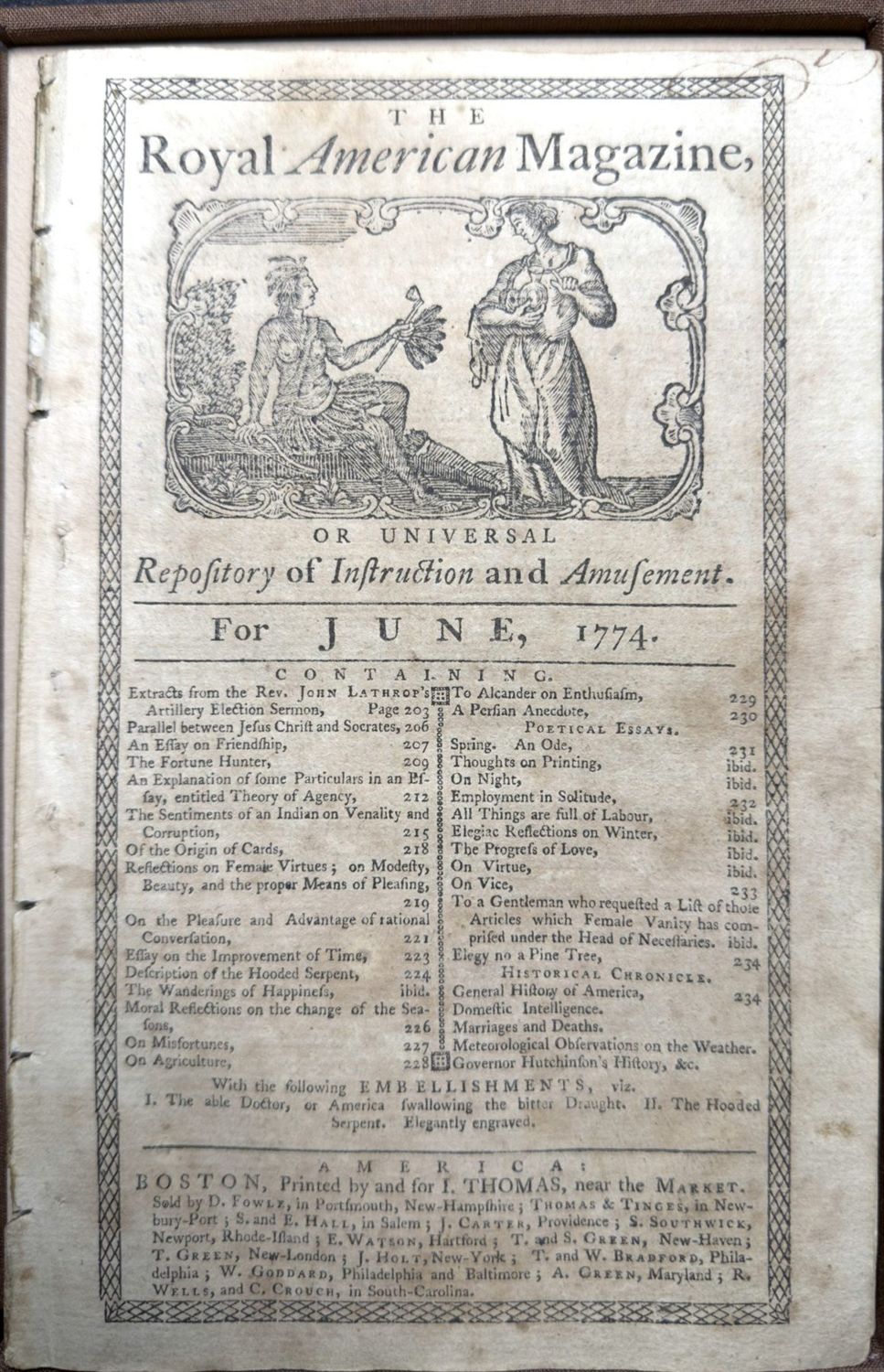
Title page for June 1774, with the masthead engraved by Paul Revere.
The Royal American Magazine, or Universal Repository of Instruction and Amusement, for June 1774
Boston: printed by Isaiah Thomas, 1774
Isaiah Thomas began the Royal American Magazine in January 1774, in the months between the Tea Party and the closing of the port of Boston, and Paul Revere engraved for it. The magazine ran fifteen months and failed, as nearly every colonial magazine did, but its numbers carried some of the sharpest political prints made in America.
This number does not have the Revere plate called for in it, which is the piece most buyers of this magazine are looking for, and it is offered on that understanding. What it does have is the June number entire, the engraved masthead, and the text as Thomas printed it in the month Boston's port was closed by act of Parliament.
Inquire about this item
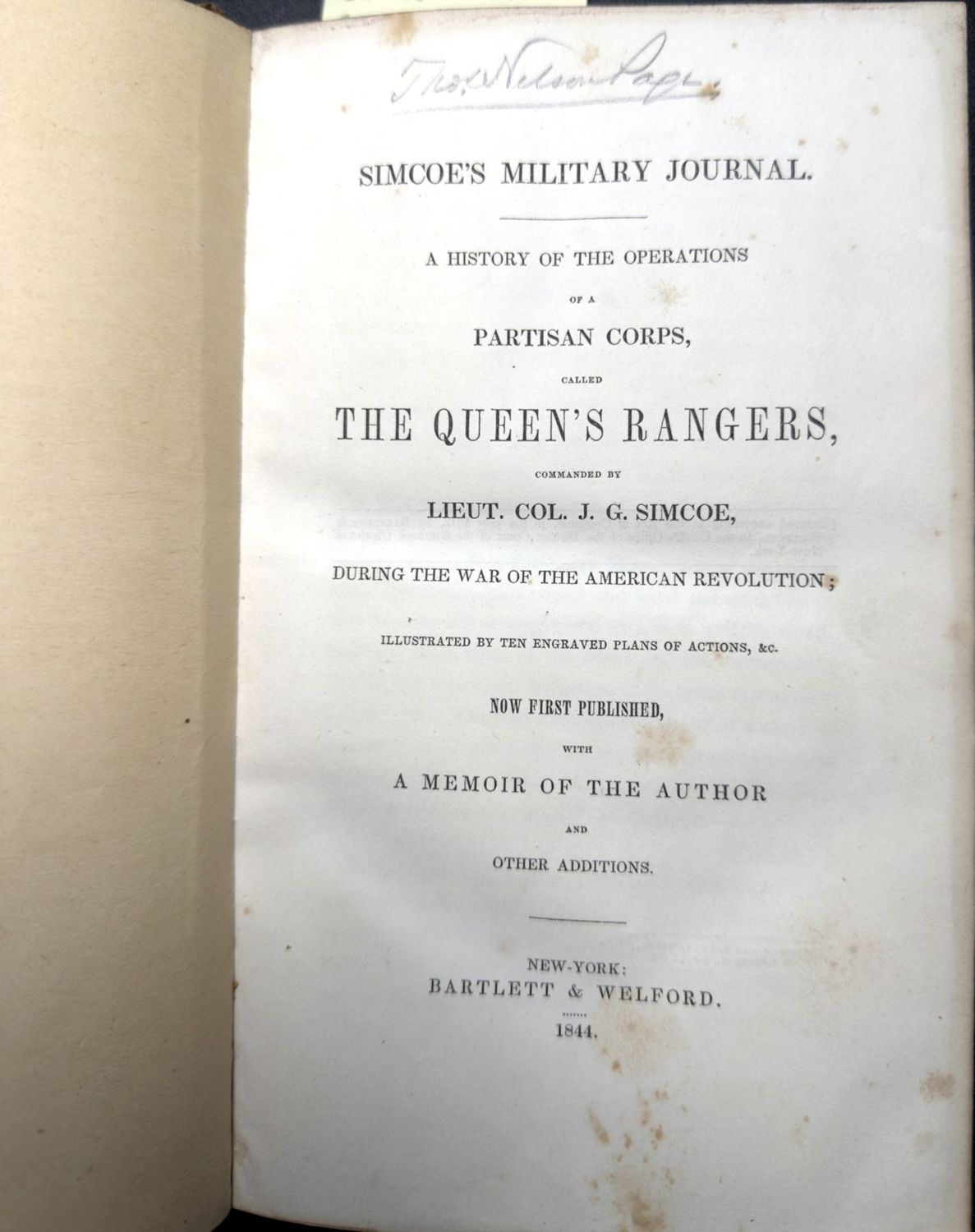
Title page.
Simcoe's Military Journal: A History of the Operations of a Partisan Corps, called the Queen's Rangers
First American edition. New York: Bartlett and Welford, 1844
John Graves Simcoe commanded the Queen's Rangers, the most effective loyalist corps of the war, through the Philadelphia campaign of 1777 and 1778 and afterwards in New Jersey and Virginia, where he was captured. He wrote this account of it from his own orderly books, printed it privately at Exeter in 1787 in a very small number of copies, and went on to become the first lieutenant governor of Upper Canada.
This is the first American edition, published in New York in 1844 with a memoir of the author and other additions, and with the engraved plans of actions. It is the war seen from the other side, by an officer who fought his way through the country around Philadelphia in the year the British held the city.
With an early ownership signature at the head of the title.
Inquire about this item
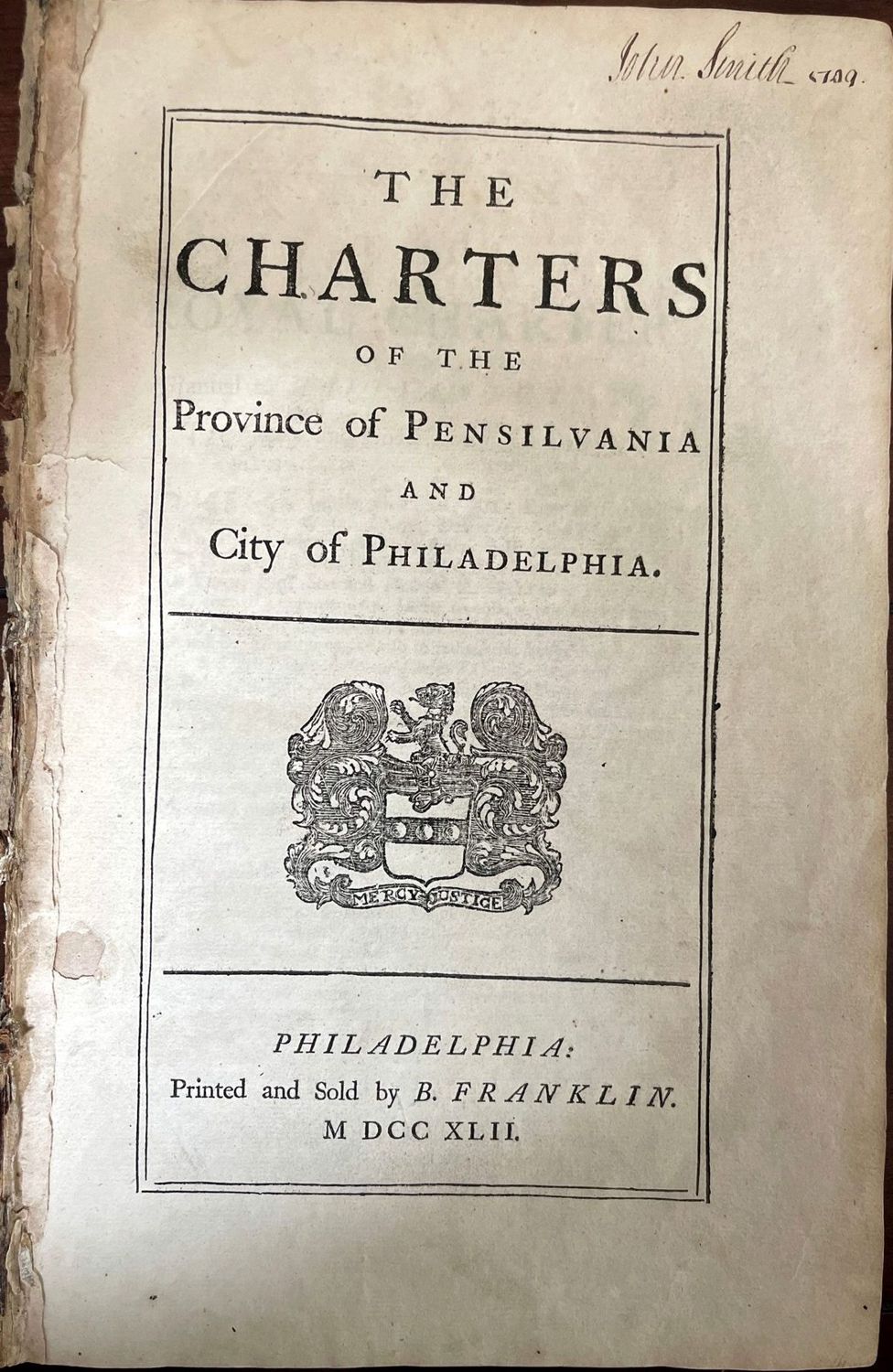
Title page, with the ownership signature of John Smith dated 1749.
The Charters of the Province of Pensilvania and City of Philadelphia
Philadelphia: printed and sold by B. Franklin, 1742. Disbound section from the folio of charters and laws
Franklin printed this folio for the Assembly, which paid him for it and ordered a small edition. It gathered in one volume the Royal Charter granted to William Penn by Charles II in 1681, Penn's charter of privileges, the charter of the city of Philadelphia, and behind them a collection of all the laws of the province then in force, with an appendix of those expired, altered or repealed. It was the working book of the province: what a magistrate, a lawyer or a member of the Assembly reached for when he needed to know what the law was.
This is the charters section, disbound from such a volume. It opens with the title page carrying Franklin's imprint and the arms of the Penn family with their motto, mercy and justice, and continues with the Royal Charter itself: Charles II granting his trusty and well-beloved subject William Penn, son and heir of Sir William Penn deceased, all that tract of land in America bounded on the east by the Delaware.
An early owner signed the title page John Smith and dated it 1749.
Inquire about this item
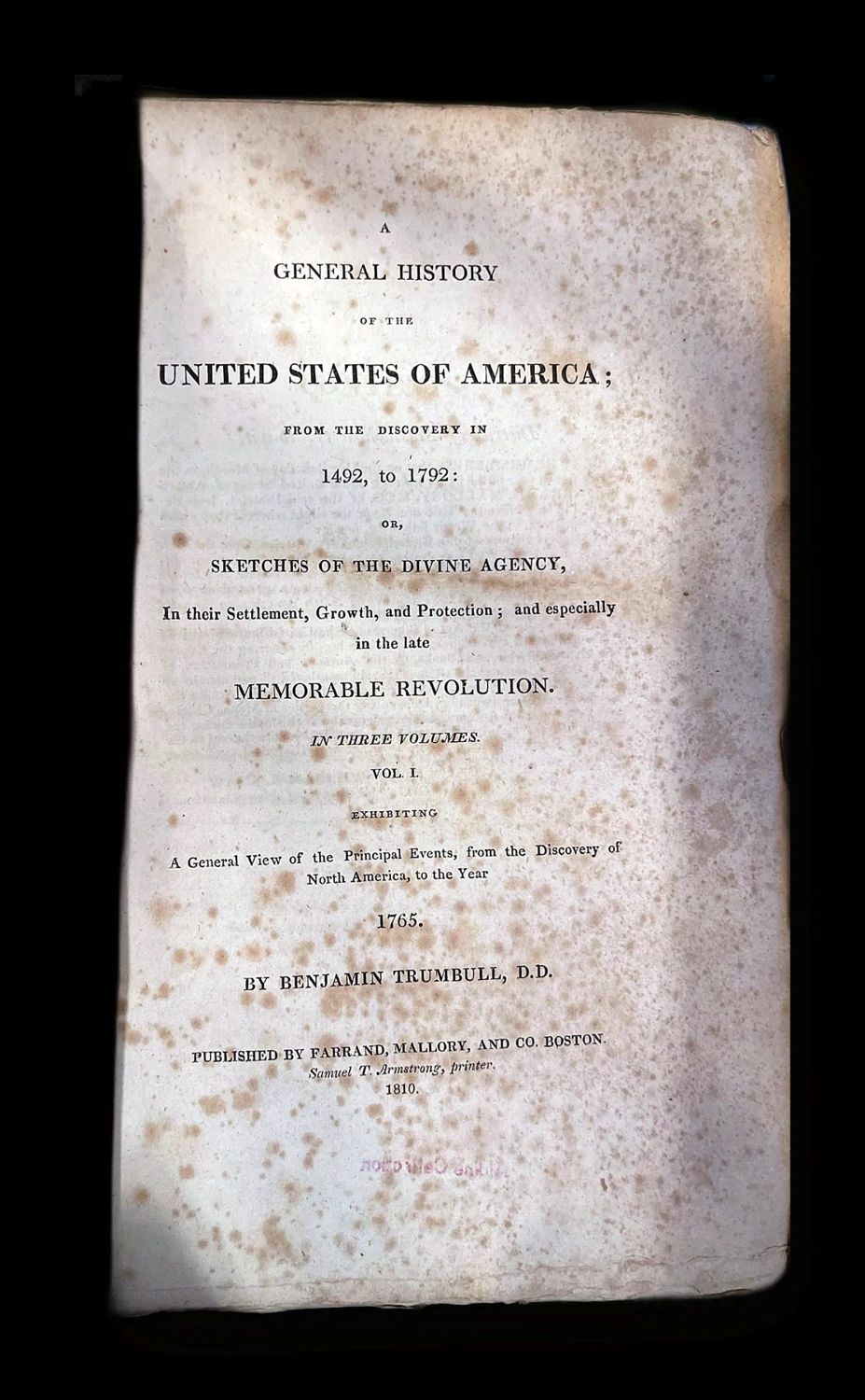
Title page.
Benjamin Trumbull, A General History of the United States of America
First edition. Boston: Farrand, Mallory, and Co., 1810. Volume I, all published
Benjamin Trumbull of Connecticut served through the Revolution as a volunteer and a chaplain, and wrote its history as a clergyman would, tracing the hand of providence from the discovery of 1492 through the settlement of the colonies to the war he had lived through. The title page promises three volumes and a narrative to 1792. Only this first volume, carrying the story to 1765, ever appeared.
Octavo, in the original boards with the printed spine label, housed in a custom clamshell case. Sabin 1034. Howes T367.
Inquire about this item
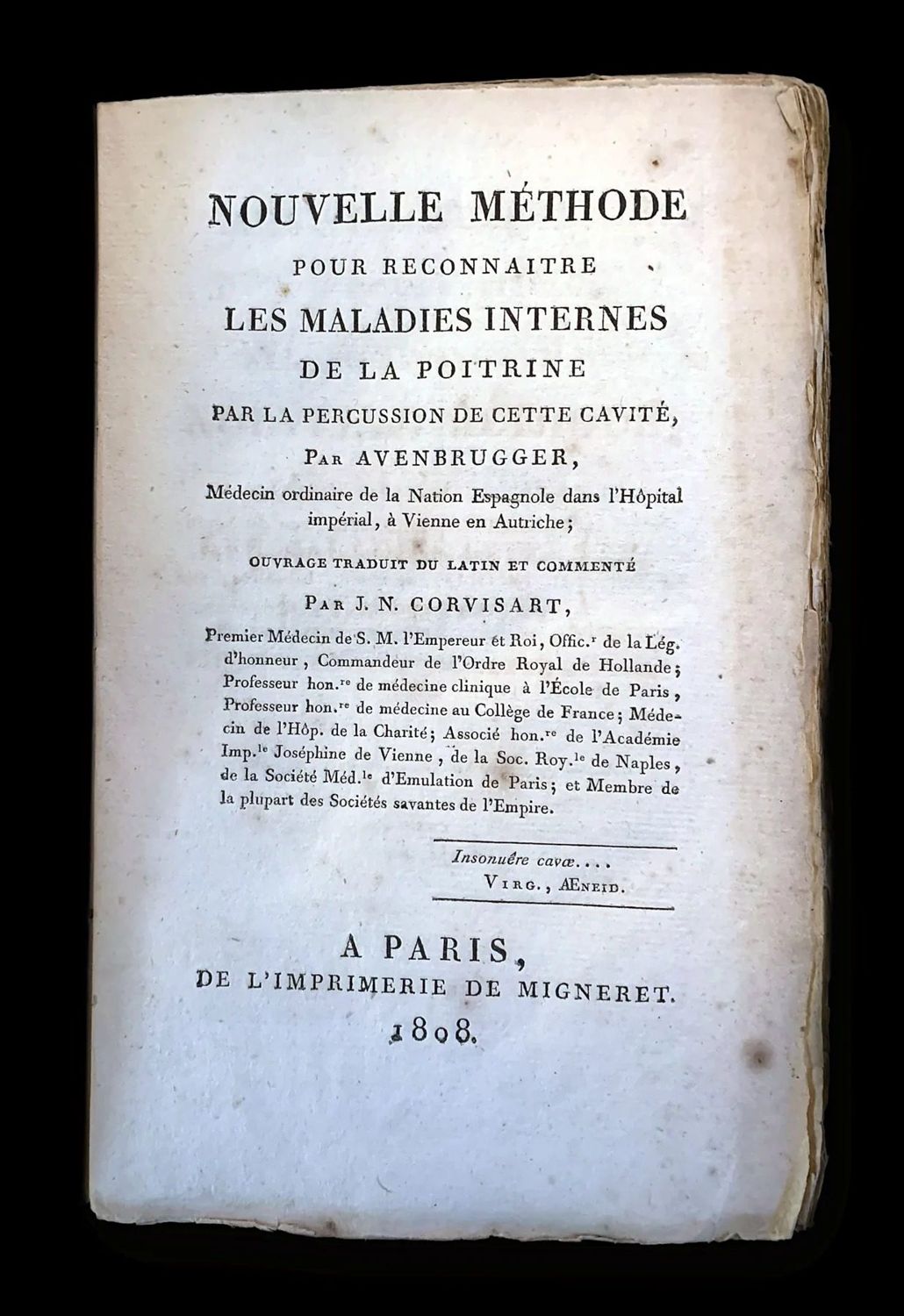
Title page.
Auenbrugger and Corvisart, Nouvelle Méthode pour reconnaître les Maladies Internes de la Poitrine
First edition of Corvisart's translation. Paris: de l'Imprimerie de Migneret, 1808
The book that gave medicine percussion of the chest. Leopold Auenbrugger, a physician at the Spanish Hospital in Vienna, published his Inventum Novum in 1761, describing how tapping the chest and listening to the note it returns will tell what lies beneath. For nearly fifty years almost no one used it. Then Jean-Nicolas Corvisart, Napoleon's own physician and the teacher of Laennec, translated the text with a commentary of his own several times its length, and the method entered practice everywhere. Every physician who has since tapped a patient's chest is working from this book.
Complete with the half-title and the errata leaf. Uncut in the original wrappers, rebacked with the original spine label, and housed in a slipcase.
Inquire about this item
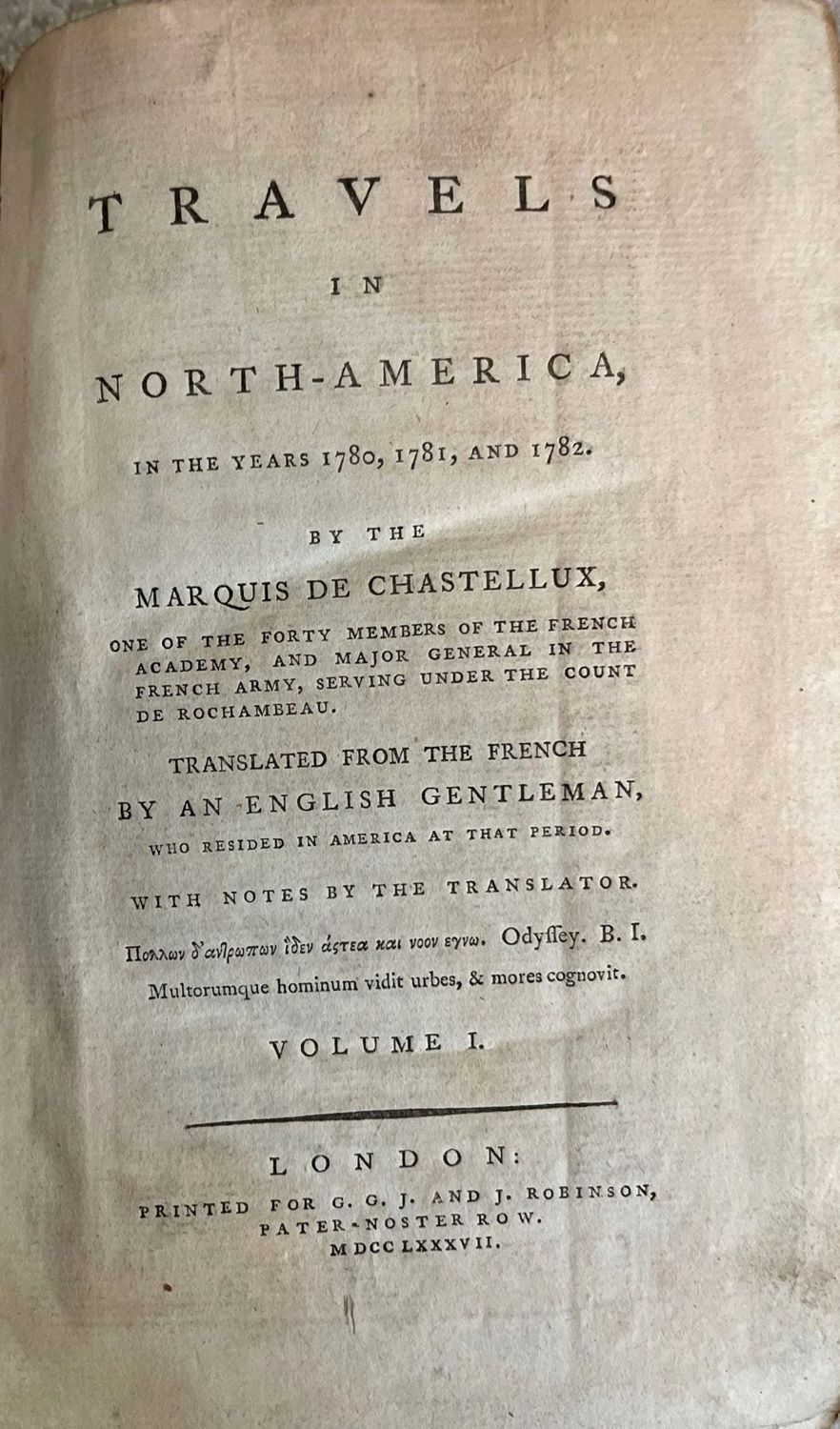
Title page of volume one.
Chastellux, Travels in North-America in the Years 1780, 1781, and 1782
First English edition, two volumes. London: printed for G. G. J. and J. Robinson, Pater-Noster Row, 1787
François Jean de Beauvoir, Marquis de Chastellux, was a major general under Rochambeau and one of the forty members of the French Academy. Between 1780 and 1782 he rode through New England, New York, New Jersey, Pennsylvania and Virginia, and wrote down what he saw: the roads and taverns, the farms, the state of the war, and the men who were running it. He visited Washington in camp and Jefferson at Monticello, where the two of them went to see the Natural Bridge. Howes called the book the "first trustworthy account of life in the United States."
The English translation, by an Englishman who had lived in America, adds notes of its own, some of them arguing with the author. Two folding maps trace Chastellux's route, one from the Delaware north to New England, with Philadelphia at its lower left, and one of Virginia. Three folding plates include the Natural Bridge, drawn from the spot Jefferson showed him.
Two volumes, xv and 462 pages, xii and 432 pages. Two folding maps and three folding plates. Uncut, in the original boards, covered in contemporary block-printed floral paper. Howes C-234, "aa." Clark, Travels in the Old South, I:212. Reese, The Revolutionary Hundred, 82. Sabin 12227.
Inquire about this item
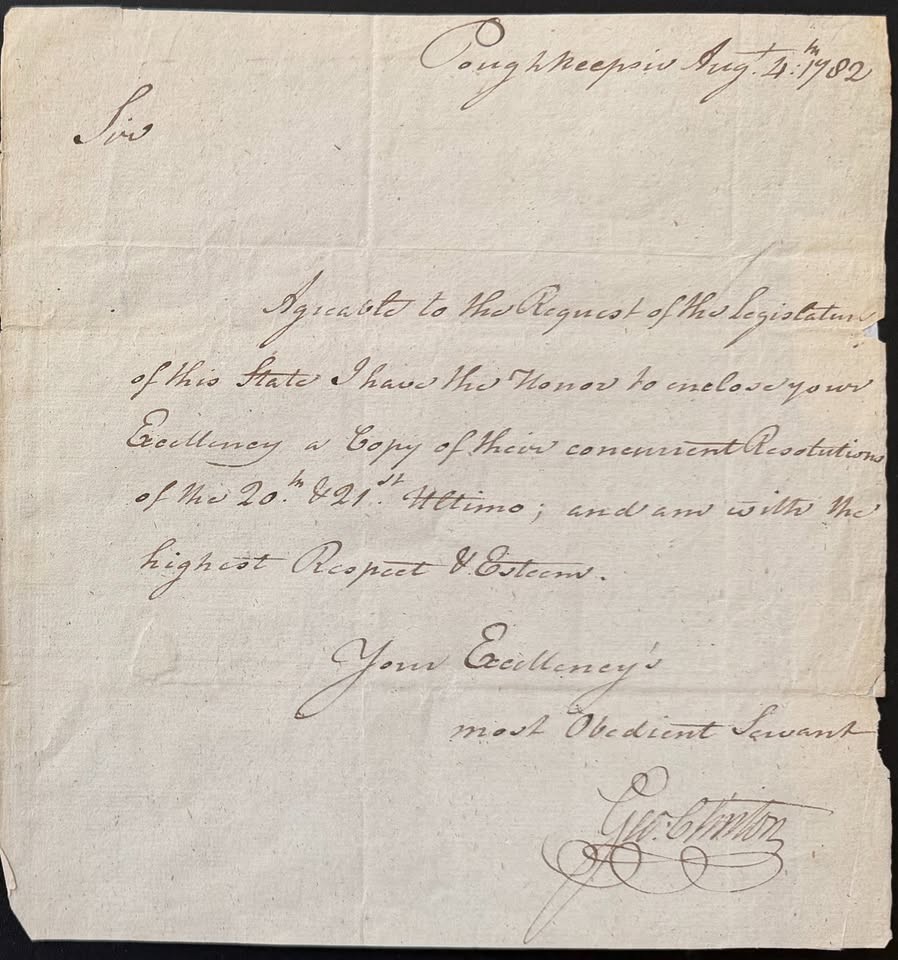
The letter, signed "Geo: Clinton."
Governor George Clinton of New York to Governor John Hancock of Massachusetts, sending New York's call for a convention to revise the Confederation
Letter signed, Poughkeepsie, 4 August 1782
Clinton writes: "Agreeable to the Request of the Legislature of this State I have the Honor to enclose your Excellency a Copy of their concurrent Resolutions of the 20th & 21st Ultimo; and am with the highest Respect & Esteem, Your Excellency's most Obedient Servant, Geo: Clinton." The address leaf is directed to "His Excellency John Hancock Esquire, Governor of the State of Massachusetts," franked "public service Geo: Clinton," and docketed. A small remnant of the red wax seal remains. The enclosed copy of the resolutions is no longer with the letter.
The resolutions Clinton sent were among the first official calls for what became the Constitutional Convention. Under the Articles of Confederation Congress could ask the states for money but could not compel them to pay, and by 1782 it could not meet its debts or pay its army. On 20 and 21 July the New York legislature, meeting at Poughkeepsie, resolved that these ends "can never be attained by partial Deliberations of the States, separately," and that Congress should recommend, and each state adopt, "the Measure of assembling a general Convention of the States, specially authorised to revise and amend the Confederation." The resolutions are generally credited to Alexander Hamilton, whom the same legislature sent to Congress that summer.
Nothing came of the call at once. The mutiny that drove Congress out of Philadelphia in June 1783 and Shays' Rebellion in Massachusetts in 1786 made the argument for it. Hamilton pressed it again at Annapolis in 1786, and in May 1787 the states met at the State House in Philadelphia, with Franklin among the Pennsylvania delegates. This letter is New York's first word in that conversation, as it reached the governor of Massachusetts.
Condition very good. Laid paper, with archival tape on the reverse of the letter reinforcing the folds.
Inquire about this item
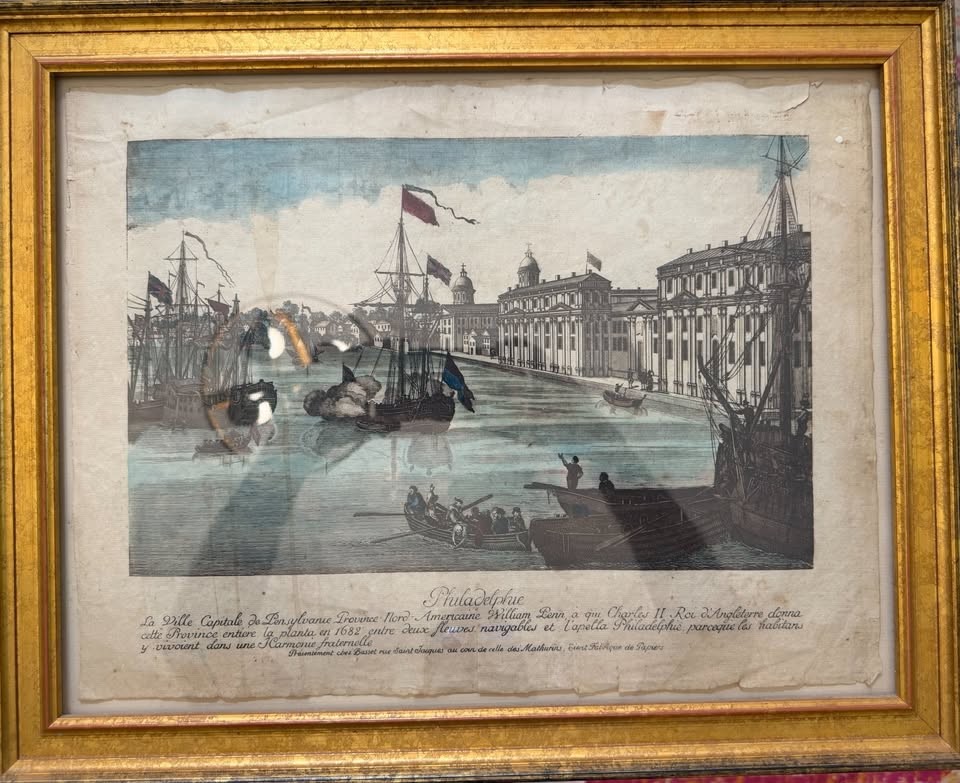
Shown framed, under glass.
Philadelphie: a French view of the city, published by Basset
Hand-coloured engraving on laid paper, Paris: Basset, rue Saint-Jacques, second half of the eighteenth century
An engraved view of Philadelphia with original hand colour, printed in Paris for the shop of Basset, rue Saint-Jacques at the corner of the rue des Mathurins, a Paris publisher of popular prints. Ships under flags crowd a broad river; a boat is rowed across the foreground; a quay of domed and pedimented public buildings runs back along the right. The strike is bold, and the colours remain bright and crisp.
The French title beneath reads, in translation: "Philadelphia. The capital city of Pennsylvania, a North American province. William Penn, to whom Charles II, King of England, gave the entire province, planted it in 1682 between two navigable rivers and called it Philadelphia because its inhabitants lived there in brotherly harmony."
Prints of this kind are vues d'optique, made to be looked at through the lens of a viewing box, and they were sold across Europe to people who would never cross the Atlantic. The engraver had not seen Philadelphia either. He drew a European harbour and gave it the city's name. The picture shows what Paris imagined when it heard of Penn's city of brotherly love. Two other vues d'optique, of the burning of New York and the pulling down of the statue of George III in 1776, hang in the museum's Cockpit room.
Inquire about this item
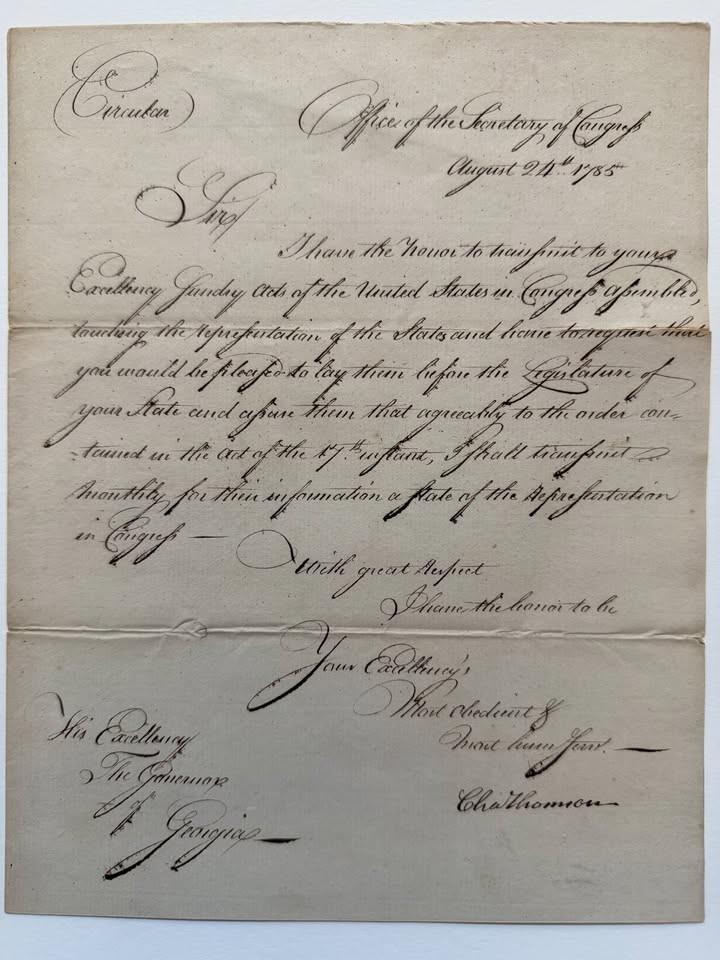
The letter, signed by Charles Thomson.
Charles Thomson, Secretary of Congress, to the Governor of Georgia
Circular letter signed, Office of the Secretary of Congress, 24 August 1785
A circular letter sent to the governors of the states, this copy addressed to "His Excellency The Governor of Georgia" and signed "Chas Thomson." Thomson transmits "sundry Acts of the United States in Congress assembled, touching the representation of the States," asks the Governor to lay them before his legislature, and promises that, agreeably to the Act of the 17th instant, he will send them each month "a state of the representation in Congress." Docketed on the reverse "Letter Charles Thompson 24. Aug 1785," with "Exchange" struck through and "of Laws & Resolutions Congress" below.
The letter records a weakness of the Confederation. Under the Articles each state cast a single vote, and most business of weight needed nine states to pass. Many states sent no delegates at all, or sent only two, who could divide and cancel their state's vote. Congress had pleaded for full attendance in November 1783 and again in April 1784, without effect. On 17 August 1785, on a motion of Charles Pinckney, it resolved that its Secretary should report every month to each legislature which states were present, which were absent, and who sat for each, so that the delinquents might be shamed into attendance. The resolution admitted that the Confederation itself might be blamed "as the cause of evils which solely result from an incompleat representation." Two years later the same frustration filled the State House in Philadelphia.
Thomson, a Philadelphian, a friend of Franklin, and a member of the Philosophical Society, served as Secretary to the Continental and Confederation Congresses for their entire existence, from 1774 to 1789.
Accompanied by a modern photocopy of the printed Act of 17 August 1785 for reference.
Inquire about this item