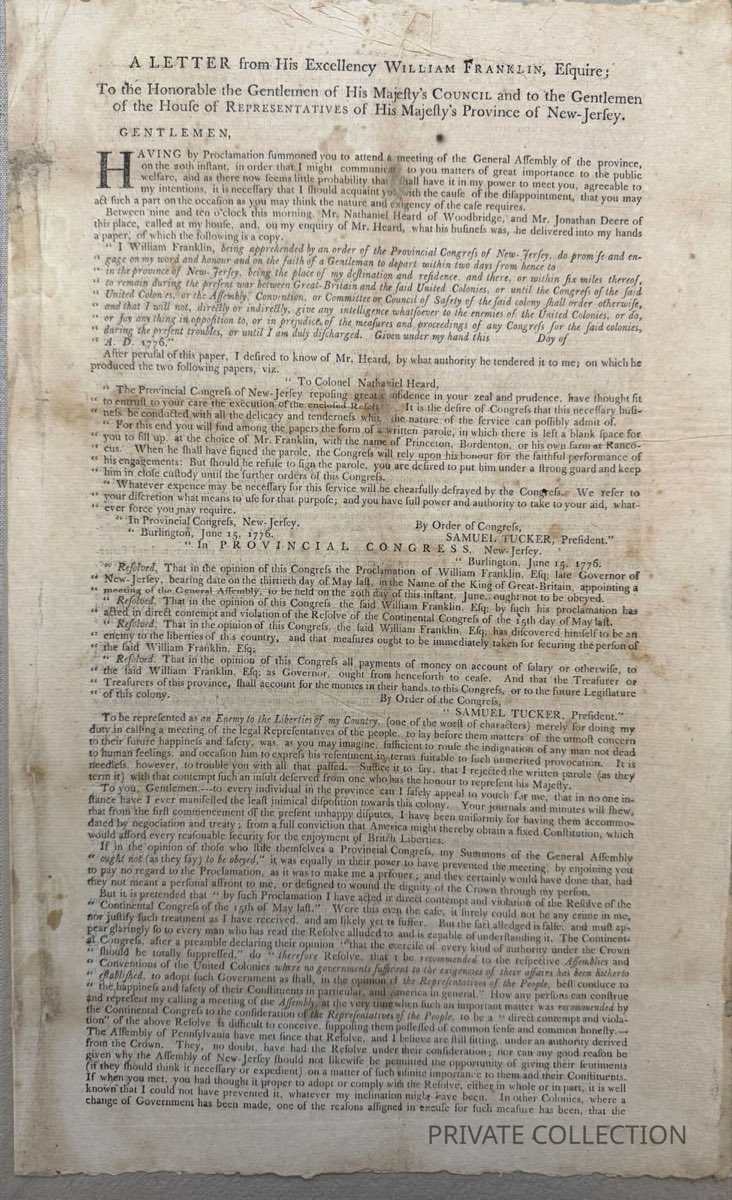
FRANKLIN, William. A Letter from His Excellency William Franklin, Esquire; To the Honorable the Gentlemen of His Majesty’s Council and to the Gentlemen of the House of Representatives of His Majesty’s Province of New-Jersey
FRANKLIN, William. A Letter from His Excellency William Franklin, Esquire; To the Honorable the Gentlemen of His Majesty’s Council and to the Gentlemen of the House of Representatives of His Majesty’s Province of New-Jersey. [Burlington, NJ: Isaac Collins], 1776. Folio broadside. 3, [1]pp. Single sheet folded, fully untrimmed. Some mild toning, a few lines of text professionally mended affecting eleven words throughout. Richard Smith’s copy with contemporary ink manuscript on verso of last page. Overall very good.
Initial reply of William Franklin (c. 1730-1813), the last royal governor of New Jersey, to the Continental Congress’s June 15, 1776 announcement branding him a traitor, mere weeks before they would sign the Declaration of Independence. Franklin’s manuscript reply, sent on June 17th, is printed here with a postscript dated June 22, and responds to the charges against him. However, this failed to prevent his being taken into custody, and he was arrested on the 26th by the Provincial Congress of New Jersey, a body William regarded as an "illegal assembly,” and swiftly taken to Connecticut, where he was to spend the next two years in prison.
William Franklin, Benjamin Franklin's acknowledged illegitimate son, had been appointed Royal Governor of New Jersey in 1763, in part as a way of rewarding the elder Franklin for his work in weakening the Penn family's influence in Pennsylvania. William was considered a good governor but decided to side with the Loyalist cause, while his father joined the Patriots. Both father and son worked hard to convince the other to join his cause. William outlasted all other colonial governors, mostly due to his and his father's good reputations.
Nevertheless he was imprisoned in Connecticut for two years after the outbreak of war, mostly in Wallingford and Middletown. The stubborn governor-in-exile refused to submit to his captors and continued gathering intelligence for Loyalists, as well as helping protect the property of Connecticut Tories by issuing them royal pardons. In May 1777, William was placed into solitary confinement in Litchfield, Connecticut. Throughout his imprisonment, William begged for parole to be able to visit his dying wife, but so dangerous was he considered to the Revolutionary cause that even this was refused and Elizabeth died in July 1777 without her husband by her side. William was finally freed in 1778; he fled to New York, where he remained an active Loyalist. In 1782 he sailed to England where he spent the remainder of his life, never reconciling with his father.
Joseph Felcone writes that this document was “Franklin’s response to a declaration by the provincial congress on June 15, 1776, that he was ‘an enemy to the liberties of this country’ and must choose either parole or arrest. In the postscript Franklin states that Isaac Collins initially refused to print the letter and return it to the author: ‘But though he [i.e., Collins] at first gave me expectations that he would do his duty… he afterwards returned it, declaring that he was afraid of offending the Provincial Congress, and that he did not doubt but he should be killed if should print it for me…’”
One of the reasons William was treated so harshly by the Continental Congress was that both he and his father were viewed with suspicion by different alliances within Congress due to their intertwined land holdings. Both Franklins were major shareholders in the Vandalia Walpole Company, which owned much land in what is now West Virginia and Kentucky. There were those in the Continental Congress who thought that Ben and William were serving on opposite sides as a way of looking out for each other and their mutual financial interests.
Richard Smith (1735-1803) was the New Jersey delegate to the Continental Congress from 17741776. After serving the Continental Congress, Smith was elected treasurer of New Jersey and served through 1777. Smith had numerous business relations with William Franklin and was secretary to the Burlington Company, yet another land investment group supported by the Franklins. He had accompanied Franklin to western New York where he served as clerk at the 1768 Treaty of Fort Stanwix, and was one of those who received land from the nearby Otsego Tract in the investing spree of the following year. On the verso of the last leaf Richard Smith wrote “Wm Franklins Letter Memo. The Late Gov. Franklin departed from Burlington for Connecticut Wed. June 26, 1776. Under a guard commanded by Lt. Col. Bowes Reed, Capt. Butler [?], Lt. Carlisle &c. They got to Princeton that night. Rd. Smith.”
This would have been exclusively printed in a very limited run specifically for the Continental Congress by Isaac Collins, who feared retaliation from the new government. It was later republished in Hugh Gaine’s New-York Gazette on February 3, 1777. Rare. Felcone lists only 5 institutional holdings and the only market appearance was in a Rosenbach catalogue 78 years ago.
- Date
- 1776
- Condition
- Single sheet folded, fully untrimmed. Some mild toning, a few lines of text professionally mended affecting eleven words throughout. Richard Smith’s copy with contemporary ink manuscript on verso of last page. Overall very good.
- References
- Felcone 211.Evans 14915. Humphrey 163. ESTC W18896.
“FRANKLIN, William. A Letter from His Excellency William Franklin, Esquire; To the Honorable the Gentlemen of His Majesty’s Council and to the Gentlemen of the House of Representatives of His Majesty’s Province of New-Jersey.” The Soiferman Collection, Wynnewood, Pennsylvania. EIS LIBRIS, https://eislibris.com/objects/franklin-william-a-letter-from-his-excellency-william-franklin-esquire-to-the-ho (accessed [date]).