 EIS LIBRIS
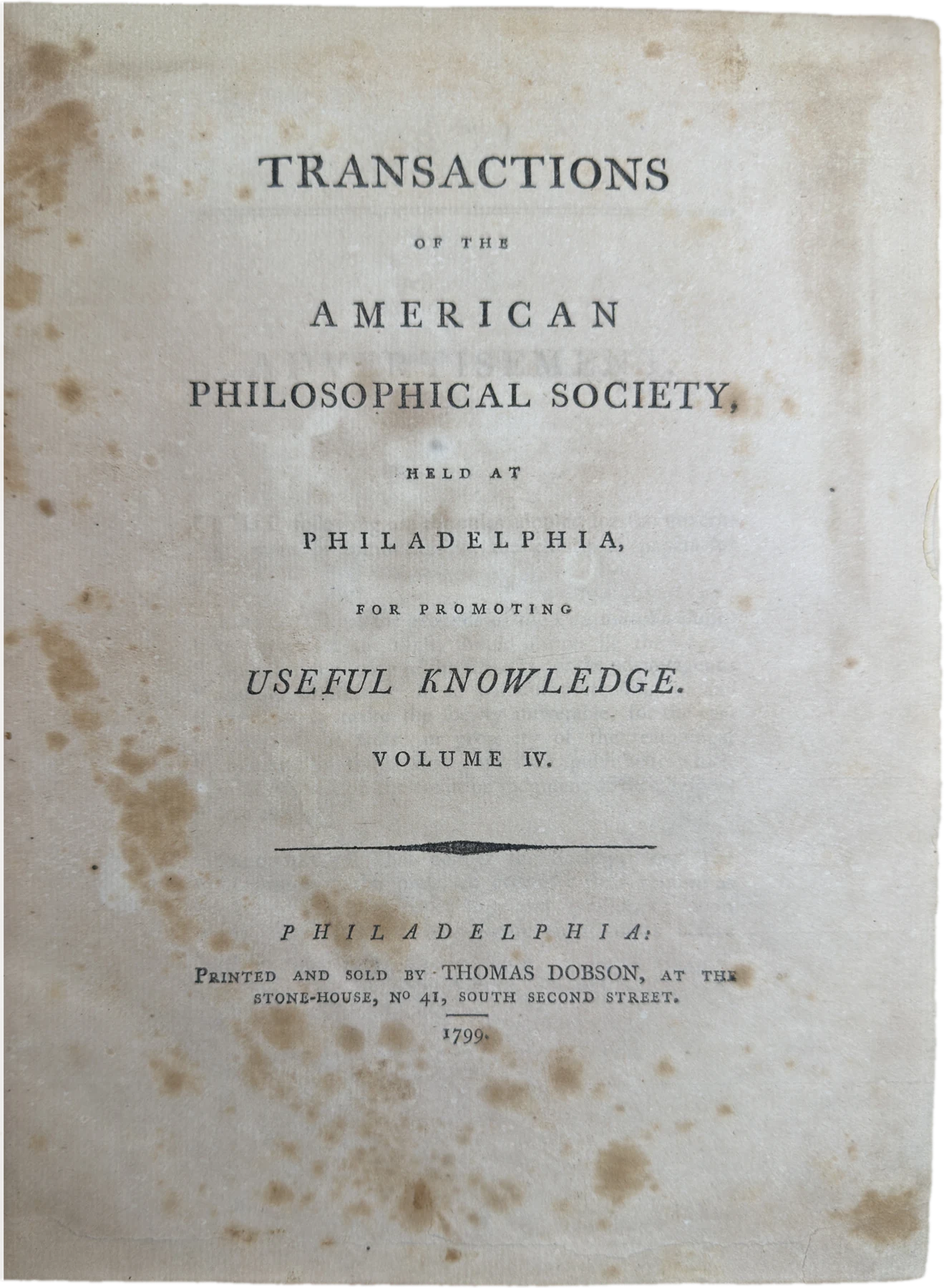
Philadelphia: Thomas Dobson, 1799
BF-2027.007
 Click to enlarge
Philadelphia: Printed and sold by Thomas Dobson, 1799. First edition.
Jefferson had been elected president of the Society in 1797 and called it the most flattering incident of his life, an office he kept while he was vice president and president of the United States. The fourth volume carries two of his papers. The first, on the bones of a clawed quadruped found in western Virginia, announced the megalonyx to the learned world; it is now known as an extinct ground sloth. The second describes a mould-board of least resistance, his design for a plough, which he had first thought about in France in 1788, modelled at Monticello when he returned there in 1790 and used on his farms from 1794.
Rush, Rittenhouse and Benjamin Smith Barton also contribute.
Jefferson had been a member of the Society since 1780. His memoir on the bones appears at page 246, and his description of the mould-board at page 313.
His interest in the plough began on a journey from Strasbourg to Meaux in April 1788, when he remarked on the awkward shape of the French mould-board. He wrote a short description with two diagrams soon afterward and built a block and a model after he came home in 1790. William Strickland saw the plough at work in 1795 and recommended it to the Board of Agriculture in London. While Jefferson was secretary of state at Philadelphia he had also prepared a fuller written description and obtained David Rittenhouse's approval of it. Sinclair's repeated encouragement to send the Board something of importance finally led him to publish the paper here.
Quarto, xliv, 281, 288-450, [2], 451-531, [3] and 42 pages, with fourteen engraved plates, some folding. Contemporary calf, the spine ruled in gilt with a red morocco lettering piece. Foxing and staining. The plate facing page 444 is detached and has several tears.
References: Evans 35106. Rink 5. ESTC W15746.
People in this record
Back to The Club and Its Institutions