 EIS LIBRIS
EIS LIBRIS
EIS LIBRIS
Manuscript, Philadelphia, 4 April 1793. One sheet 1793
BF-2026.202
 Click to enlarge
2 photographs of this object
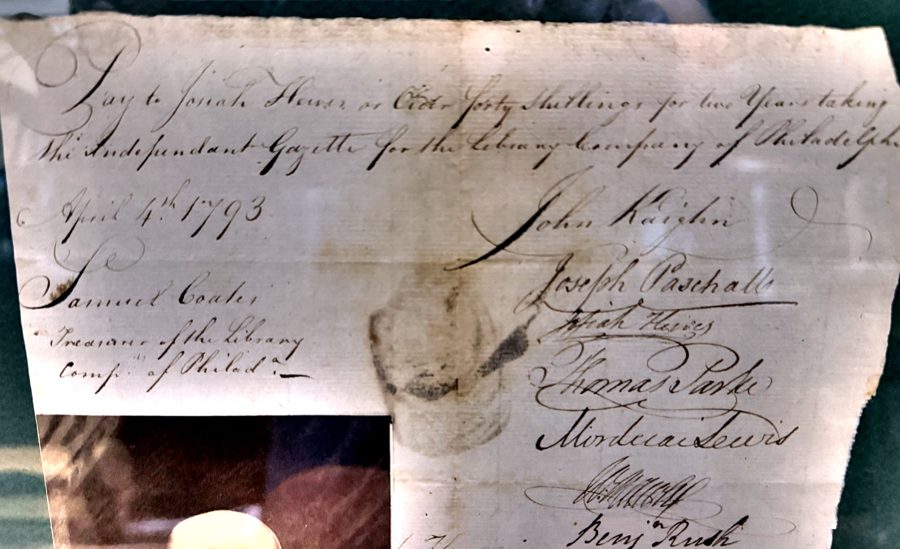
An order on the Treasurer: pay to Josiah Hewes, or order, forty shillings for two years taking the Independent Gazetteer for the Library Company of Philadelphia. Hewes, one of the directors signing, had evidently laid out the money himself and was being reimbursed, which is how a small institution handled a subscription before it had a clerk to do it.
The document is the institution Franklin founded in 1731 still running sixty-two years later, with its bills approved by a board that included Benjamin Rush. Samuel Coates, to whom it is addressed, was Treasurer of the Library Company from about 1790 until 1820 and a manager of the Pennsylvania Hospital. Thomas Parke, signing above Rush, was a founder of the College of Physicians, one of the Quaker physicians who stayed in the city through the fever, and a lifelong friend and occasional opponent of Rush in practice. Mordecai Lewis and Josiah Hewes were merchants and long-serving directors; Joseph Paschall and John Kaighn were of Quaker merchant families. Comparable orders of 1792 signed by Rush, Hewes and Lewis survive in other collections, which suggests these men formed the working quorum of the board in those years.
Two things give the sheet its interest beyond the signatures. The first is the date. It is 4 April 1793, four months before the fever reached the wharves; Rush and Parke both stayed in the city through it, and Parke's name appears again in the literature of the epidemic. The second is what the money was for. The Independent Gazetteer was Eleazer Oswald's paper, among the most combative in Philadelphia, and the Library Company was buying it to keep on its shelves. Franklin's library subscribing to the newspapers of Franklin's trade, with a physician's signature on the warrant.
Back to The Club and Its Institutions