 EIS LIBRIS
EIS LIBRIS
EIS LIBRIS
BR-2026.002
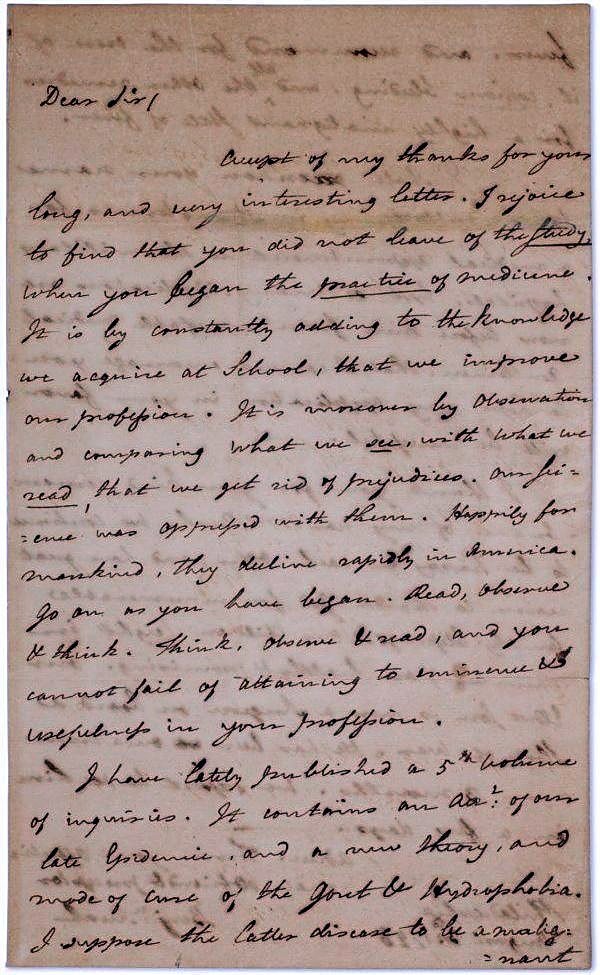 Click to enlarge
Transcription:
Dear Sir,
Accept of my thanks for your long, and very interesting letter. I rejoice to find that you did not leave of the study when you began the practice of medicine. It is by constantly adding to the knowledge we acquire at school, that we improve our profession. It is moreover by observation and comparing what we see, with what we read, that we get rid of prejudices. Our science was oppressed with them. Happily for mankind, they decline rapidly in America. Go as you have began. Read, observe, and think. Think, observe, and read, and you cannot fail of attaining to eminence and usefulness in your profession.
I have lately published a 5th volume of inquiries. It contains an acct of our late epidemic, and a new theory, and mode of cure of the gout and hydrophobia. I suppose the latter disease to be a malignant fever, and recommend for the cure of it copious bleeding, and all the other remedies for a highly malignant fever.
I shall mention your name to [illegible] McHenry in strong terms for a medical appointment in the military hospitals, but so many applications are now before him from respectful medical gentlemen, that I cannot encourage you to hope my application in your favor will be successful.
I thank you for your kind remembrance of my dear Mrs. Rush. We continue to be happy in each other, and have great reason to thank God for immeasurable family blessings. Our children (eight in number) are healthy and promising. Our eldest son is now a surgeon on board a sloop of war. He has been on a cruise near 3 months. We expect to see him in a few days.
Adieu from your affectionate friend and preceptor, Benj. Rush.
Philadelphia August 2, 1798
Writing to his former student at the University of Pennsylvania, the Declaration signer advised a continuous pursuit of knowledge. A fantastic letter that contains references to many of Rush's main teaching and theories of medicine. It also alludes to Yellow Fever, and discussed his oldest son, who would later live his life in the psychiatric ward of Pennsylvania Hospital.
Back to Edinburgh to Philadelphia