EIS LIBRIS
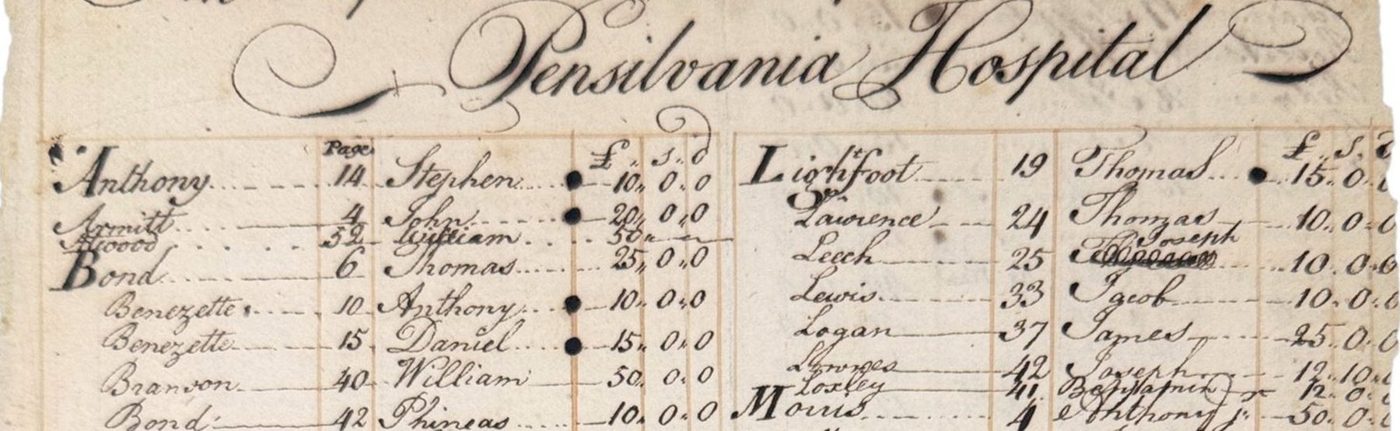
The clerk's title to the founders' book: An Alphabetical List of Subscribers to the Pensilvania Hospital

Room 3 of 10

The Pennsylvania Hospital

Founded 1751

The clerk's title to the founders' book of 1751: An Alphabetical List of Subscribers to the Pensilvania Hospital.

Philadelphia had no hospital in 1750. The sick who could pay were nursed at home, and the sick who could not were left to the almshouse. Dr. Thomas Bond thought the city could do better, and that year he went about raising money for a hospital that would treat the sick poor free of charge. He got nowhere. The men he asked would not commit until they had heard what Benjamin Franklin thought of it. Once Franklin took up the scheme, the money began to come.

Franklin wrote the petition to the Assembly in January 1751 and met the usual objection, that the benefit would fall on Philadelphia alone. So he proposed a bargain. The Assembly would grant two thousand pounds, on condition that private citizens first raised two thousand of their own. The members who had opposed the grant, thinking they might have the credit of charity without the expense, let it pass. Franklin wrote in his Autobiography: “I do not remember any of my political manoeuvres, the success of which gave me at the time more pleasure, or wherein, after thinking of it, I more easily excused myself for having made some use of cunning.”

The bargain had a catch, and it is why this room is full of paper. When the Managers came to claim the grant, the Speaker, Isaac Norris, would not count mere promises toward the two thousand pounds. Every subscriber had to sign a penal bond for what he pledged, at double the sum. They signed, on printed forms from Franklin’s press. The contributors met at the State-House on 1 July 1751 and elected twelve Managers and a Treasurer, John Reynell. By the middle of August the pledges came to more than two thousand seven hundred pounds.

The Hospital took its first patients in February 1752, in a house on High Street, now Market Street. The Managers were already planning a building of its own. Its cornerstone was laid on the Pine Street lot on 28 May 1755, under an inscription Franklin composed, which said that it was “by the bounty of the government, and of many private persons, piously founded for the relief of the sick and miserable.” Samuel Rhoads was its architect. The patients moved into the east wing in December 1756. The act that created the Hospital had provided for the insane as well as the sick, and the ground floor held cells for them.

The notes outlived the debts. The Treasurers bound them into books, two to a page, wrote receipts on their backs, and cut away the signature of each man who paid, which is how a bond was cancelled. Some never were. In April 1767 the clerk listed the nine pledges still unpaid, sixteen years after the founding.

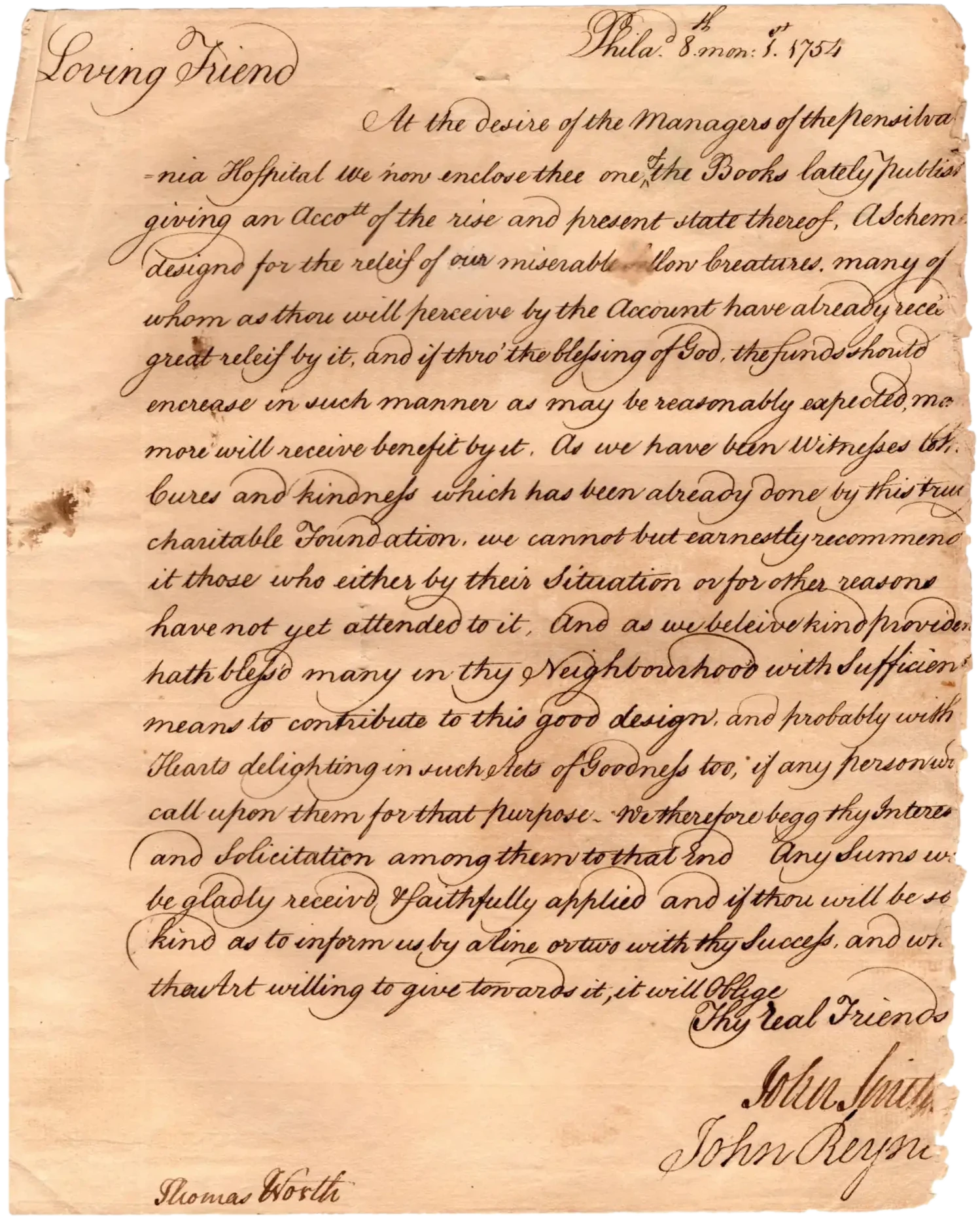
The Hospital raised money by print as well. In 1754 its Managers published Some Account of the Pennsylvania Hospital, the first part of it generally believed to be Franklin’s, and sent copies to friends of the cause with a letter asking each to solicit his neighbours. One of those letters, from John Smith and John Reynell to Thomas Worth, stands at the head of this room.

It was also a school. In 1766 Bond began the first course of clinical lectures in America, taught at the bedsides of its patients. Benjamin Rush joined the staff in 1783 and served until his death in 1813, and his reforming career began on these wards, among the patients in the cells. By the 1790s the building was too small. The Managers added new wings with money from the legislature and printed the building committee’s accounts on single sheets, three of which are in this room. The original building still stands at Eighth and Pine.

John Smith and John Reynell to Thomas Worth, soliciting subscriptions for the Pennsylvania Hospital, 1 August 1754

John Smith and John Reynell to Thomas Worth, soliciting subscriptions for the Pennsylvania Hospital
Philadelphia, 1 August 1754
BF-2026.930

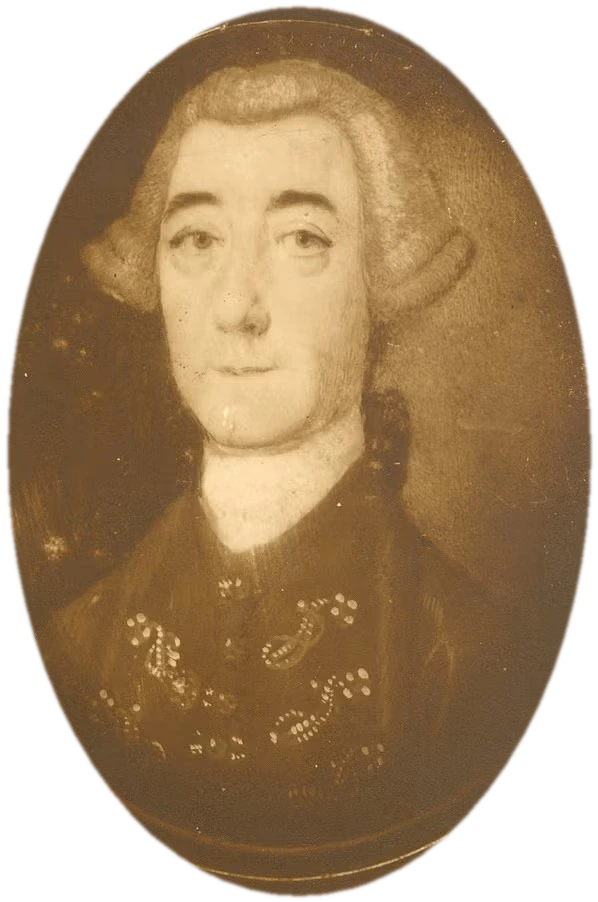
Dr. Thomas Bond, 1713 to 1784

The man with the idea

Dr. Thomas Bond

1713 to 1784

Portrait miniature. Image courtesy of the University Archives and Records Center, University of Pennsylvania.

A Maryland-born physician who made his career in Philadelphia, where he joined the Library Company, became an original member of the Philosophical Society in 1743, and served as an original trustee of the Academy. The Hospital was his idea, and he could raise no money for it until Franklin took it up. He signed as a Manager, with Joseph Morris, the notes of Thomas Cadwalader and Isaac Jones, and his own pledge is No. 11 in the founders' book. In 1766 he began the first course of clinical lectures in America, at the Hospital's bedsides.

Thomas Bond in the Dramatis Personae

“We therefore begg thy Interest”

Collection Highlight

“We therefore begg thy Interest”

John Smith and John Reynell to Thomas Worth, Philadelphia, 1 August 1754
BF-2026.930

Two of the original Managers enclose a copy of the new account of the Hospital and ask Thomas Worth to go among his neighbours, put the case in person, and write back with what he has raised. Any sums, they promise, will be “gladly received & faithfully applied.” EIS LIBRIS knows of no other letter of this kind, soliciting donations for the Hospital, in private hands.

Read the full entry

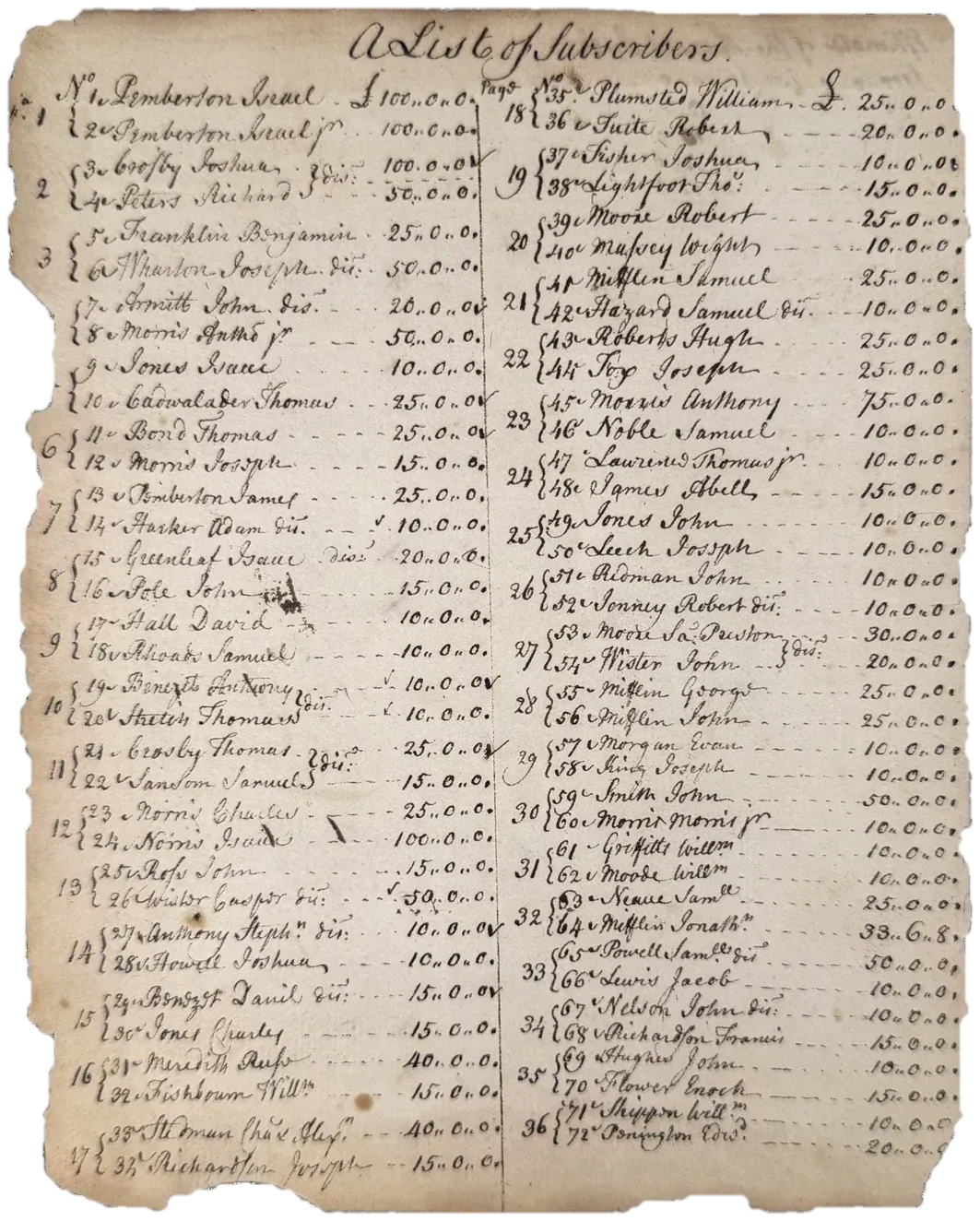
A List of Subscribers, Nos. 1 to 72

Collection Highlight

The Founders' Book

The Hospital's books of promissory notes, 1751 to 1798

Every pledge to the Hospital was a debt, signed, sealed, witnessed, and bound into the Treasurer's books two to a page. Five of those books are here, with some two hundred and seventy notes: the clerk's lists naming Franklin as No. 5 and Bond as No. 11, the notes of the Hospital's first physicians, William Franklin's bond and the receipt showing that David Hall paid it, a potter who pledged earthenware for life, a hundred pounds settled with a house in Darby, and Francis Hopkinson paying in full in the autumn of 1778.

Open the founders' book

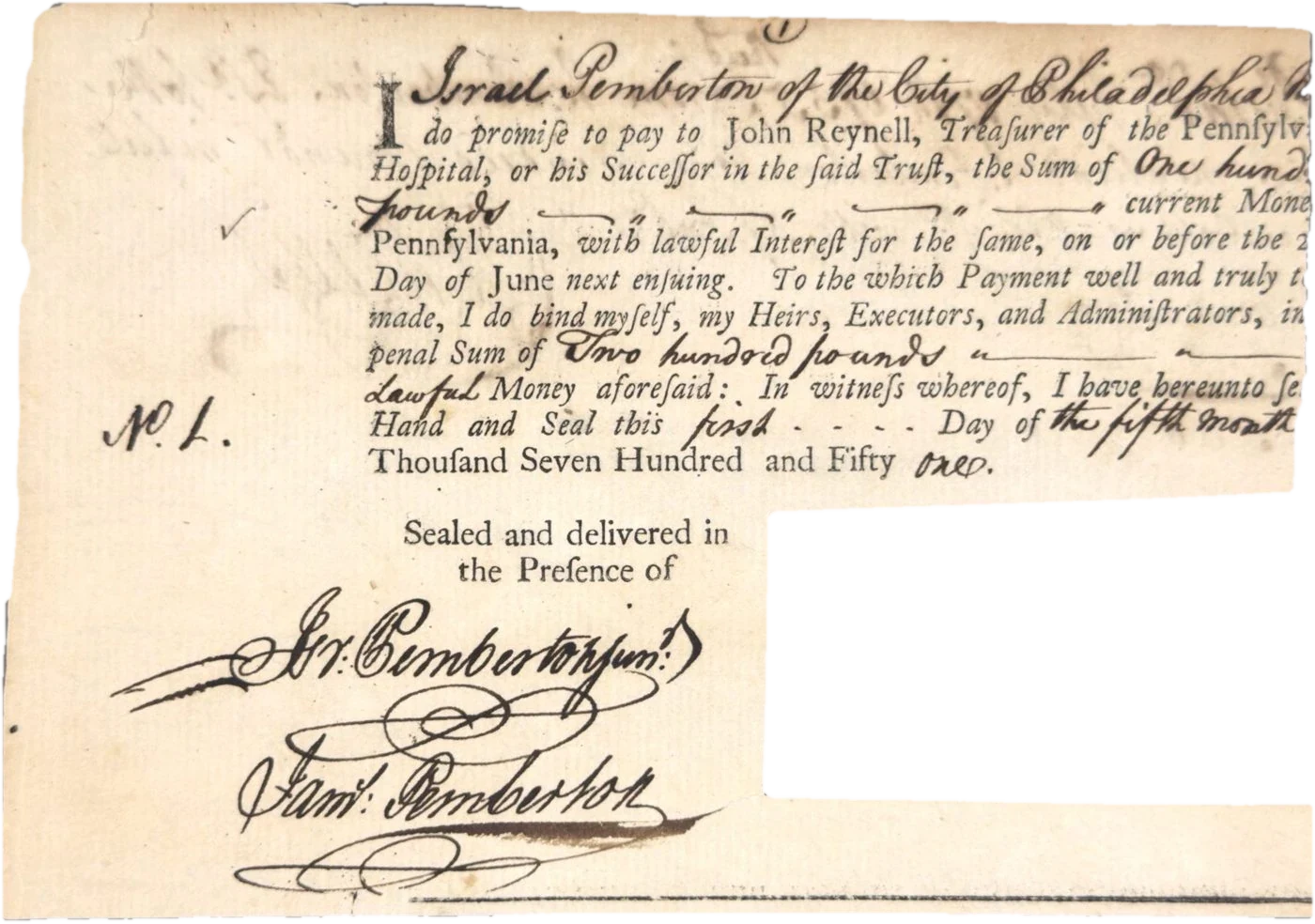
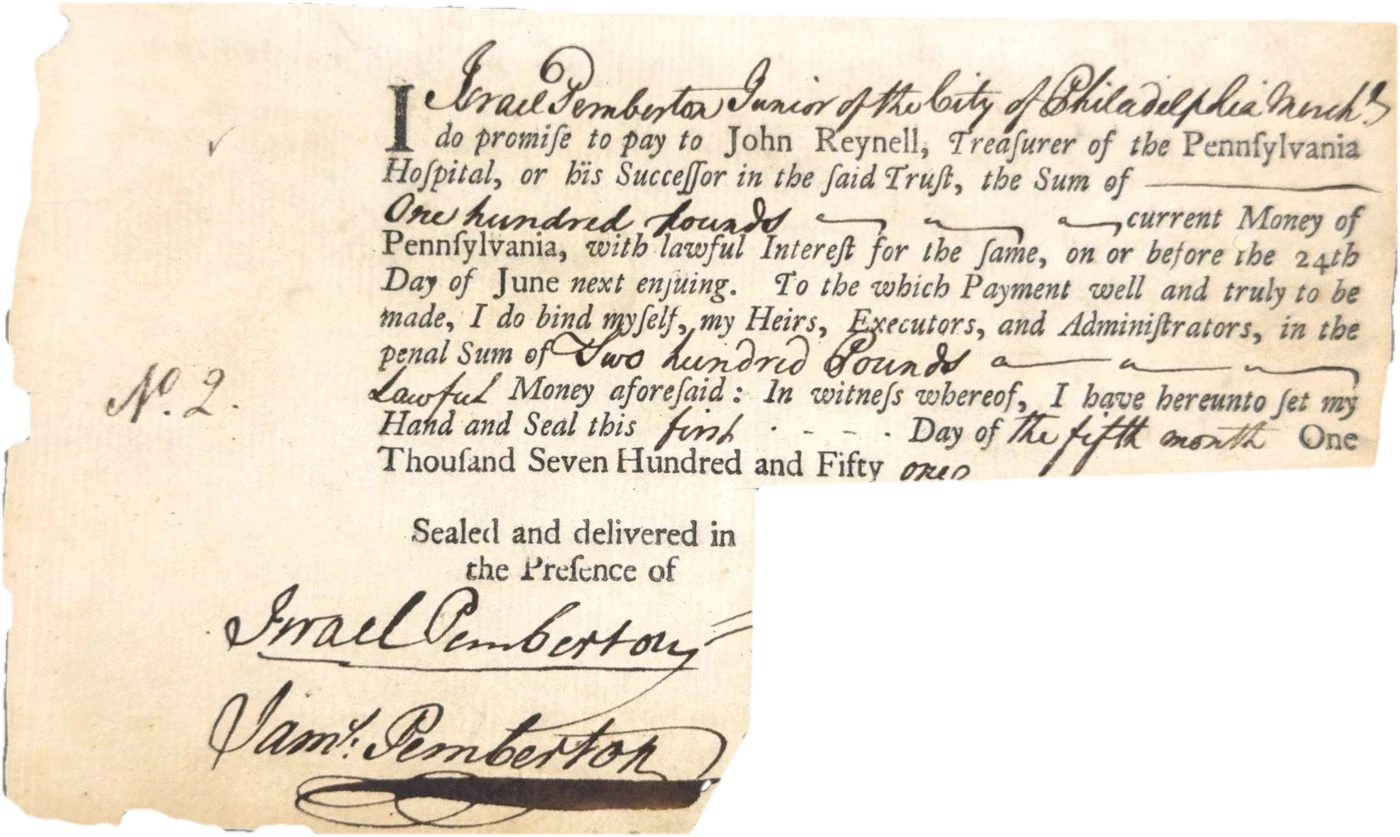
No. 1, Israel Pemberton the elder, 1 July 1751No. 2, Israel Pemberton the younger, 1 July 1751

The first two notes the Hospital ever took

Nos. 1 and 2, the first day of the fifth month 1751

The Treasurer began his book with a family. No. 1 is Israel Pemberton the elder, who came to Philadelphia from Bucks County as a young man, built one of the great mercantile houses of the province, sat twenty years on the Provincial Council and presided over the Yearly Meeting of Friends. No. 2 is his eldest son, Israel Pemberton the younger, signing as merchant. Each promised John Reynell, Treasurer, one hundred pounds with lawful interest by the twenty-fourth of June next ensuing, and bound himself in the penal sum of two hundred.

The two notes witness each other. The father’s is signed in the presence of "Isr: Pemberton jun:" and "Jam: Pemberton," his two sons. The son’s is witnessed by "Israel Pemberton" and the same brother James. Both are dated in the Quaker manner, the first day of the fifth month, which in 1751 was July. Both were paid in full on 17 July 1755, the son settling his father’s as executor a year after the old man’s death, and on each the signature has been cut away, which is how the Treasurer cancelled a note he had been paid.

The son is the one history remembers, and not always kindly. He was clerk of the Philadelphia Yearly Meeting through the 1750s, a founder of this Hospital and of the Contributionship, and head of the Friendly Association, which raised Quaker money to make peace with the Indians when the province would not. His enemies on the frontier called him King of the Quakers and meant it as an insult. The Paxton marchers named him in 1764. The revolutionary government exiled him to Virginia without trial in 1777, and he came home broken and died two years later. He opposed Franklin in the Assembly over the scheme for royal government, and his name is on the second note of Franklin’s Hospital.

The father’s note is still in the founders’ book, first in the Treasurer’s sequence. The son’s was taken out of the volume generations ago and is held separately in the collection.

The Founders' Book

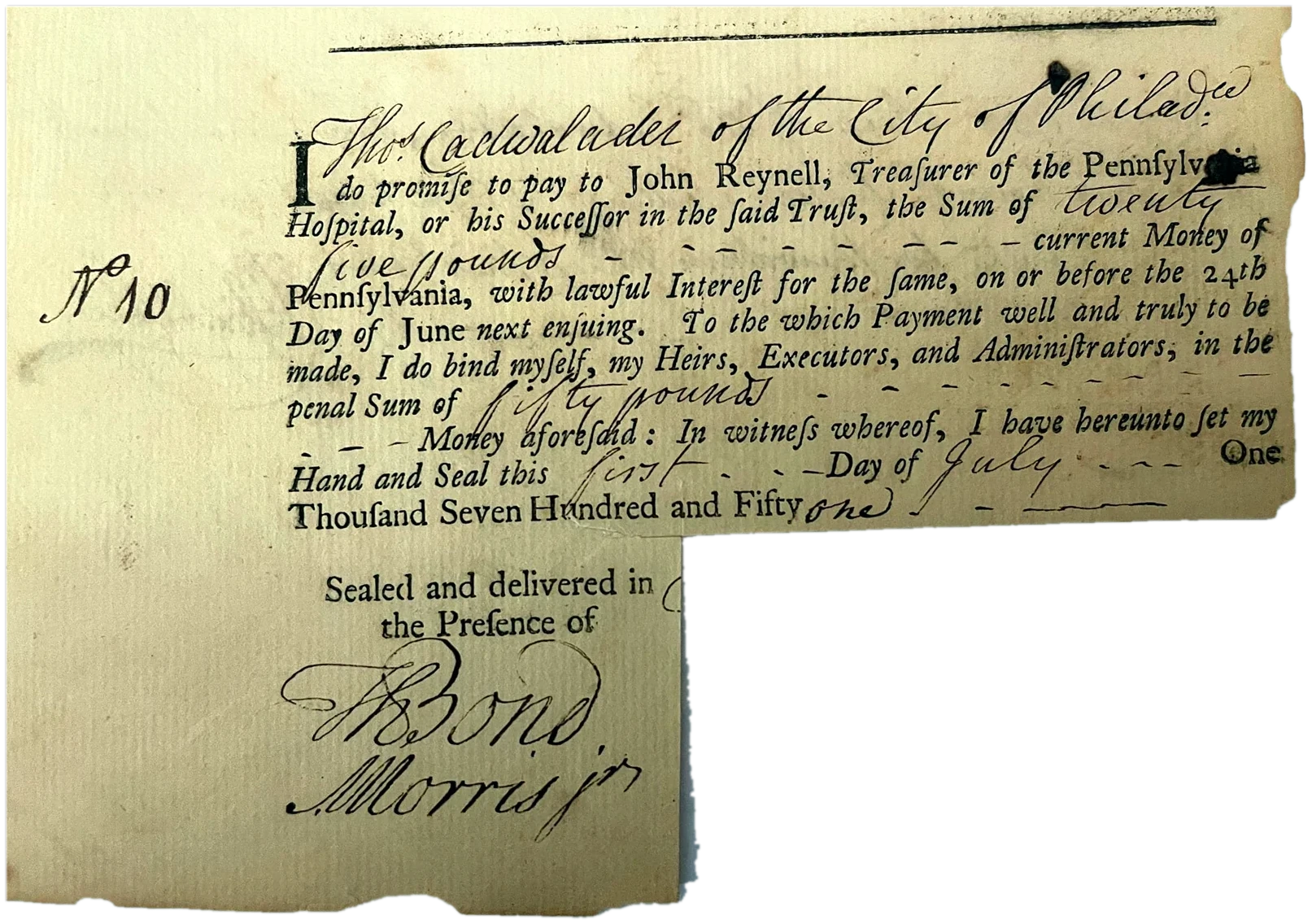
The first physicians, 1751 to 1754

The first physicians, 1751 to 1754


BF-2023.051

Thomas Cadwalader and Isaac Jones, Nos. 9 and 10, still together on one sheet, signed for the Hospital by Thomas Bond and Joseph Morris. John Armitt and Anthony Morris Jr., Nos. 7 and 8. John Redman, under whom Benjamin Rush served his apprenticeship, No. 51. Samuel Preston Moore, No. 53. Phineas Bond, No. 83. William Shippen the elder and Edward Penington, Nos. 71 and 72, witnessed by the young Timothy Matlack. With them is the note of James Clewlow, potter.

Read the full entry · 10 photographs

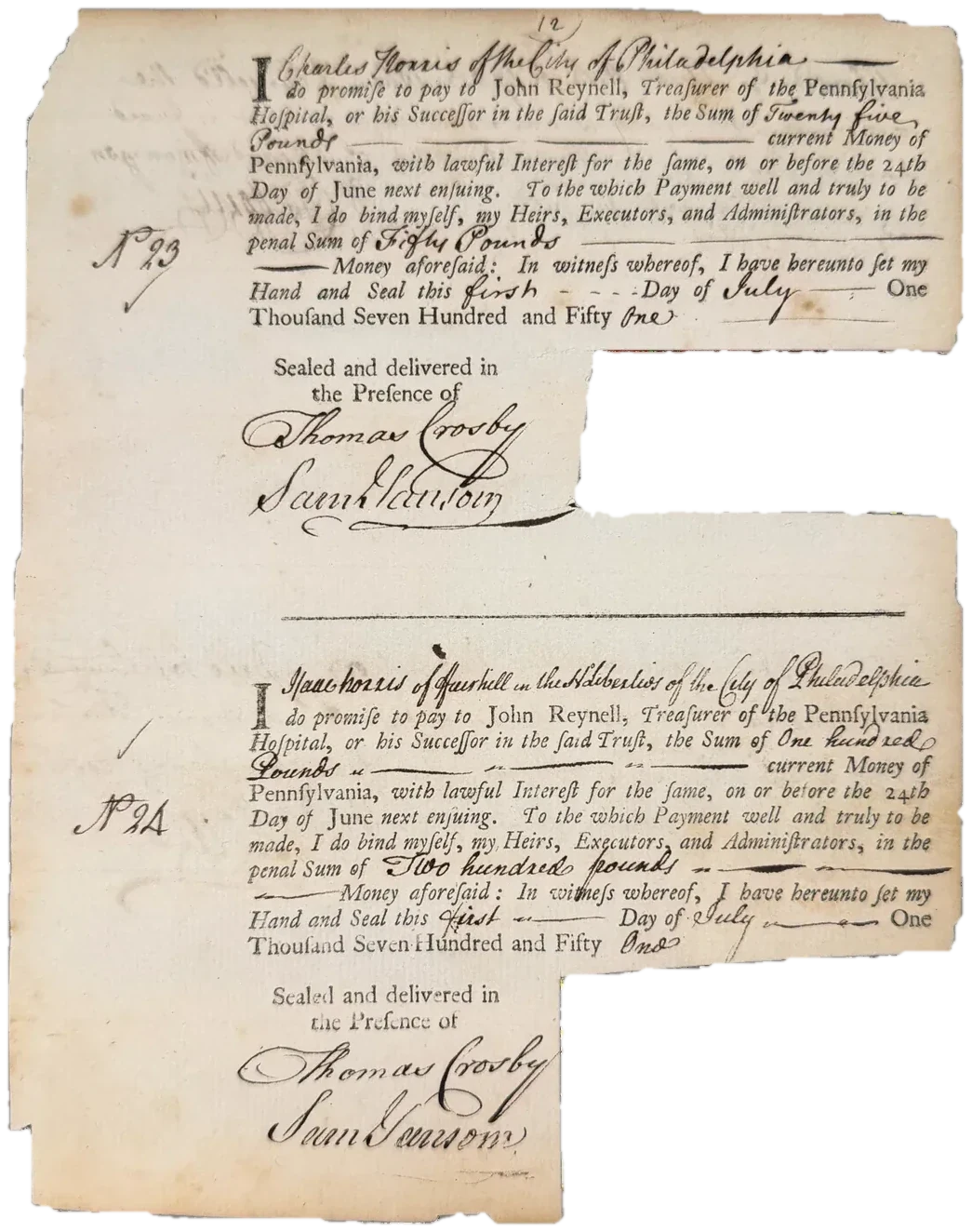
Charles Norris and Isaac Norris of Fairhill, 1 July 1751

Charles Norris and Isaac Norris of Fairhill, 1 July 1751

Nos. 23 and 24 of the founding subscription, two to a page as the Treasurer bound them. Charles, soon to be Treasurer himself, pledged twenty-five pounds. His brother Isaac, Speaker of the Assembly and the man who chose the words on the State House bell, pledged one hundred, a sum matched only by the Pembertons. Thomas Crosby and Samuel Sansom witnessed both.

The Founders' Book

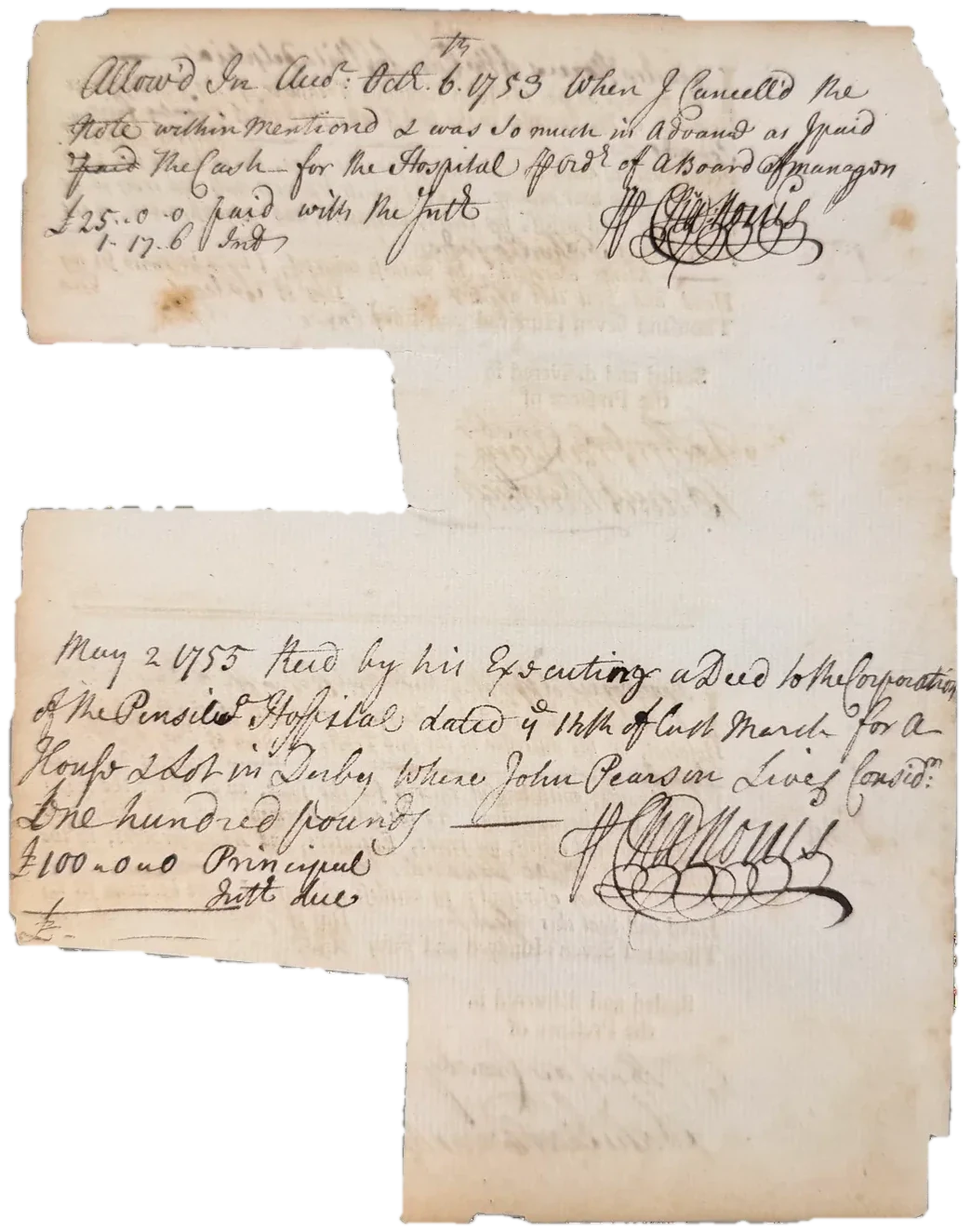
A hundred pounds, paid with a house in Darby

A hundred pounds, paid with a house in Darby

The back of the Norris brothers' page, in the hand of Charles Norris as Treasurer, with his flourished signature twice. His own twenty-five pounds was "Allow'd in Acct." against cash he had advanced for the Hospital. His brother the Speaker paid differently: "May 2 1755 Recd by his Executing a Deed to the Corporation of the Pensilva. Hospital dated ye 14th of last March for a House & Lot in Derby where John Pearson Lives. Consid: One hundred pounds."

The Founders' Book

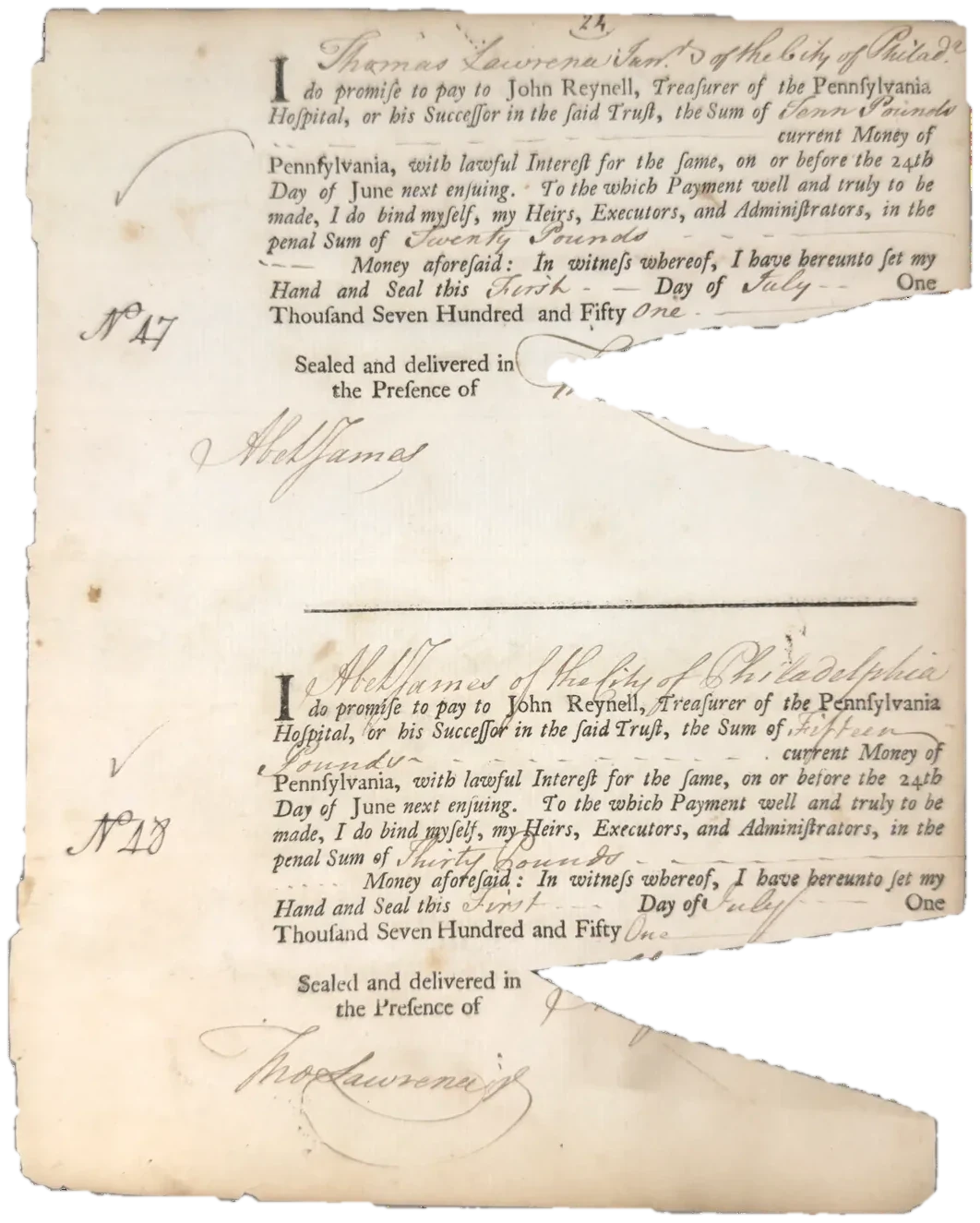
Thomas Lawrence Jr. and Abel James, 1 July 1751

Thomas Lawrence Jr. and Abel James, 1 July 1751

Nos. 47 and 48. The two men signed together and each witnessed the other's bond. Abel James is the merchant who, thirty years later, came into possession of the first part of Franklin's memoirs and wrote urging him to finish them. Franklin placed that letter at the head of Part Two of the Autobiography.

The Founders' Book

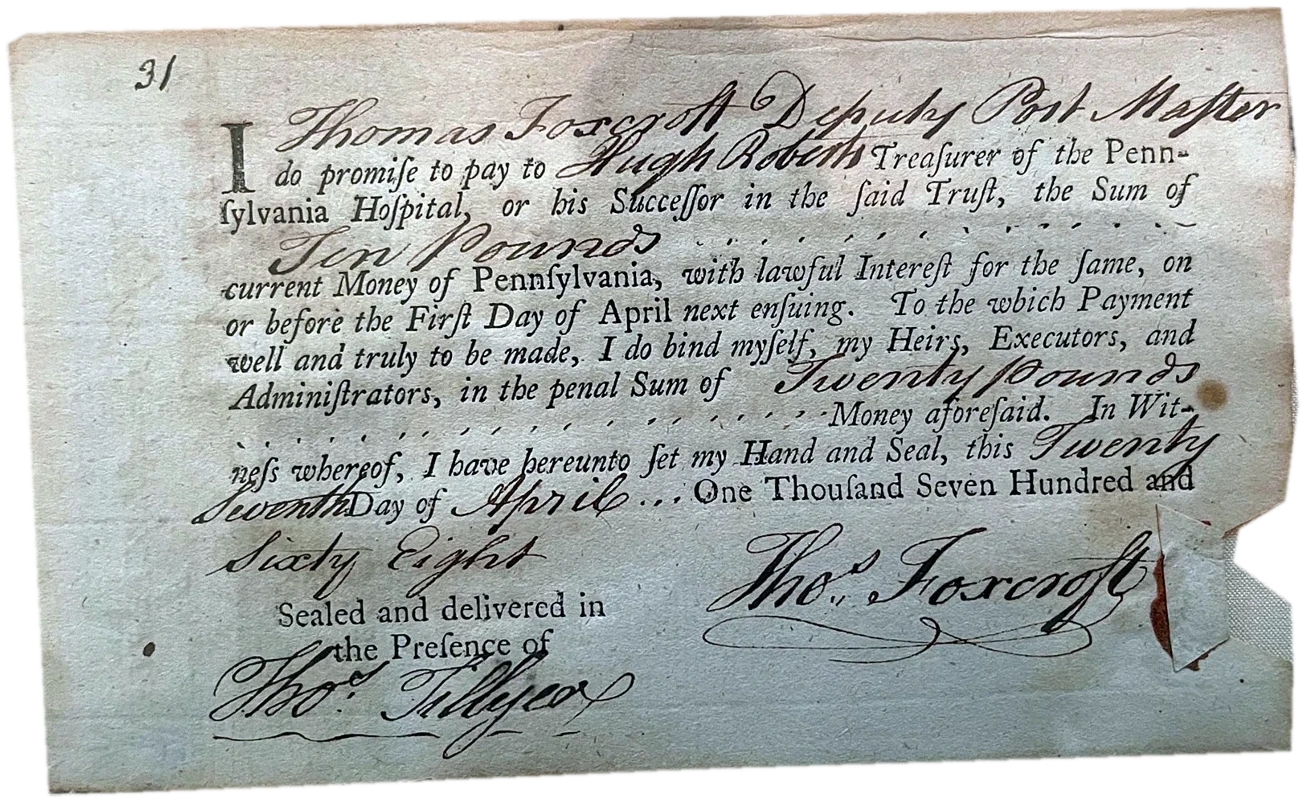
Thomas Foxcroft note, 27 April 1768

Franklin's Deputy Postmaster


BF-2023.032

Thomas Foxcroft signs with his title, Deputy Post Master. He was postmaster of Philadelphia, and his brother John Foxcroft was Franklin's partner as joint Deputy Postmaster General for the northern colonies. On 27 April 1768 he promised Hugh Roberts, Treasurer of the Hospital, ten pounds with interest, and bound himself in the penal sum of twenty. Thomas Tillyer of the post office witnessed it.

Read the full entry

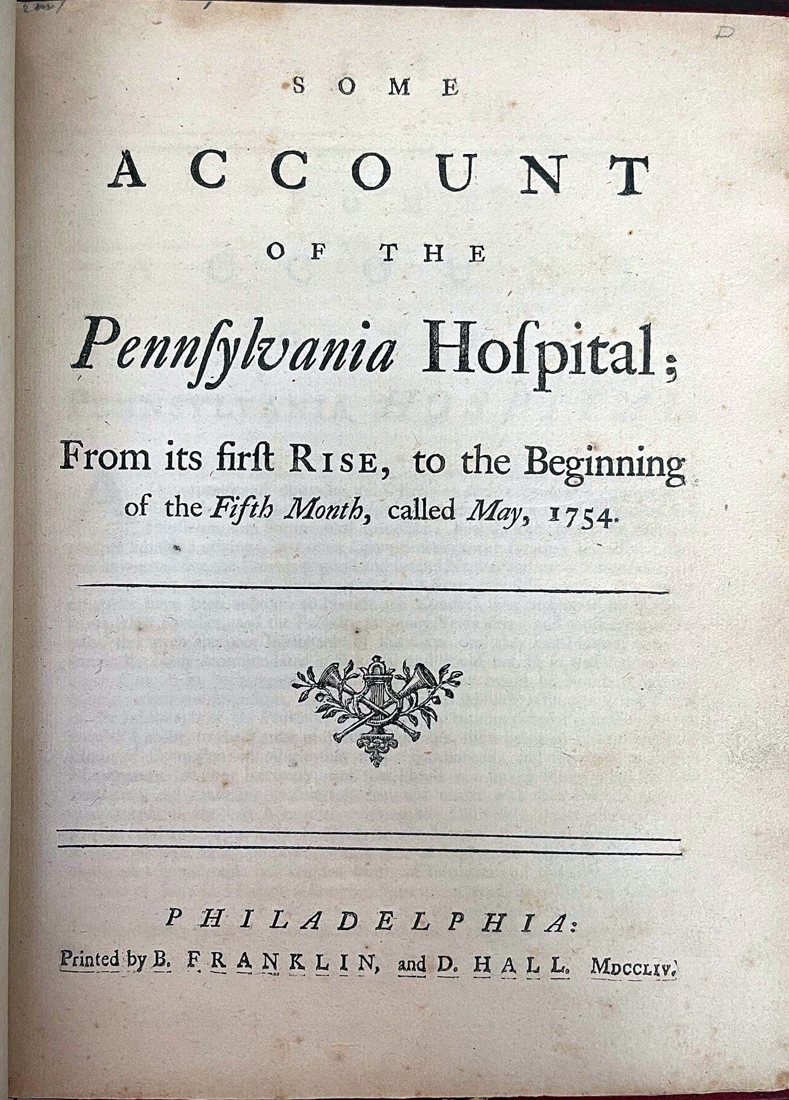
Some Account of the Pennsylvania Hospital

Some Account of the Pennsylvania Hospital

Philadelphia: B. Franklin and D. Hall, 1754
BF-2022.016

The notes came first. This came after. Three years of subscriptions, matching grant, building and admissions, written up by Franklin himself and printed at his own press in 1754, with the charter, the rules, the accounts and the names of every contributor. He wrote it to raise more money, and it worked. It is also the first American hospital report, and the record of what all those signatures on the promissory notes had bought. This is the book Smith and Reynell enclosed in their letter.

Read the full entry · 11 photographs

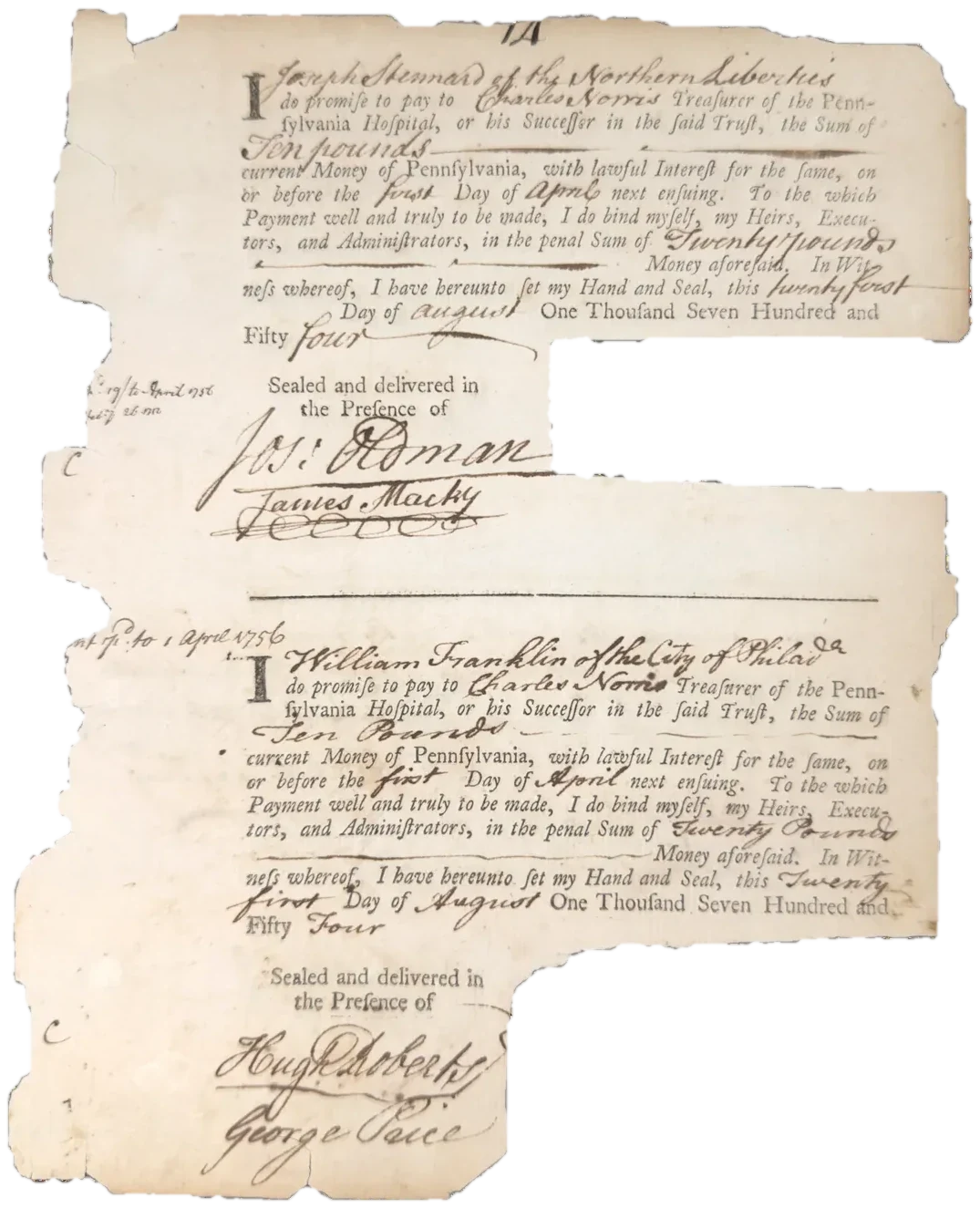
William Franklin, 21 August 1754

William Franklin, 21 August 1754

Franklin's son was about twenty-four, clerk of the Assembly and his father's postmaster, when he bound himself for ten pounds. Hugh Roberts, his father's friend from the Junto, signed as witness with George Price. The note shares its page with that of Joseph Stennard of the Northern Liberties. Both signatures were cut away when the debts were paid, which is how the Treasurer cancelled a bond.

The Founders' Book

The Governor's debt, paid by his father's partner

The Governor's debt, paid by his father's partner

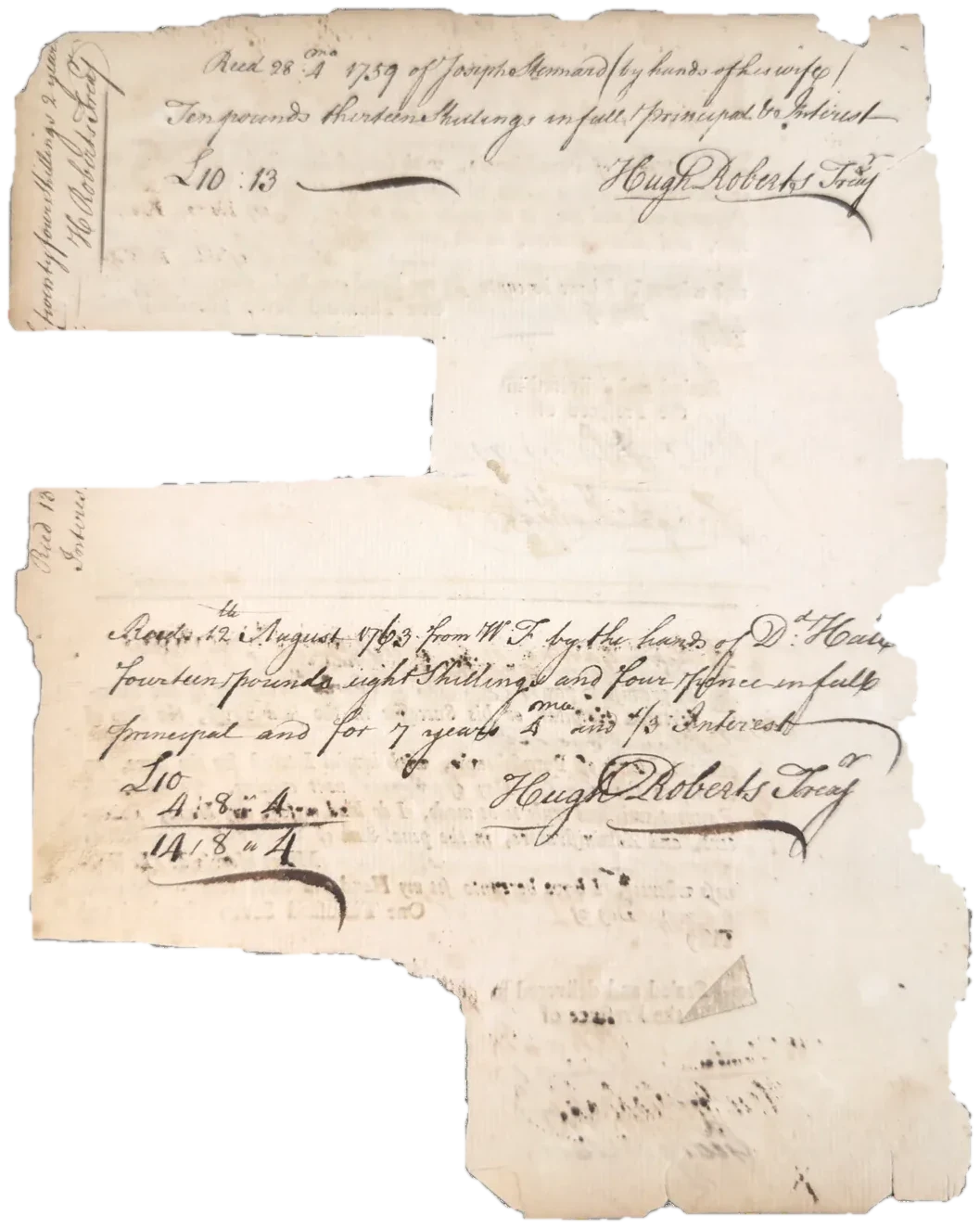
The back of William Franklin's note. By 1763 he was royal governor of New Jersey, and the pledge of 1754 was still open. Hugh Roberts records the end of it: "Recd 12th August 1763 from W.F. by the hands of Dd. Hall Fourteen pounds eight Shillings and four pence in full principal and for 7 years 4 mo. and 1/3 Interest." David Hall, Franklin's partner in the printing house, settled the account. Above it, Joseph Stennard's ten pounds came in "by hands of his wife."

The Founders' Book

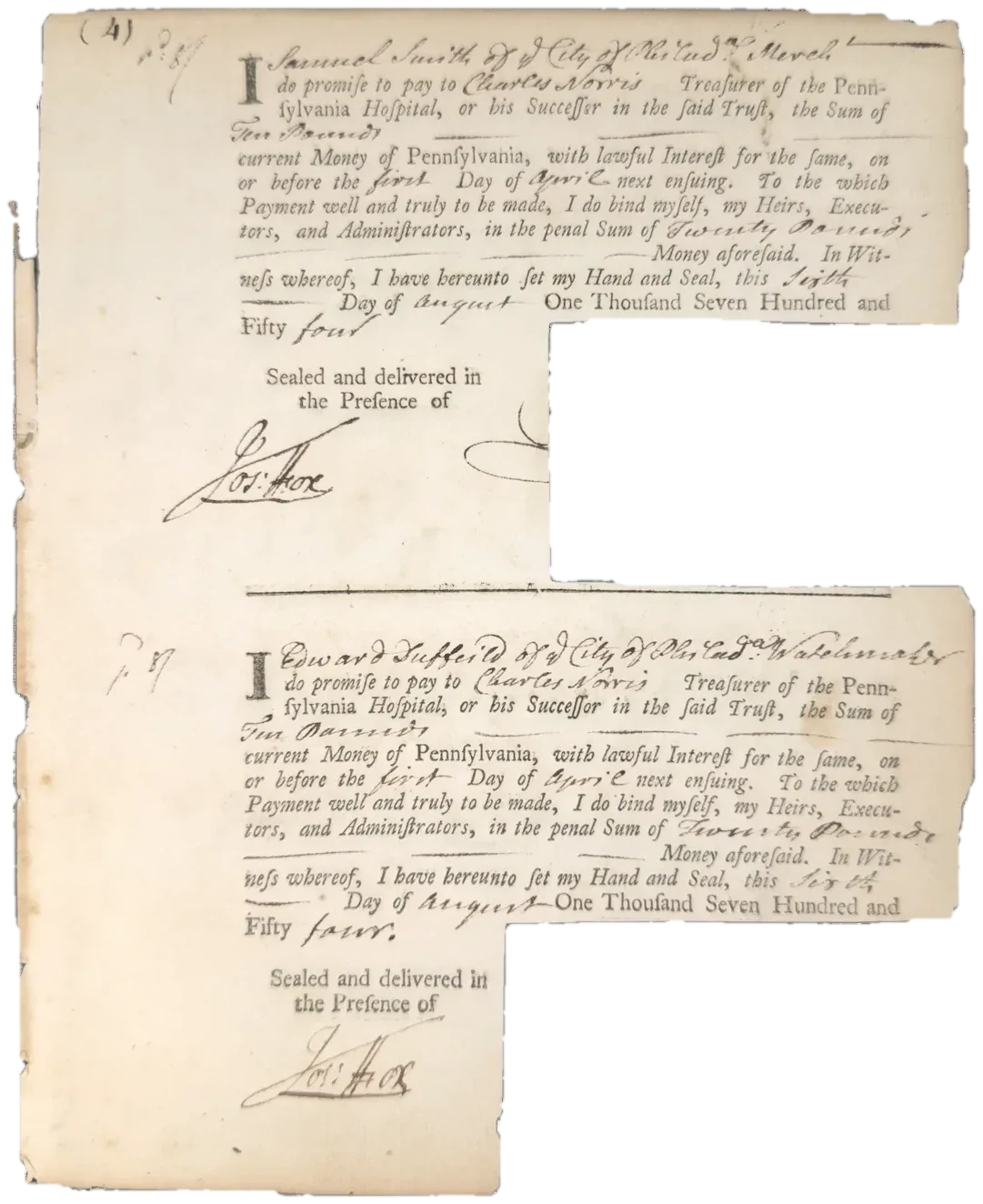
Edward Duffield, watchmaker, 6 August 1754

Edward Duffield, watchmaker, 6 August 1754

The clerk wrote his trade into the form: "Edward Duffeild of the City of Philada. Watchmaker." Duffield kept the State House clock, cut the dies for the first medal struck in the colonies, and was named by Franklin an executor of his will. Joseph Fox, the master carpenter who became Speaker, witnessed this note and that of Samuel Smith above it.

The Founders' Book

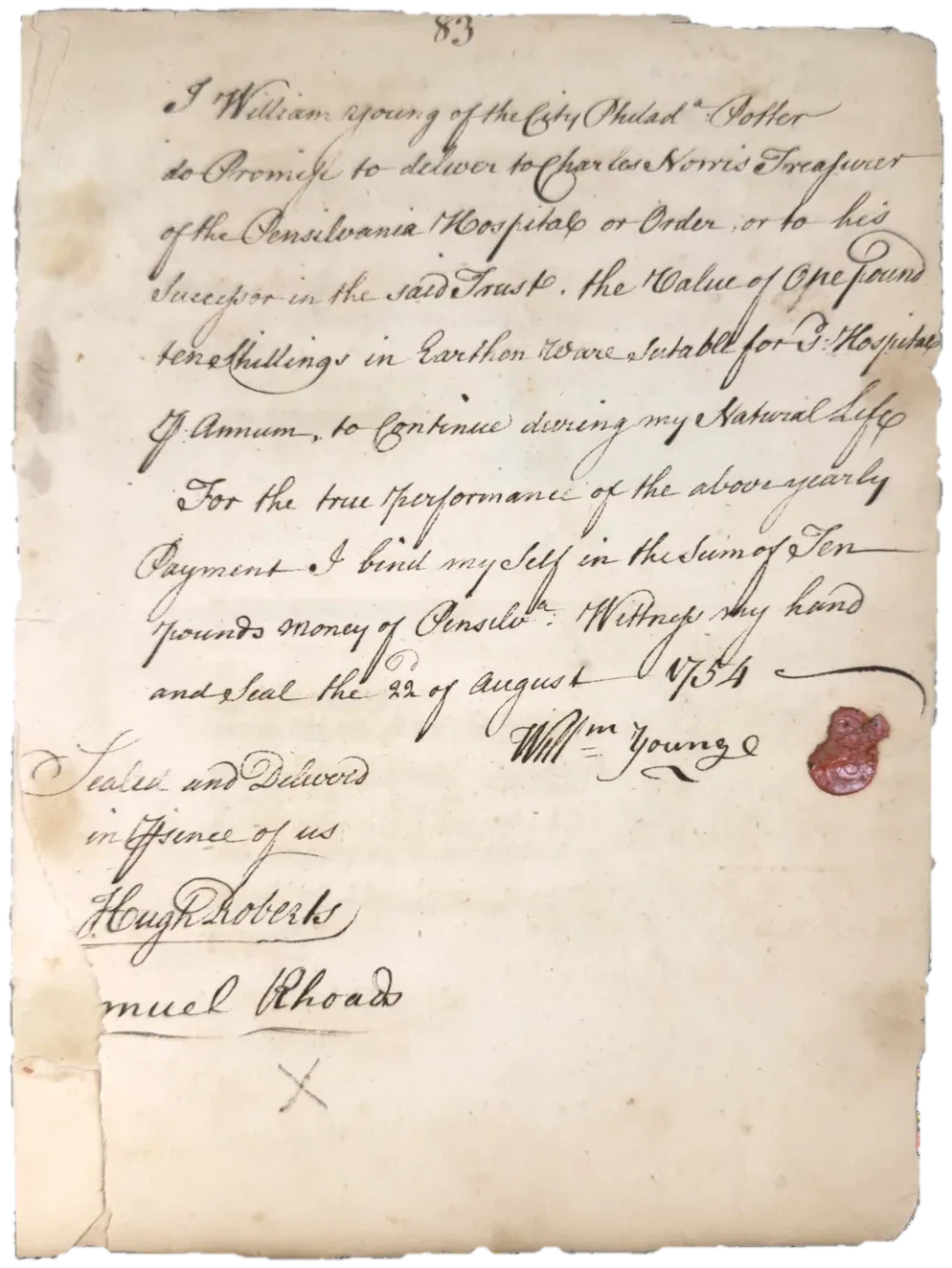
William Young, potter, 22 August 1754

William Young, potter, 22 August 1754

No printed form would serve, so the pledge was written out by hand. Young promises to deliver "the Value of One Pound ten Shillings in Earthen Ware suitable for the Hospital per Annum, to Continue during my Natural Life." He signed and sealed it in red wax before Hugh Roberts and Samuel Rhoads, the two Managers who were then planning the building on Pine Street.

The Founders' Book

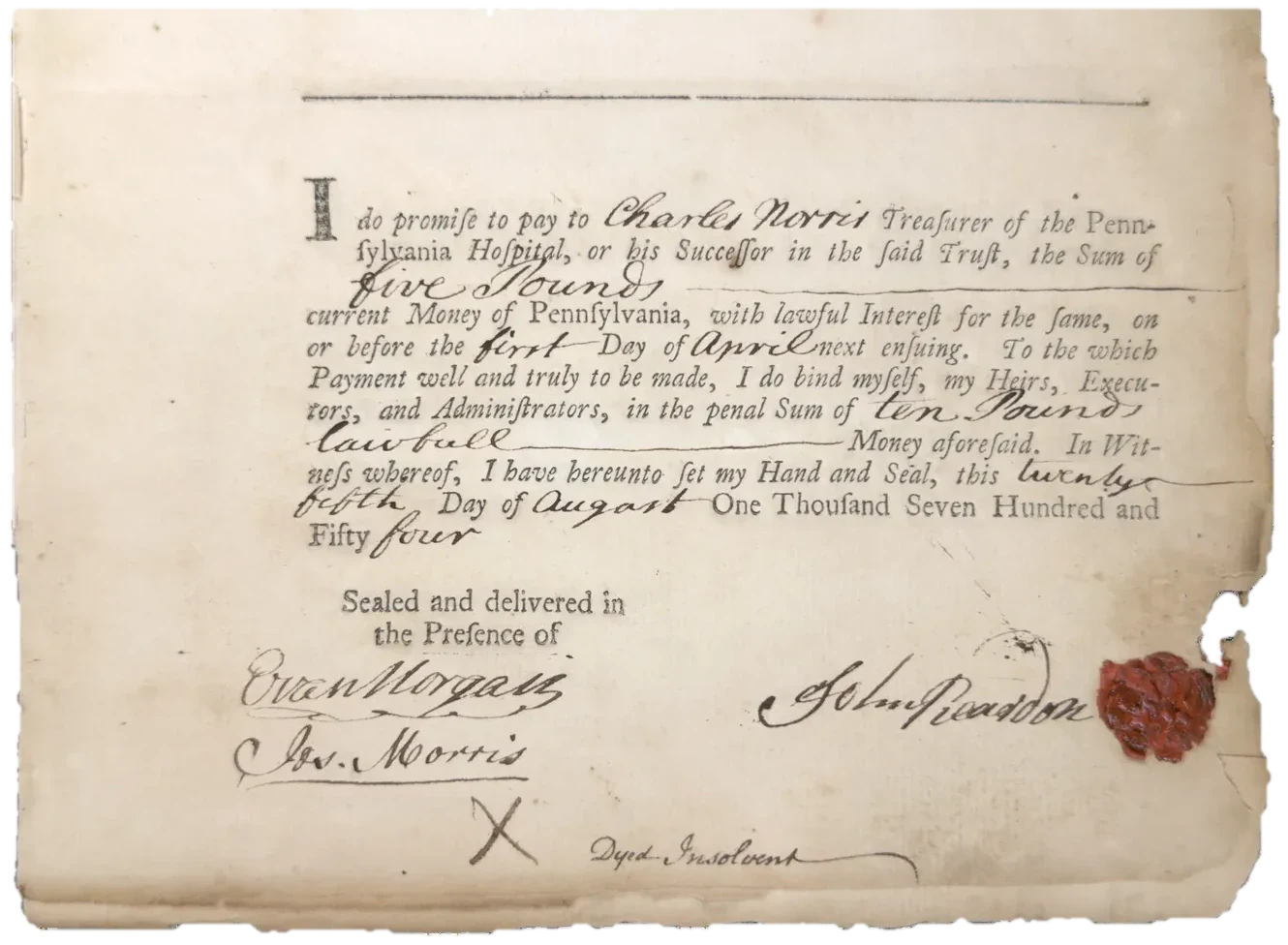
John Reardon, "Dyed Insolvent," 25 August 1754

John Reardon, "Dyed Insolvent," 25 August 1754

Not every pledge was collected. John Reardon bound himself for five pounds before the Managers Evan Morgan and Joseph Morris, and his signature and wax seal are still in place because the bond was never paid and so never cancelled. Beneath it the Treasurer closed the account in two words.

The Founders' Book

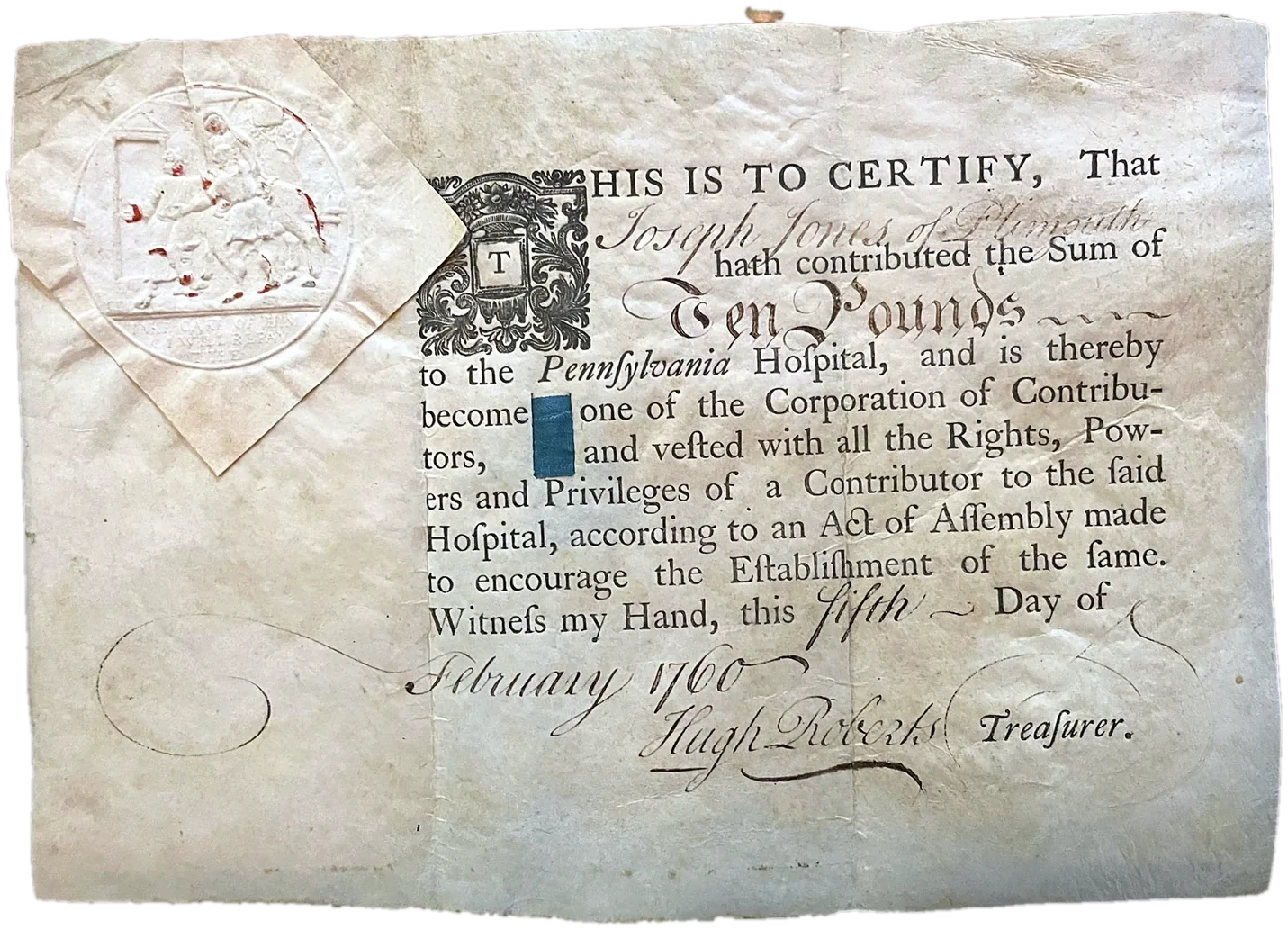
Joseph Jones of Plymouth becomes a Contributor

Collection Highlight

The Contributor's Certificate

Franklin and Hall, on vellum. Accomplished 5 February 1760
BF-2023.052

A subscriber who could not pay at once gave the Treasurer a promissory note. A subscriber who paid in cash received this instead: a printed certificate on vellum, signed by Hugh Roberts and sealed with the Good Samaritan, declaring that Joseph Jones of Plymouth had given ten pounds and was “thereby become one of the Corporation of Contributors.” It was his proof of membership and of his vote for the Managers. The notes stayed in the Treasurer's books and survive by the hundred. The certificates went home with their owners, and Miller locates only five.

Read the full entry · 3 photographs

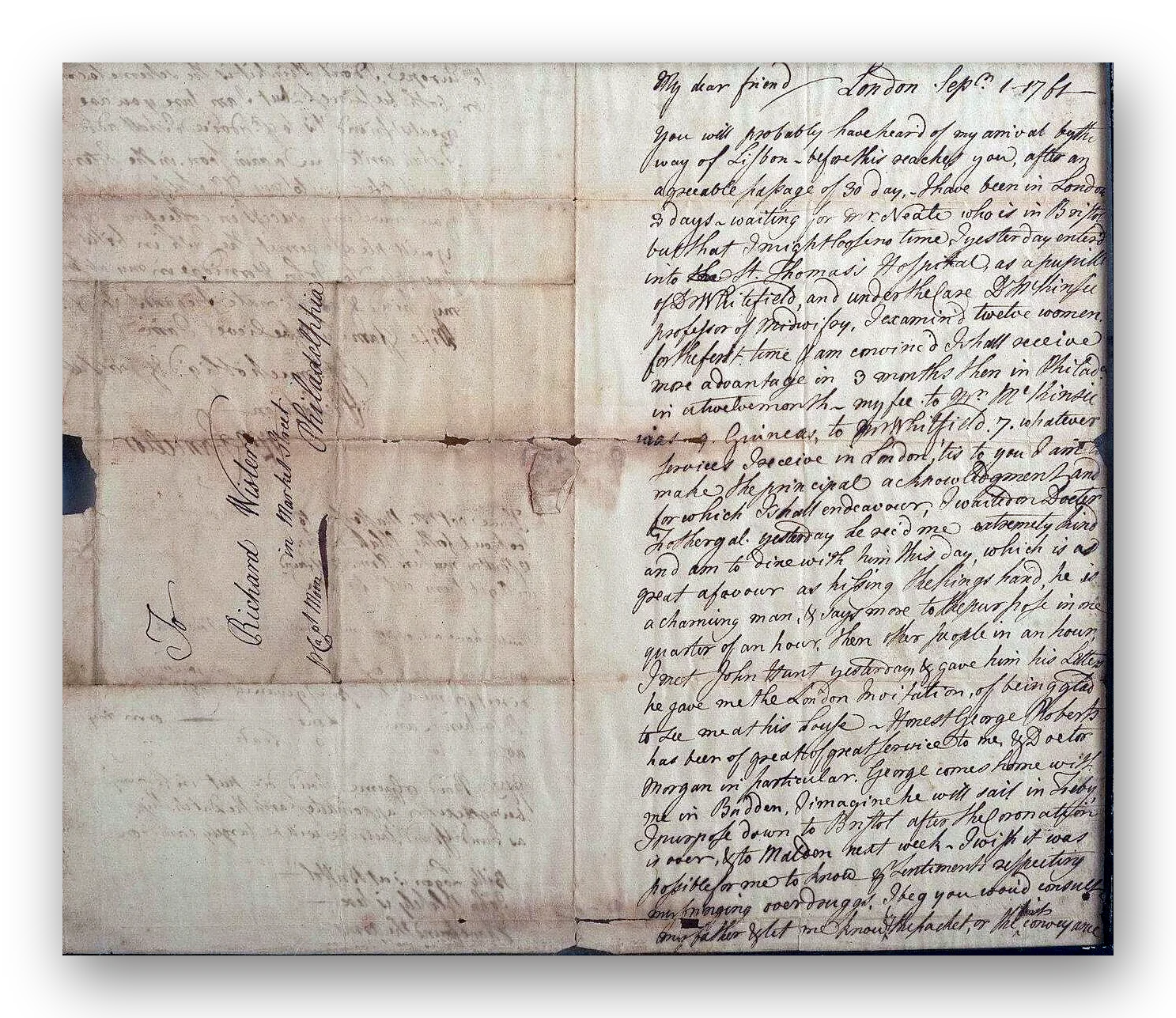
Dr. William Chancellor to Richard Wister, 1 September 1761

Dr. William Chancellor to Richard Wister, 1 September 1761

Autograph letter signed, London, 1 September 1761
BF-2024.062

William Chancellor wrote this letter to the Market Street merchant Richard Wister soon after reaching London to study with the city's surgeons and in its hospitals. He laments the poor education he received in Philadelphia and says he will see more patients in a month in London than in twelve in Philadelphia. In a postscript below his signature he adds that if Dr. Bond or Dr. Graeme should die, Wister should put in for him as the person appointed to search the Dutch ships, as he understands the trade will be largely carried on.

The post he seeks is an appointment by the Assembly as inspector of unhealthy ships, specifically those arriving with enslaved men, women and children from Africa. In 1749 Chancellor had sailed as the doctor on the sloop Wolf on a twenty-month slaving voyage to the coast of West Africa, and the volume of the diary he kept on board survives. Only one other letter of his is known.

The letter may also piece together the founding of the Pennsylvania Hospital's medical library. As David L. Crosby's article describes, Chancellor went to London and met Dr. John Fothergill, and soon afterward Fothergill sent the famous anatomical drawings to the Hospital for use in teaching. It is surmised that Chancellor carried a letter from Israel Pemberton to Fothergill asking for funds for the Hospital, and that Fothergill sent the drawings instead. A straight line can be drawn from Pemberton through Chancellor to Fothergill at the right time.

Read the full entry · 2 photographs

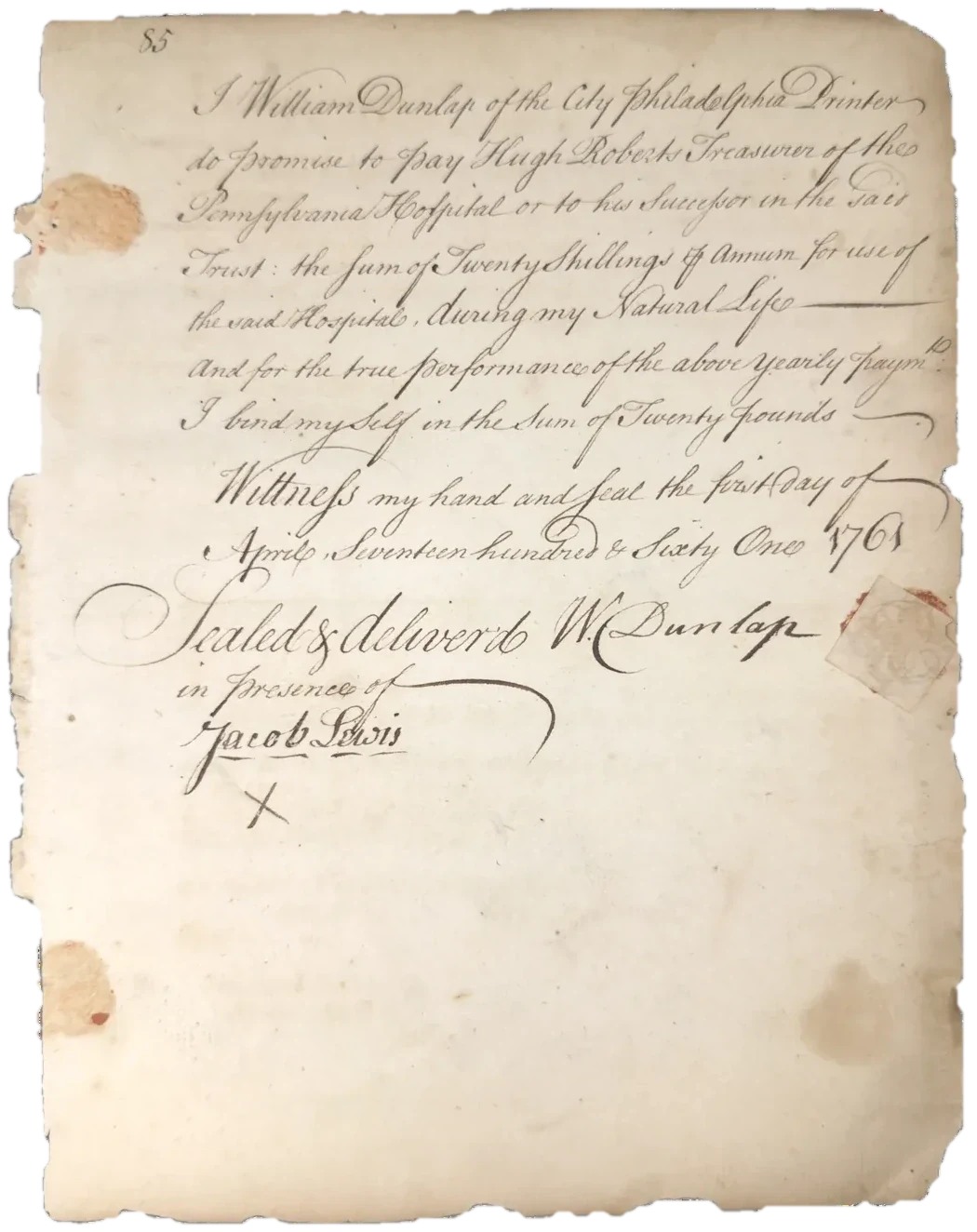
William Dunlap, printer, 1 April 1761

William Dunlap, printer, 1 April 1761

Another pledge for life, in manuscript: twenty shillings a year "during my Natural Life," signed and sealed before Jacob Lewis. Dunlap had married a niece of Deborah Franklin, and Franklin had made him postmaster of Philadelphia. His nephew and apprentice John Dunlap would print the Declaration of Independence.

The Founders' Book

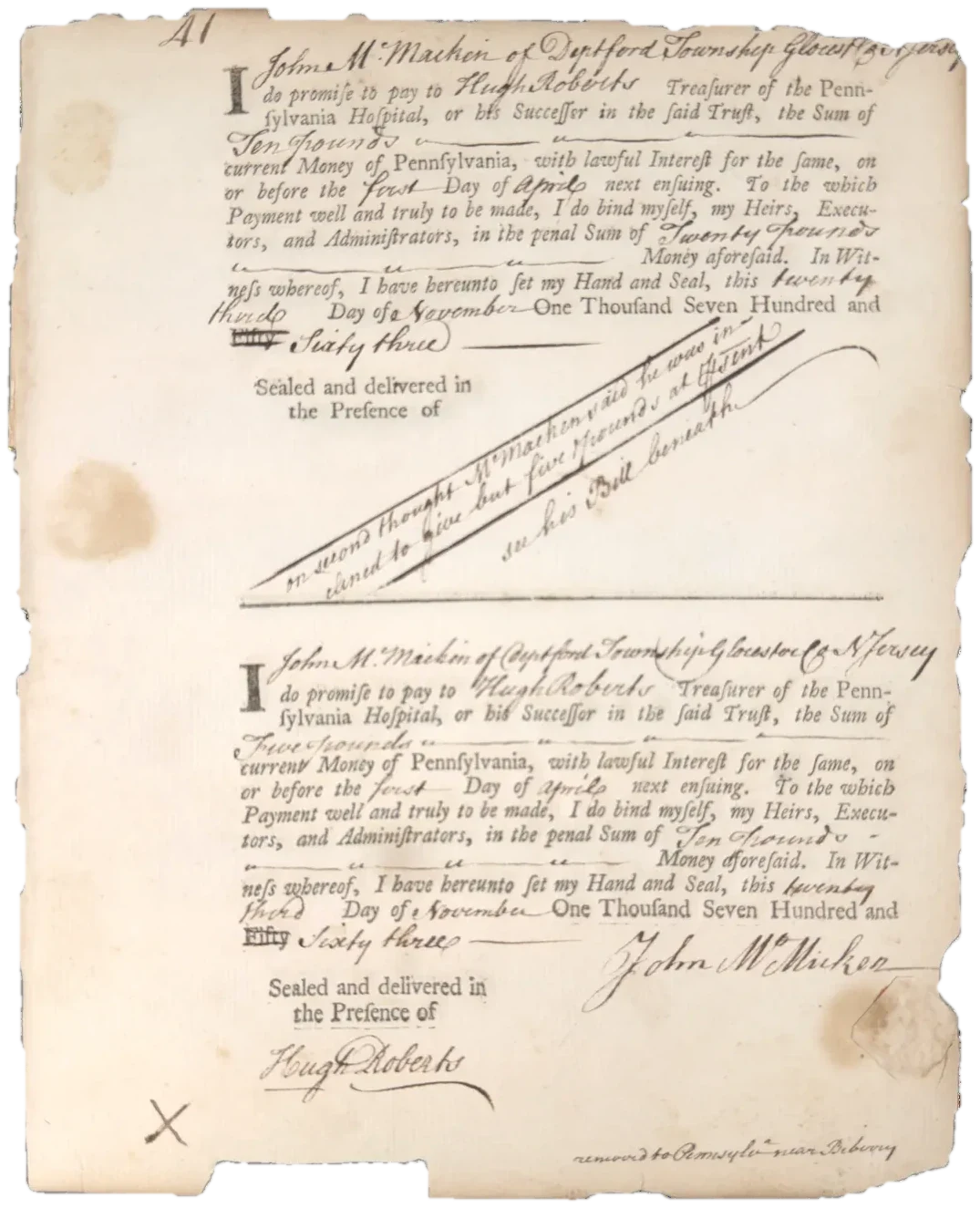
John McMackin changes his mind, 23 November 1763

John McMackin changes his mind, 23 November 1763

McMackin, of Deptford Township in Gloucester County, New Jersey, signed for ten pounds. Then he reconsidered. Hugh Roberts struck through the first bond and wrote across it: "on second thought McMackin said he was inclined to give but five pounds at present, see his Bill beneath." The second bond, for five, follows on the same page, signed and sealed. A later hand adds that he had "removed to Pennsylva. near Byberry."

The Founders' Book

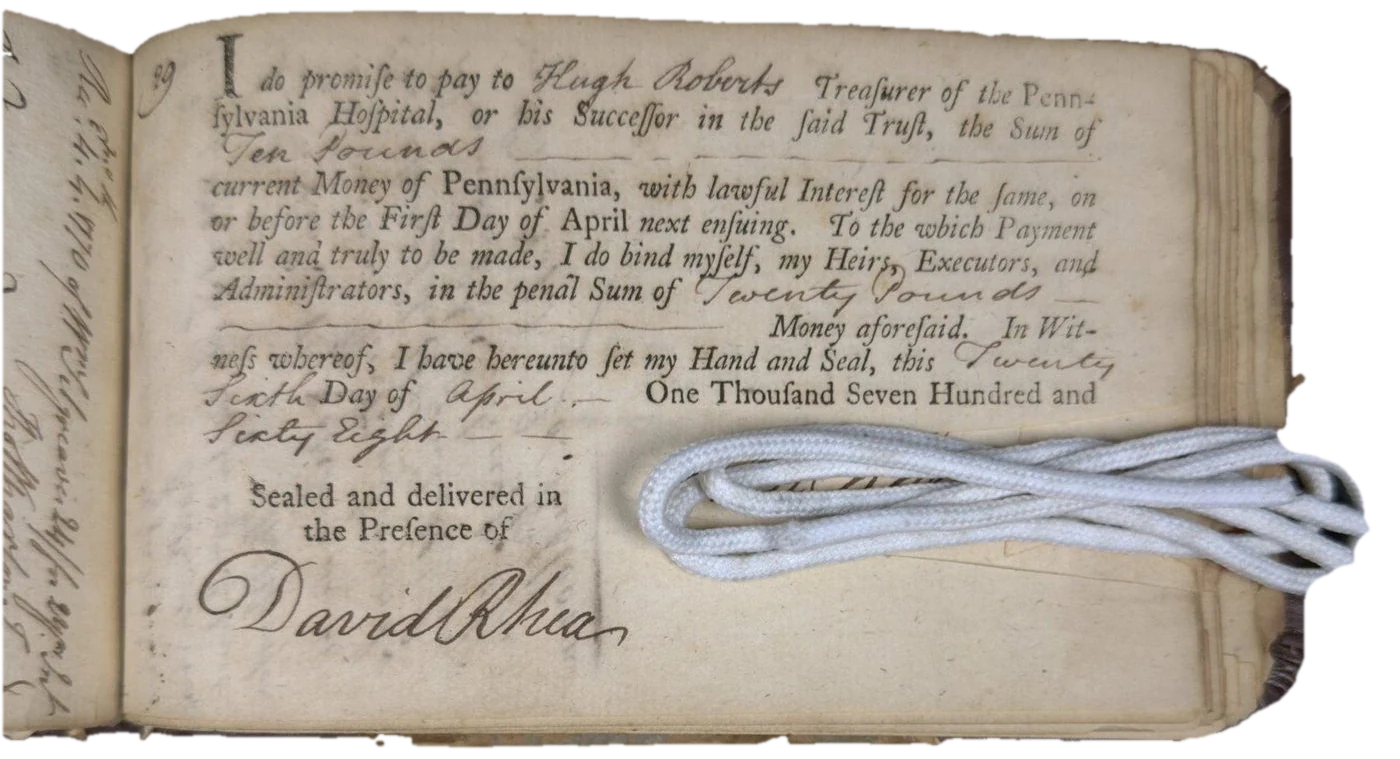
Francis Hopkinson, 26 April 1768

Francis Hopkinson, 26 April 1768

In the small book of 1764 to 1772. Hopkinson signed for ten pounds before David Rhea, eight years before he signed the Declaration of Independence. He was the first pupil of Franklin's Academy and one of the executors of Franklin's will. His signature was cut away when the pledge was paid, and the window it left would show a signature from a later leaf, so a soft cord is laid across the opening to keep the two from being confused.

The Founders' Book

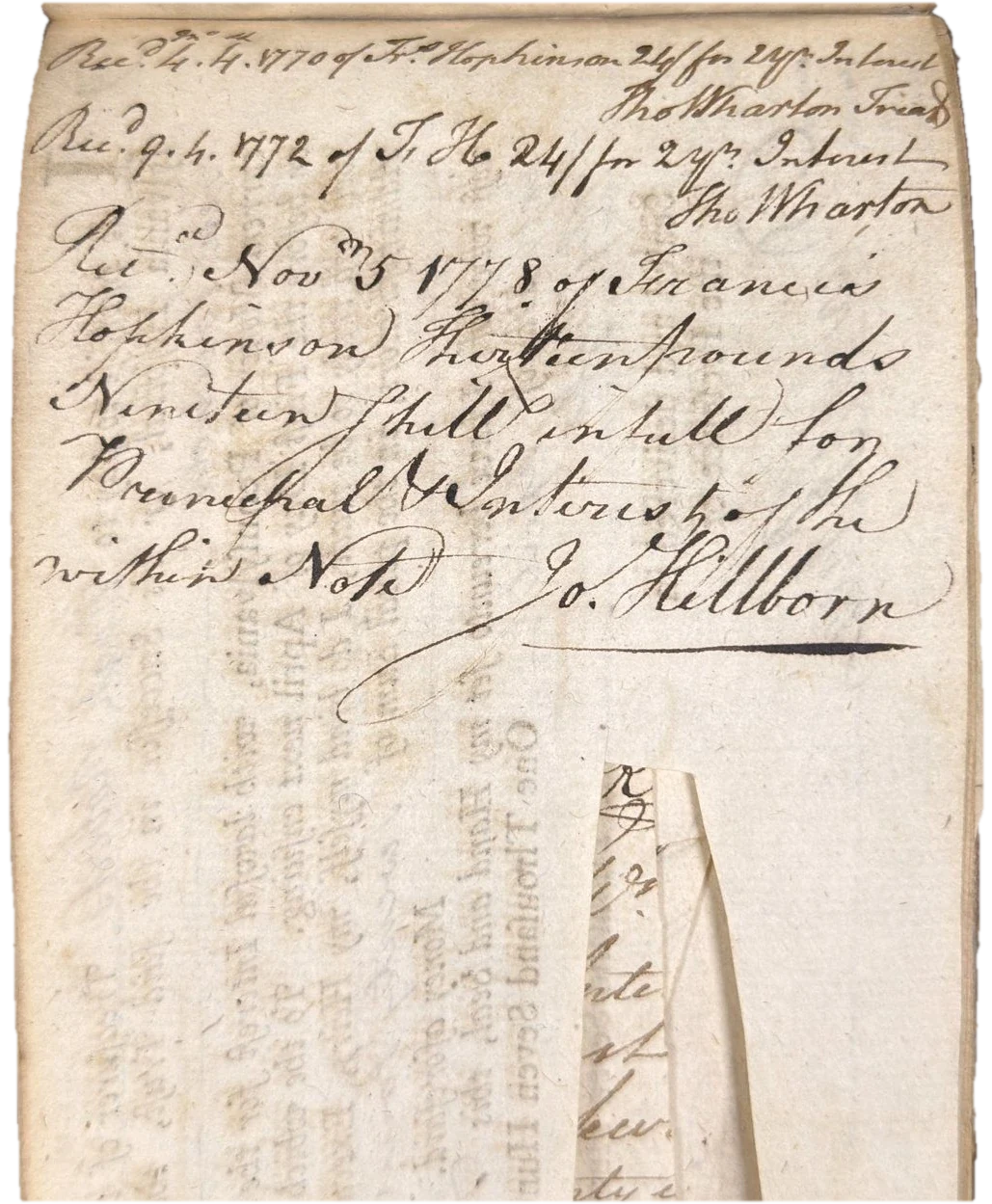
Francis Hopkinson pays in full, 5 November 1778

Francis Hopkinson pays in full, 5 November 1778

The back of Hopkinson's note. Thomas Wharton twice records twenty-four shillings for two years' interest, in 1770 and 1772. Then the hand changes: "Recd Novr 5 1778 of Francis Hopkinson Thirteen pounds Nineteen shills. in full for Principal & Interest of the within Note. Jo. Hillborn." Between the second receipt and the third, Hopkinson had signed the Declaration of Independence, and the British had taken Philadelphia and left it again.

The Founders' Book

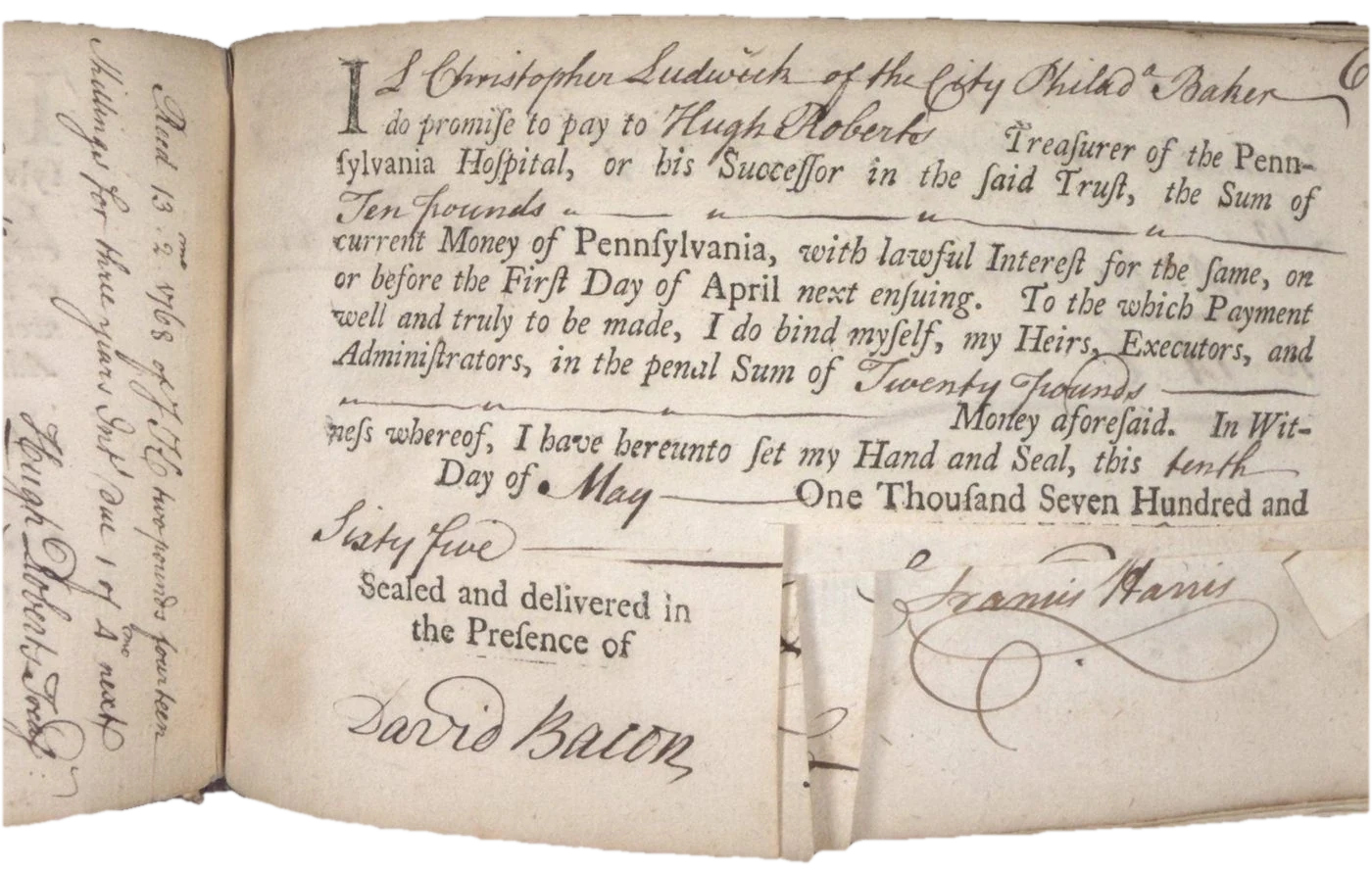
Christopher Ludwick, baker, 10 May 1765

Christopher Ludwick, baker, 10 May 1765

In the small book of 1764 to 1772, still bound. "Christopher Ludwick of the City Philada. Baker" pledged ten pounds before David Bacon. The gingerbread baker became Baker General of the Continental Army, and Benjamin Rush wrote and published his biography. Where Ludwick's signature was cut away, the signature of Francis Harris shows through from the leaf beneath.

The Founders' Book

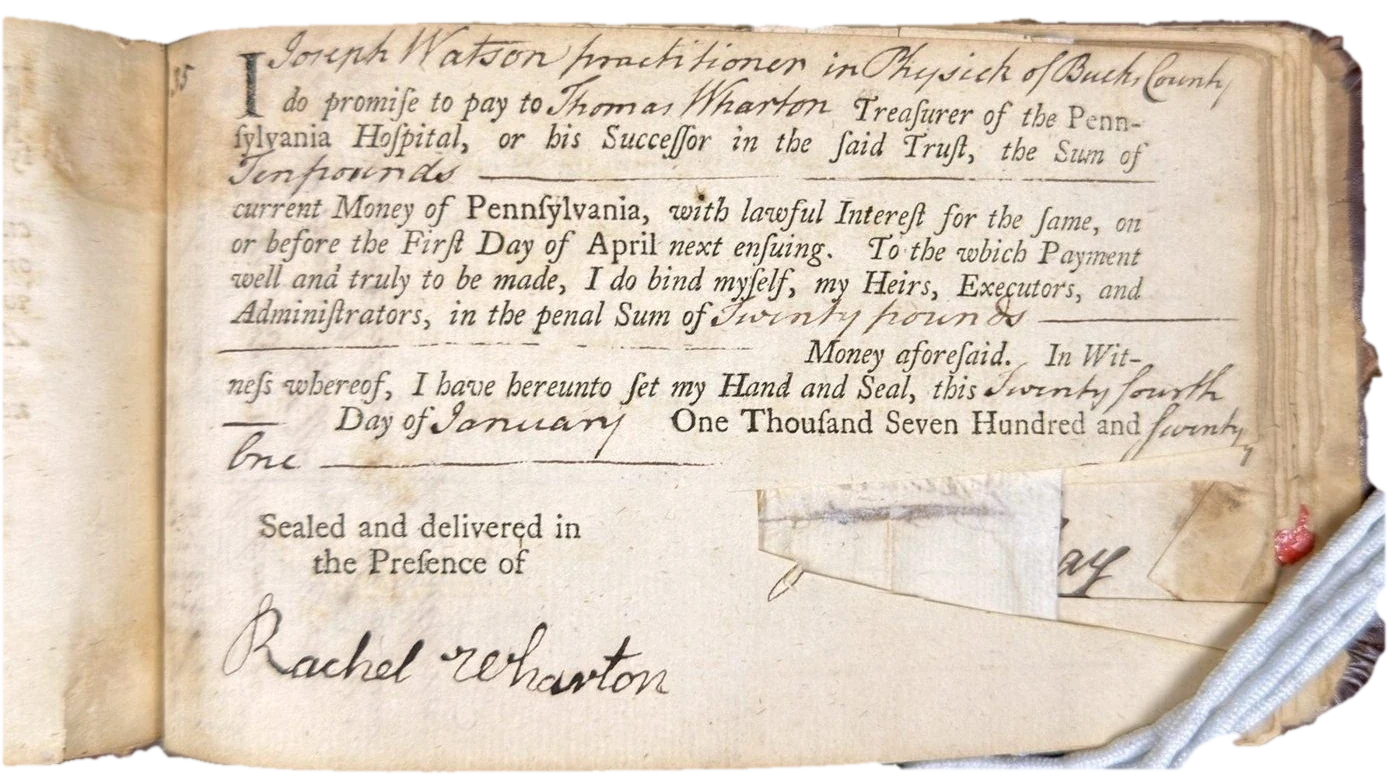
Joseph Watson, witnessed by Rachel Wharton, 24 January 1771

Joseph Watson, witnessed by Rachel Wharton, 24 January 1771

"Joseph Watson practitioner in Physick of Bucks County" pledged ten pounds to Thomas Wharton, the new Treasurer. The witness is the Treasurer's wife. Among some two hundred and seventy bonds, hers is one of the very few signatures of a woman, and it suggests a country doctor calling at the Wharton house with no one else at hand to attest his seal.

The Founders' Book

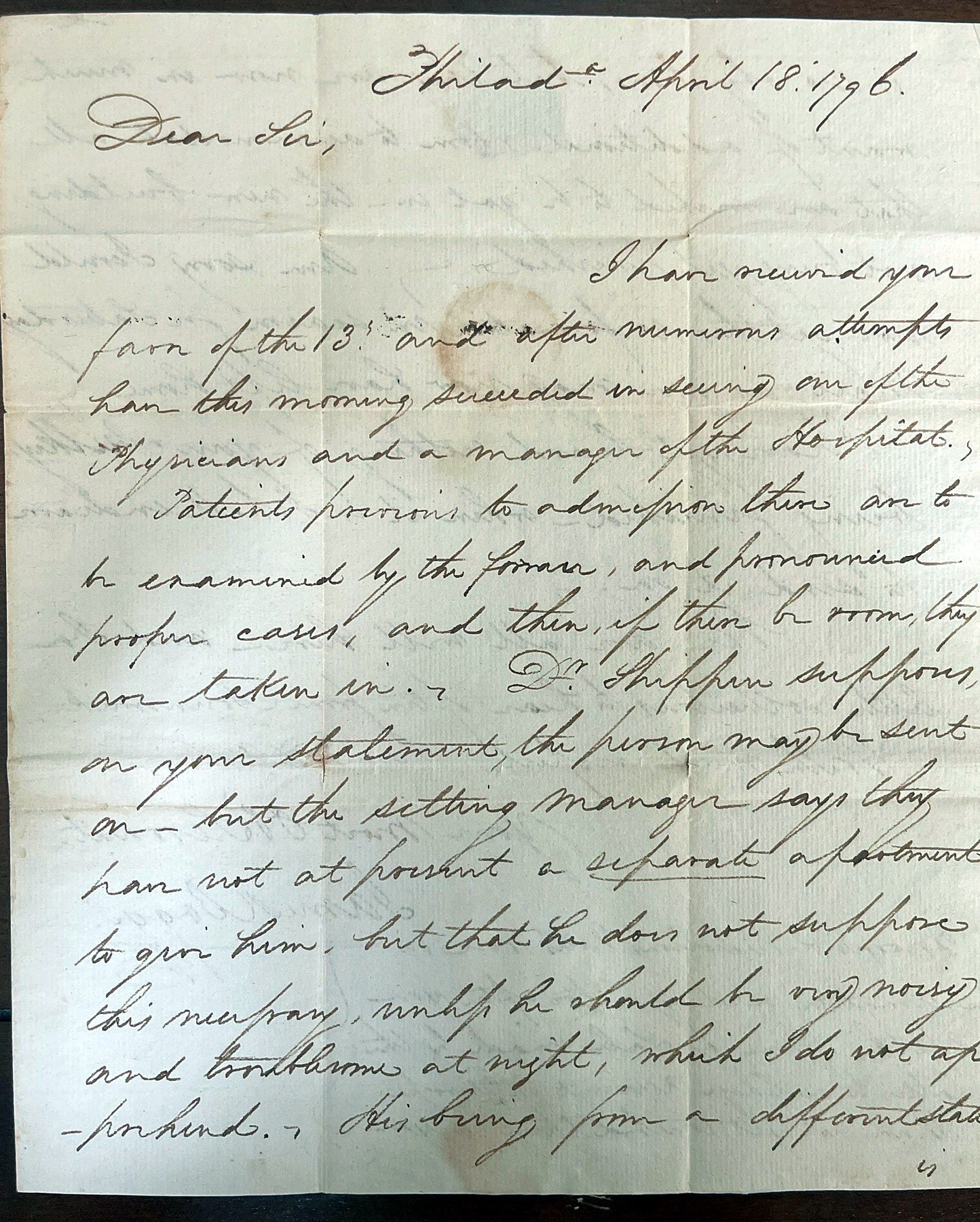
Letter regarding the admission of a patient to the Pennsylvania Hospital, 18 April 1796

Letter regarding the admission of a patient to the Pennsylvania Hospital, 18 April 1796

Manuscript letter, Philadelphia, 18 April 1796
BF-2023.029

The writer answers a note of the 13th. After several attempts he has seen one of the Hospital's physicians and one of its managers, and he reports the rule: a patient is examined beforehand by a physician and judged a proper case, and is then taken in if there is room. Dr. Shippen thinks the man might be sent on the correspondent's statement, but the sitting manager says the Hospital has no separate apartment to give him, though he does not expect that to matter unless the man is noisy at night.

The writer and the patient have not yet been identified. It is one of several letters in the collection about admissions, and it shows the procedure at the door of the Hospital forty-five years after its founding.

Read the full entry · 4 photographs

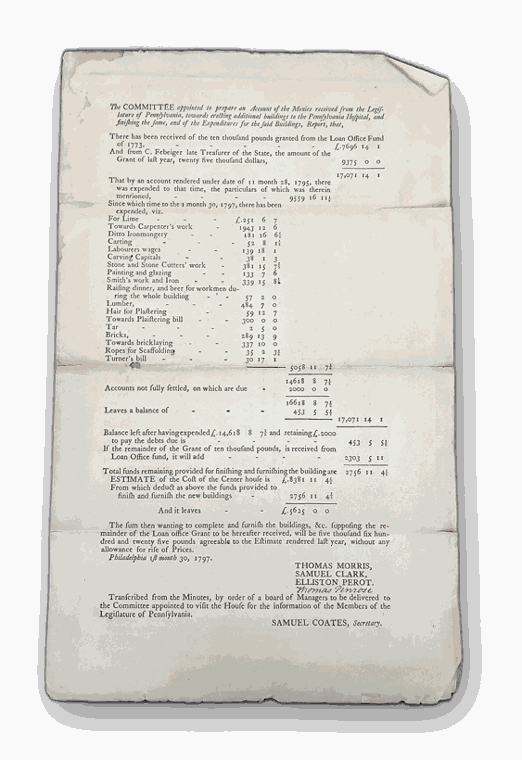
Pennsylvania Hospital Ledger

Pennsylvania Hospital Ledger

Philadelphia: John Fenno, 1797
BF-2023.033

A printed report taken from the minutes of the Hospital's building committee, signed in print by its secretary, Samuel Coates. The committee, Thomas Morris, Samuel Clark and Elliston Perot, with the name of Thomas Penrose added in ink, accounts for expenses to 28 November 1795, itemising lumber, hair for plastering, wages and more, and sets them against the money received from the Loan Office fund and the state treasurer.

The collection holds several reports of this kind, among them those for 1800 and 1805, and the 1805 report closes with a deficit of $29,272.92. OCLC records one institutional copy of this report and none of the later two.

Read the full entry · 4 photographs

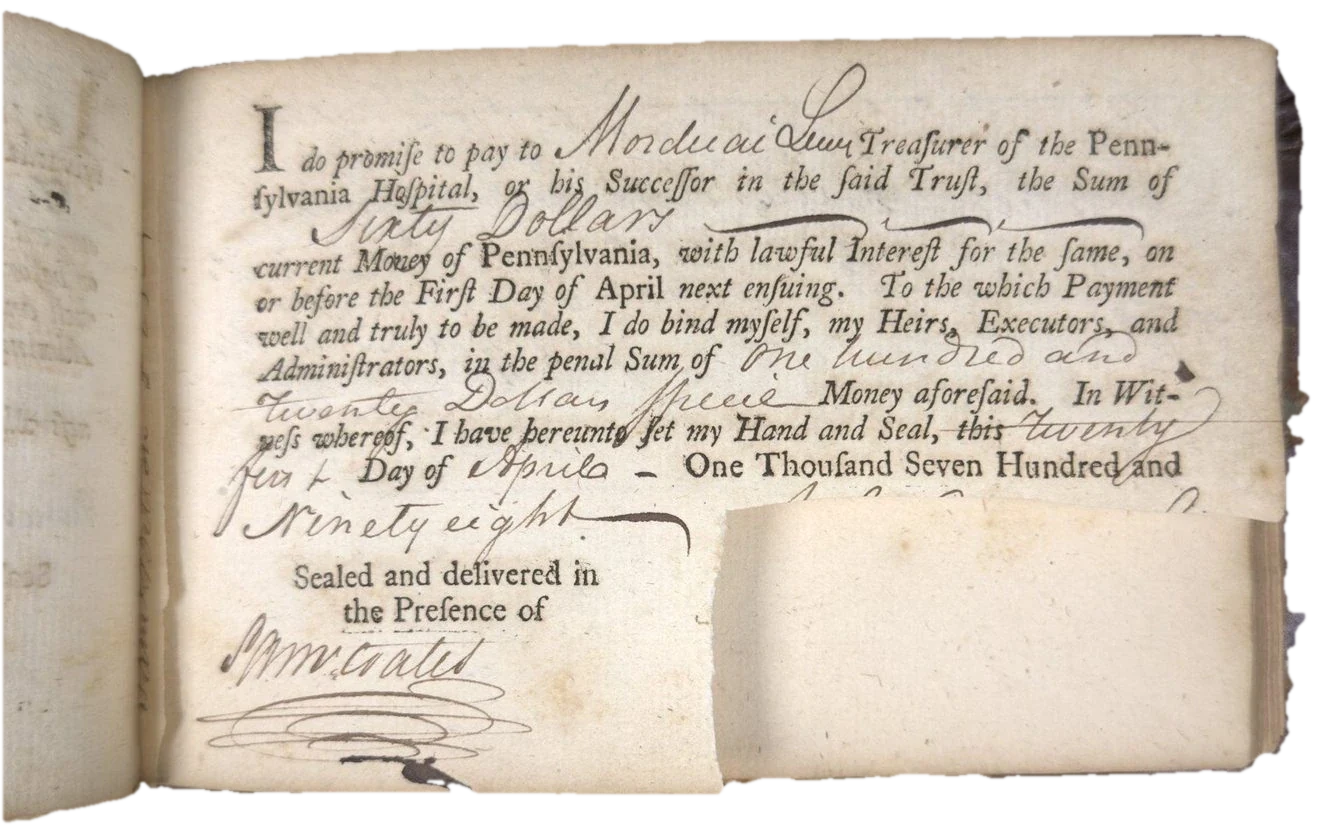
John Redman Coxe, 1798

John Redman Coxe, 1798

The last note in the last book, and the only one in dollars: sixty dollars, under a penal sum of one hundred and twenty "Dollars specie," payable to Mordecai Lewis and witnessed by Samuel Coates. Coxe was the grandson of Dr. John Redman, whose own note is No. 51 in the founders' book of 1751, and the pupil of Benjamin Rush.

The Founders' Book

Further Reading

Where the story of this room is told at length.

The Cast of This Room

The people whose names are on the objects in this room. Each opens a short life in the Dramatis Personae, with the institutions that person belonged to and every other object in the collection that carries the name.

Thomas BondBenjamin FranklinJohn ReynellJohn SmithThomas WorthHugh RobertsIsrael Pemberton the elderIsrael Pemberton Jr.Joshua CrosbyThomas CadwaladerJohn RedmanPhineas BondWilliam Shippen the elderSamuel RhoadsRichard PetersWilliam SmithWilliam FranklinDavid HallWilliam DunlapFrancis HopkinsonThomas Wharton the elderBenjamin Rush