EIS LIBRIS
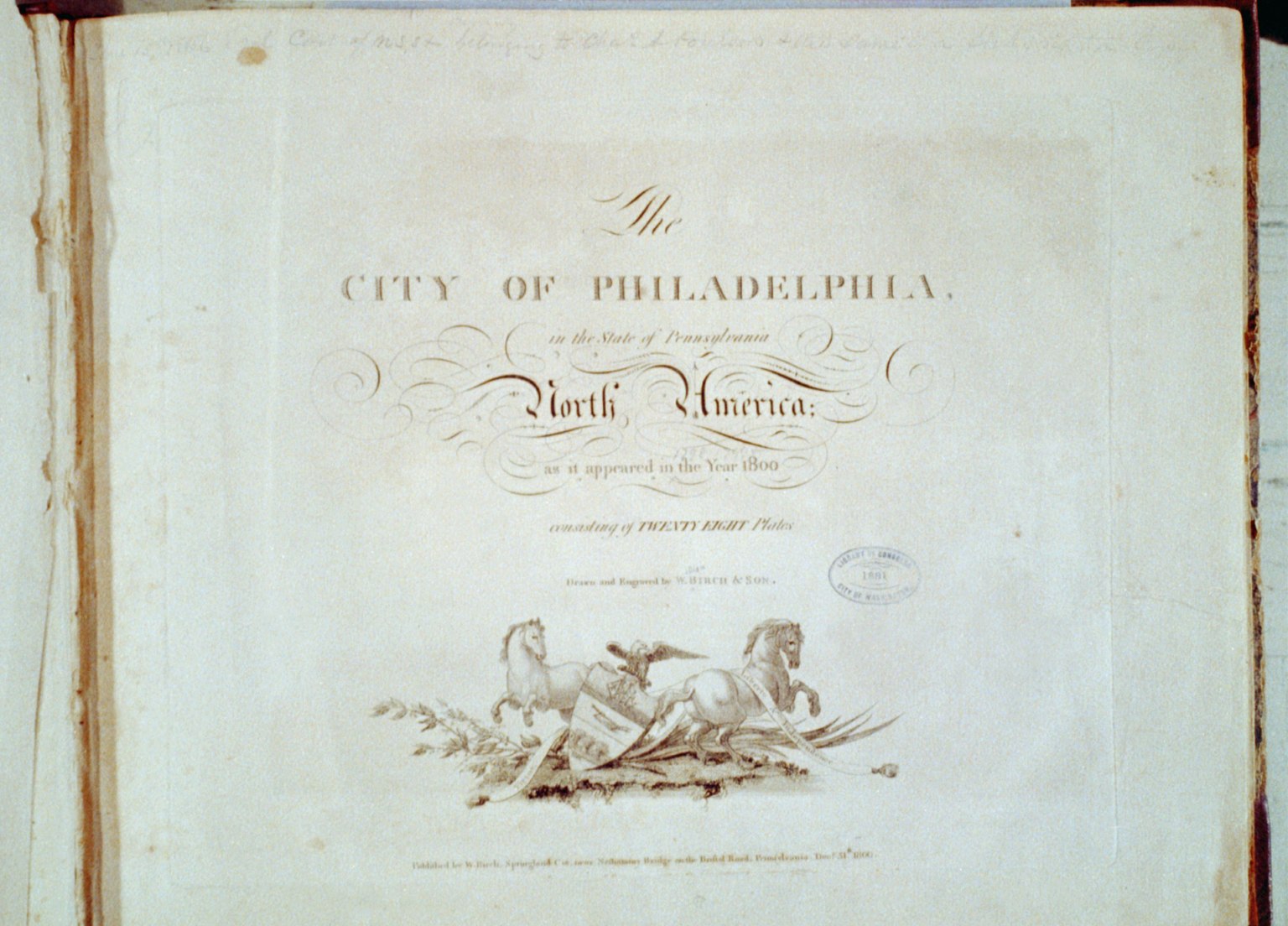
The City of Philadelphia as it appeared in the year 1800, by William Birch. Library of Congress.

Room 5 of 10

The Beginning of the End

Paxton, the election, the Stamp Act, and the land, 1763 to 1769

The City of Philadelphia as it appeared in the year 1800, by William Birch. Library of Congress.

In December 1763 a party of frontiersmen from Paxton township, in the back country near modern Harrisburg, murdered the last twenty Conestoga Indians: six in their village, and fourteen more in the workhouse at Lancaster where the authorities had put them for safety. The Conestoga were a small, peaceable community who had lived under a treaty with William Penn for eighty years. In February the Paxton men marched on Philadelphia, several hundred strong, intending to kill the Moravian Indians whom the government had sheltered on an island in the Delaware. The city armed itself. Franklin organised the defence, rode out to Germantown with the Governor's commissioners to meet the marchers, and talked them into going home.

Then he lost. The pamphlet war that followed set the frontier counties and the Presbyterian interest against the Quaker party that had run Pennsylvania since its founding, and Franklin, who had written the most savage of the pamphlets against the marchers, made himself the target. Pennsylvania was a proprietary colony, owned and governed by the heirs of William Penn rather than by the Crown, and Franklin's party wanted the King to take it over. In the Assembly election of October 1764 he was defeated for the first time in fourteen years. His party sent him to London anyway, to petition for the end of proprietary government. He was still there when Parliament passed the Stamp Act.

The Stamp Act of 1765 required a tax stamp on every printed sheet in America: newspapers, pamphlets, almanacs, legal forms, even playing cards. The printers, who had the most to lose, made the most noise, and several stopped their presses rather than pay. Franklin misjudged it badly at first, recommending a friend for the post of stamp distributor in Pennsylvania, and a crowd nearly pulled his house down for it. He recovered in February 1766 by standing before the House of Commons for four hours and telling the members plainly that the colonies would never submit. The Act was repealed in March, and the colonies celebrated with bonfires, illuminations and lanterns hung in the streets.

Asked what would happen if a military force were sent to enforce the Act, Franklin gave the answer that was printed from London to Charleston: "They cannot force a man to take stamps who chuses to do without them. They will not find a rebellion; they may indeed make one." Five weeks later the Act was repealed. Parliament saved its face with a Declaratory Act, passed the same day, asserting its right to bind the colonies "in all cases whatsoever." That clause would be remembered when the celebrations were over.

This room holds the year that changed him and the celebration that followed, and it runs on a few years further, because the other business of the decade did. While the pamphlets flew and the stamps were burned, the same men were buying land. Croghan and Trent were pressing their claims for the losses of the war, William Franklin was taking shares in the Otsego tract, and his father stayed in London long after the repeal, pursuing grants in the west. The last two pieces here belong to that quieter quarrel.

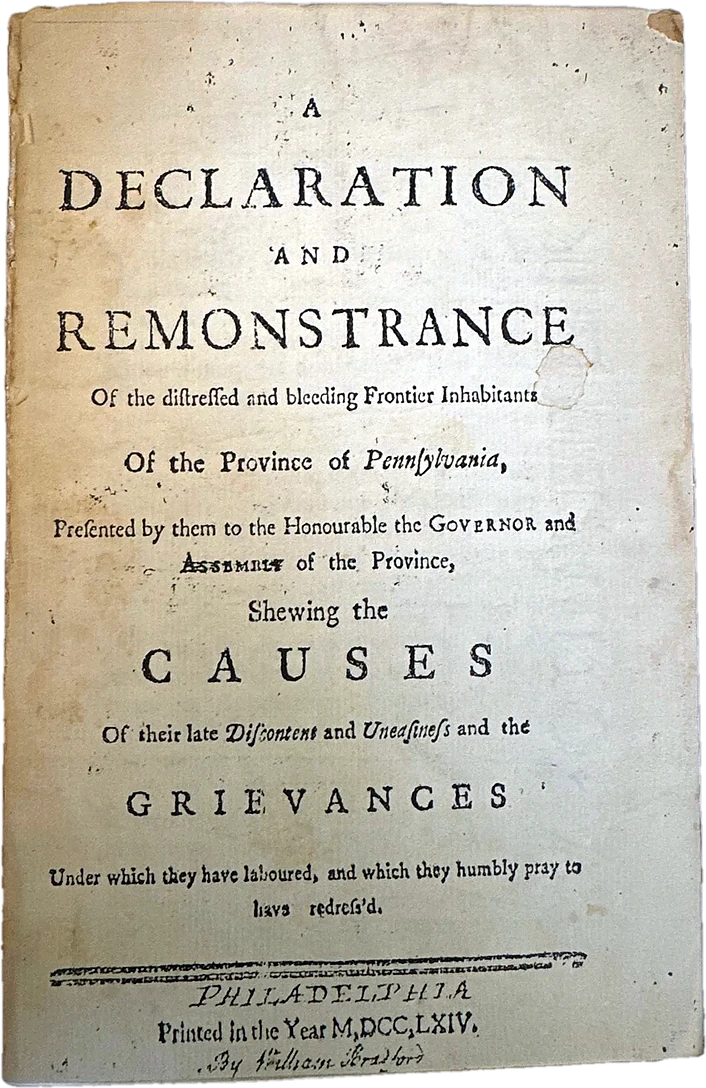
A Declaration and Remonstrance of the Frontier Inhabitants

[Paxton Boys] A Declaration and Remonstrance ....
BF-2025.001

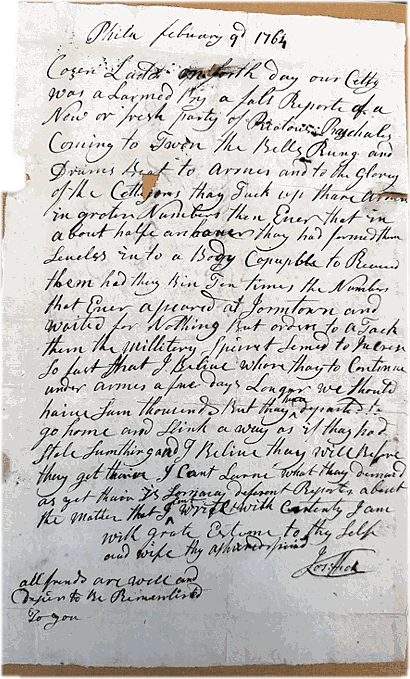
Autograph letter signed, Philadelphia, 9 February 1764, to “Cozen Ladd”, on the alarm of a second Paxton party

Autograph letter signed, Philadelphia, 9 February 1764, to “Cozen Ladd”, on the alarm of a second Paxton party


BF-2024.132

A letter written in Philadelphia on 9 February 1764, two days after Franklin turned the Paxton men back at Germantown. The previous morning a false report that a fresh party was coming brought the city to arms within half an hour, in greater numbers than ever, and the writer, a Friend, reports it to his cousin in Gloucester County with satisfaction and a parting shot: they slink away as if they had stole something. Shown beside the marchers own manifesto, written the same week.

Read the full entry · 3 photographs

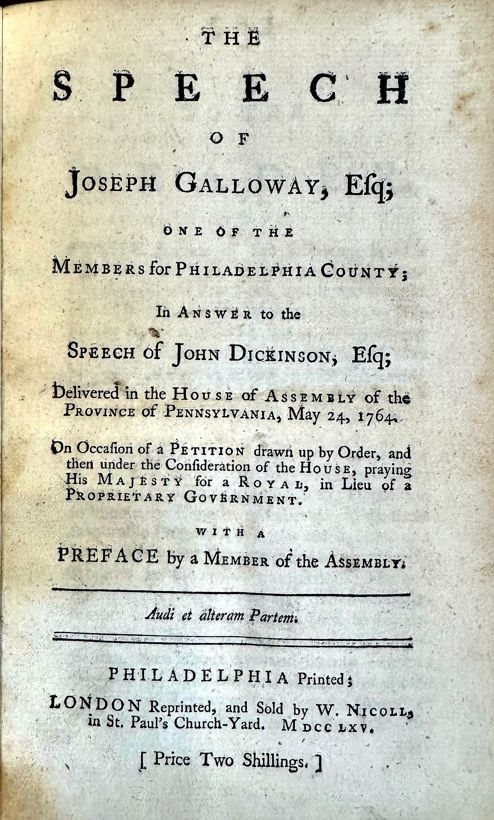
Joseph Galloway, The Speech of Joseph Galloway, Esq.

Joseph Galloway, The Speech of Joseph Galloway, Esq.


BF-2025.116

Joseph Galloway's Speech in answer to John Dickinson, delivered in the Assembly on 24 May 1764, with a preface by “a Member of the Assembly” that is Franklin's. The two men fought the Penns together that spring and lost their seats together in October. This copy is the London reprint of 1765, sold by W. Nicoll at two shillings: the quarrel had become a London quarrel by the time Franklin arrived to argue it before the ministry.

Read the full entry · 2 photographs

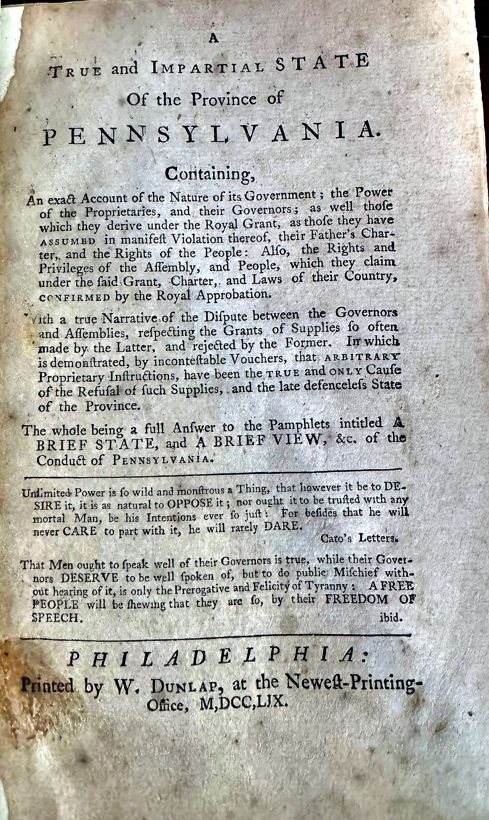
A True and Impartial State of the Province of Pennsylvania

A True and Impartial State of the Province of Pennsylvania


BF-2025.117

A True and Impartial State of the Province of Pennsylvania, printed by William Dunlap at the Newest-Printing-Office in 1759, with two mottoes from Cato's Letters on unlimited power and freedom of speech. The case against proprietary government that the 1764 campaign was built on, from the press of the printer Franklin had set up in business.

Read the full entry

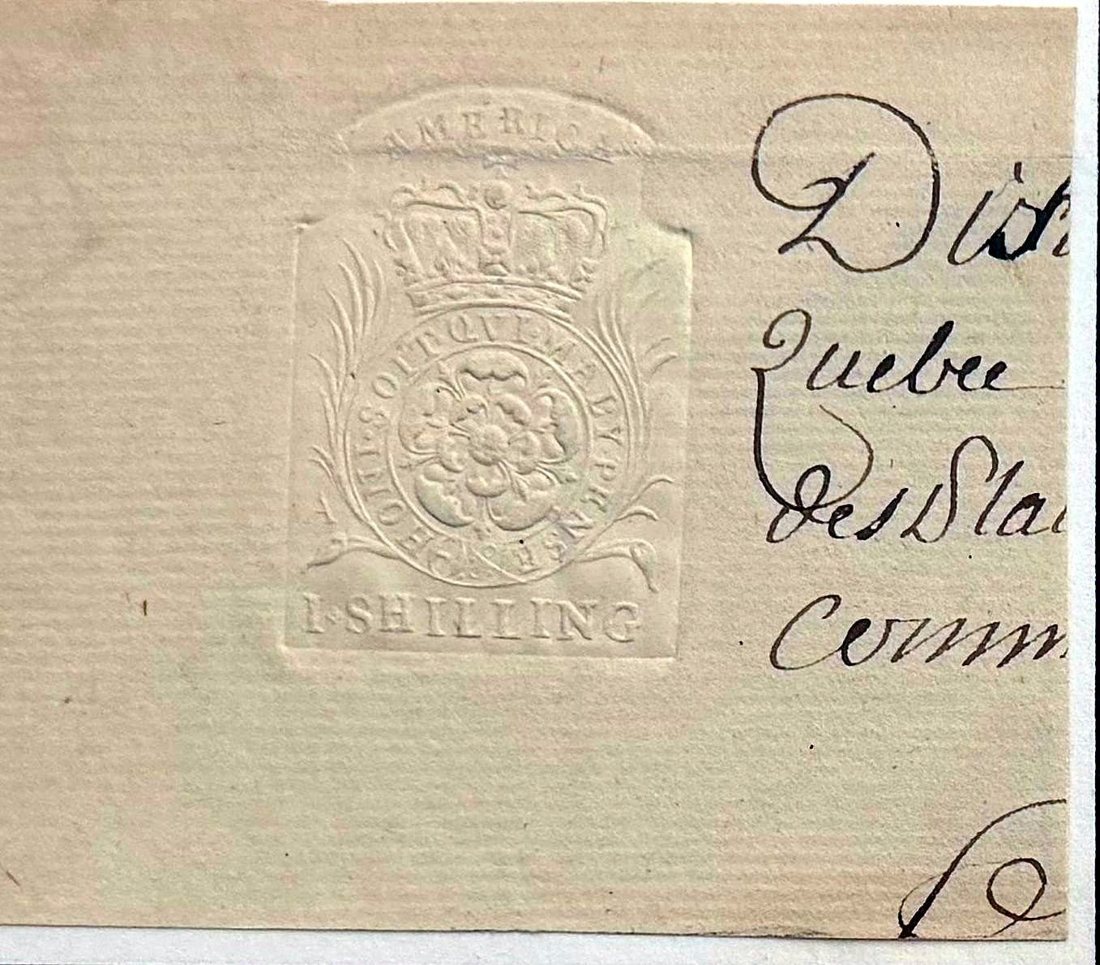
American Tax Stamp

American Tax Stamp


SA-2026.001

A one-shilling revenue stamp of 1765. The physical object the whole quarrel was about, and the thing almost no one in America would buy.

Read the full entry

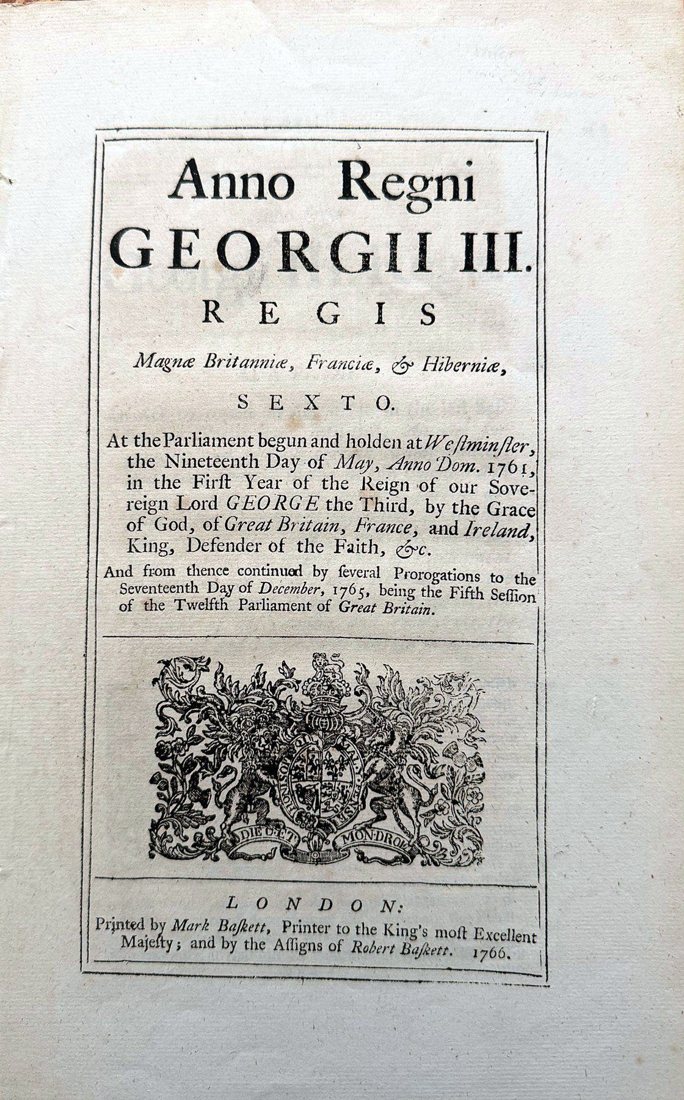
Stamp Act Repeal

Stamp Act Repeal


SA-2026.014

The Act repealing the Stamp Act, in the official folio printing of 1766 by Mark Baskett, the King's printer. Two leaves that ended the crisis, after Franklin's four hours before the House of Commons. Six copies are recorded.

Read the full entry · 3 photographs

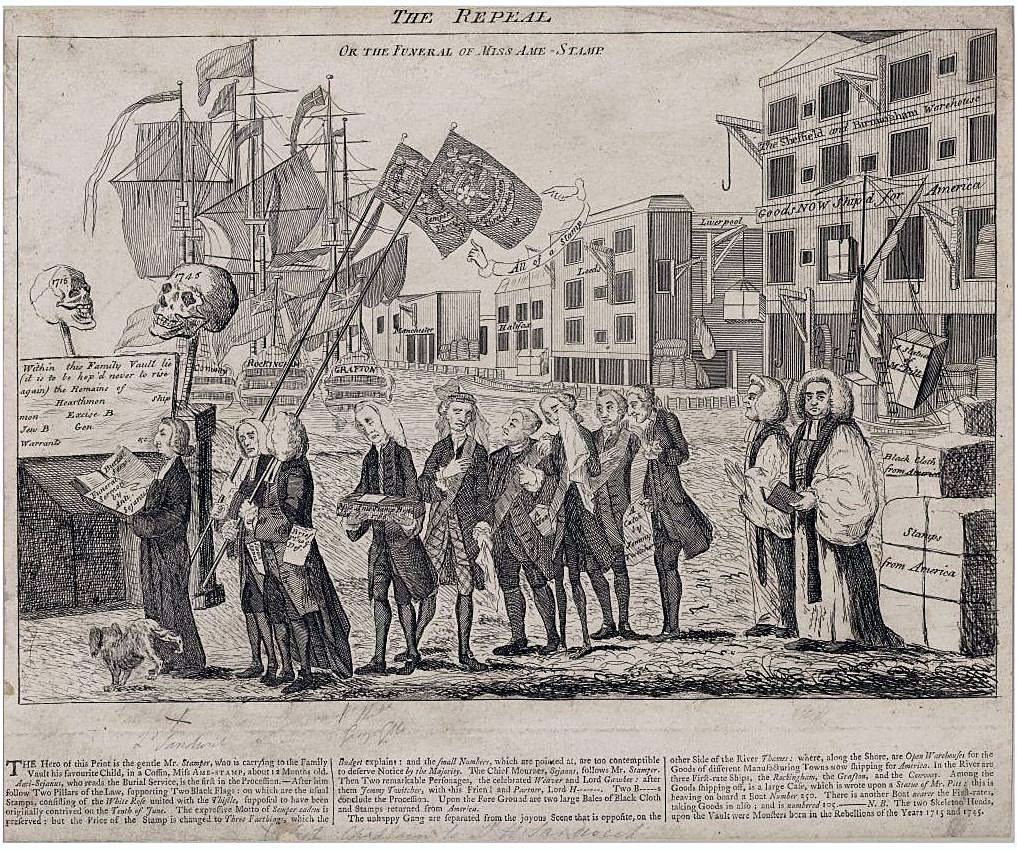
The Repeal

The Repeal, or the Funeral of Miss Ame-Stamp


SA-2025.001

The most famous satire of the Stamp Act, after Benjamin Wilson, London, 1766: Grenville carries the Act in a child's coffin to a family vault of failed tax bills, while the trade of America revives on the quays behind him. Shown beside the Act itself.

Read the full entry

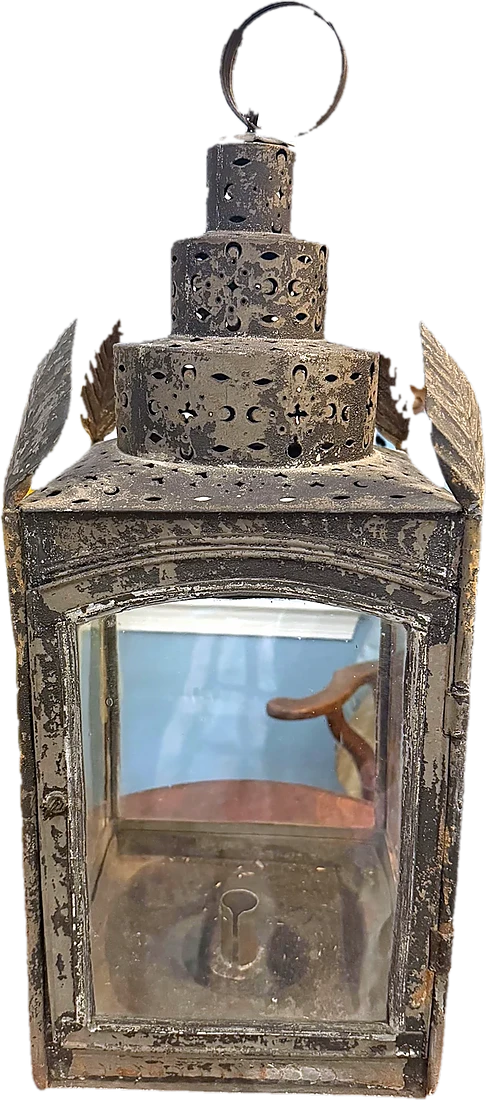
Liberty Tree Lantern

Liberty Tree Lantern


SA-2026.002

A glass lantern with elm-leaf finials that hung on Boston's Liberty Tree in the illumination for the repeal of the Stamp Act in May 1766. The town strung the great elm with lanterns and lit an obelisk of oiled paper on the Common; there were fireworks and church bells until midnight. The obelisk burned before the night was out. The lantern did not. A very rare surviving lantern, and the single most evocative object in the collection.

Read the full entry · 3 photographs

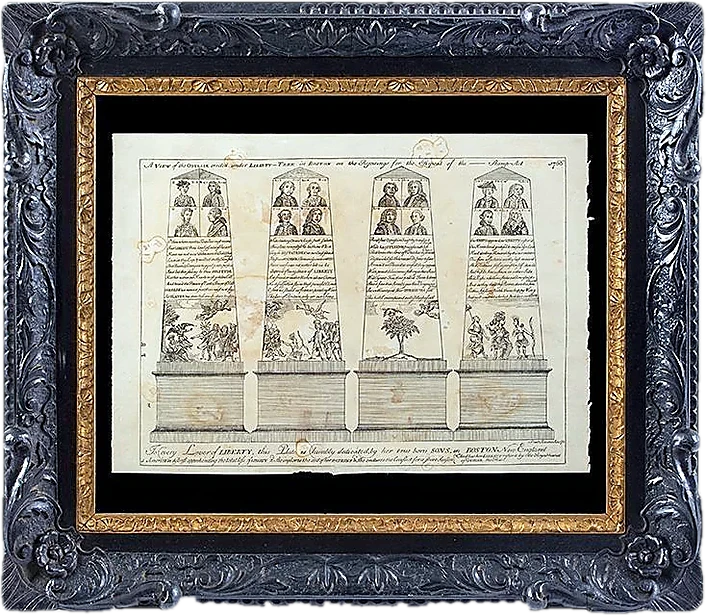
A View of the Obelisk

A View of the Obelisk


SA-2026.003

Revere's engraving of the four painted sides of the paper obelisk lit on the Common on the night the lantern hung in the tree. Revere reportedly helped decorate it. Only one impression from his own day survives, at the American Antiquarian Society; the plate is at Harvard, and this impression was pulled from it in 1881. The two objects belong to a single evening.

Read the full entry · 9 photographs

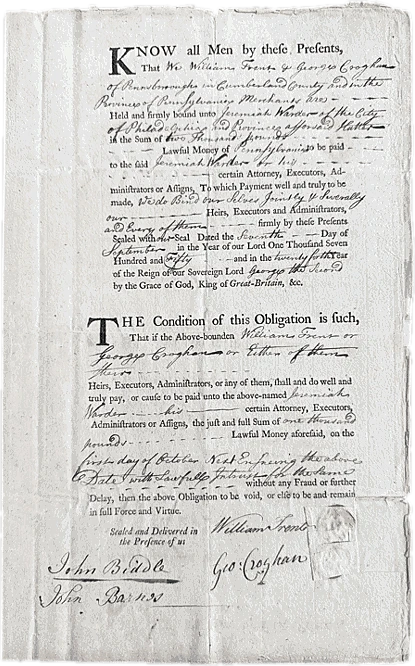
A printed bond for William Trent and George Croghan

A Franklin-printed bond for William Trent and George Croghan

Printed form completed in manuscript, Philadelphia: B. Franklin and D. Hall
BF-2026.002

Trent and Croghan were the two great Indian traders of the Pennsylvania frontier, and after the war they were the two great claimants for the losses of it. Croghan was deputy to Sir William Johnson and the man who negotiated with the Six Nations; Trent was his partner, and it was Trent who in 1763 handed out the smallpox blankets at Fort Pitt. Their bond was printed on Franklin's press.

Land was the business running underneath the politics of these years, and Franklin was in it as deeply as anyone. The letter that closes this room is his son's.

Read the full entry

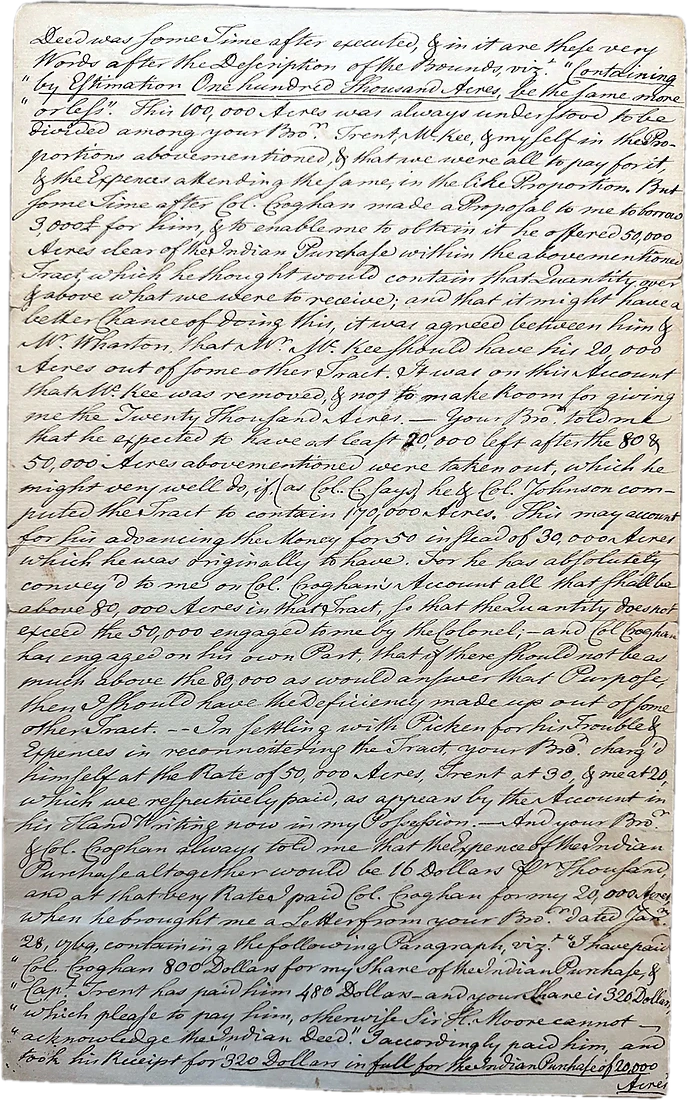
William Franklin to Thomas Wharton, on the Otsego lands

William Franklin to Thomas Wharton, on the Otsego lands

Autograph letter signed, Burlington, New Jersey, 19 September 1769
BF-2026.007

The other business of these years, carried on by the same men who were fighting over the Proprietors and the stamps. Four pages from the royal governor of New Jersey to one of his partners, on the Otsego tract in western New York, about 170,000 acres of Iroquois land to be bought and divided among shareholders, and on who owed what to whom. Croghan is in it, so are the Six Nations, the Burlington Company and the Whartons.

William Franklin speculated in partnership with his father. The land schemes of the 1760s, Croghan's and Trent's among them, ran under the politics of the decade for nearly everyone in this room, and they are the reason Franklin stayed in London so long after the Stamp Act was repealed. Thomas Wharton later became Treasurer of the Pennsylvania Hospital, and his name is on the notes in the Founders' Book.

Read the full entry · 3 photographs

Further Reading

Where the story of this room is told at length.

The Cast of This Room

The people whose names are on the objects in this room. Each opens a short life in the Dramatis Personae, with the institutions that person belonged to and every other object in the collection that carries the name.

Benjamin FranklinBenjamin RushWilliam BradfordWilliam DunlapRobert AitkenBenjamin WilsonThomas PennWilliam SmithJoseph GallowaySamuel WhartonGeorge CroghanWilliam TrentCharles Read, father and sonThomas Paine