
The Electrical Philosophy
Letters to Peter Collinson and the Making of a Reputation, 1747–1774
THE experiments began with a gift. In 1746 Peter Collinson, the London Quaker merchant who acted as the Library Company's agent, sent the Company a glass tube and an account of the new German electrical experiments. Franklin took the tube home. Within a year he was writing to Collinson to describe what he had found — that electricity was a single fluid, not two; that a body could carry a surplus or a deficit of it, which he called positive and negative; that pointed conductors drew it off quietly; and, most daringly, that the crackle from a charged jar and the lightning in a summer sky were the same thing.
Collinson read the letters to the Royal Society, which was unimpressed, and then had them printed as a pamphlet in 1751, which changed everything. Within a year the French naturalist Dalibard had translated the letters and, following Franklin's proposal, drawn lightning from a cloud with an iron rod at Marly-la-Ville. The king of France sent his compliments. Harvard and Yale gave the Philadelphia printer honorary degrees. The Royal Society, reconsidering, gave him its Copley Medal in 1753 and its fellowship in 1756. No American before him had been famous in Europe for anything.
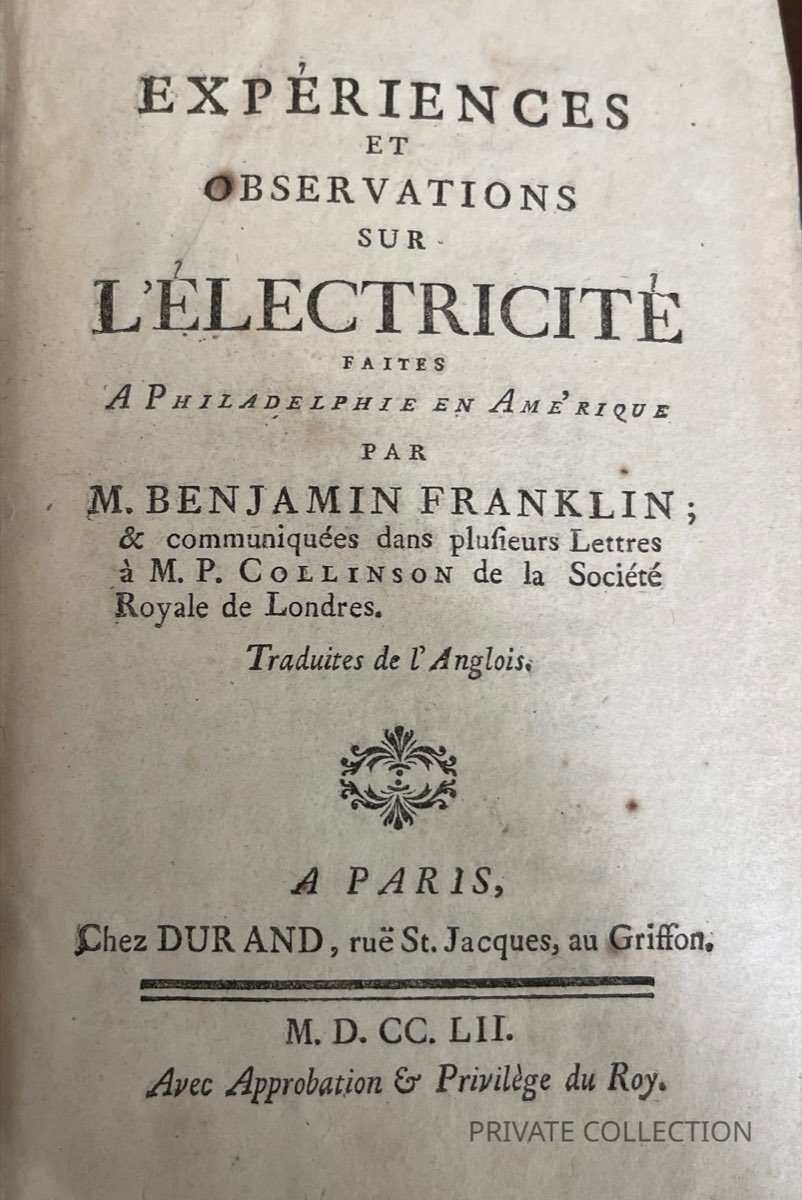
Expériences et Observations sur l'Électricité faites à Philadelphie en Amérique
The first French edition, and the book that made Franklin's reputation on the Continent. Dalibard's translation appeared within a year of the London pamphlet, and it was Dalibard, acting on the proposal in these pages, who first drew electricity from a thundercloud in May 1752 — a month before the kite. Howes F320; Ford 80.
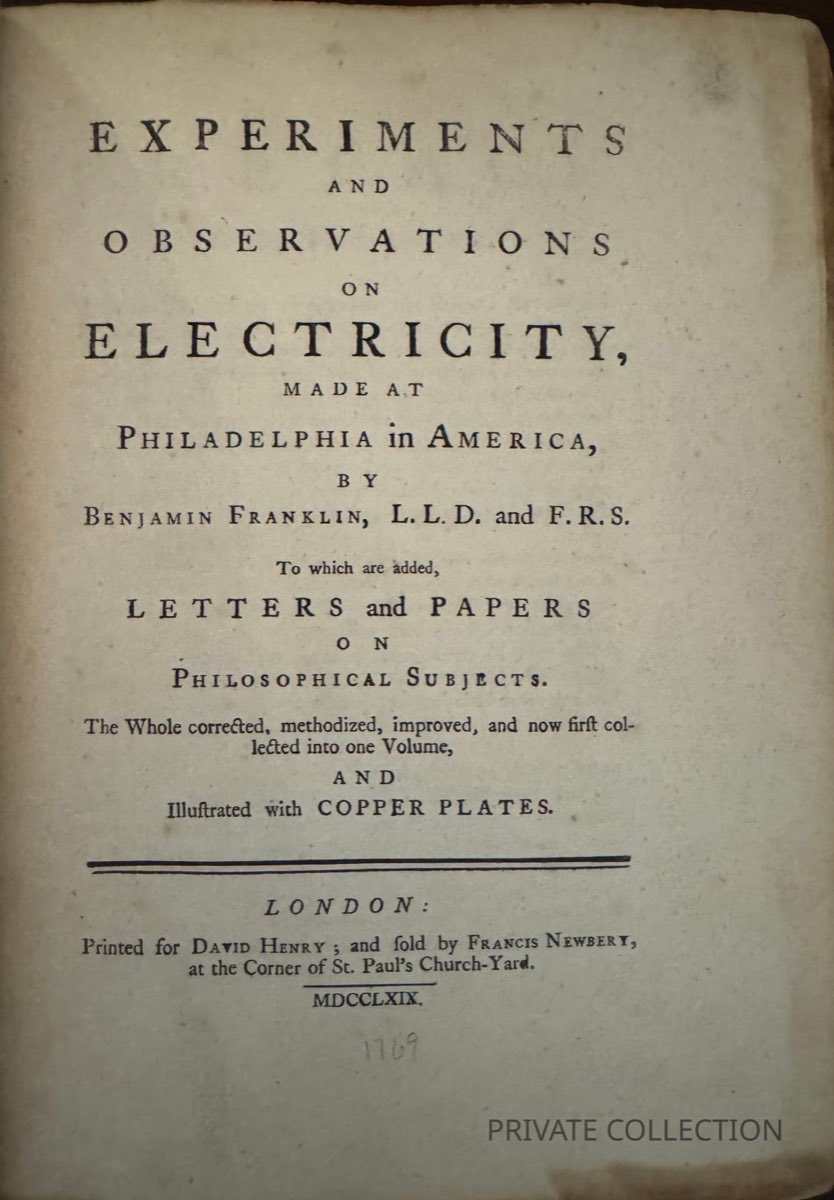
Experiments and Observations on Electricity, Made at Philadelphia in America
The edition Franklin edited himself: the first to gather all the letters in one volume, with complete notes, the correspondence with Collinson and other collaborators, an index, and seven engraved plates. It includes the Leyden jar experiments, the sentry-box and kite proposals, the lightning rod, and the discovery of the northeastward course of American storms. This copy retains the errata and advertisement leaf usually lacking. 'America's first great scientific contribution' — Howes.
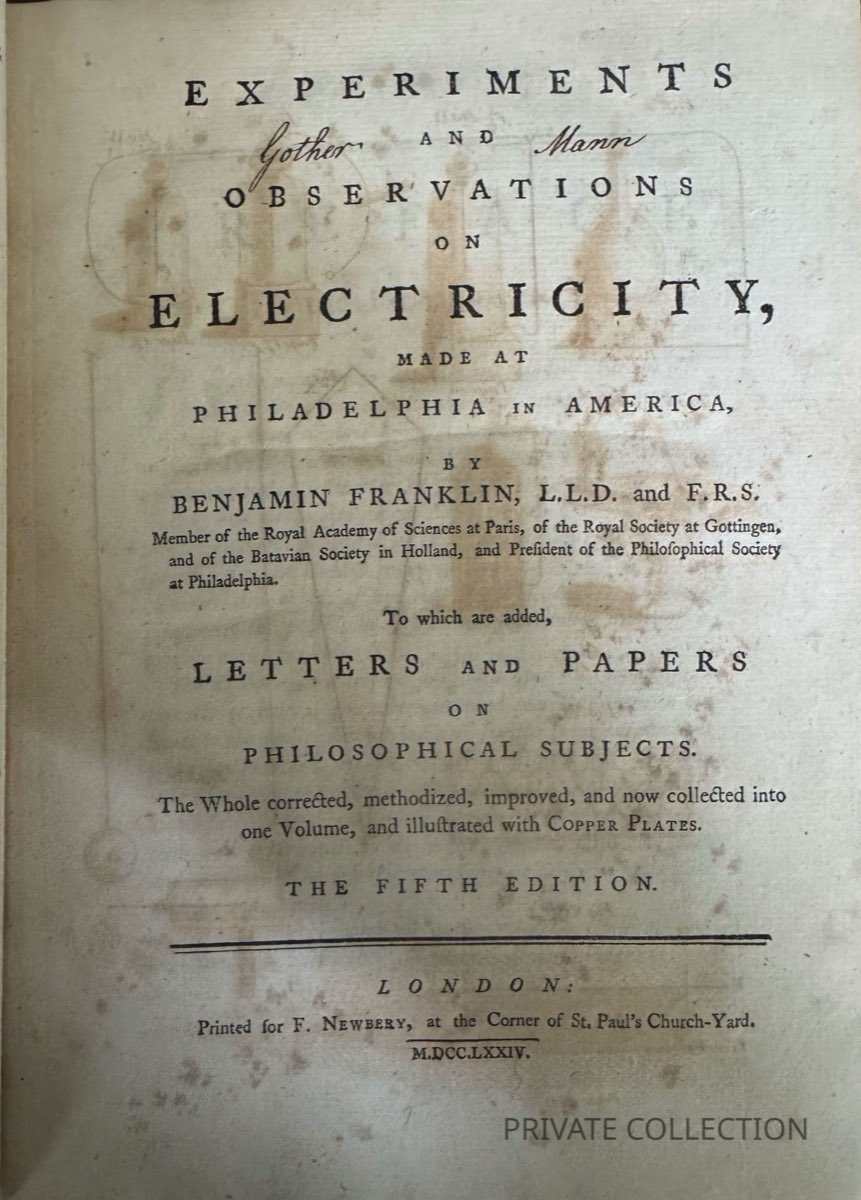
Experiments and Observations on Electricity, Made at Philadelphia in America
The last edition published in Franklin's lifetime and the last he saw through the press, issued in the year the Coercive Acts closed the port of Boston. The collection holds the fourth and fifth editions together, so that the final state of Franklin's electrical text can be read against the first collected one.
Within a year the French had drawn lightning from a cloud with an iron rod. No American before him had been famous in Europe for anything.
The German-speaking world read Franklin too, and the collection holds his letters on electricity in German translation, together with the Italian treatise by Tiberius Cavallo that carried Franklin's single-fluid theory into the textbooks of the 1770s. Alongside them sits the apparatus: a Leyden jar, a discharger, an insulating stool, and the instruments with which any gentleman of the 1760s could repeat the Philadelphia experiments in his own parlour.
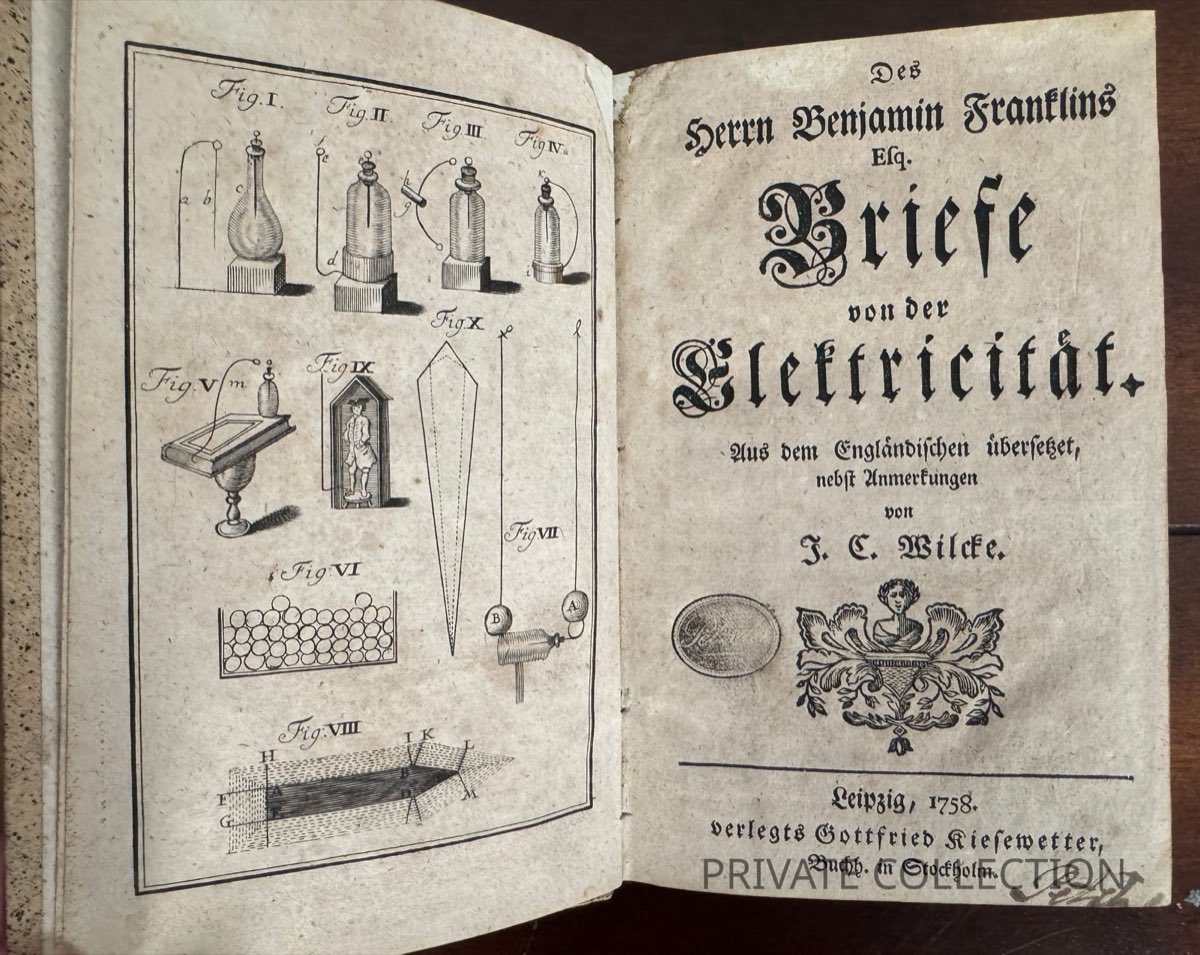
Des Herrn Benjamin Franklins Esq. Briefe von der Elektricität
The German translation of the electrical letters, with the translator's annotations. Franklin's theory reached the German universities through this edition, and it was in Germany that the lightning rod met its most determined theological resistance — and its most careful experimental confirmation.
Trattato Completo d'Elettricità Teorica e Pratica
Cavallo's treatise, the standard textbook of electricity in the last quarter of the century, in its Italian edition. Cavallo was a Neapolitan working in London and a Fellow of the Royal Society; his book is Franklin's system taught as settled science, with the experiments a student was expected to repeat.
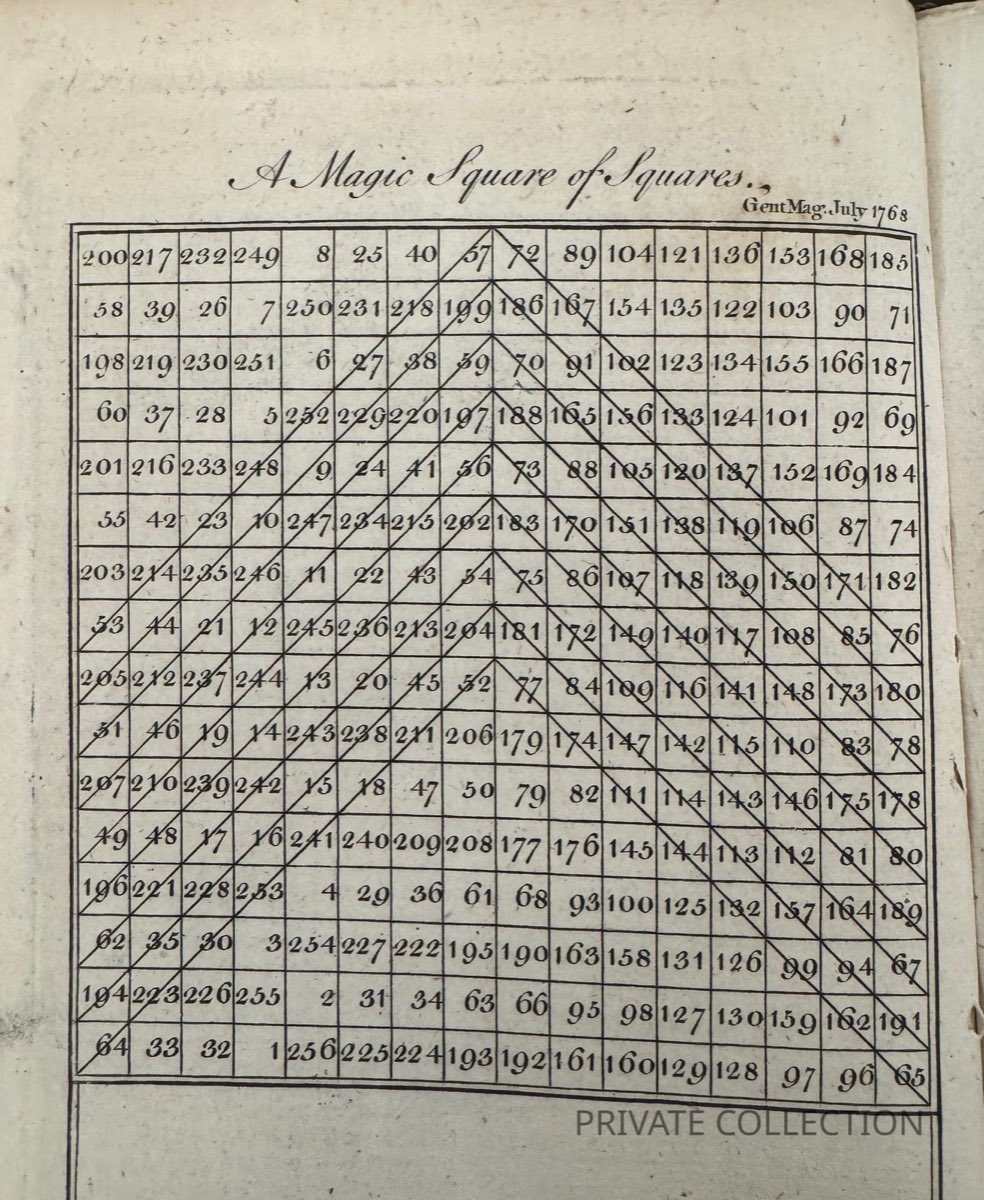
A Magic Square of Squares
The larger of Franklin's two magic squares, a sixteen-by-sixteen array in which every row, column, and bent diagonal sums to 2,056, which he described as 'the most magically magical of any magic square ever made by any magician.' He had constructed it as a young clerk of the Assembly to relieve the tedium of debates. First published in James Ferguson's Tables and Tracts (London, 1767) and reprinted in the Gentleman's Magazine for July 1768.
The Philosophical Society Franklin proposed in 1743 took a quarter-century to produce a volume, but when the Transactions appeared in 1771 they announced that Philadelphia could observe the heavens as well as London could. The first volume is dominated by the transit of Venus of 1769, timed by David Rittenhouse and his colleagues with instruments they had largely built themselves. The collection holds that volume and the fifth, of 1802, in which the Society Rush and Franklin belonged to had become the scientific establishment of a nation.
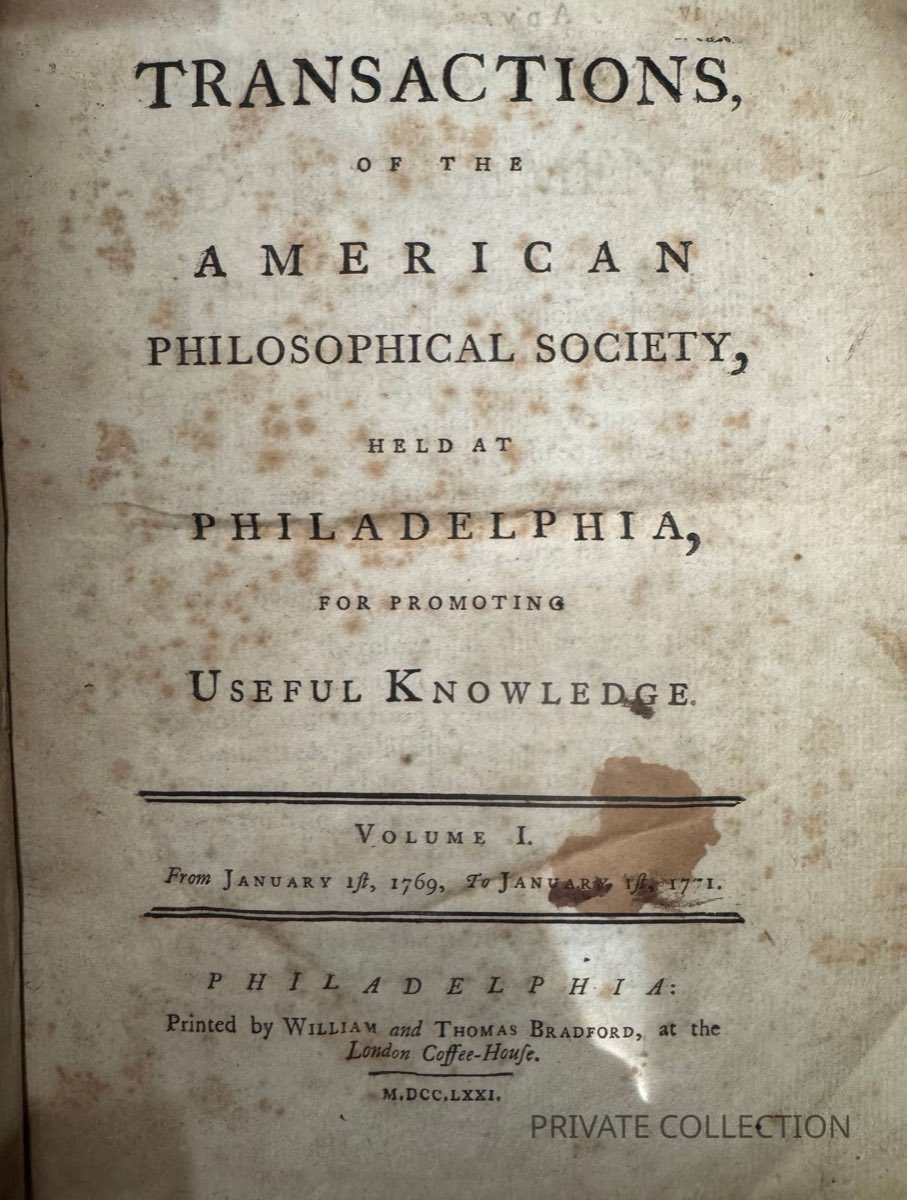
Transactions of the American Philosophical Society, Volume I
The first volume of the first learned journal in America, carrying the Philadelphia observations of the 1769 transit of Venus that Europe accepted as among the best made anywhere. Franklin, in London, was the Society's president in absentia; Rittenhouse was its instrument-maker and observer; Rush was among its youngest members.
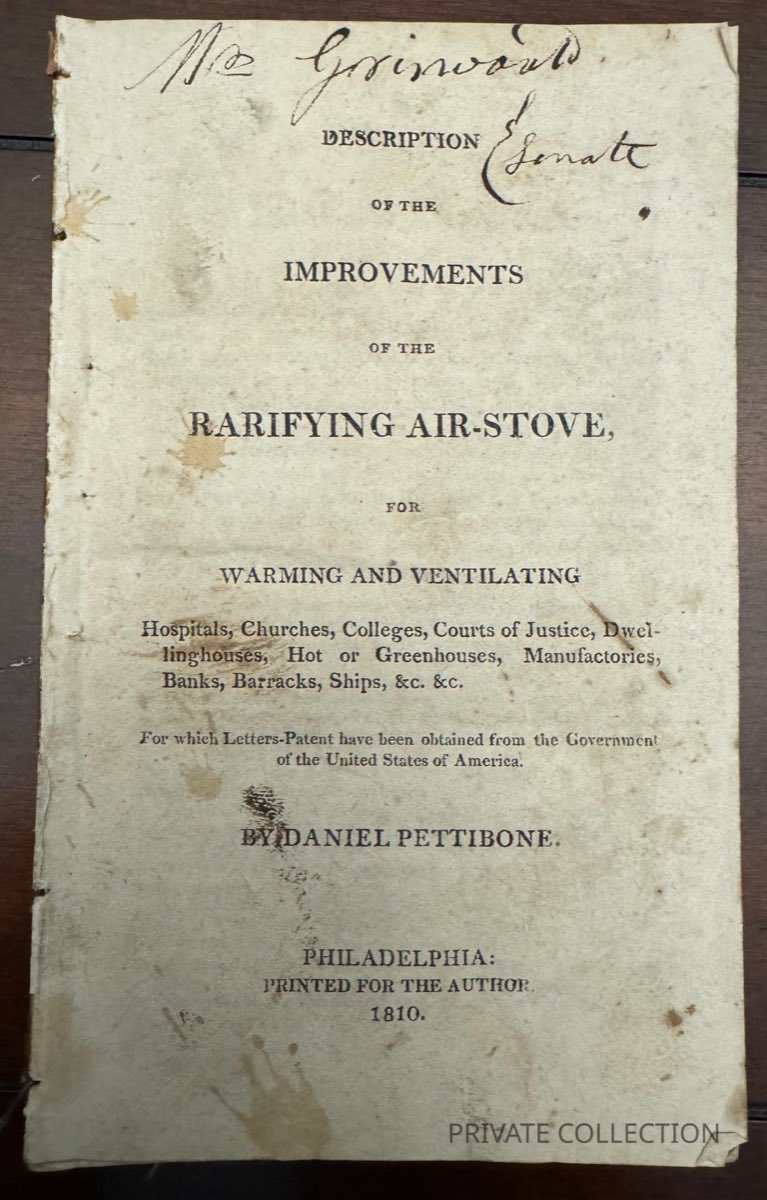
Description of the Improvements of the Rarifying Air-Stove, for Warming and Ventilating Hospitals, Churches, Colleges
Franklin's other great practical invention was the stove, and this pamphlet — with the collection's French account of the grilles à feu pensilvaniennes — follows the Pennsylvania fireplace from Franklin's 1744 design to the ventilated hospital heating of the next century. Pettibone addressed his improvements to the very institutions, hospitals and colleges, that Franklin had founded.
Franklin's science was never separate from his city. The stove was designed to heat Philadelphia houses; the lightning rod went up first on the Academy and the State House; the Philosophical Society met in the same rooms as the Library Company. The next chapter follows him out of the laboratory and into the Assembly, where the same habit of mind — observe, test, publish — would prove far more dangerous.