
The Sage of Passy and the Memory of Franklin
Paris, the Autobiography, and the Afterlife, 1776–1818
FRANKLIN sailed for France in October 1776 and did not come home for nine years. In Paris he was not a printer or an electrician or a colonial agent; he was America, in a fur cap, and he played the part with a discipline his admirers mistook for ease. He negotiated the French alliance that won the war, the treaty with Sweden that recognized the new nation, and the peace with Britain that ended it. He also, at Passy, set up a private press and printed bagatelles for his friends, because a man who had begun at a press could not be near one and not use it.
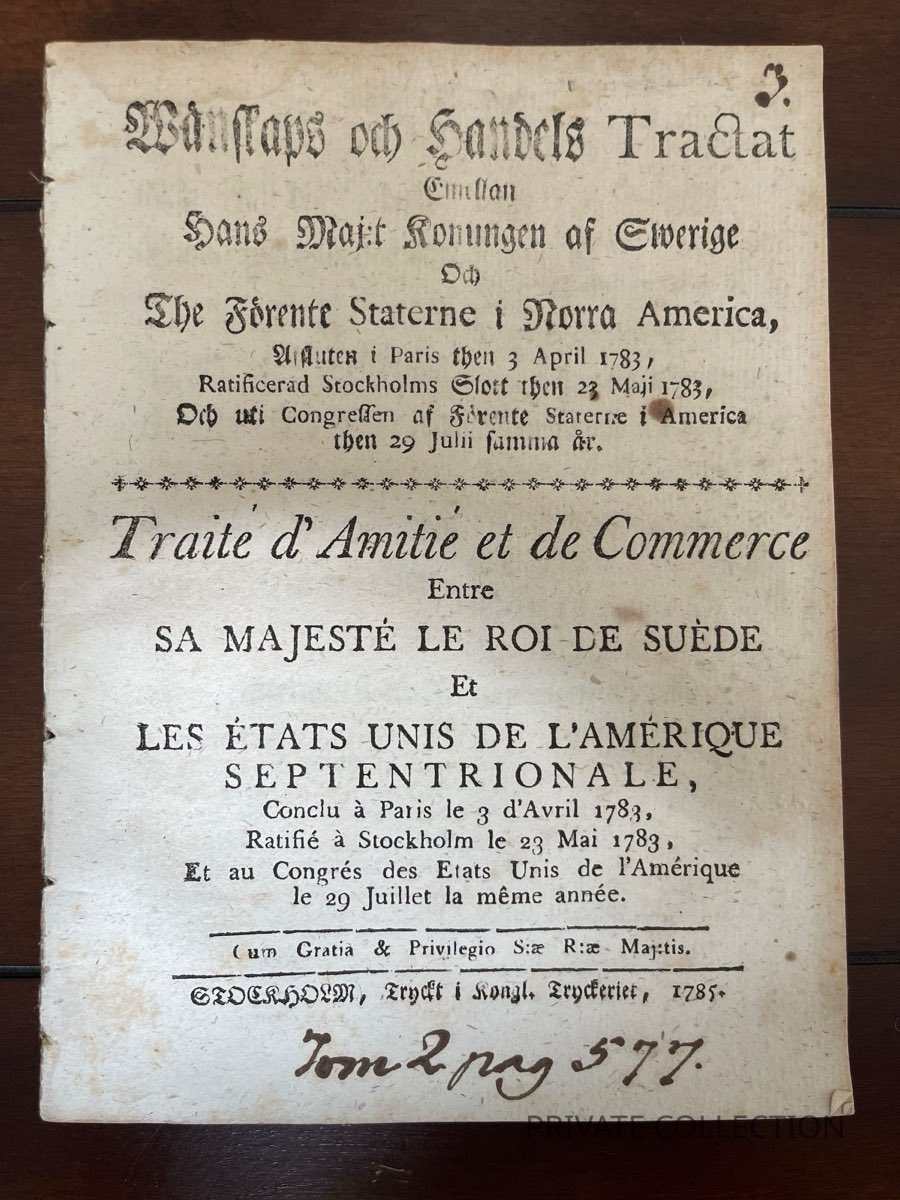
Treaty of Amity and Commerce between His Majesty the King of Sweden and the United States
The treaty Franklin signed at Paris on April 3, 1783 — the first treaty the United States made with a nation that had not been at war with Britain, and Sweden's recognition of American independence before the peace was concluded. In the official Swedish printing; the collection holds it as the one treaty in which Franklin's signature bound the republic alone.
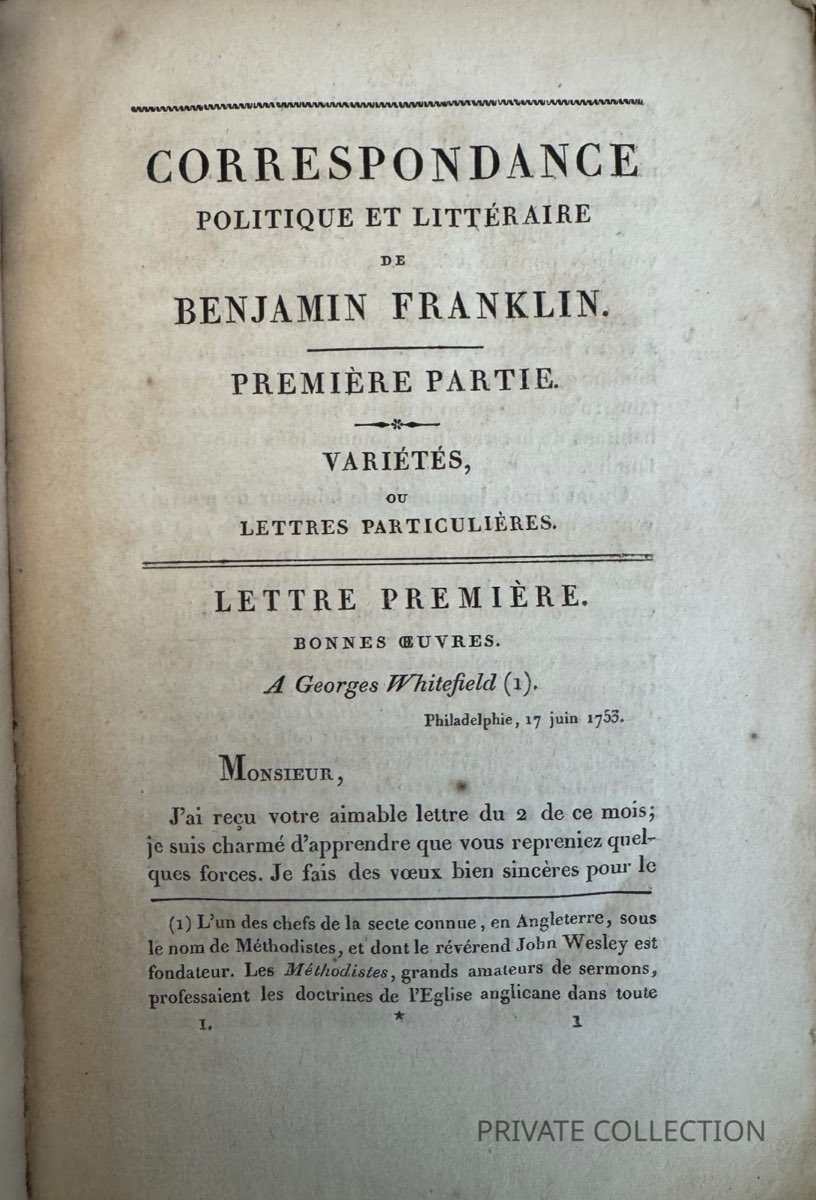
Correspondance Inédite et Secrète du Docteur B. Franklin
Franklin's diplomatic letters from the years of the alliance, published in Paris a generation after his death. The French had kept the Passy correspondence with a care the Americans had not, and much of what we know about how the alliance was made came first from this edition.
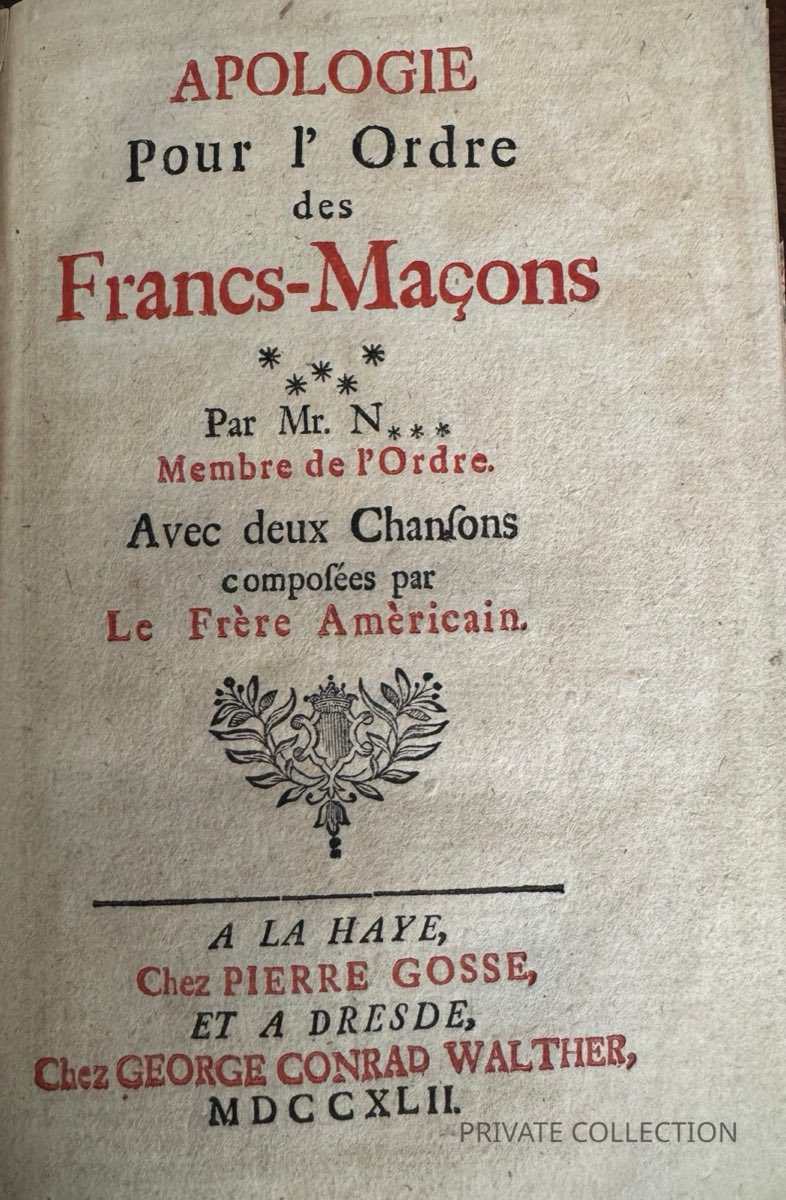
Apologie pour l'Ordre des Francs-Maçons
Franklin was a Freemason from 1731, Grand Master of Pennsylvania at twenty-eight, and in Paris the Venerable Master of the Lodge of the Nine Sisters, where he presided at Voltaire's initiation. Natter's Apologie is the French-language defence of the craft that circulated in the lodges Franklin frequented; the collection holds it as the key to a side of his Paris years that the diplomatic histories neglect.
In Paris he was not a printer or an electrician. He was America, in a fur cap.
Europe read Franklin in every language. The collection holds the Italian Scelta di Lettere of 1774 and the Opere Politiche of 1783, the French Oeuvres translated from the fourth English edition, and La Science du Bonhomme Richard — The Way to Wealth in the French version that made Poor Richard a European proverb-book. Franklin encouraged all of it. He understood, better than any American before him, that a reputation was a thing that could be printed.
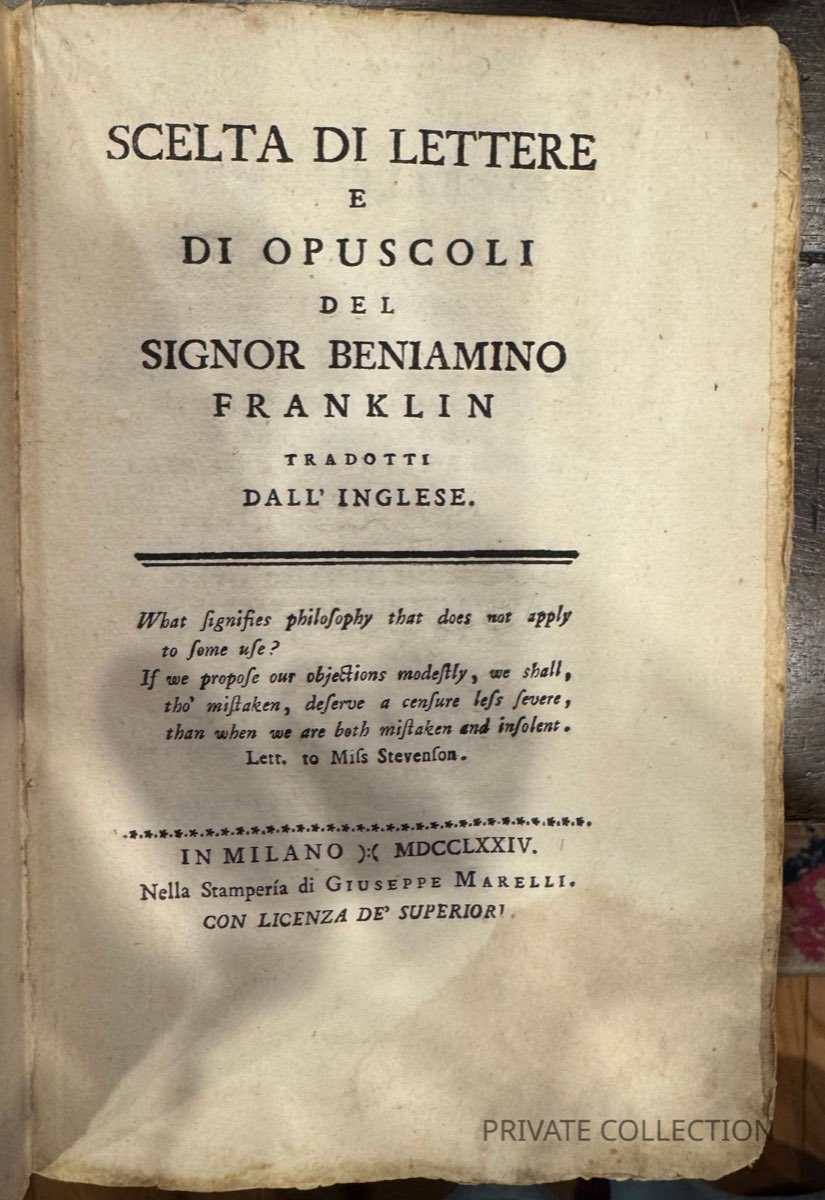
Scelta di Lettere e di Opuscoli del Signor Beniamino Franklin
An abridgment of Barbeu-Dubourg's French edition of Franklin's works, made for Italian readers by Campi. Exceptionally rare; Ford notes it without locating a copy. Italy's introduction to the American philosopher came through Milan two years before the Declaration.
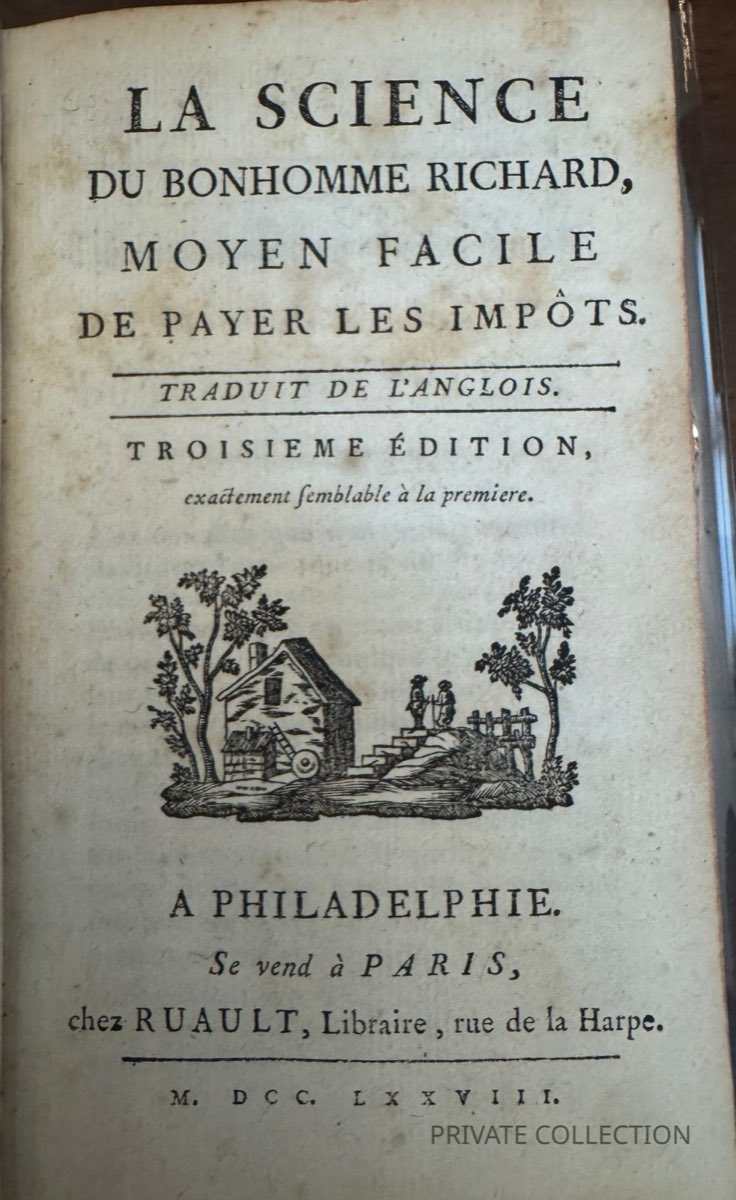
La Science du Bonhomme Richard, ou Moyen Facile de Payer les Impôts
The Way to Wealth in French, printed in Paris under a false Philadelphia imprint in the first year of Franklin's mission — a piece of propaganda as much as a proverb-book, presenting the American as the embodiment of frugal virtue at the moment France was deciding whether to bankroll him.
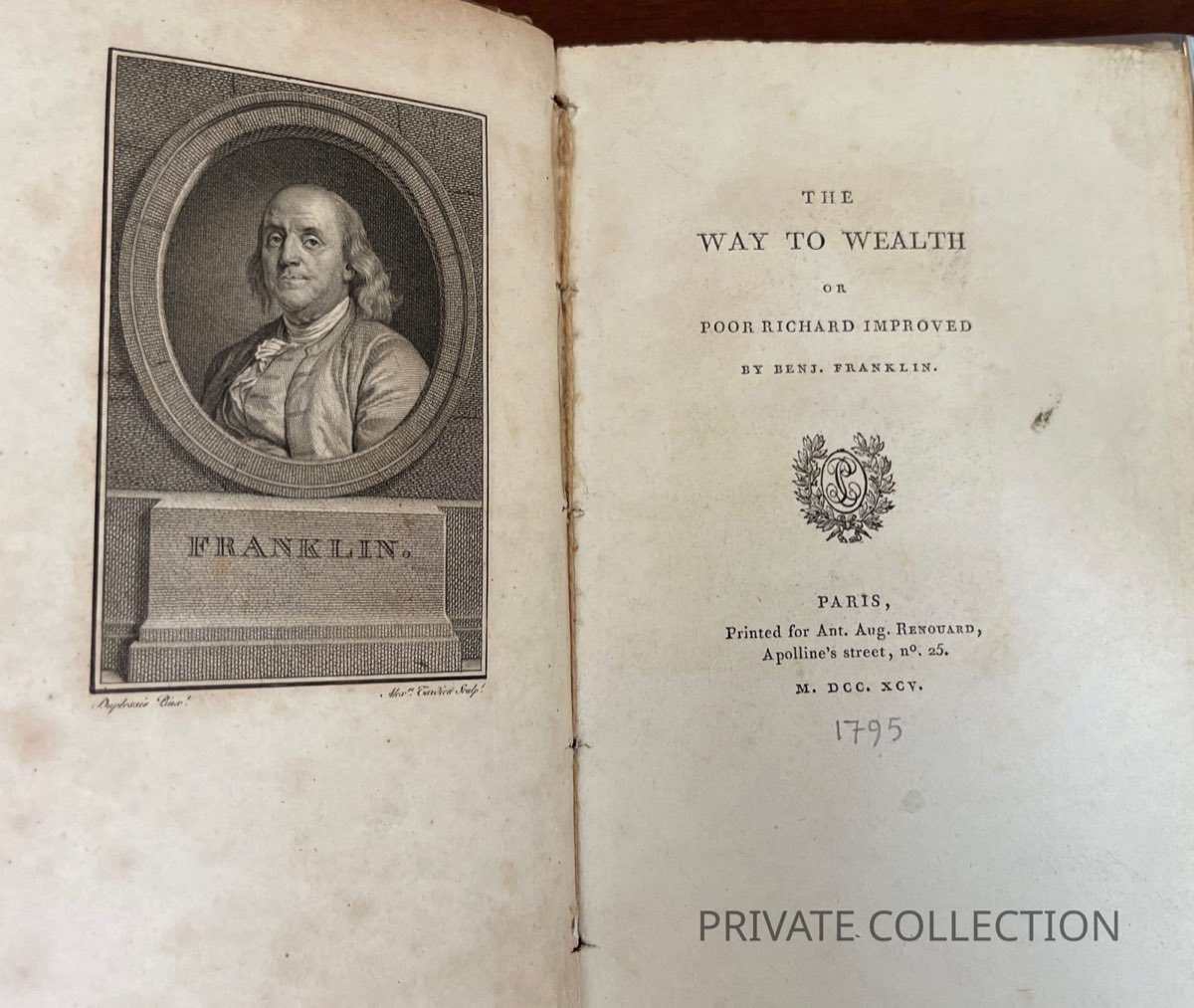
The Way to Wealth, or Poor Richard Improved
A later French printing of the preface to the 1758 almanac that became, detached from its calendar, the most reprinted piece of American prose of the eighteenth century. Renouard's edition gave it to a Napoleonic readership that had made Franklin a secular saint.
Franklin died in April 1790, and the fight over his memory began at once. He had left an unfinished memoir — the Autobiography — and the manuscript passed to his grandson William Temple Franklin, who sat on it for nearly thirty years. Europe would not wait. A French translation of the first part appeared in Paris in 1791, made from a manuscript copy that had circulated in Franklin's lifetime; English retranslations of the French followed in London and Philadelphia. For a generation, Americans read their most famous countryman's account of himself in a back-translation from French.
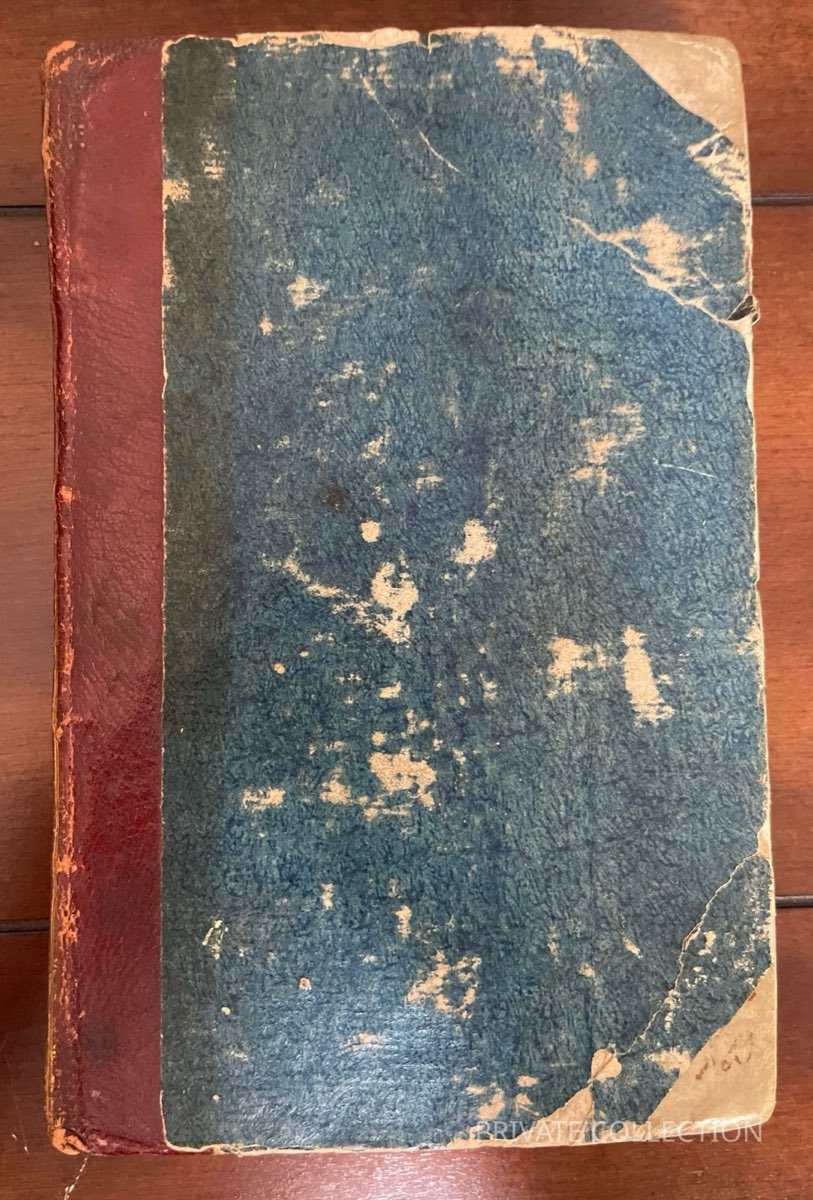
Mémoires de la Vie Privée de Benjamin Franklin, Écrits par Lui-Même et Adressés à Son Fils
The first edition of the Autobiography in any language — in French, translated from a manuscript copy, and published a year after Franklin's death. Franklin's best-known work and the founding text of the American self-made man, here in a fine period binding. The collection holds two copies.
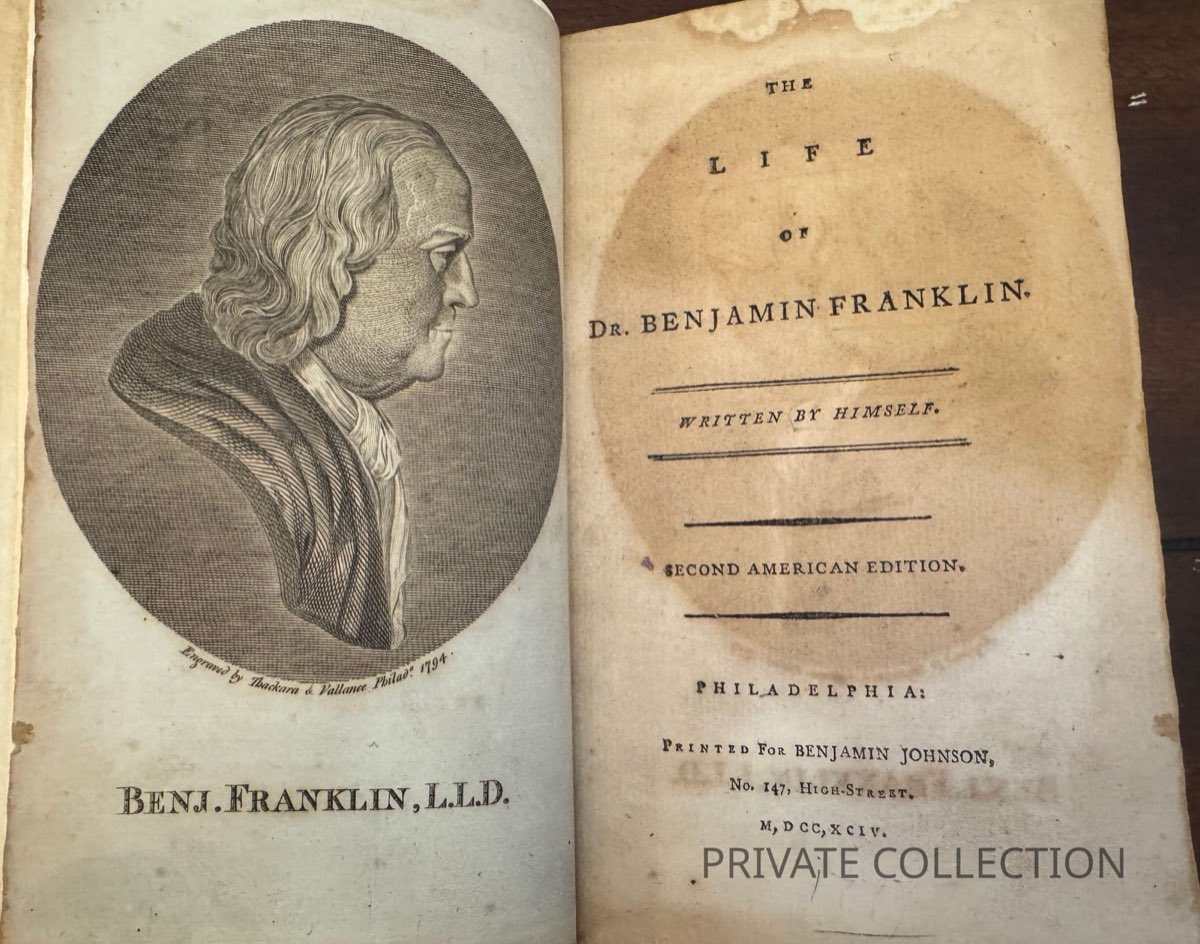
The Life of Dr. Benjamin Franklin, Written by Himself
The rare Philadelphia printing of the second American edition, an English retranslation of the Paris text — Franklin's own city reading his life back from the French. The collection also holds the London Works of the Late Dr. Benjamin Franklin in several editions of the 1790s and the New York first issue of 1794.
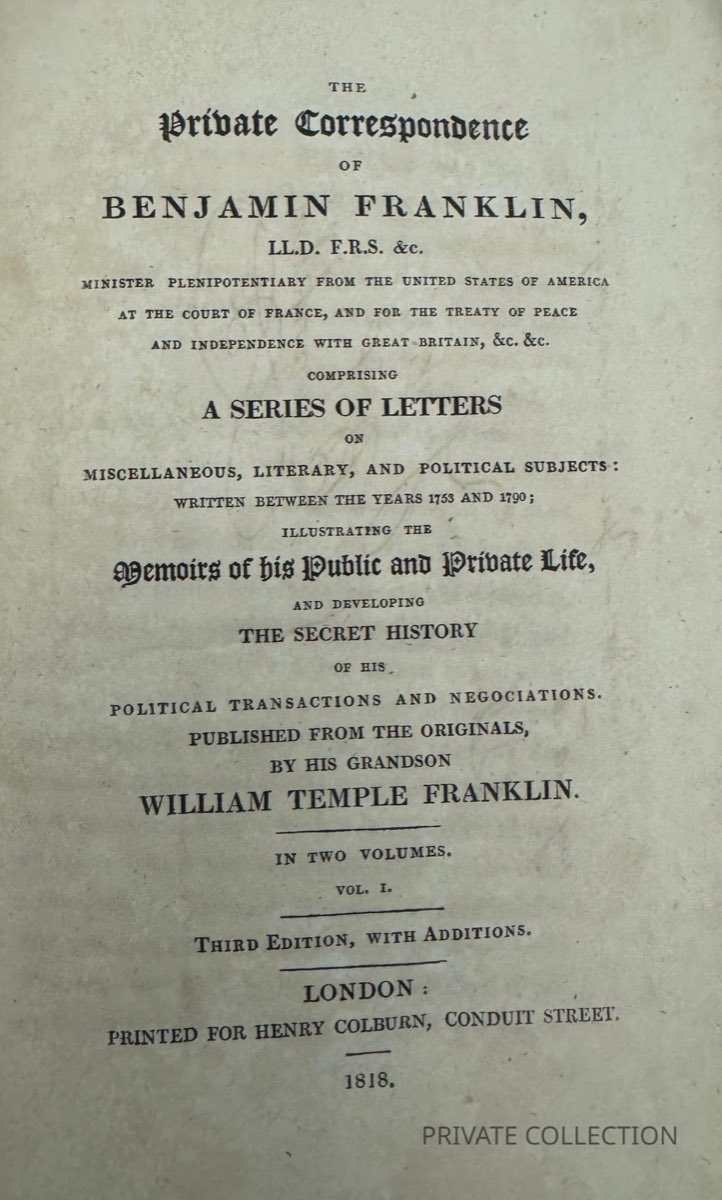
The Private Correspondence of Benjamin Franklin, Published from the Originals by His Grandson
The first appearance of Franklin's private letters, edited at last by the grandson who had held the papers since 1790. Temple Franklin's edition was incomplete, occasionally bowdlerized, and indispensable for a century; the collection's copy sits beside the 1818 Memoirs that finally printed the Autobiography from Franklin's own English.
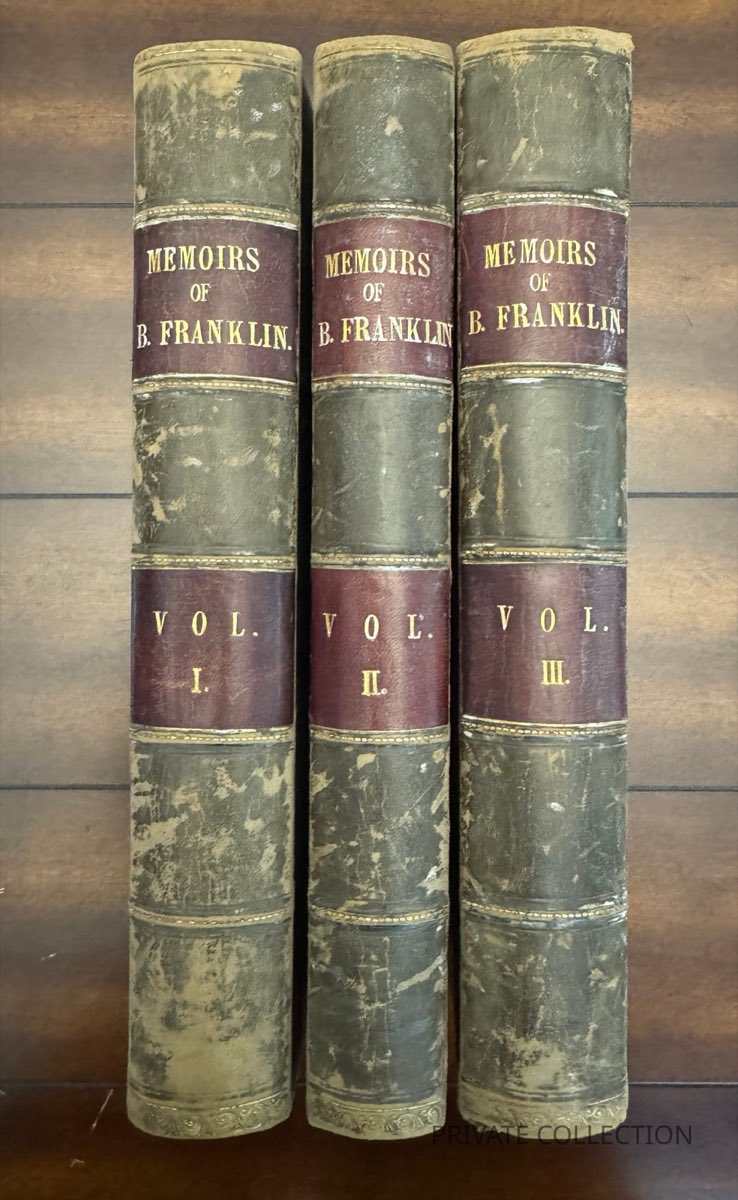
Memoirs of the Life and Writings of Benjamin Franklin
The first printing of the Autobiography from Franklin's English manuscript, twenty-eight years after his death, in a large-paper set extended with additional portraits and plates by an early owner. The end of the long detour through French, and the beginning of the Franklin the nineteenth century would make its own.
The last object in this catalog is the earliest. It belongs to the household Franklin left behind when he sailed for London in 1757 and again in 1764: to Deborah Read Franklin, who ran the shop, the post office, and the family for the better part of two decades while her husband was famous somewhere else, and who died in December 1774 without seeing him again. Her letters are far scarcer than his. This one is the collection's reminder that behind the printer, the philosopher, and the sage there was a house on Market Street, and someone keeping it.
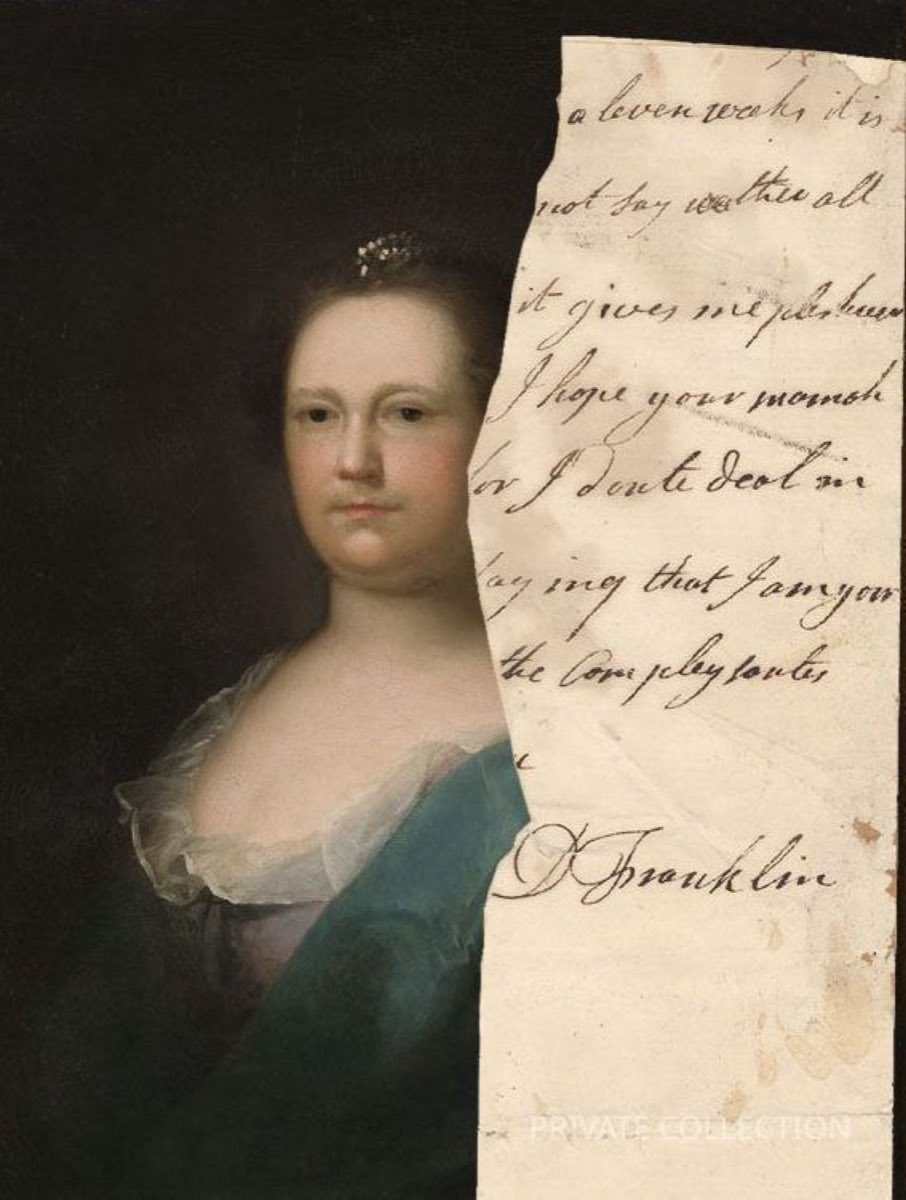
Partial Letter Signed
An excessively rare Deborah Franklin signature — the last example offered was this same piece. Her phonetic spelling, for which she apologized to her husband, is the surest authentication of her hand. Deborah kept the Philadelphia household and business through Franklin's long absences, and this letter is the one object in the collection in her voice.
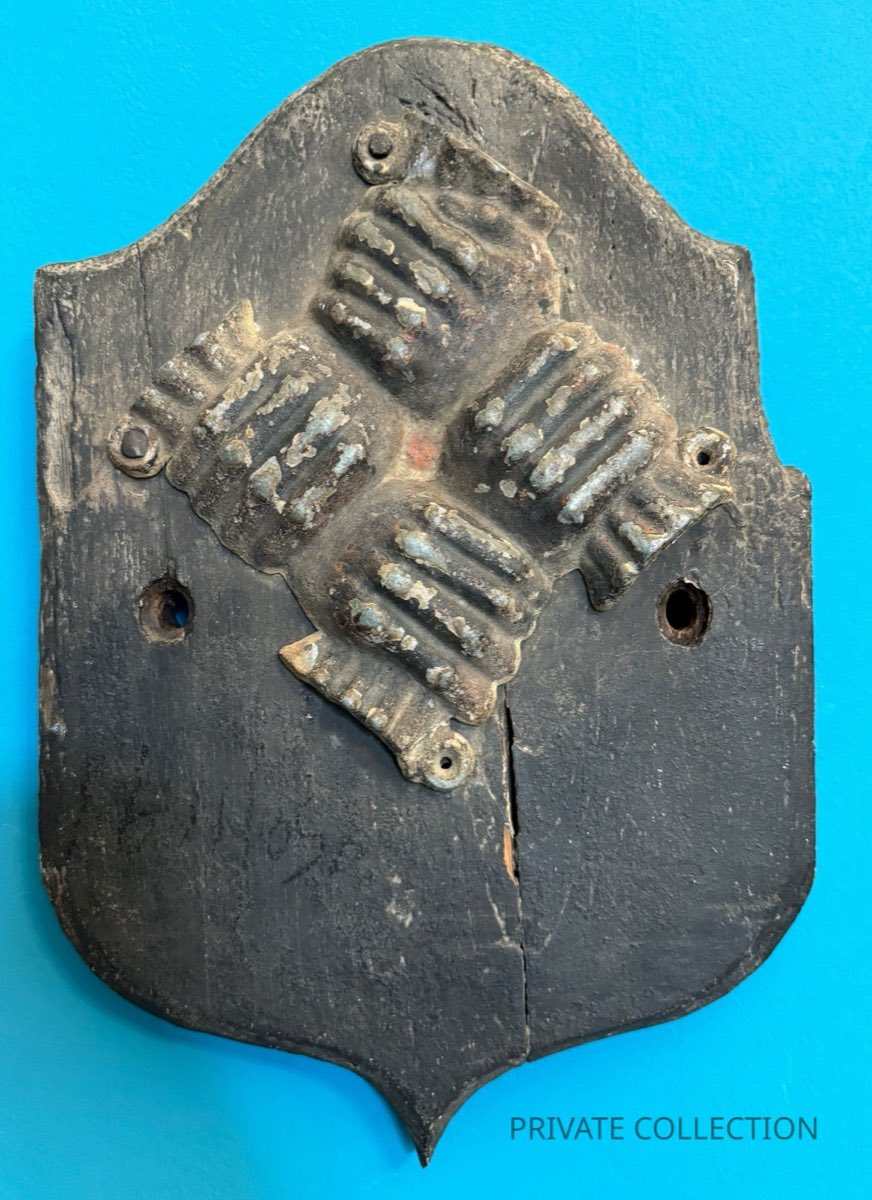
Philadelphia Contributionship Fire Mark
The four clasped hands of the Contributionship, the mutual fire insurance company Franklin organized in 1752 — the oldest property insurer in America. This mark, removed from 322 Delancey Street, was possibly cast by John Stow of Pass and Stow, the founders who recast the Liberty Bell. It hung on a Philadelphia house as Franklin's institutions were meant to: in plain sight, doing their work.