
Boston and London
The Apprentice and the Journeyman, 1721–1726
IN the summer of 1721 smallpox came to Boston, and with it the first great medical controversy in American print. Cotton Mather, who had read of inoculation in the Philosophical Transactions, persuaded Zabdiel Boylston to try it; William Douglass, the only university-trained physician in the town, denounced the experiment as reckless and published a series of pamphlets against it. The pamphlets were printed by James Franklin, whose new press had become the mouthpiece of the anti-inoculation party and whose fifteen-year-old apprentice, his brother Benjamin, was setting the type.
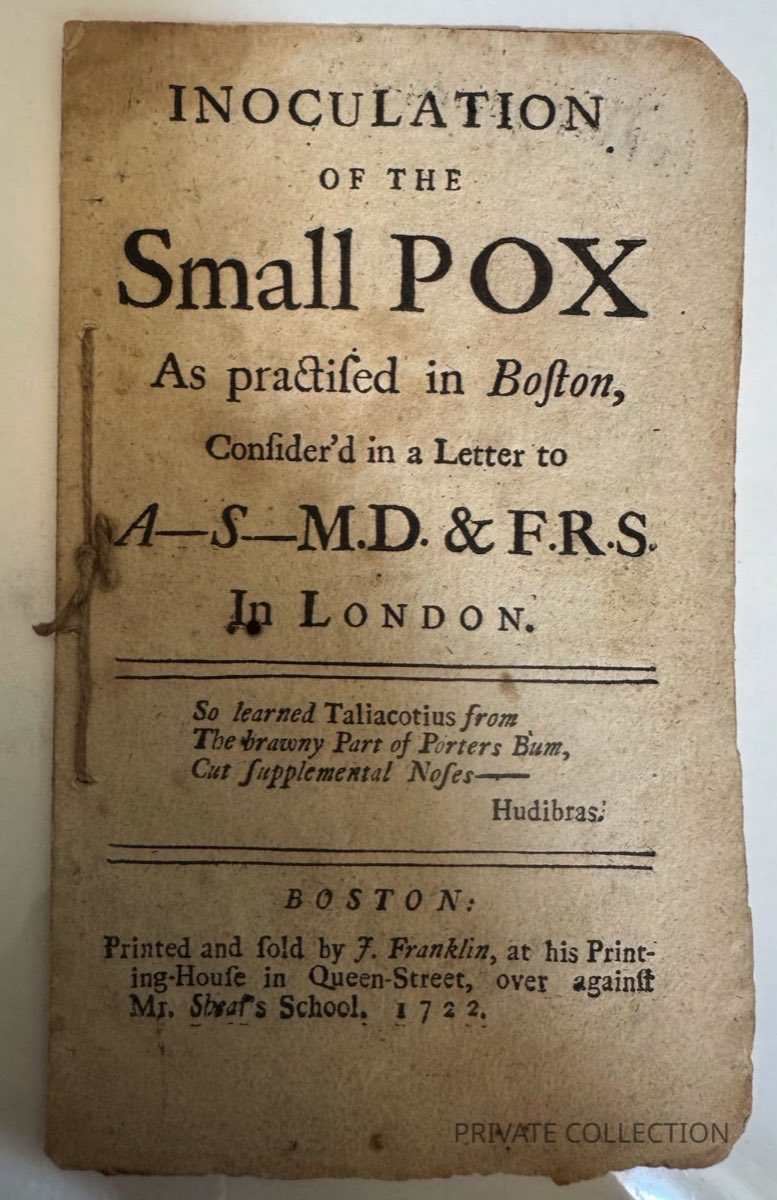
Inoculation of the Small Pox as Practised in Boston, Consider'd in a Letter to A— S— M.D. & F.R.S. in London
One of Douglass's four inoculation pamphlets, three of them anonymous, printed by James Franklin during the epidemic in which Benjamin served his apprenticeship. Douglass was personally aggrieved: he had lent Mather the very numbers of the Philosophical Transactions that described the practice. The earliest object in the collection from a Franklin press, and the beginning of a medical argument — inoculation — that Benjamin would take up in his own almanac forty years later.
Benjamin left Boston in 1723, worked briefly for Keimer in Philadelphia, and in December 1724 sailed for London on the promise of a governor's patronage that never materialized. He spent the next eighteen months as a journeyman compositor, first at Samuel Palmer's famous house in Bartholomew Close, where he set type for the second edition of William Wollaston's Religion of Nature — and, provoked by it, wrote and printed his own Dissertation on Liberty and Necessity, the freethinking pamphlet he spent the rest of his life regretting.
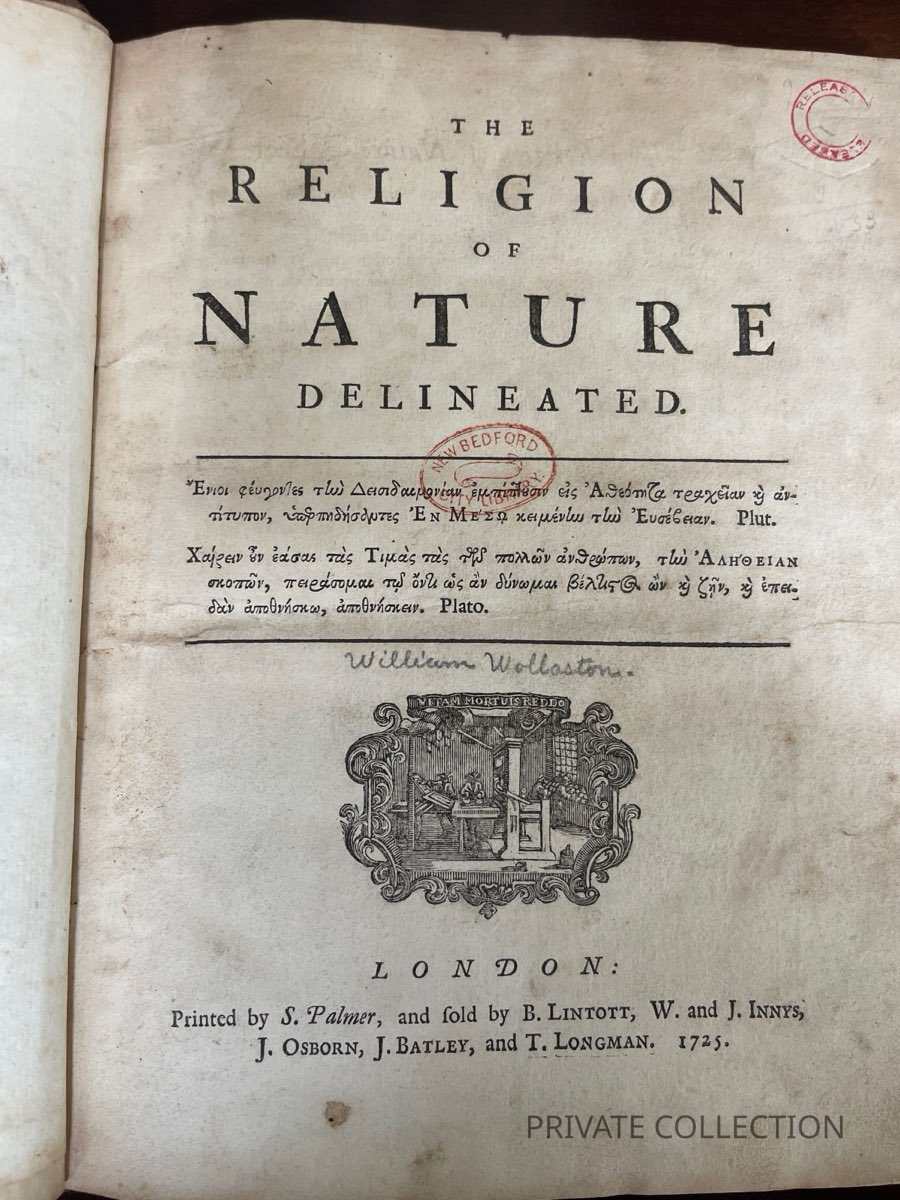
The Religion of Nature Delineated
The book Franklin composed as a journeyman at Palmer's in 1725. Which edition his hands set has been argued since Henry Stevens gave it as this one of 1726; the collection's entry lays out the case. Whichever it was, this is the text that made Franklin an author: his answer to it, printed at Palmer's, was his first publication and the one he later suppressed.
Waiting for him in Philadelphia was Samuel Keimer, whose own extraordinary life had been printed in London eight years earlier. A former French Prophet, a Quaker convert, a bankrupt, and a veteran of the Fleet prison, Keimer had run a shop in Paternoster Row that printed for Daniel Defoe before he fled to America. Franklin's portrait of him in the Autobiography is unforgettable and unflattering; Keimer's portrait of himself is stranger still.
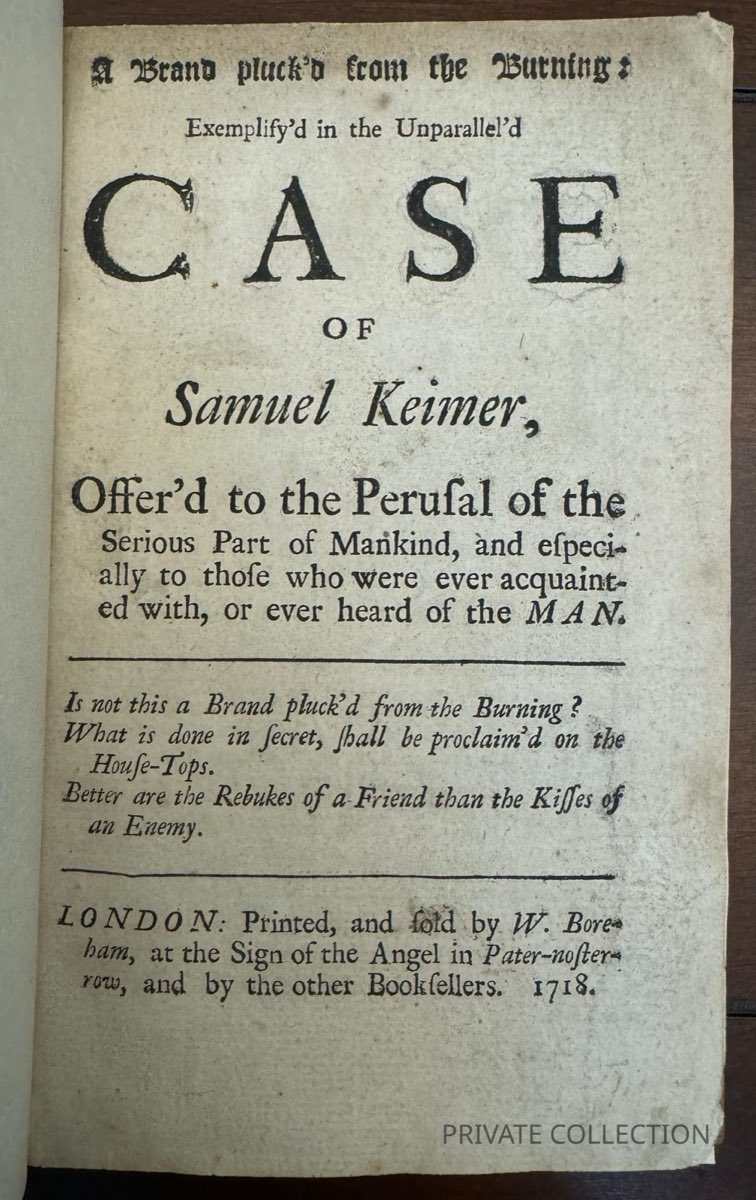
A Brand Pluck'd from the Burning: Exemplify'd in the Unparallel'd Case of Samuel Keimer
Keimer's autobiography, published three years before he sailed for Philadelphia: his seduction by the French Prophets, his marriage and Quaker conversion, his shop in Paternoster Row, his pamphlets for Defoe, his bankruptcy, and his years in the Fleet. The DNB detects Defoe's hand in the prose. This is the man who employed Franklin, as he saw himself before Franklin ever met him.