
Keimer's Journeyman and the New Printing-Office
Philadelphia, 1727–1734
FRANKLIN came back to Philadelphia in October 1726 and, after a year as a merchant's clerk, went to work for Keimer again — this time as the manager of a shop that was busier than its owner could handle. Keimer had the Quaker Meeting's commission for a folio history of the Friends, seven hundred pages, the largest book yet attempted in the colonies, and he had Welsh Quaker tracts for the settlers of the Welsh Tract. Franklin set the Sewel, worked the press when Keimer fell behind, and learned on it what a well-run shop could do.
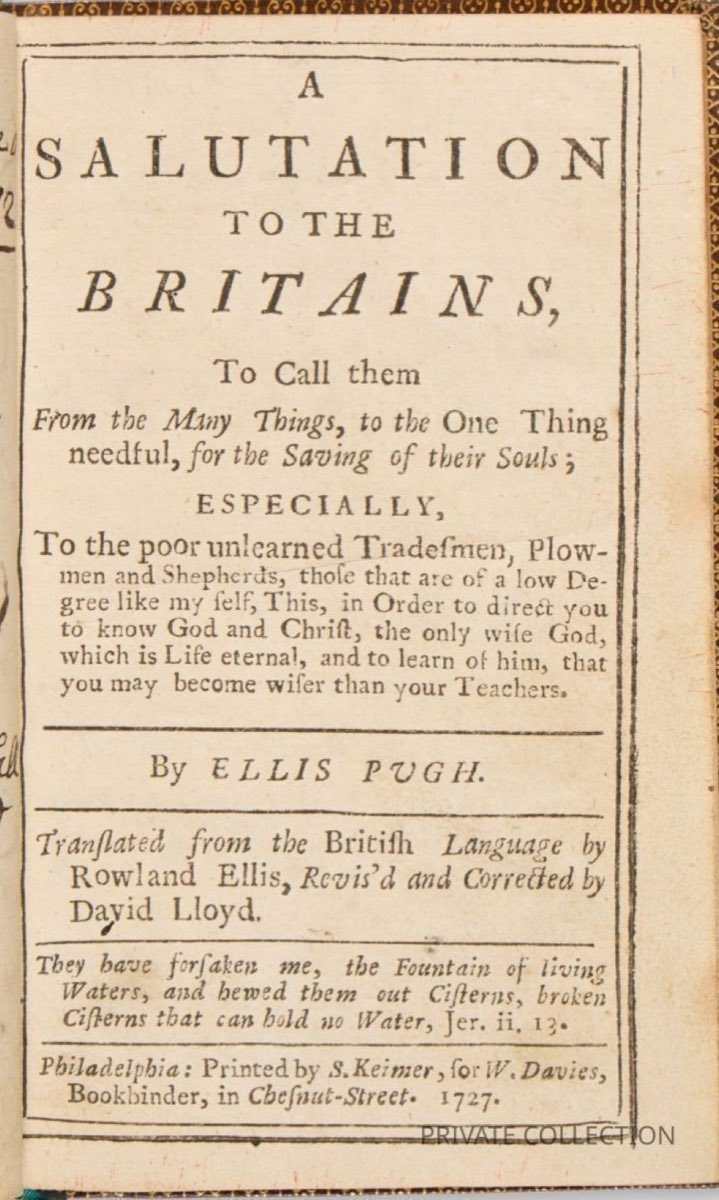
A Salutation to the Britains
A rare Keimer imprint from the year Franklin rejoined the shop. Pugh's exhortation, translated from the Welsh for the Meeting, is the small steady work that kept a Philadelphia press alive between commissions — and the kind of work Franklin would soon take from Keimer for good.
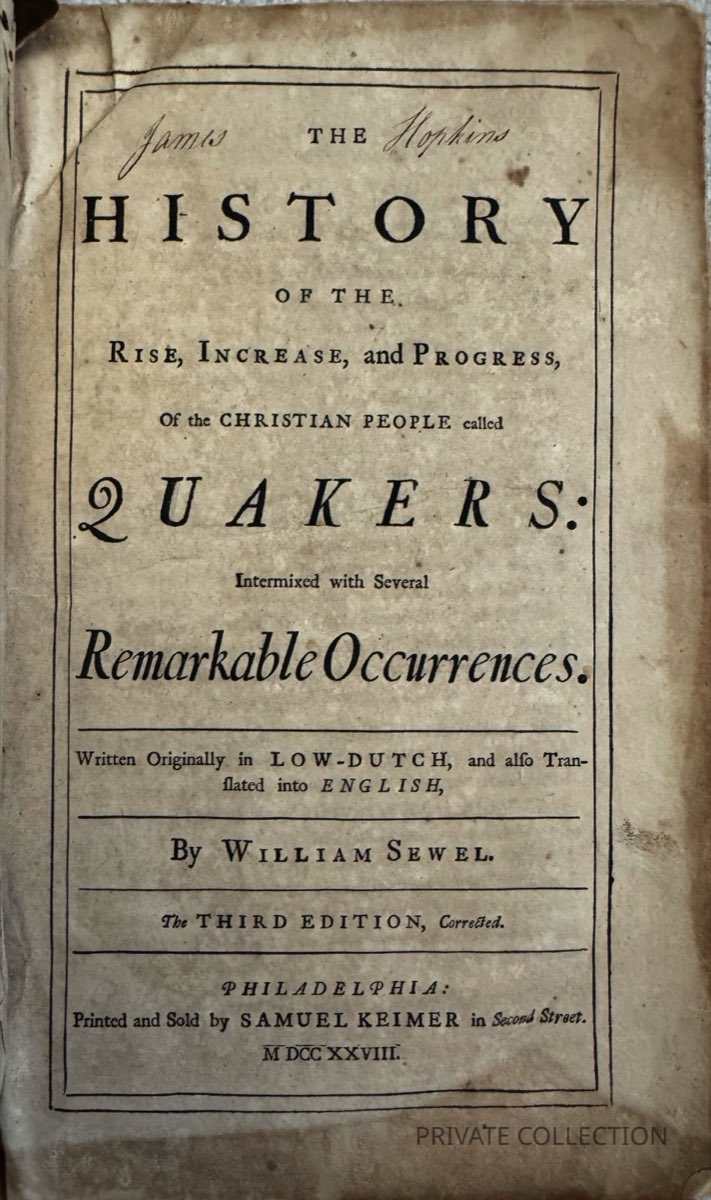
The History of the Rise, Increase and Progress of the Christian People called the Quakers
The first product of Franklin's labor as a printer in Philadelphia and the largest book yet made in British America. Franklin set a substantial part of the type and, by his own account, pulled the press himself when Keimer's schedule collapsed. The Meeting's commission made Keimer's shop and, indirectly, unmade it.
In 1728 Franklin and Hugh Meredith, whose father put up the money, opened the New Printing-Office near the Market. They had one press and no work. Within a year Franklin had the Assembly's printing when Bradford botched a job, the General Loan Office's mortgage bonds, and the first of the almanacs that would be the steadiest income of the house. Meredith drank and sold out in 1730; Franklin, at twenty-four, owned the shop.
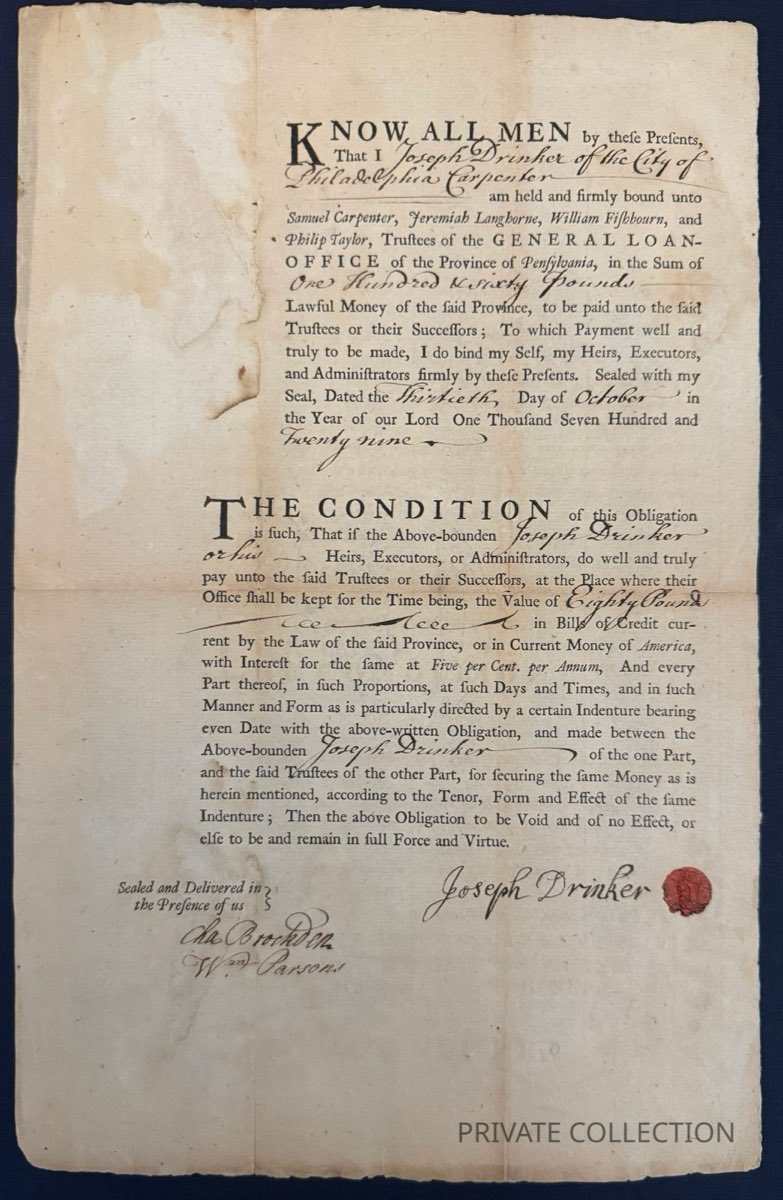
Know All Men by These Presents … (Mortgage Bond of the General Loan Office)
A partially printed mortgage bond from the first year of the New Printing-Office, by which Joseph Drinker, carpenter, borrowed £160 at five per cent from the trustees of the General Loan Office on 13 October 1729. The trustees — Carpenter, Langhorne, Fishbourn, Taylor — are set in type. Miller 10; Intellectual World of Benjamin Franklin 9. Job printing of this kind paid the rent; almost none of it was kept.
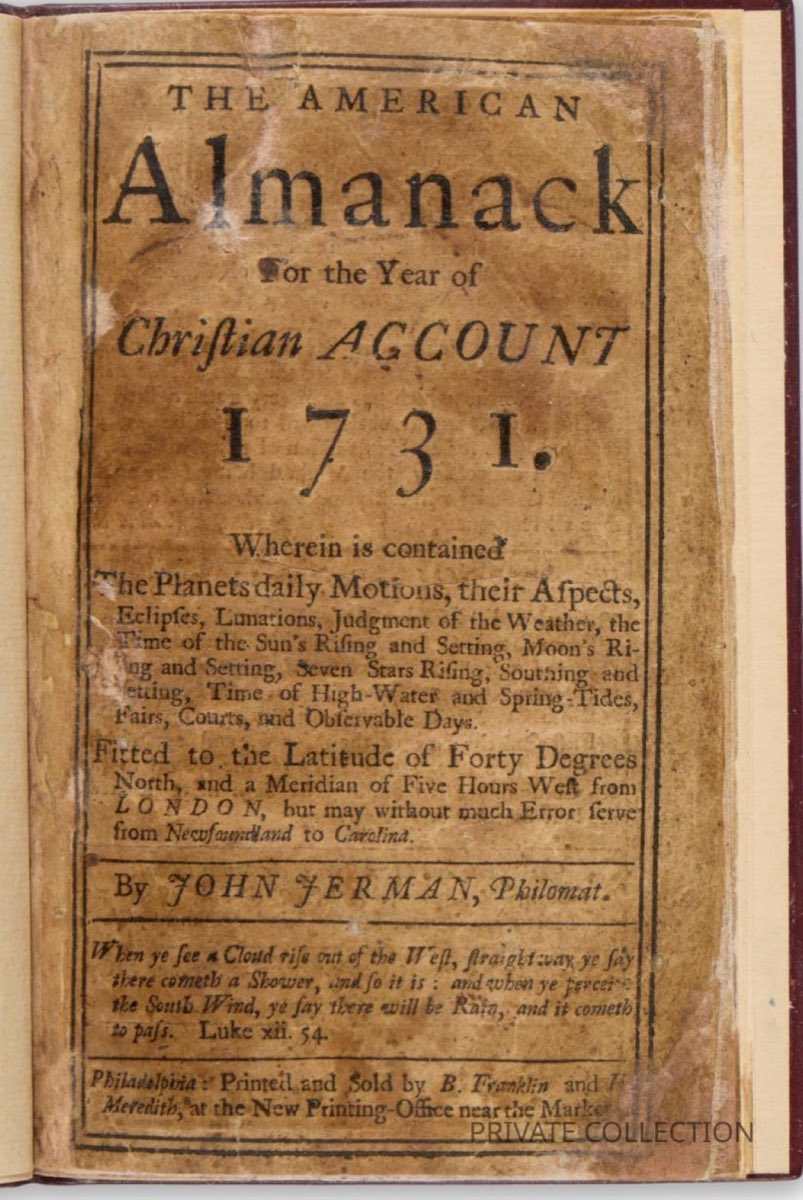
The American Almanack for the Year of Christian Account 1731
The earliest surviving almanac printed by Franklin, and the only known copy in private hands. John Jerman, a Chester County schoolmaster and astrologer, gave Franklin the almanac trade two years before Poor Richard. Woodcut borders; title silked; full antique calf in slipcase and chemise.
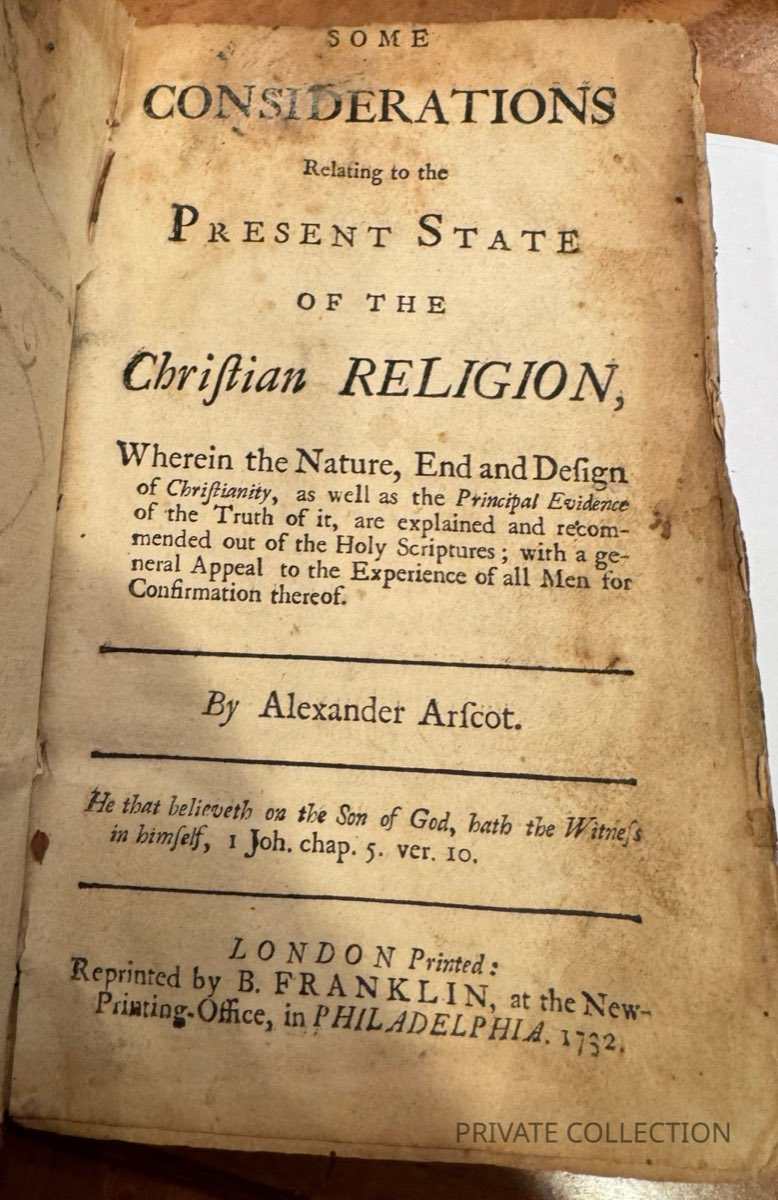
Some Considerations Relating to the Present State of the Christian Religion, Parts I and II
Among the earliest Franklin books in the collection, and the earliest known in which every craftsman of its production can be named: Franklin the printer, Stephen Potts the binder. Both parts present; the American Antiquarian Society has only the first. One institutional copy in WorldCat; eleven at auction since 1904, the last in 2008.
By the Proprietaries. To Benjamin Eastburn, Surveyor General (Land Warrant)
A land warrant form from Franklin's first five years, signed by John and Thomas Penn as proprietors, leasing two hundred acres at the head of Doe Run in Chester County to John Henry and directing the Surveyor General to lay it out. The Penns' province, parcelled into farms on Franklin's paper. The collection also holds the later form addressed to Eastburn's successor Nicholas Scull.
Meredith drank and sold out in 1730. Franklin, at twenty-four, owned the shop.