
The Letter Franklin Wrote
Edinburgh, 1766: Rush Arrives with an Introduction
BENJAMIN Rush left Philadelphia for Edinburgh in the summer of 1766 carrying Franklin's letter and very little else. He was twenty-one years old, a graduate of the College of New Jersey (later Princeton) who had spent five years apprenticed to John Redman, one of the most respected physicians in Philadelphia. He had no money to speak of and no connections in Edinburgh. The letter was everything.
Franklin had been corresponding with William Cullen since at least the 1750s, as part of the extensive transatlantic network of natural philosophers and physicians that connected Edinburgh, London, and Philadelphia in the middle of the eighteenth century. Their correspondence covered electrical theory, medical questions, and the broader concerns of the natural philosophical community that the Edinburgh Medical School anchored in Britain. When Rush arrived at Cullen's door with Franklin's introduction, he was not an unknown quantity — he was a recommended protégé of the man who had demonstrated that lightning was electricity.
Cullen received him warmly. Rush spent the next two years under the most comprehensive and stimulating medical instruction then available in the English-speaking world. He attended Cullen's lectures on the theory and practice of medicine, on the materia medica, on chemistry. He attended Joseph Black's chemistry lectures. He attended lectures on clinical medicine at the Edinburgh Royal Infirmary. He dissected at Alexander Monro's anatomy theater. He read voraciously in the university's library. And he was shaped, in ways that would determine everything he subsequently did and believed, by Cullen's systematic approach to fever — the conviction that disease was a systemic condition susceptible to rational, forcible correction.
"I studied physic with Dr. Redman from 1761 to 1766, and with Dr. Cullen in Edinburgh from 1766 to 1768. I owed more to Dr. Cullen than to any other teacher." — Benjamin Rush, Autobiography
The Edinburgh of Rush's student years was at the peak of its intellectual power. The Scottish Enlightenment was producing, in a few square miles of stone and cold air, some of the most important thought of the eighteenth century: David Hume's philosophy, Adam Smith's economics, Francis Hutcheson's moral theory, William Robertson's history. The medical school participated in this Enlightenment atmosphere rather than existing separately from it. Cullen was as comfortable discussing moral philosophy as he was discussing nosology; his students were expected to be citizens of the republic of letters, not merely technical practitioners.
Rush absorbed this expectation completely. When he returned to Philadelphia in 1769 — with an Edinburgh MD, Franklin's renewed patronage, and an appointment to the medical faculty of the College of Philadelphia — he brought with him not just Cullen's clinical methods but Cullen's vision of the physician as a figure whose authority extended beyond medicine into moral and social life. The physician who could diagnose and treat fever could also diagnose and treat the social fevers of slavery, intemperance, and unjust punishment. Rush would spend the next four decades acting on this conviction.
The collection documents this Edinburgh formation through the books Rush studied, owned, and annotated: the Van Swieten commentaries on Boerhaave that were the foundational text of Edinburgh clinical medicine, Cullen's own lectures and nosological system, and the Edinburgh dissertations of the generation Rush trained alongside. These are not merely bibliographical curiosities — they are the intellectual DNA of everything Rush subsequently published and practiced.
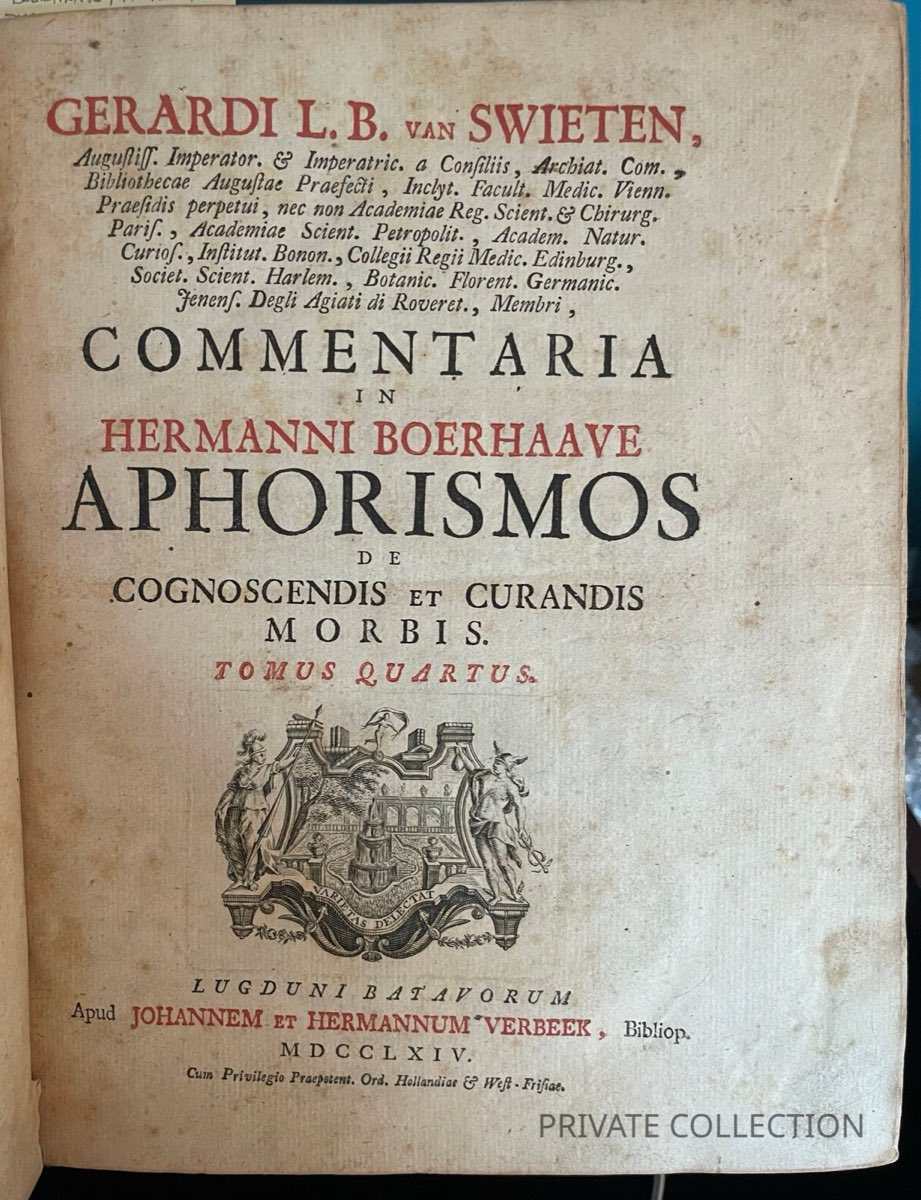
Commentaria in Hermanni Boerhaave Aphorismos de Cognoscendis et Curandis Morbis
The most personally significant volume in the collection's Edinburgh section. Gerard van Swieten (1700-1772) was Boerhaave's greatest student in the Netherlands and the physician who carried the Boerhaave tradition to Vienna, where he founded the famous Vienna Medical School. His Commentaria was the essential mediation of Boerhaave's Aphorisms for the Edinburgh generation. That Rush's copy bears his armorial bookplate and autograph inscription places this volume directly in the hands of the man who transmitted the Boerhaave-Cullen tradition to America. The chain: Boerhaave taught Van Swieten; Van Swieten's tradition shaped Edinburgh; Edinburgh trained Rush; Rush trained three thousand American physicians.
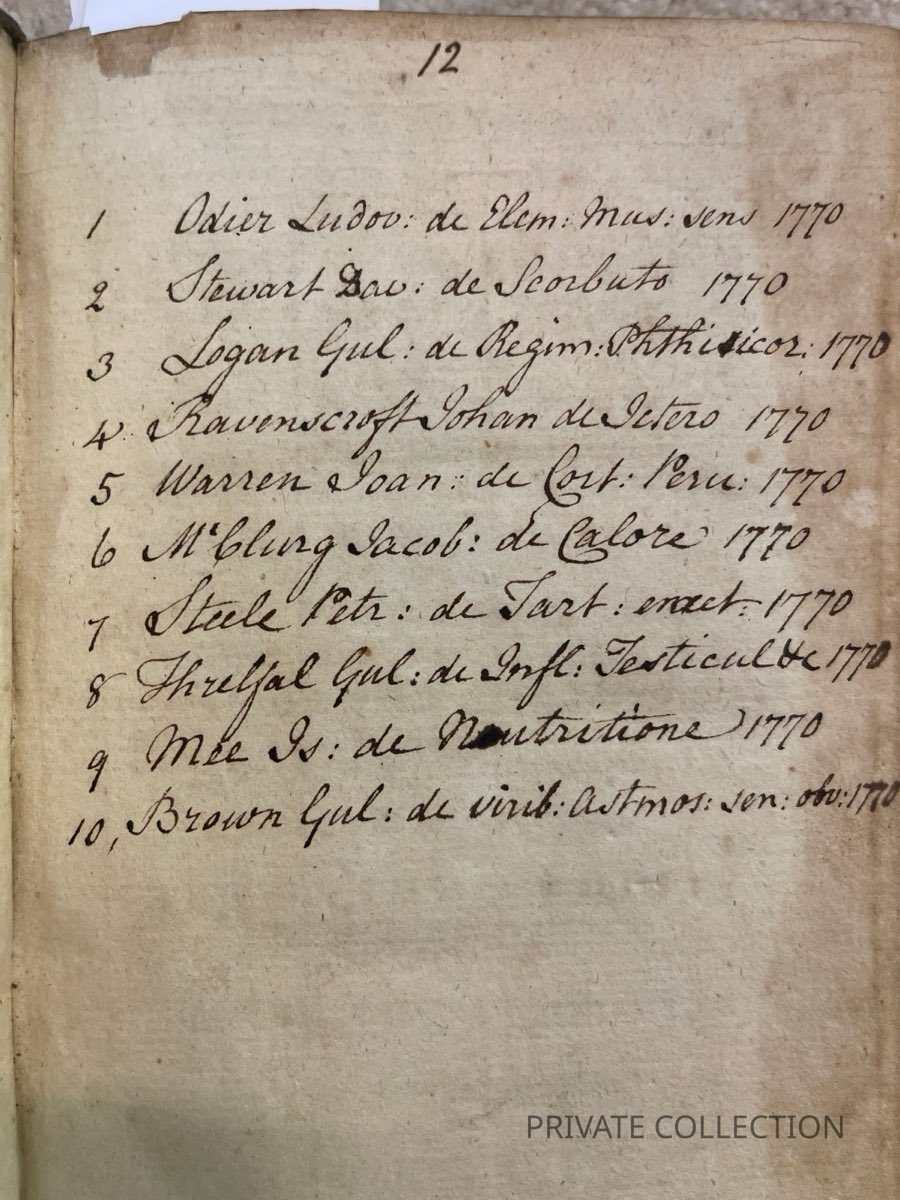
Sammelband of 10 Medical Dissertations Issued in Edinburgh, 1770
The Edinburgh medical dissertation was the culmination of the student's training: a public defense of a clinical or theoretical proposition before the faculty. These ten dissertations from the year 1770 — the year Rush returned to Philadelphia with his own Edinburgh MD — document the intellectual production of the medical school at the moment Rush was its most recent American graduate. They cover topics in fever theory, materia medica, and clinical observation that Rush would engage with for the rest of his career. A working document of the Edinburgh medical world Rush inhabited.
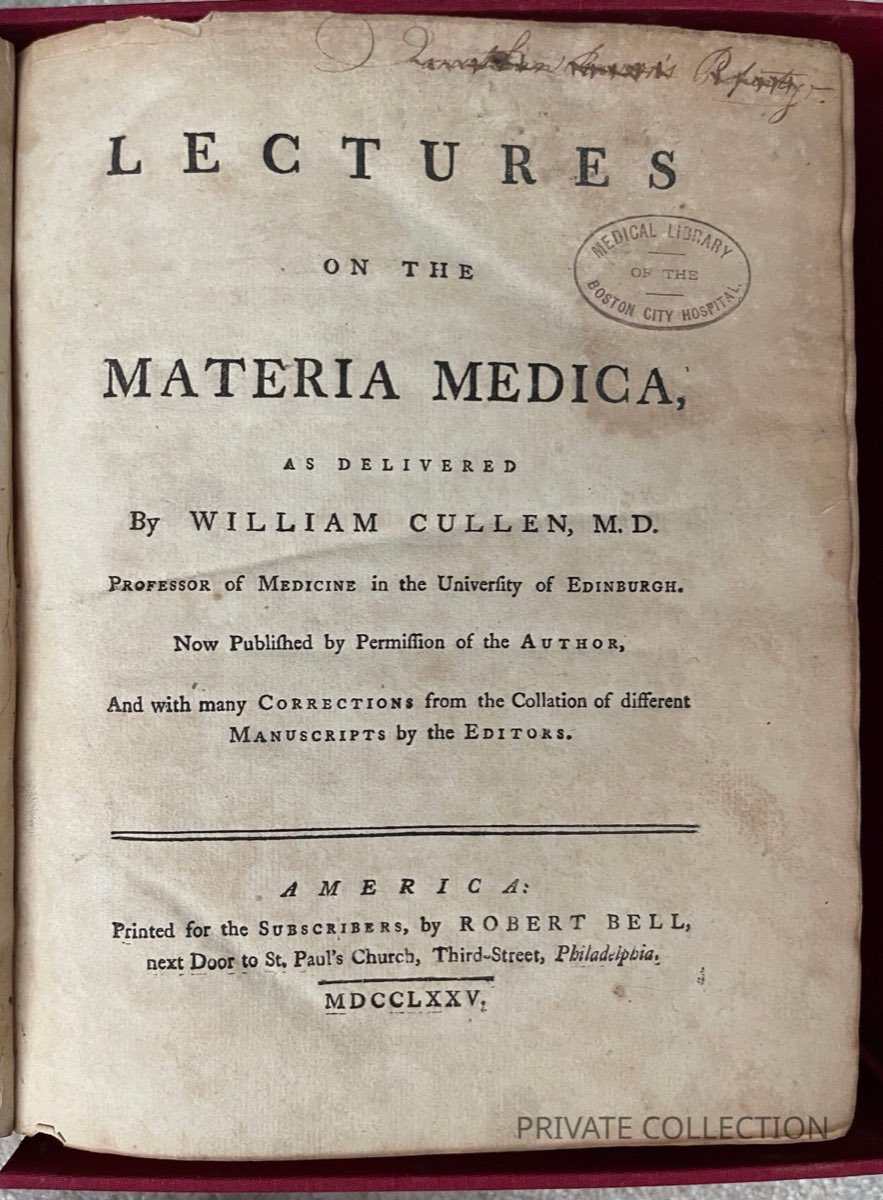
Lectures on the Materia Medica
William Cullen (1710-1790) was the dominant medical teacher in the English-speaking world during the second half of the eighteenth century, and Rush's most important intellectual formation. The Lectures on the Materia Medica represent Cullen's systematic approach to the drugs available to eighteenth-century physicians — the pharmacological dimension of the Cullenic tradition that Rush absorbed and transmitted to three thousand American students. Rush's yellow fever treatment — the calomel and jalap "double barrel" — is a Cullenic therapeutic application, however extreme.
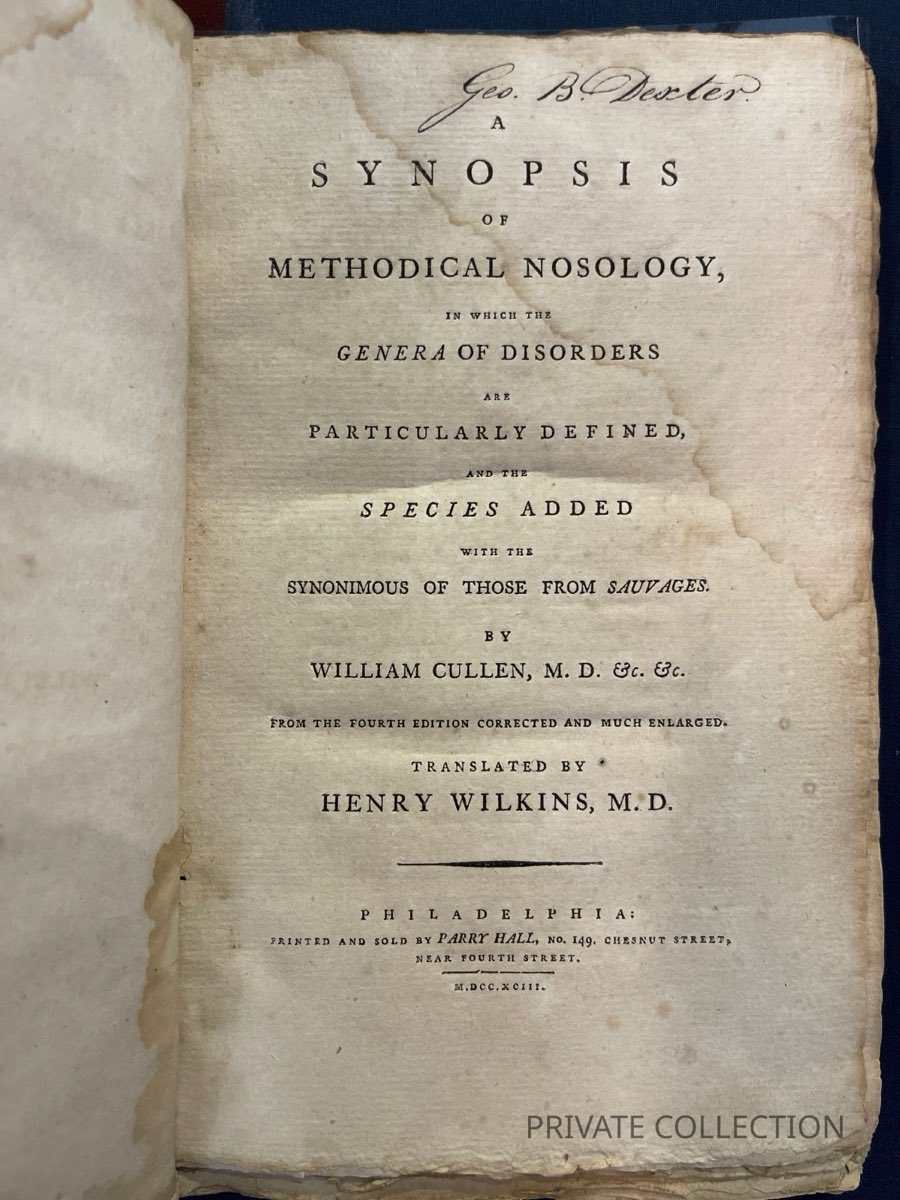
A Synopsis of Methodical Nosology
Cullen's nosology — his systematic classification of diseases — structured Rush's understanding of illness for forty years. The first American edition appeared in 1793, the year of the yellow fever epidemic, reflecting the demand that three decades of Rush's teaching had created for Cullen's theoretical frameworks. The nosology classified yellow fever as a genus within the Pyrexiae (fevers), and it was from within this Cullenic framework that Rush and his opponents argued about what, precisely, the epidemic was.
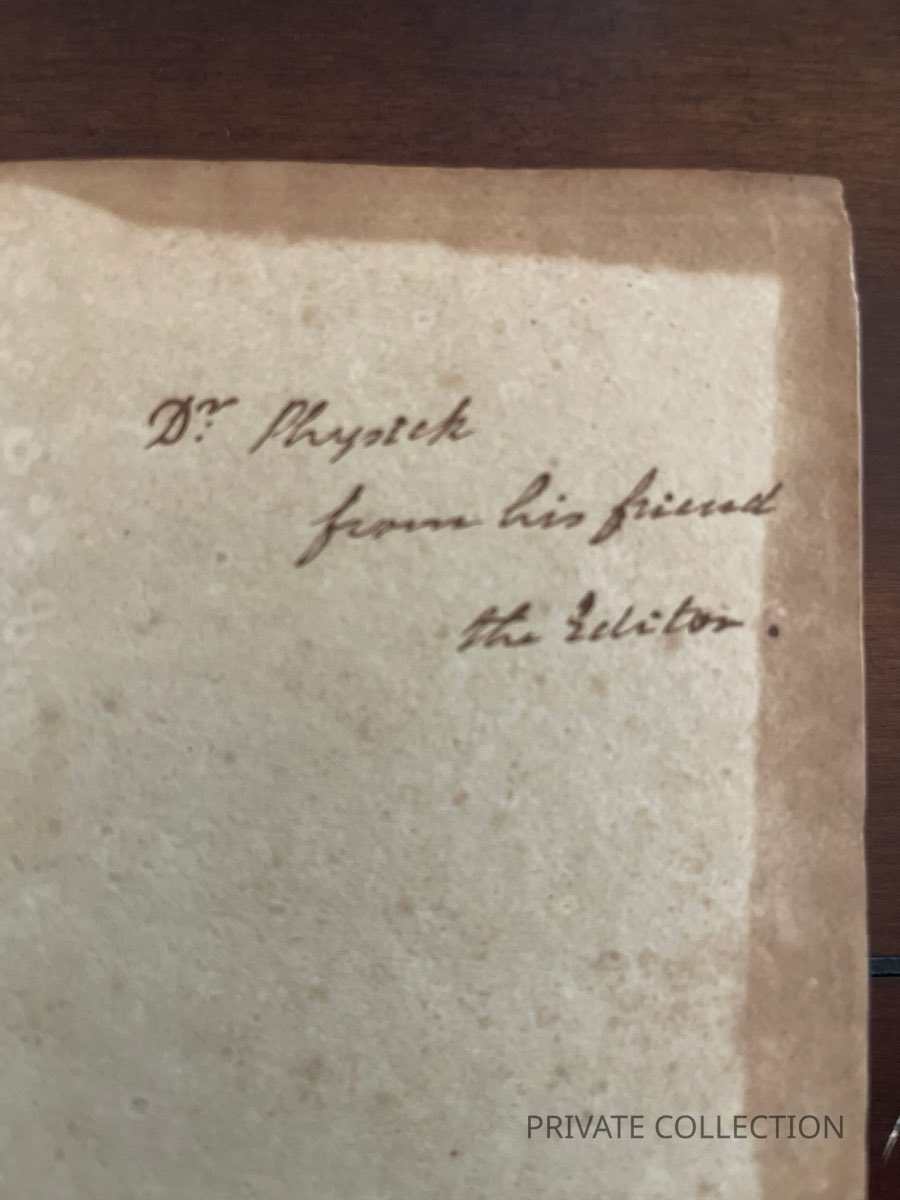
Observations on the Epidemical Diseases in Minorca
George Cleghorn (1716-1789) spent eleven years on Minorca in British Army service, keeping meticulous records of the connection between climate, weather, and disease — the foundational work of medical geography that Rush would draw on when arguing that yellow fever arose from Philadelphia's local miasmatic conditions. This presentation copy, inscribed by Cleghorn, documents the Edinburgh intellectual community through which Rush moved. The clinical habits this book modeled — environmental correlation, meteorological record-keeping — are directly visible in the yellow fever literature of the 1790s.
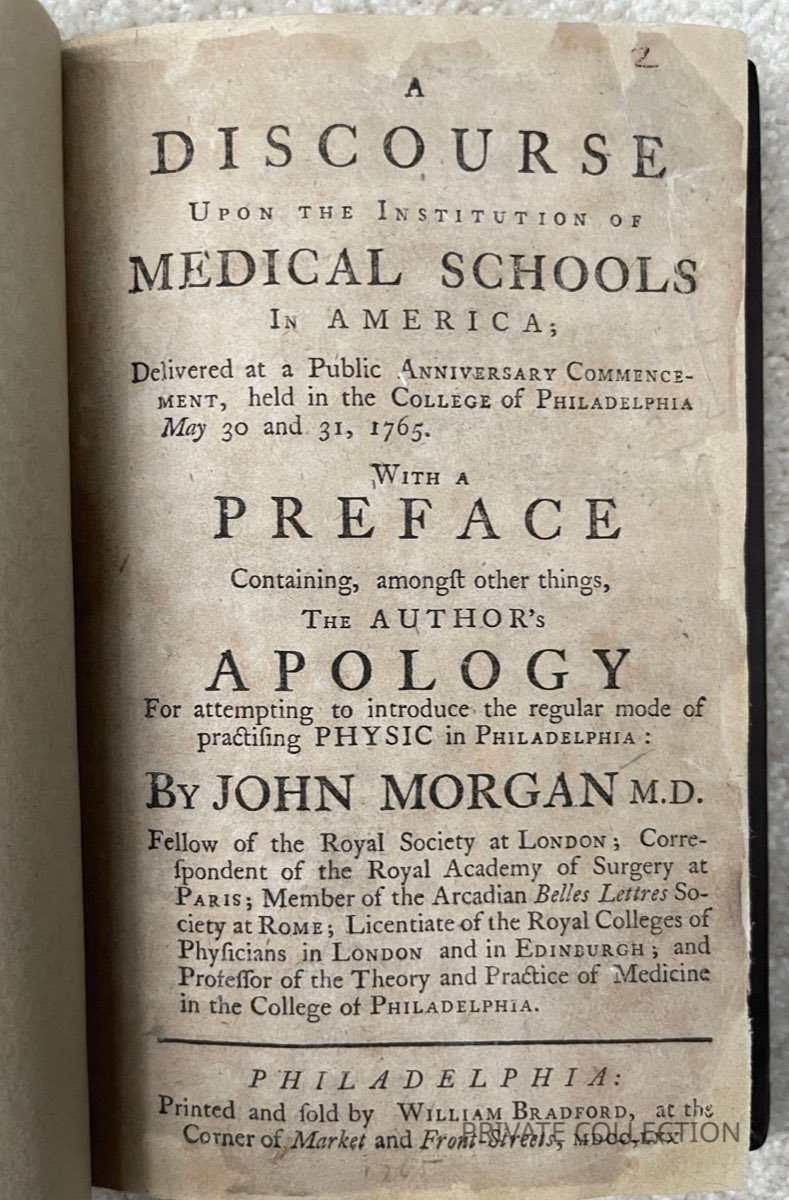
A Discourse upon the Institution of Medical Schools in America
John Morgan's founding document of American medical education, delivered at the establishment of the College of Philadelphia's medical faculty in 1765 — the institution Rush would join four years later after returning from Edinburgh. Morgan, like Rush, had studied at Edinburgh; like Rush, he was shaped by Franklin's circle and by the conviction that American medicine required systematic university-based training. Morgan's vision was Rush's inheritance, complicated by a bitter personal controversy over Morgan's conduct as Director-General of the Continental Army's medical department, which Rush eventually addressed in his Short Account of Dr. Morgan (BR-2023.038, this collection).
Rush returned to Philadelphia in 1769 as the youngest professor on the College of Philadelphia's medical faculty. He was twenty-three years old. Franklin was sixty-three and about to depart for London as colonial agent; their daily proximity would not resume for a decade. But Franklin had done his essential work: the introduction to Cullen had set the chain in motion, and Rush would spend the next forty years following it wherever it led.