
Rush in Public Life
Orations, Controversies, and the Cobbett Affair
RUSH delivered his first oration before the American Philosophical Society in 1786, the year after Franklin returned from France to preside over the institution he had founded in 1743. The subject was the influence of physical causes upon the moral faculty — the argument that would anchor Rush's entire reform career. The APS was the most important intellectual institution in America, the forum where natural philosophy, medicine, agriculture, geography, and political science converged in the republic of letters. Rush used it as a platform for his most ambitious theoretical arguments for the next three decades.
Franklin's death in April 1790 deprived Rush of his most important patron and his most important example. Rush was present at the deathbed; he described the scene in a letter to his friend Jeremy Belknap with the precision of a physician and the grief of a son. He had known Franklin for twenty years — since the letter to Cullen had been written, since the return from Edinburgh, since the long collaboration on the Pennsylvania Hospital and the Abolition Society and the Society for Promoting Political Enquiries. Franklin's death closed a chapter in Rush's life that could not be reopened.
Rush's public life after 1790 was increasingly marked by controversy. The yellow fever epidemics of the 1790s — documented in Catalog I — generated the most sustained attack on his professional reputation that he had ever faced. But the attack that finally produced a legal confrontation came not from his medical opponents but from a journalist: William Cobbett, the English-born satirist who wrote under the name "Peter Porcupine" and who had been arguing in print since the 1797 epidemic that Rush's yellow fever treatment was killing patients faster than the disease itself.
Jeffrey Pasley, in "The Tyranny of Printers" (2001), describes the Cobbett-Rush conflict as one of the defining press controversies of the early republic — a moment when the question of whether professional reputation was legally protected from journalistic attack was tested before a Philadelphia jury and answered definitively. Cobbett had collected mortality statistics, quoted Rush's published claims against observed outcomes, and repeatedly characterized Rush's methods as quackery backed by professional authority. Rush sued for libel. The jury awarded him five thousand dollars — the largest libel verdict in American history to that point. Cobbett, unable to pay, sailed for England.
"Rush, the most popular physician of the city, thought proper to bleed and purge; to purge and bleed. The deaths were in proportion to the doses he prescribed." — William Cobbett, The Rush Light, 1800
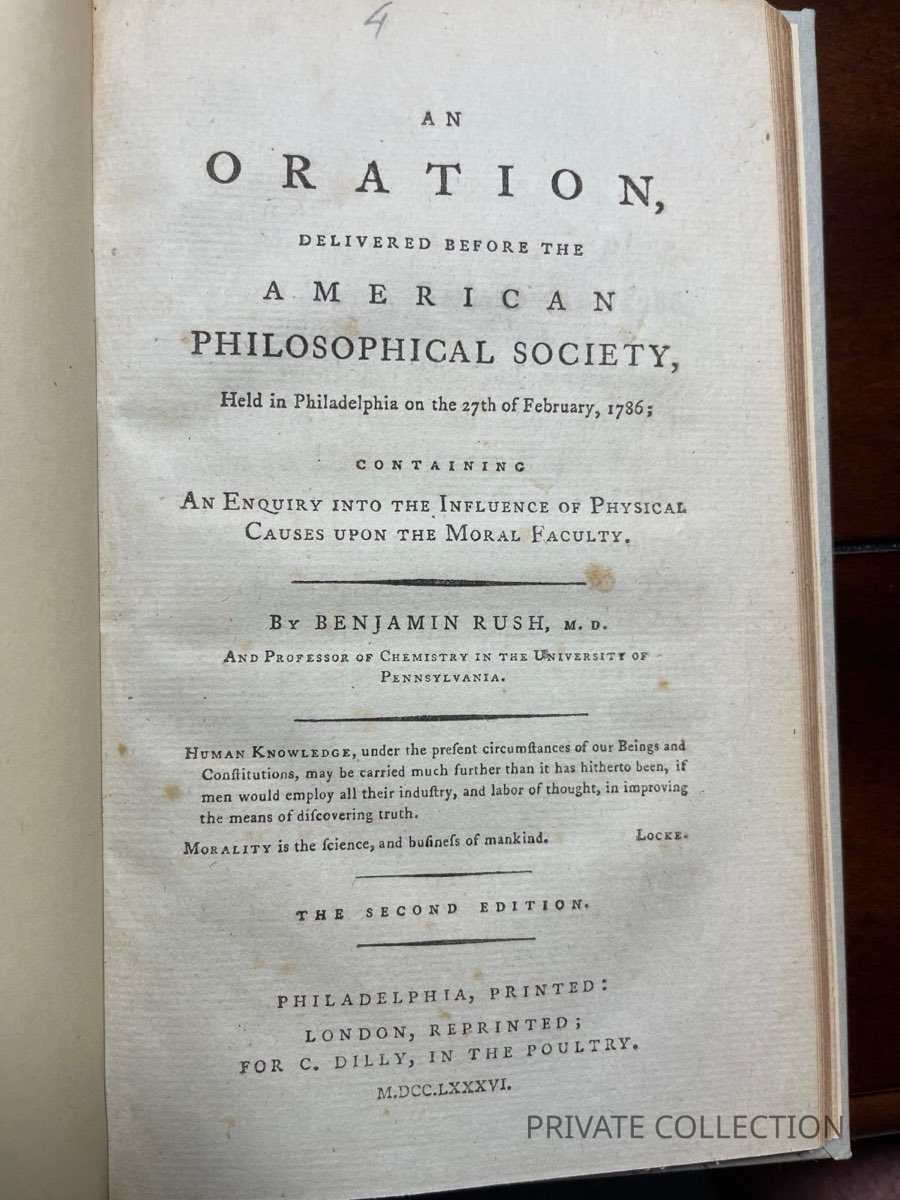
An Oration Delivered before the American Philosophical Society
Rush's first major APS oration, on the influence of physical causes upon the moral faculty — the argument that physical conditions shape moral behavior and are therefore susceptible to physical intervention. Delivered before Franklin and the full membership of the Society in 1786, this pamphlet is the theoretical foundation for the entire reform agenda: if drunkenness is a disease and vice is a physical condition, then medicine has a legitimate claim on social policy. Franklin was in the audience. The pamphlet's argument is, in a sense, the intellectual inheritance Franklin bequeathed to Rush: use natural philosophy in the service of social improvement.
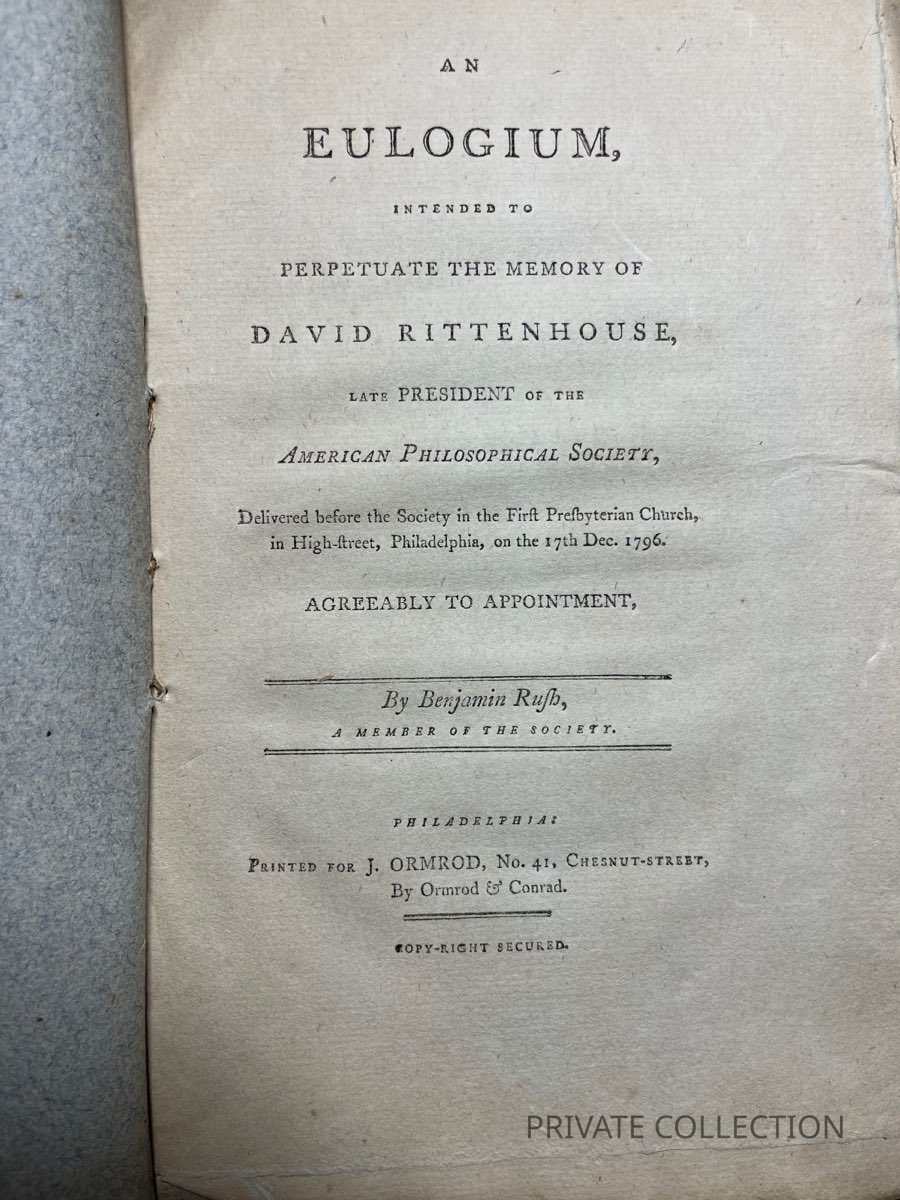
An Eulogium Intended to Perpetuate the Memory of David Rittenhouse
David Rittenhouse (1732-1796) was the astronomer and instrument maker who had been Franklin's most important scientific colleague in Philadelphia, and who after Franklin's death in 1790 became Rush's most intimate friend among the generation of Philadelphia Enlightenment figures. Rush's eulogy, delivered six years after Franklin's death and one year after Rittenhouse's, is a document of an entire world passing: the American Philosophical Society, the Pennsylvania Hospital, the networks of correspondence and collegiality that connected Franklin, Rush, Rittenhouse, Barton, and their circle. Rush is burying his generation.
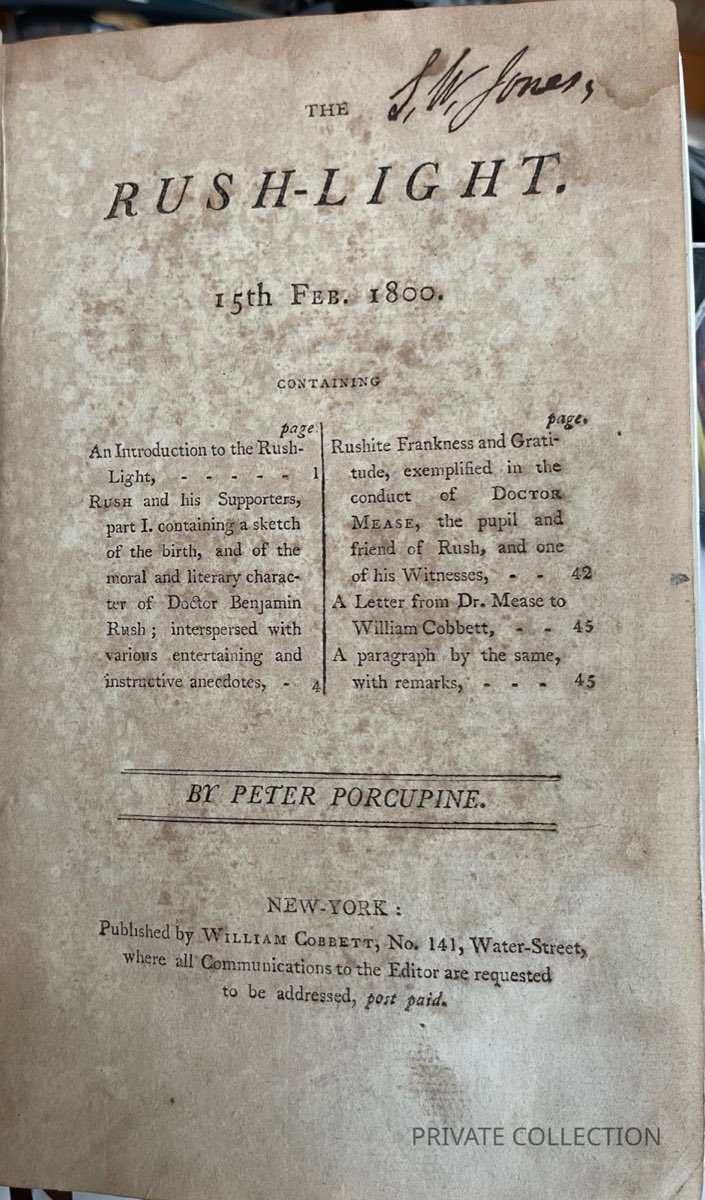
The Rush Light
The Rush Light was Cobbett's most sustained attack on Rush — seven numbers of satirical journalism combining genuine medical argument with personal invective, published in the immediate aftermath of the yellow fever epidemics of the 1790s. Cobbett had been arguing since the 1797 epidemic that Rush's combination of aggressive bloodletting and mercurial purging was killing patients faster than the disease itself. The Rush Light escalated those attacks into a sustained campaign, collecting mortality statistics and quoting Rush's published claims against observed outcomes. Rush sued; the jury awarded him five thousand dollars. The complete run of seven issues is one of the rarest American medical periodicals.
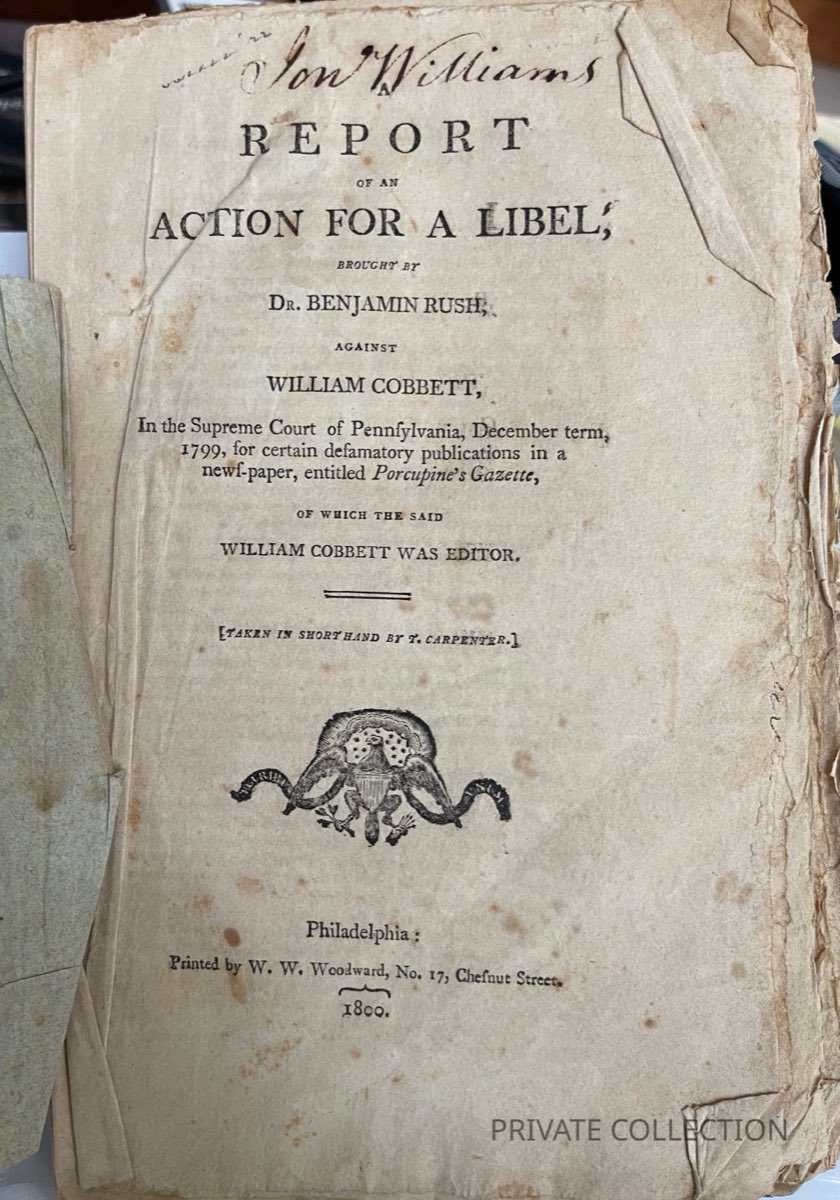
Report of an Action for a Libel
The published report of Rush v. Cobbett — the libel trial that resulted in the largest libel verdict in American history to that point and effectively ended William Cobbett's American career. The trial was a landmark in early American press law: it established that professional reputation was a legitimate subject of libel protection and that medical claims made in the press could be evaluated by juries. Cobbett had argued that Rush's yellow fever treatment killed people and that the public had a right to know it. Rush argued that Cobbett's claims were false, malicious, and designed to destroy a reputation honestly earned. The jury agreed. Cobbett sailed for England.