
Franklin the Mentor
Printer, Scientist, Institution Builder, and the Electrical Philosophy
BENJAMIN Franklin was sixty years old when Rush arrived in Philadelphia from Edinburgh in 1769 — sixty years old, the most famous scientist in the world, the colonial agent who had spent years in London arguing the American case before Parliament, the postmaster general, the author of Poor Richard's Almanac, the founder of the American Philosophical Society, the man who had flown a kite in a thunderstorm and proved that lightning was electricity. He was also, as Walter Isaacson notes in Benjamin Franklin: An American Life (2003), "the first American" in the sense of being the first major figure who was recognizably shaped by the values and experiences that would come to characterize the American character: pragmatic, self-made, civic-minded, suspicious of inherited authority.
Rush admired Franklin with an intensity that bordered on reverence, and he was not alone: the Philadelphia intellectual community of the 1770s and 1780s organized itself substantially around Franklin's example and patronage. The American Philosophical Society, founded by Franklin in 1743 and revived under his active presidency after 1785, was the institutional center of that community. The Pennsylvania Hospital, the Library Company, the Philadelphia Contributionship for the Insurance of Houses from Loss by Fire — each of these civic institutions bore Franklin's fingerprints, and each of them was also a stage on which Rush performed his own civic commitments.
But it was Franklin's scientific work — specifically his electrical experiments — that placed him at the center of the eighteenth century's most important intellectual transformation. The Enlightenment's conviction that nature was knowable, that natural forces could be understood and controlled, that the gap between the terrifying and the manageable could be closed by systematic inquiry and experiment: this conviction found its most dramatic vindication in Franklin's demonstration that lightning was electrical and could be controlled by a pointed rod. Gordon Wood, in The Americanization of Benjamin Franklin (2004), argues that Franklin's electrical work transformed him from a colonial printer into an international philosopher — and that this transformation was the precondition for everything else he did.
The collection holds more than one hundred items related to Franklin. The selection presented here focuses on the Franklin most directly relevant to the Rush relationship and to the collection's Zone I display on electrical philosophy: the scientist whose experiments established the intellectual prestige of American natural philosophy, the founder of the institutions that shaped Rush's career, and the author of the popular writings that Rush emulated in his own reform pamphlets.
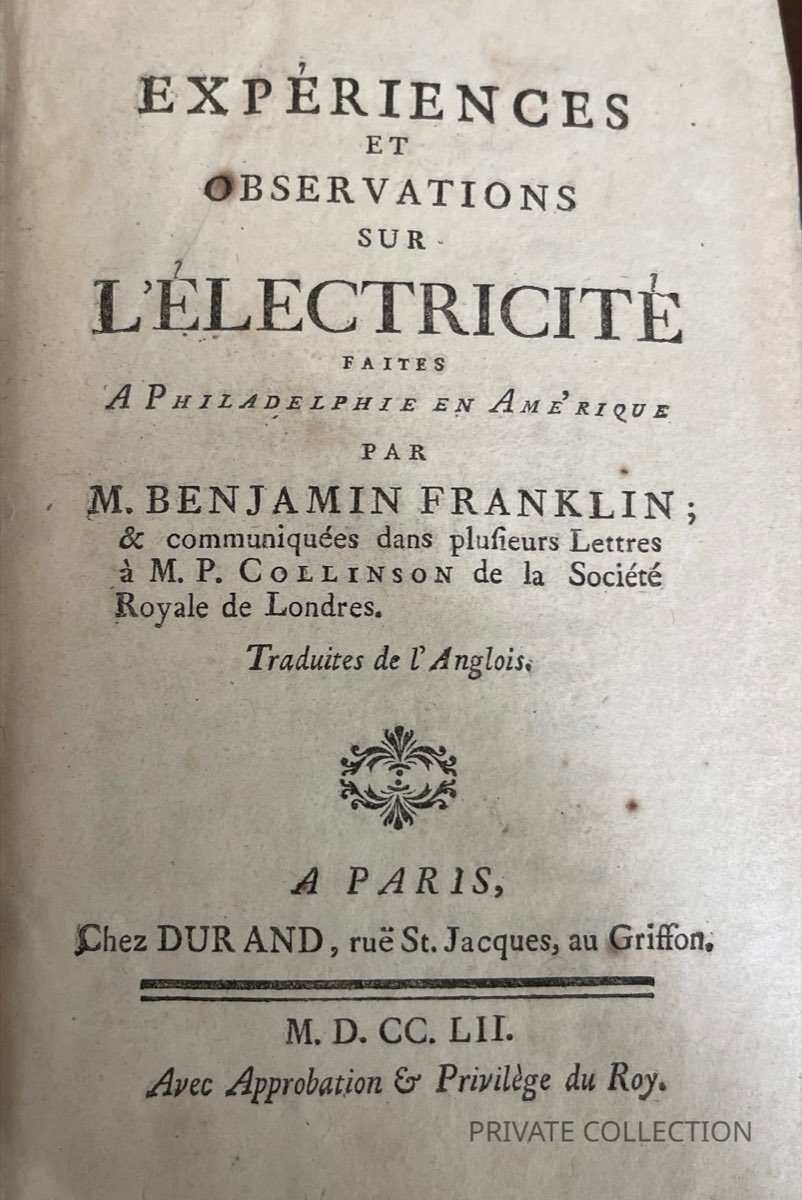
Experiences et Observations sur l'Electricite Faites a Philadelphie en Amerique
The French translation of Franklin's Experiments and Observations on Electricity — the work that made him the most famous scientist in Europe and established electricity as the lens through which the Enlightenment understood natural forces. I. Bernard Cohen, in Benjamin Franklin's Science (1990), identifies this work as the founding document of American scientific research: the first major contribution to natural philosophy produced in the colonies that was taken seriously by European scholars. Rush encountered Franklin first as the author of this work before he ever met him in person. The French translation was the text through which European readers knew Franklin; the collection holds it alongside the German and other language editions that document the work's international reach.
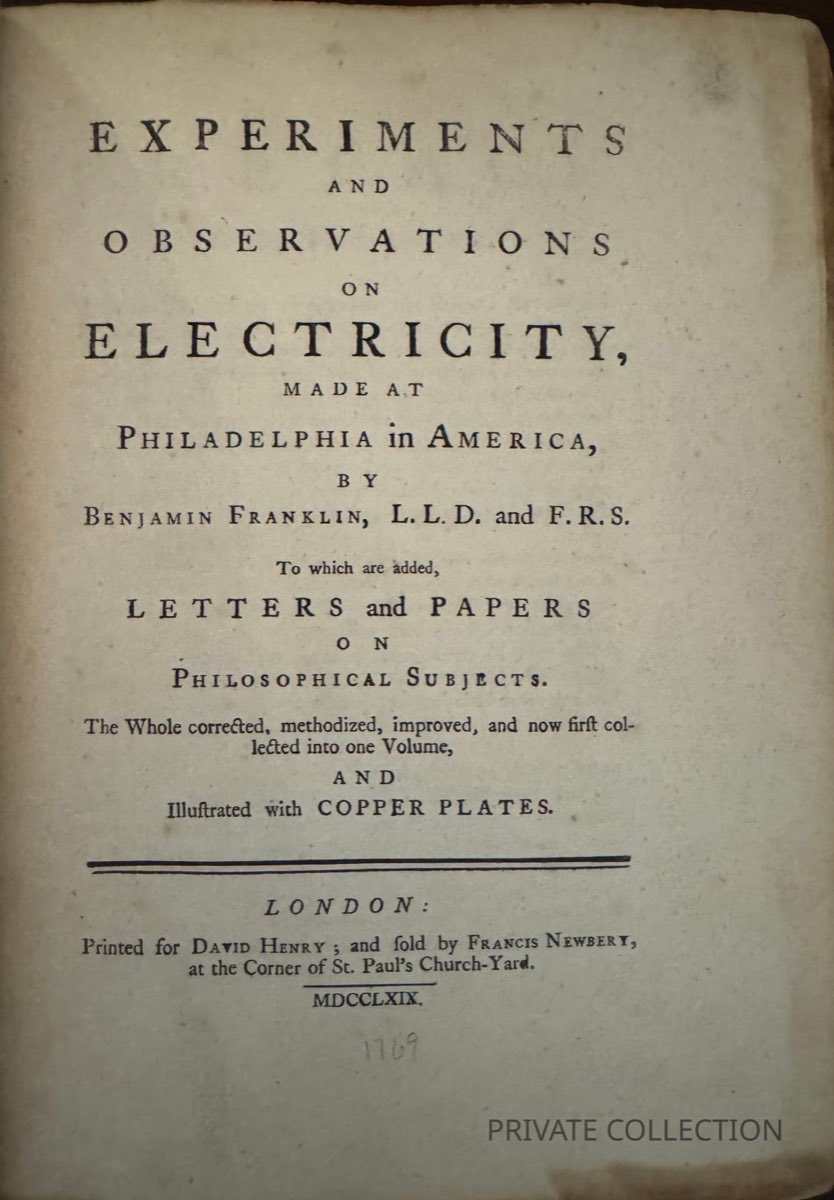
Experiments and Observations on Electricity, Made at Philadelphia in America
The English editions of Franklin's electrical work, published in London beginning in 1751, document the text through which British natural philosophers first encountered Franklin's discoveries: the identification of lightning with electricity, the invention of the lightning rod, the development of the concepts of positive and negative charge. J.A. Leo Lemay, in The Life of Benjamin Franklin (2006-2009), calls these experiments "the most influential scientific work published in America before the nineteenth century." The collection holds multiple editions, enabling comparison of the work's evolution across two decades of publication.
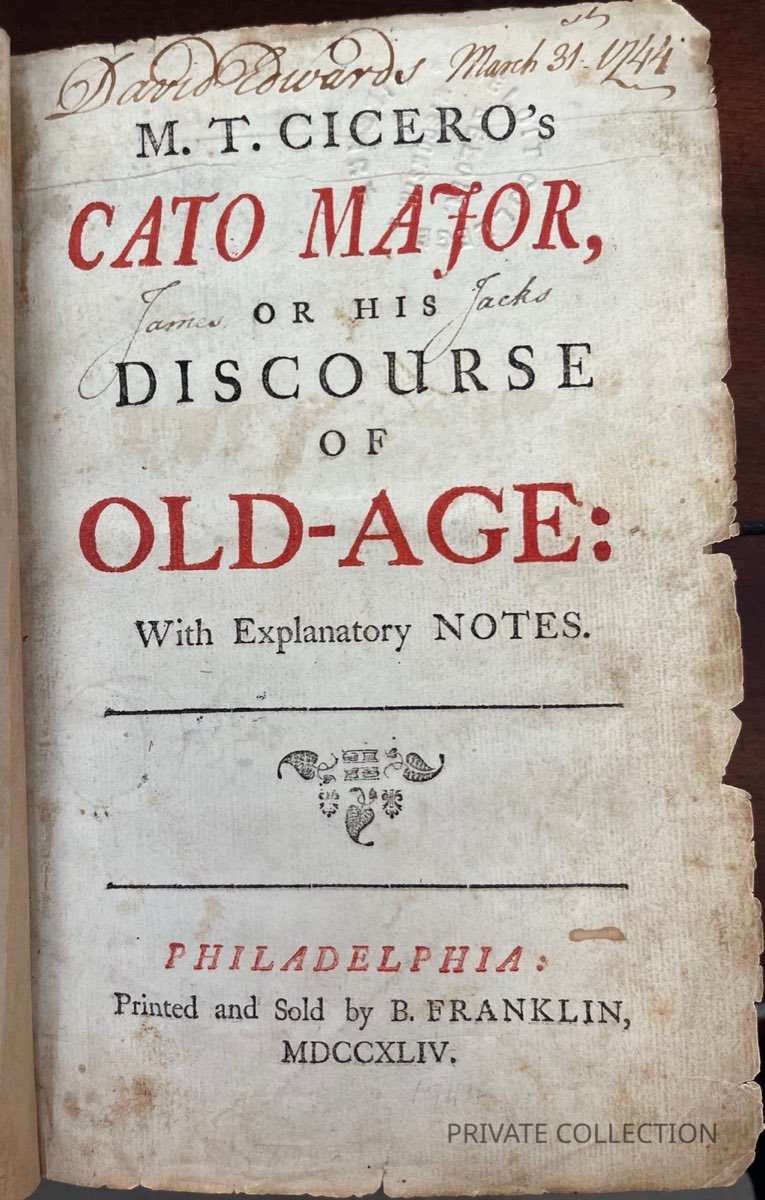
M.T. Cicero's Cato Major, or His Discourse of Old Age
Franklin's translation of Cicero's Cato Major is the first translation of a classical work into English published in America, and one of the most beautiful books to emerge from Franklin's press. Franklin printed it for himself, as a personal project: Cicero's meditation on aging and the philosophical consolations available to an old man's intellect is the kind of text that a printer-philosopher would choose to translate and print himself, not for profit but for pleasure and instruction. The book documents Franklin as humanist as well as scientist — the dimension of his character that Rush admired as much as the electrical work.
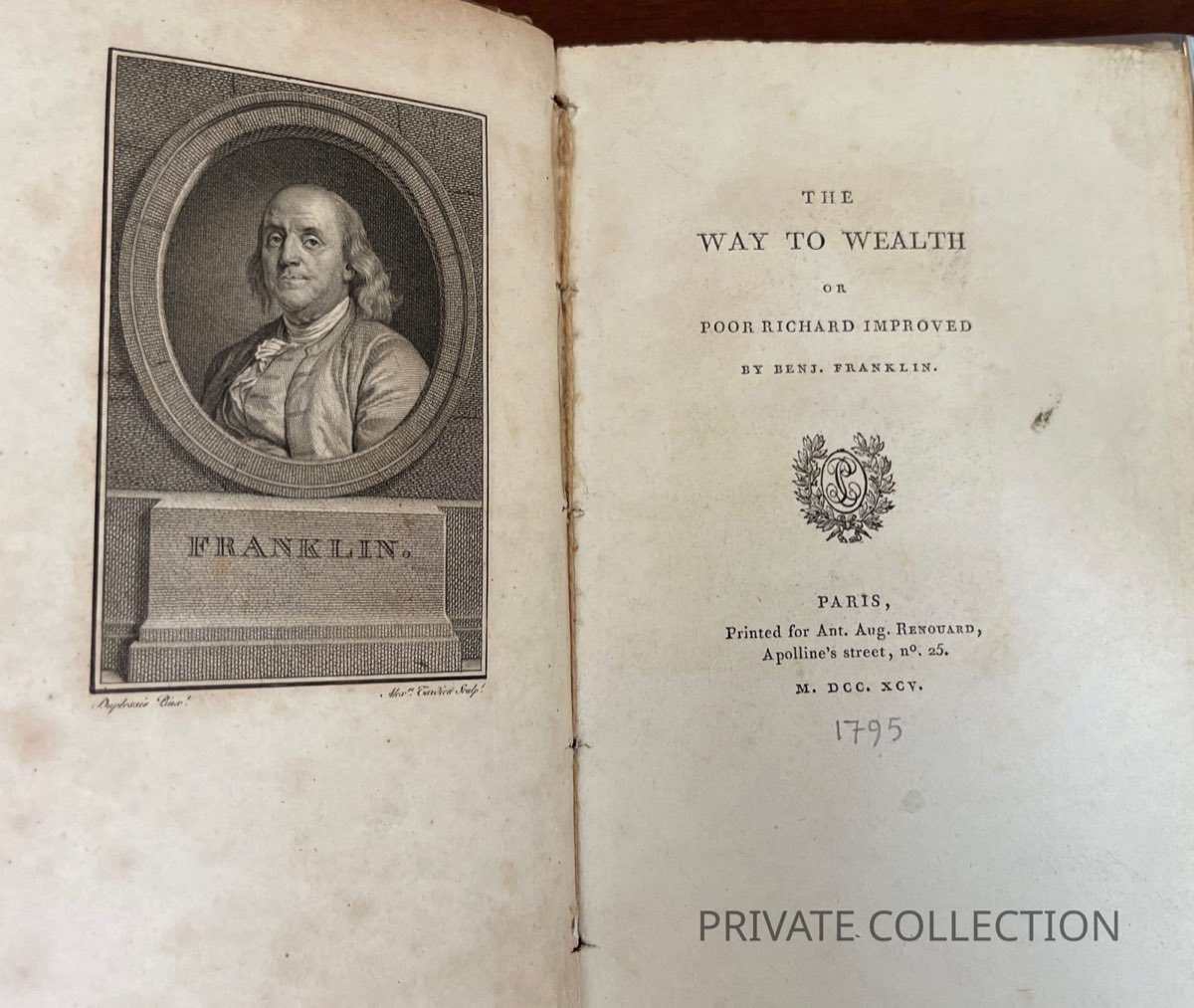
The Way to Wealth
The distillation of Poor Richard's wisdom into a single extended argument for thrift, industry, and self-improvement — one of the most widely reprinted texts in the eighteenth-century Atlantic world. Rush's admiration for Franklin's popular writing was explicit: he saw in it the same project he attempted in his medical pamphlets — reaching ordinary people with information that would improve their lives and strengthen the republic's civic fabric. The Moral and Physical Thermometer is, in a sense, Rush's version of The Way to Wealth, rendered in medical rather than economic terms.
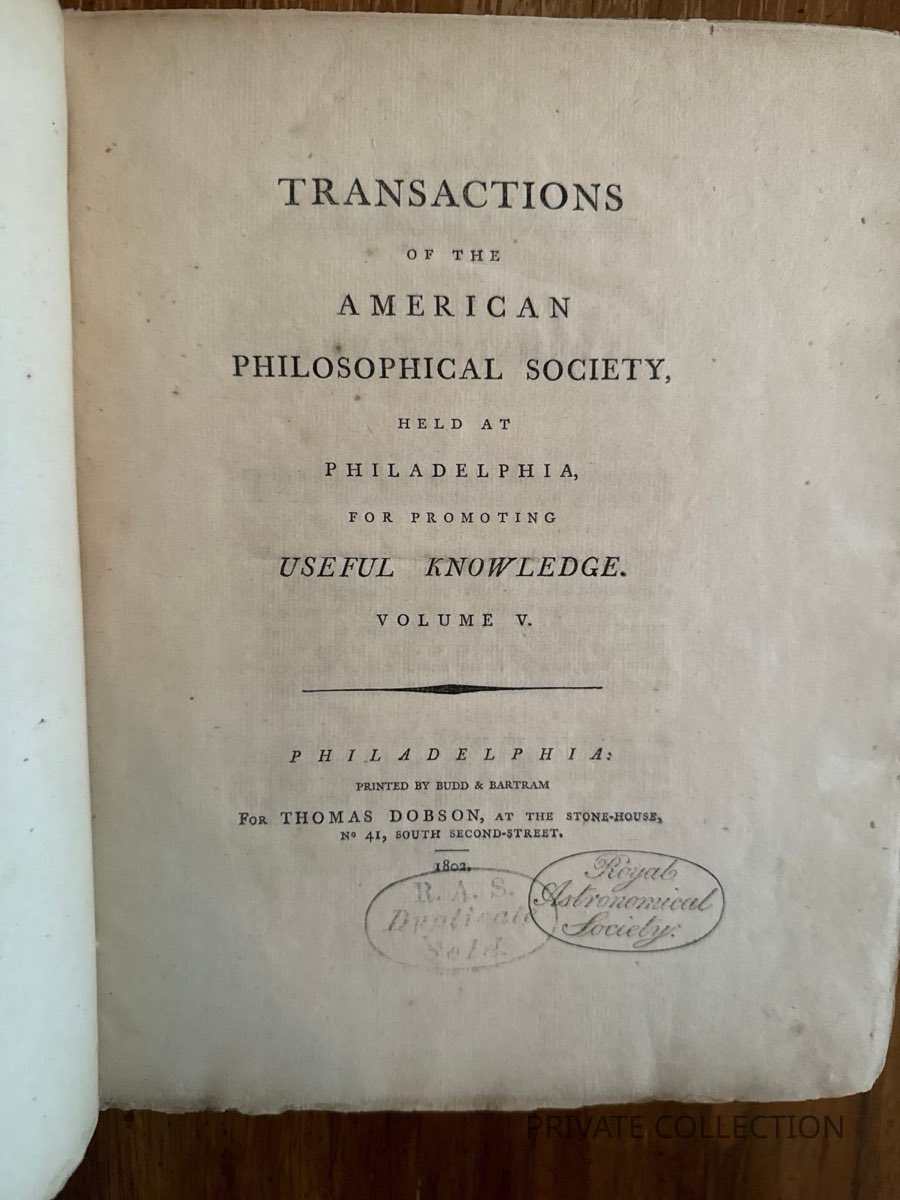
Transactions of the American Philosophical Society
Franklin founded the American Philosophical Society in 1743 and presided over it from his return from France in 1785 until his death in 1790. Rush was a member throughout and used the Society's meetings and publications as a platform for his most ambitious theoretical arguments. The Transactions document the full range of Philadelphia Enlightenment activity: natural philosophy, medicine, agriculture, geography, Indian languages, and the political science of the republic. The first volume, published in 1771, is the founding document of organized American science and one of the most important institutional records in the collection.
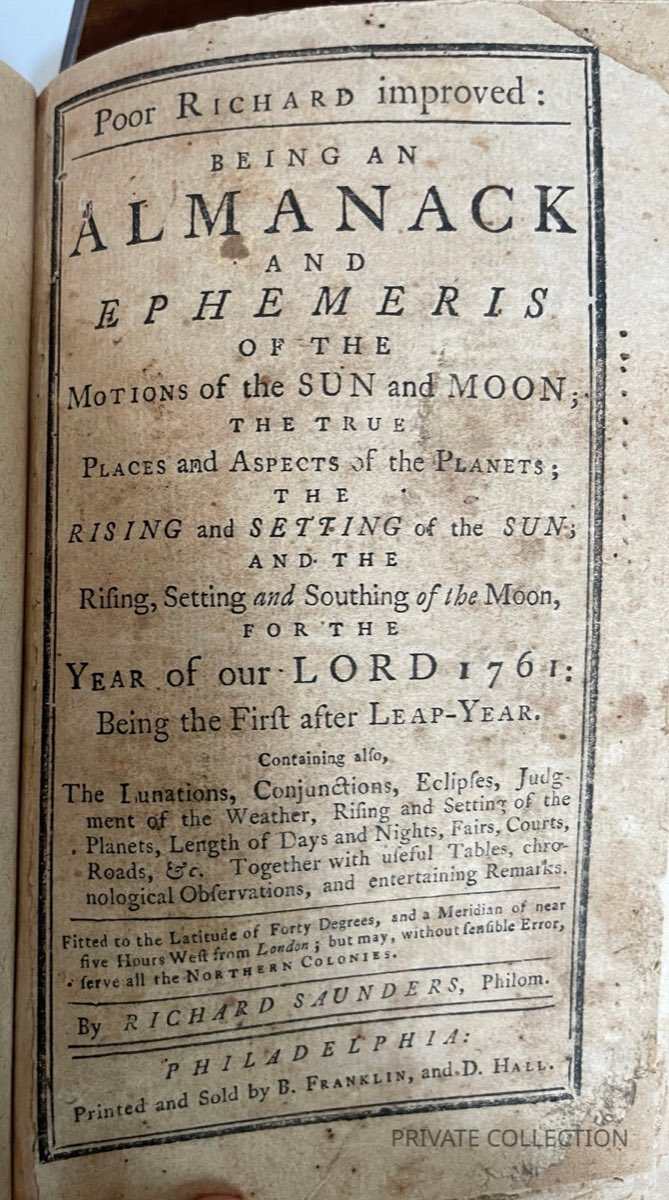
Poor Richard's Almanac (Presentation Piece)
Poor Richard's Almanac was Franklin's most democratic publication: the vehicle through which he reached farmers, merchants, and artisans across the colonies with the moral philosophy of the self-made man. The homespun wisdom of Richard Saunders masked a sophisticated rhetorical project — the formation of habits appropriate to a commercial republic. Rush understood this project precisely because he was doing the same thing in medical form: reaching ordinary people with the physician's knowledge, bypassing the medical establishment's gatekeeping, speaking directly to the body politic.
The relationship between Franklin and Rush did not end with Franklin's death in 1790. It continued in Rush's publications, in his institutional commitments, in his pedagogical practice, and in the moral framework within which he placed his medical work. When Rush argued before the American Philosophical Society, he was arguing in the institution Franklin founded. When he practiced at the Pennsylvania Hospital, he practiced in the institution Franklin built. When he campaigned against slavery, he followed the example Franklin set. When he published his reform pamphlets, he used the press as Franklin had used it: as an instrument of civic improvement addressed to the democratic public.
Franklin's electrical philosophy had established that nature was knowable and controllable — that what appeared as divine judgment (lightning, its terrifying randomness) was in fact a natural force susceptible to human management (the lightning rod). Rush extended this premise from the physical world to the social one: what appeared as moral disorder (crime, drunkenness, insanity) was in fact a medical condition susceptible to medical management. The physician was the lightning rod of the moral world.