
The World Before the Fever
Philadelphia, Medicine, and the Tradition Rush Inherited
IN the summer of 1793, Philadelphia was simultaneously the largest city in North America, the capital of the United States, and the center of American medical learning. The College of Physicians, founded only four years earlier in 1789, was the first institution of its kind in the country. The University of Pennsylvania's medical faculty — William Shippen, Adam Kuhn, Caspar Wistar, Philip Syng Physick, and Benjamin Rush — trained virtually every physician of consequence in the young republic. Rush himself had studied under the legendary John Redman and then at Edinburgh, where he absorbed the clinical tradition of William Cullen and Herman Boerhaave. When fever came to Philadelphia that summer, it came to a city that believed it had the intellectual tools to understand it.
That belief would be tested to destruction. The disease that arrived in August 1793 — introduced, most likely, by refugees from the Saint-Domingue slave rebellion who had been landing at the Philadelphia wharves throughout the summer — was unlike anything the Edinburgh-trained physicians had encountered. It would kill more than five thousand Philadelphians by November: nearly one in ten residents of the city. It would empty the government, close the courts, suspend commerce, and set physician against physician in a controversy that would last a decade. And it would generate, in the process, a literature unlike anything previously produced in American medicine.
The medical tradition into which this epidemic arrived had been building for decades. Physicians in the British colonial world had been watching tropical diseases with growing attention, correlating weather patterns to outbreaks, documenting the seasonal rhythms of fever in the low-country plantations and Caribbean ports. The most systematic of these observers was a Scottish emigrant in Charleston who spent ten years recording the connection between climate and disease before Philadelphia's epidemic generation was even born.
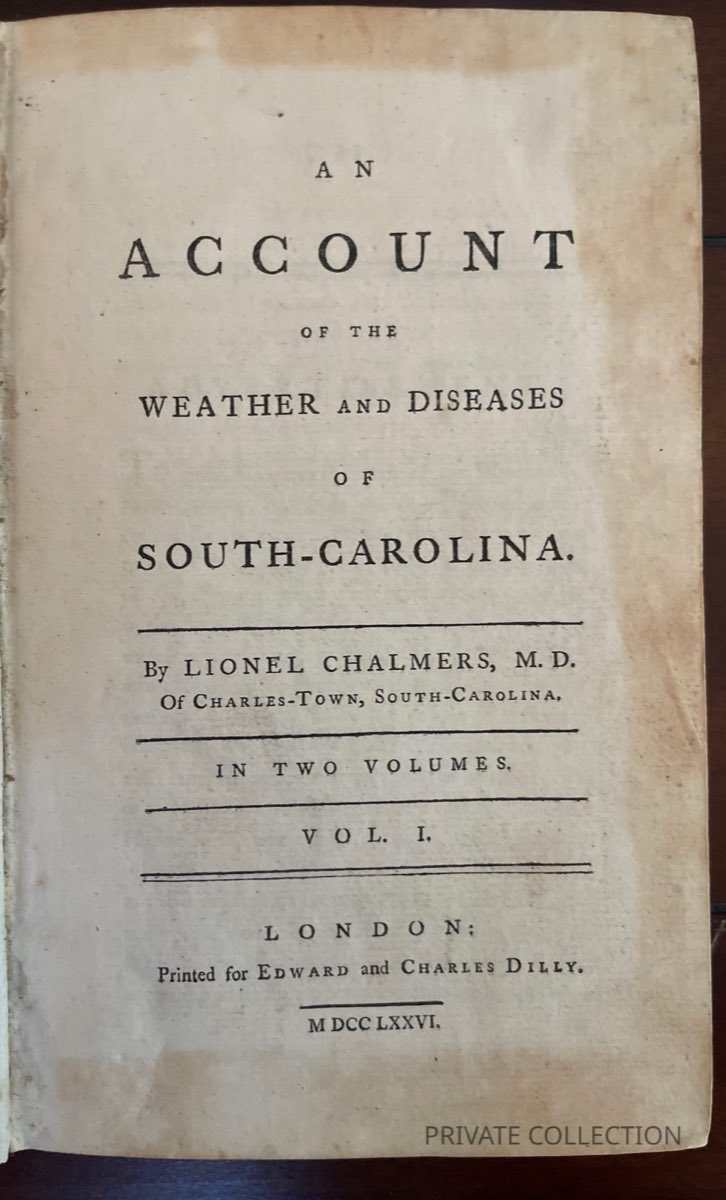
An Account of the Weather and Diseases of South-Carolina
Published seventeen years before the Philadelphia epidemic, Chalmers's work is Rush's methodological ancestor: the tradition of correlating climate, standing water, and miasmatic conditions to epidemic disease that Rush would apply — and overextend — in 1793. Rush cites the South Carolina tradition when arguing that yellow fever arises from local conditions. Chalmers was looking at the same environmental signals as Rush; neither yet knew what they were actually seeing.
The Edinburgh tradition that Rush brought back to Philadelphia in 1769 was equally preoccupied with epidemic disease. Cullen's nosology — his systematic classification of fevers — gave Rush the theoretical vocabulary he would use to describe yellow fever as a state of excessive vascular tension requiring forcible correction. That vocabulary, applied to a disease that no European physician had confronted in its full American form, would produce both Rush's most important clinical contributions and his most consequential errors.
By 1793, Rush was fifty-seven years old, the most famous physician in America, and deeply certain of his own methods. He had been treating fever in Philadelphia for more than two decades. He had survived the revolutionary war, the founding of the republic, and a dozen smaller epidemics. Nothing in his experience had prepared him for what arrived on Ball's Wharf in August 1793.