
The Summer of 1793
August–November: The Epidemic Arrives
THE first cases appeared in the blocks around Water Street and the wharves in late July and early August, in the narrow streets closest to the river where the summer heat was worst and the air smelled of the cargo that rotted in the August sun. Rush was among the first physicians to recognize what he was seeing. On August 19, he wrote to his wife Julia: "I have seen an unusual number of bilious fevers accompanied by symptoms of uncommon malignity." He had already formed a theory about the cause.
A cargo of coffee from Saint-Domingue had been offloaded onto Ball's Wharf weeks earlier, and part of it had spoiled in the heat and been left to rot on the dock. Rush was convinced he could smell it from several blocks away. It was, he concluded, the miasmatic source — the local atmospheric poison that was generating the fever. This conviction, formed in the first days of the epidemic, would shape everything he did and published for the rest of his life.
"The disease at present baffles all our remedies. I thought to carry it by the strength of medicine, but I find it requires something more." — Benjamin Rush, September 1793
The scale of the catastrophe that followed was without precedent in American experience. By September, dozens were dying every day. By October, the death toll was running at a hundred a week. The federal government — Congress, the president, the cabinet — left the city. Most of the College of Physicians' members either fled or retreated into their homes. The courts closed. The markets emptied. Families abandoned the sick in their houses rather than risk infection. The dead carts rattled through silent streets at night.
Rush stayed. This was not merely courage — though it was that — it was also Rush's absolute conviction that he understood the disease and could treat it. His "double-barreled" protocol — aggressive bloodletting combined with ten grains each of calomel and jalap — was, he believed, correcting the underlying vascular tension that constituted the fever. He treated up to a hundred patients a day, working through assistants and pupils when his own strength failed. He contracted yellow fever himself in September. He continued to practice from his sickbed, directing treatment by letter when he could not visit in person.
It was from that sickbed that he wrote the most important letter in the collection.
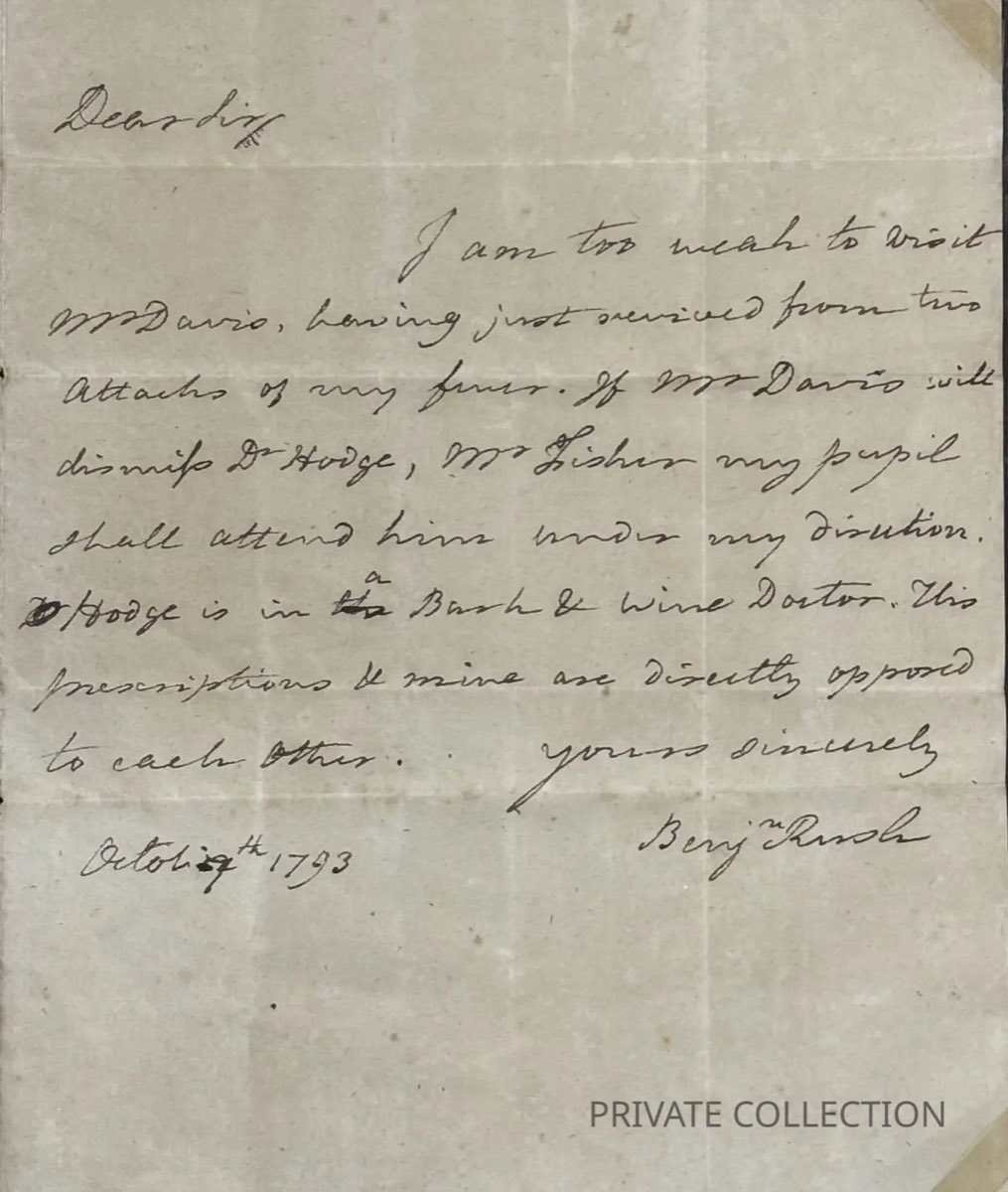
Autograph Letter Signed, "October [?] 1793"
Rush writes to James Wharton from his sickbed: "I am too weak to visit Mr. Davis, having just revived from two attacks of my fever. If Mr. Davis will dismiss Dr. Hodge, Mr. Fisher my pupil shall attend him under my direction. Hodge is in a Bark and Wine Doctor. His prescriptions and mine are directly opposed to each other." This letter — six words at its center — is the entire controversy in miniature: a dying physician, still fighting, refusing to cede a single patient to the opposition.
Hugh Hodge was not a quack. He was a respected Philadelphia physician, a colleague, trained in the same Edinburgh tradition as Rush. His preference for bark and wine — the Peruvian bark that provided quinine, combined with wine to support the patient's vital forces — was not ignorance but a different reading of the same clinical evidence. The patients at Bush Hill, the mansion outside the city that a citizens' committee had converted into a hospital, were being treated by the French physician Jean Deveze on exactly this tonic principle, and the survival rates at Bush Hill were, by most accounts, better than those of patients receiving Rush's aggressive depletion.
Rush did not want to hear this. The opposition to his method was not merely wrong, in his view — it was dangerous. Every patient sent to a "bark and wine doctor" was, in Rush's estimation, a patient who might die because his physician had chosen the wrong treatment. The fury in that sickbed letter is the fury of a man who believes he is right, who has staked everything on being right, and who cannot stop fighting even when he can barely lift a pen.
While the physicians debated, the citizens of Philadelphia were managing the crisis in whatever way they could. The free Black community, led by Absalom Jones and Richard Allen of the Free African Society, had organized an extraordinary volunteer effort at the request of Mayor Matthew Clarkson — nursing the sick, driving the death carts, burying the dead. They did this at enormous personal risk and at the explicit request of the city's white leadership, who had been told, incorrectly, that Black Philadelphians were immune to the disease. They were not immune. They died alongside their white neighbors.
The story of what happened next — how Mathew Carey published a popular account of the epidemic that accused the Black community of profiteering, and how Jones and Allen published a point-by-point rebuttal that stands as one of the earliest political documents by African Americans in American history — is one of the most important chapters of the epidemic's social history. The collection holds three editions of Carey's pamphlet, enabling direct comparison of the racist claims and their partial, reluctant correction.
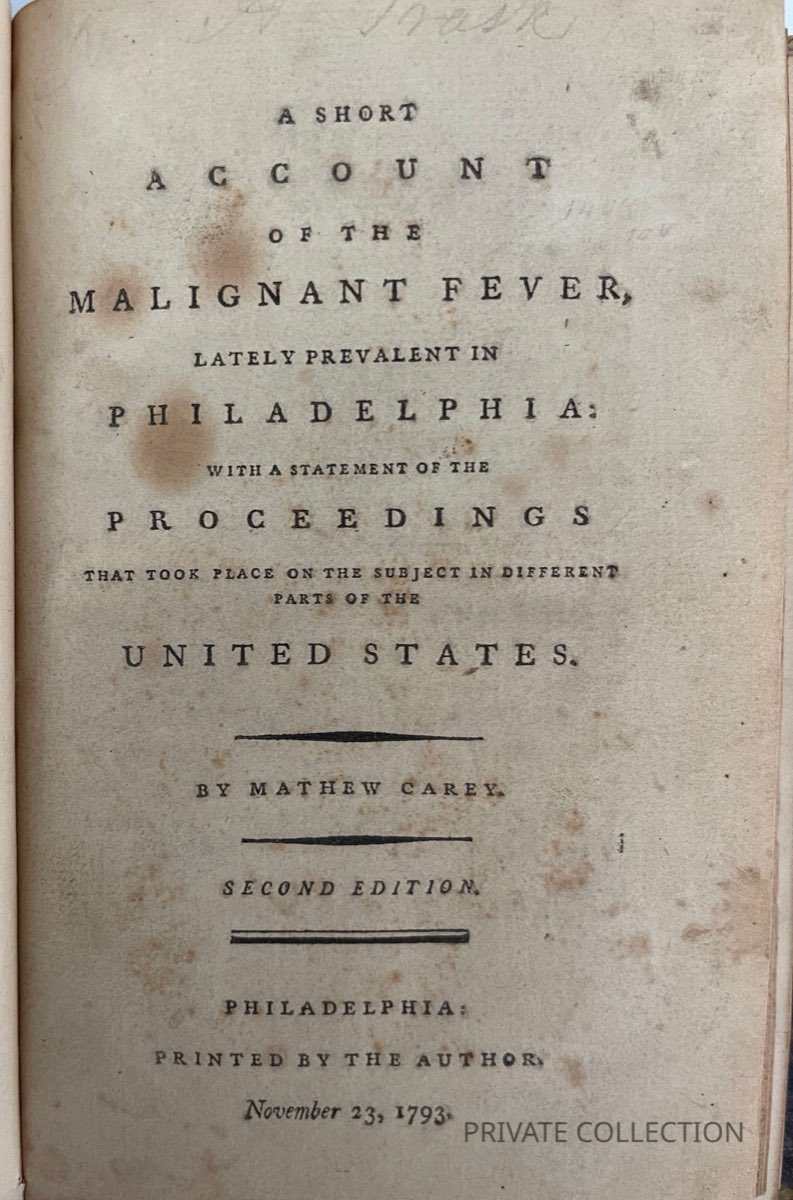
A Short Account of the Malignant Fever, Lately Prevalent in Philadelphia — Second Edition
Carey fled Philadelphia during the worst of the epidemic and wrote this account within weeks of the crisis. The second edition, printed before the year was out, contains the inflammatory accusations against the Black community that Jones and Allen would spend the next year refuting. The three Carey editions in this collection — second, fourth plain, and fourth in original wrappers — trace an arc from accusation to partial retraction.
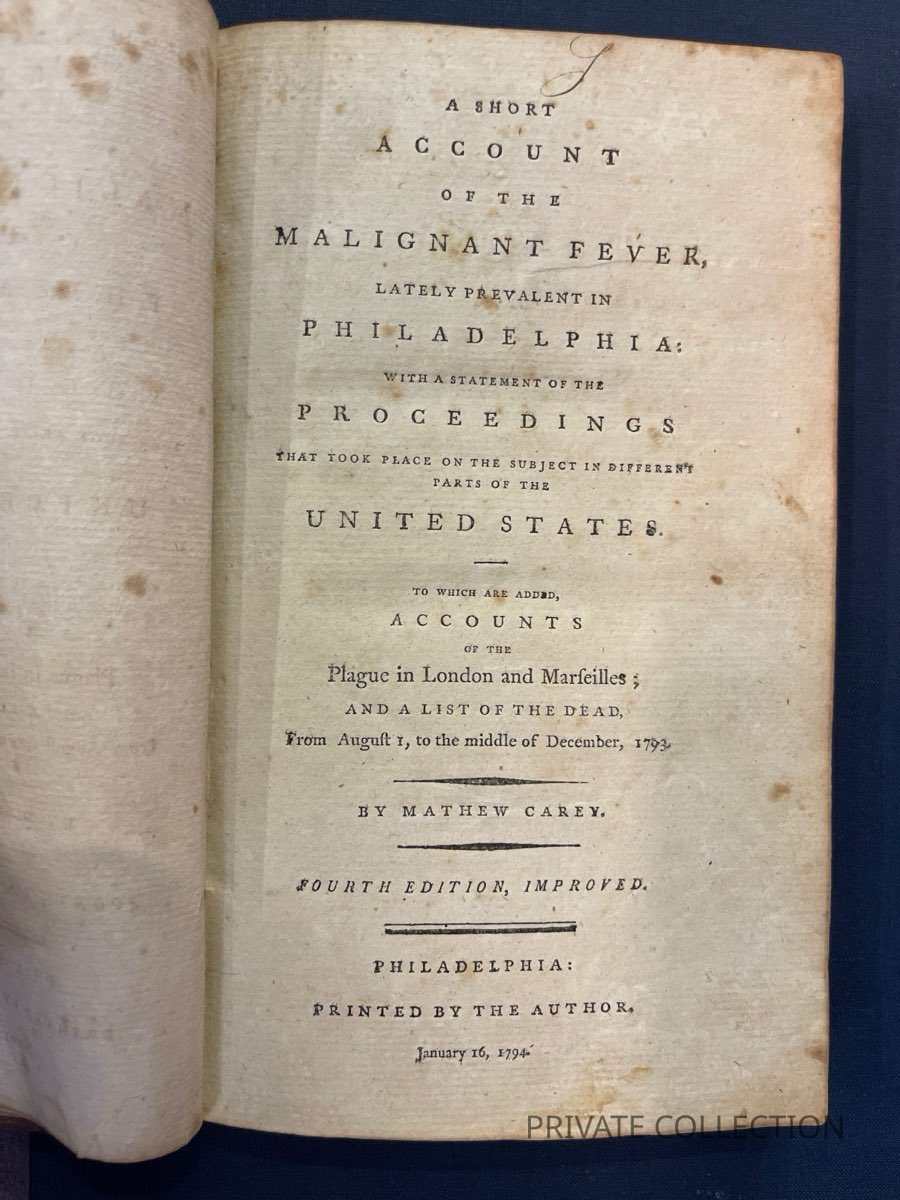
A Short Account of the Malignant Fever — Fourth Edition, Improved
The "improved" fourth edition is the first to incorporate revisions responding to the Jones-Allen rebuttal, and the first to include David Rittenhouse's meteorological charts and the full list of the dead by name and profession — more than four thousand names. Both Rush's localists and Currie's importationists cited Rittenhouse's data, reading the same numbers in opposite directions.
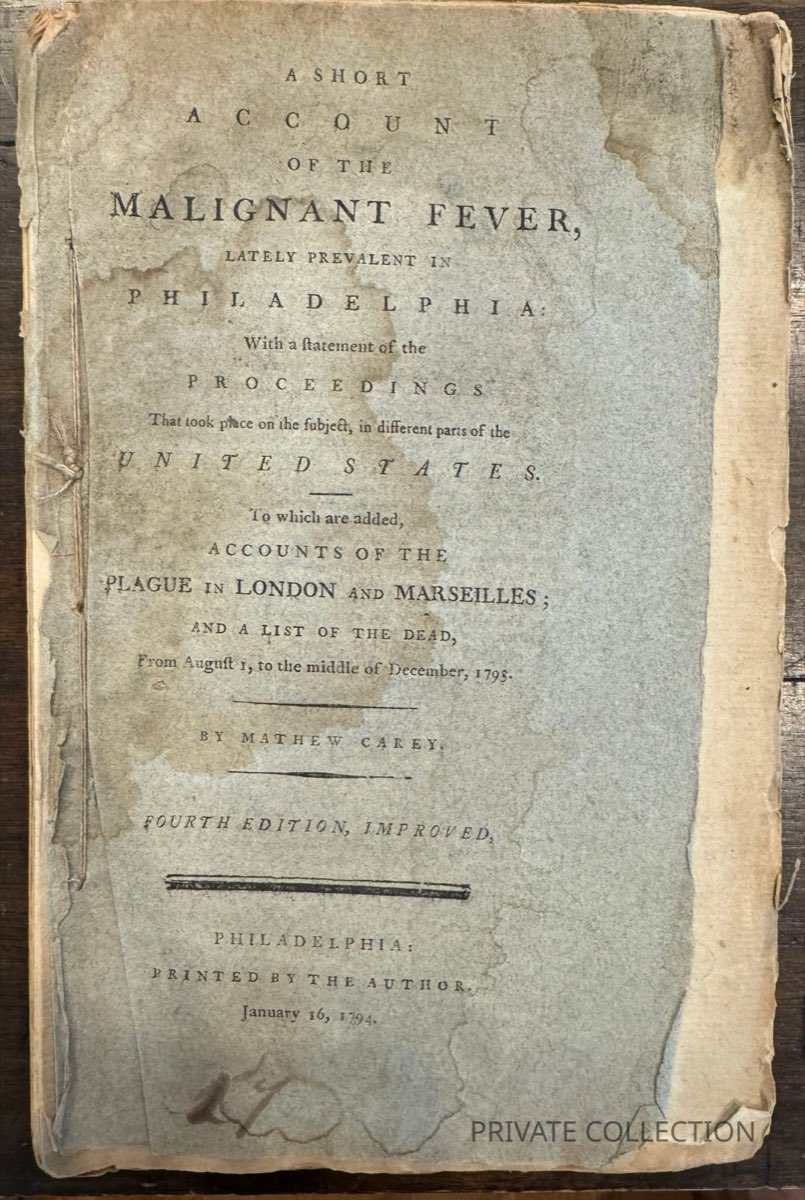
A Short Account of the Yellow Fever — Fourth Edition, Original Wrappers
No auction record exists for the fourth edition in its original wrappers. This copy — entirely untrimmed and uncut, still sewn in its original printed wrappers — is apparently unique, bearing the bookplate of Herbert McLean Evans (1882-1971), one of the great medical bibliophiles of the twentieth century. From Carey's press in 1794 to an eighteenth-century Philadelphia household to Evans's legendary Berkeley collection to the Soiferman Collection: a survival of 230 years in essentially its original state.
New York observed a day of public fasting and prayer for Philadelphia in September 1793. That a city two hundred miles away would mark an epidemic in another city with a civic religious observance tells us something about the national dimensions of the crisis: yellow fever was not merely a Philadelphia problem. It was a warning about the vulnerability of all American coastal cities, a warning that the government, the press, and the clergy were all trying to interpret simultaneously.
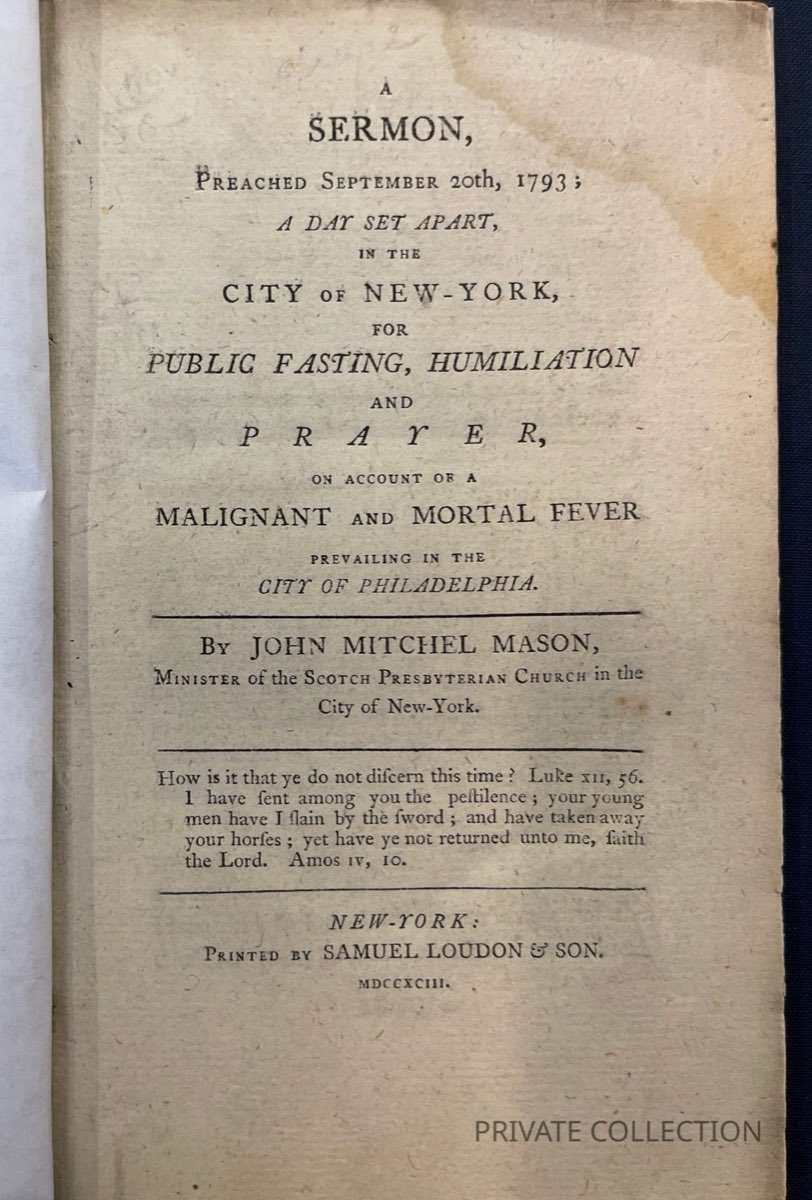
A Sermon Preached September 20, 1793 — A Day Set Apart in New York for Public Fasting on Account of the Malignant Fever in Philadelphia
Unrecorded in Austin, Miner, Fox, or Howes (Sabin 45461 only). Preserved by ecclesiastical accident rather than bibliographic attention, this pamphlet documents the epidemic's national religious resonance at its most lethal moment. The date — September 20, 1793 — places it in the week when deaths were at their peak.
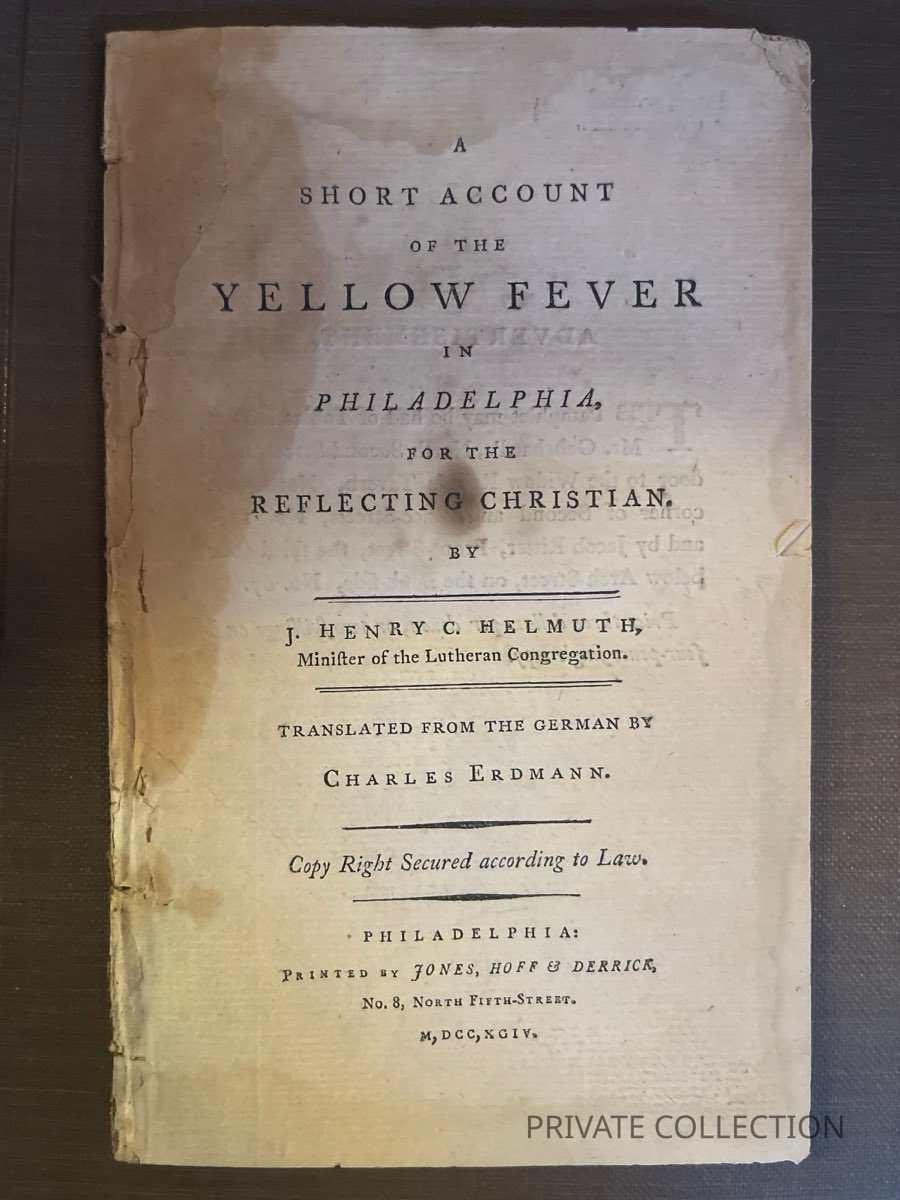
A Short Account of the Yellow Fever in Philadelphia, for the Reflecting Christian
Helmuth, minister of Philadelphia's German Lutheran congregation, was convinced the epidemic was divine punishment for the city's wickedness. This was not a fringe view — it was the default theological framework for understanding catastrophe in 1793 Philadelphia. Rush's medical argument that fever arose from rotting coffee was competing not only with Currie's importationism but with the prior certainty that God had sent the plague. The sermon and the treatise coexisted as rival explanations, and they had to fight for the same readers.
Joshua Cresson did not flee. A Philadelphia Quaker of comfortable means, he stayed in the city through the epidemic's most lethal months, tending to his spiritual account in a set of private meditations that were not intended for publication. He died of yellow fever on October 21, 1793. His meditations were published a decade later by William Dillwyn, who had preserved the manuscript. They are the most intimate personal document of the epidemic in the collection: the city dying, heard from inside.
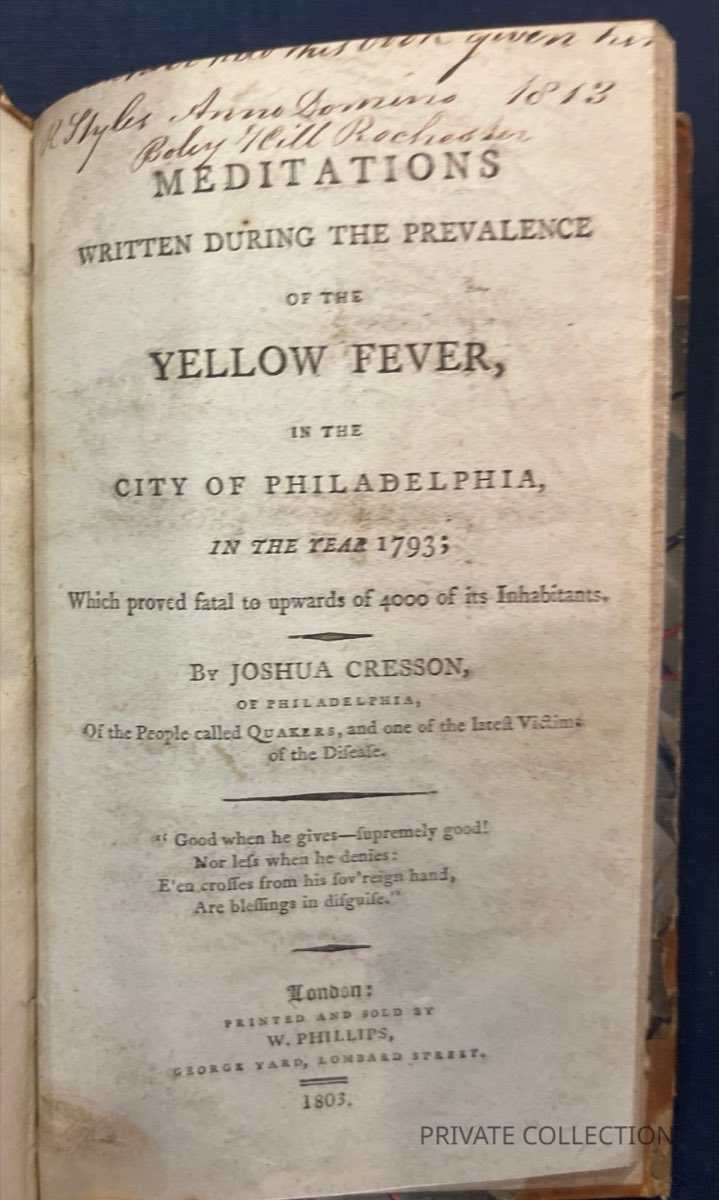
Meditations Written During the Prevalence of the Yellow Fever in Philadelphia, 1793
Where Rush's letters show a physician fighting for his theory, Cresson's meditations show an ordinary citizen trying to maintain his spiritual equilibrium while his city dies around him. The copy's later British provenance signature suggests these Philadelphia Quaker meditations were known in British Quaker networks as well — the epidemic's reach as a devotional text extending across the Atlantic.
By November, the frost had come. The Aedes aegypti mosquitoes — though no one in Philadelphia yet knew they were the vector — cannot survive temperatures below fifty degrees. The epidemic stopped as suddenly as it had started. The survivors emerged from their houses into a city of the dead.
The counting began. More than five thousand names. The College of Physicians recorded its official view. The citizens' committee compiled its minutes and its folding tables of mortality. And the physicians, who had managed to disagree about almost everything while their patients were dying, sat down to disagree about it in print.
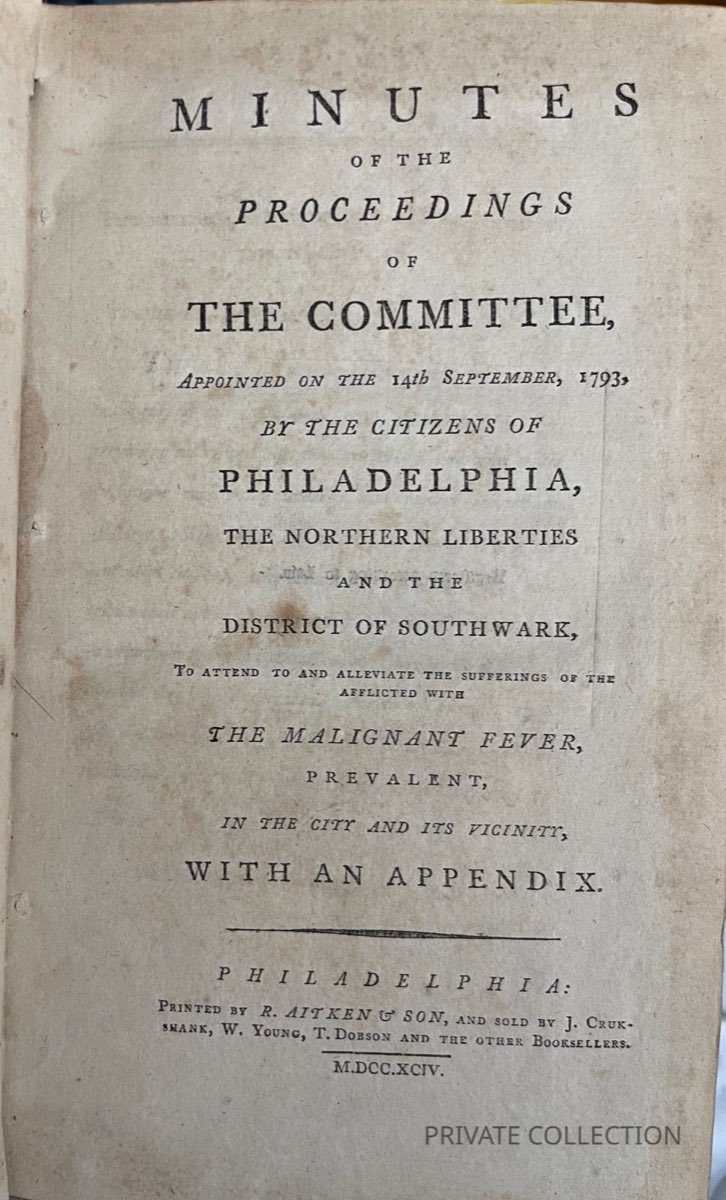
Minutes of the Proceedings of the Committee Appointed on the 14th September 1793
The official record of the citizens' committee that, in the epidemic's most desperate weeks, allocated Bush Hill as a hospital and empowered Jean Deveze to treat patients there with bark and wine. The committee's minutes are thus a direct document of the therapeutic controversy: by choosing Deveze over Rush's protocol at the one institution it controlled, the committee implicitly endorsed the tonic approach. The folding mortality tables are the most important demographic record of the 1793 epidemic.
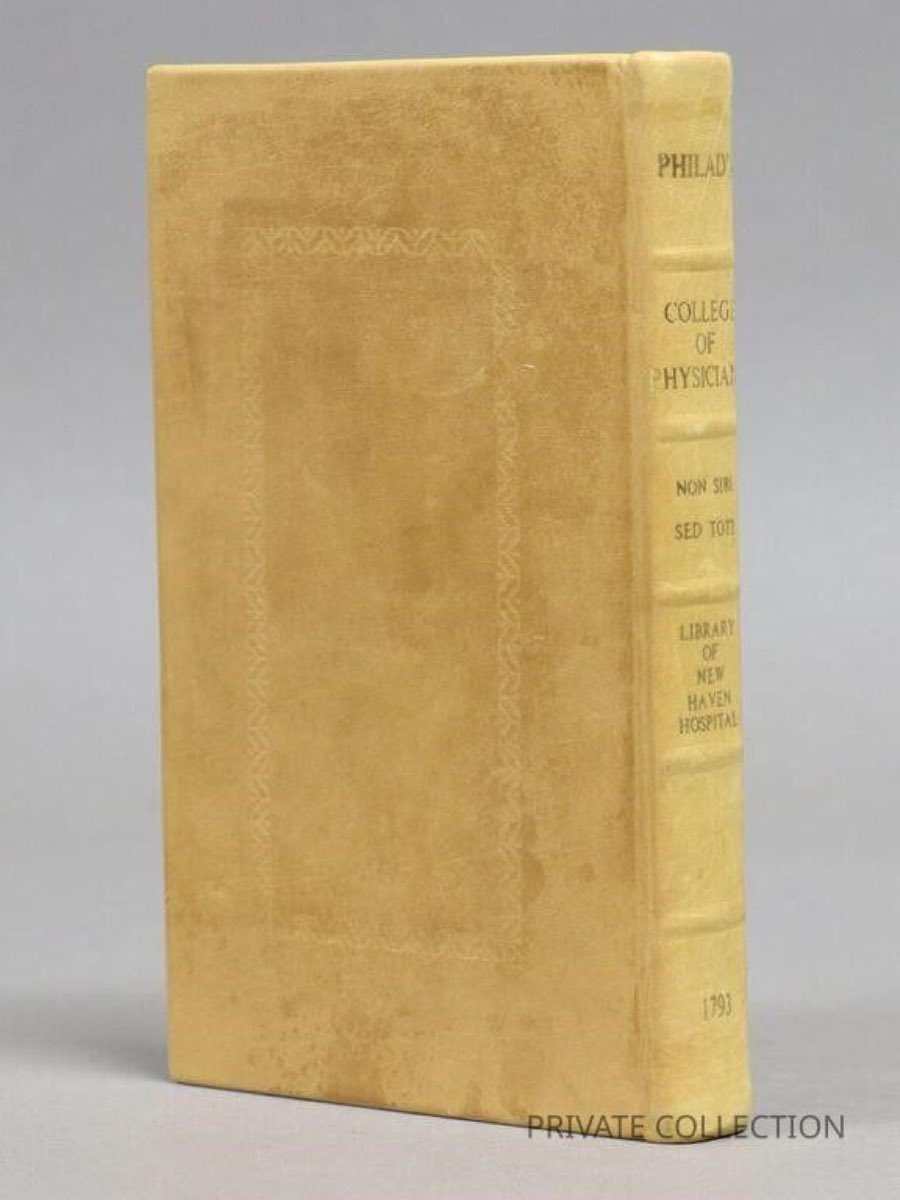
Transactions of the College of Physicians of Philadelphia, Volume I, Part I
The founding publication of the College of Physicians — the institution Rush helped establish in 1789 and with which he would spend the 1793 epidemic in open conflict. The irony is precise: Rush contributed to Volume I of the Transactions in the same year he was publicly opposing the College's position on yellow fever's origins and treatment. This copy's New Haven Hospital stamps place it in medical education a century after the controversy it documents.