
The Debate Continues
1800–1811: Rush's Final Arguments and the Literature of Retrospect
THE disease had retreated by 1800, but the argument had not. Caldwell published his major Medical and Physical Memoirs in 1801. A European voice arrived in translation in 1807. A remarkable student proved the non-contagionist position through experiments no ethical review board would ever have approved. And Rush himself — in letters, in publications, and in his Autobiography — went on arguing until two years before his death in 1813.
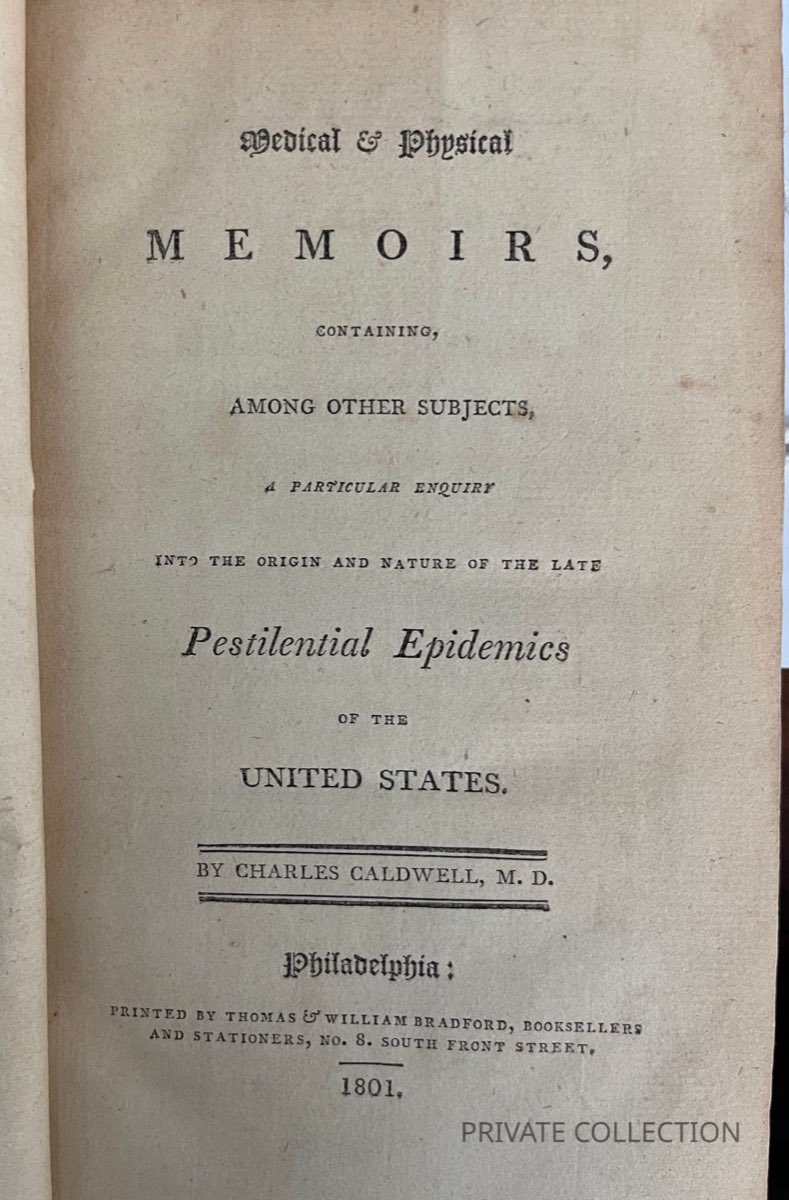
Medical and Physical Memoirs, Containing, Among Other Subjects, A Particular Enquiry into the Origin and Nature of the Late Pestilential Epidemics
Caldwell's major sustained inquiry into the Philadelphia epidemics of the 1790s, drawing on European and American literature to build the historical and comparative framework for his hybrid position. Closer to Currie than to Rush on some questions, closer to Rush on others, and ultimately his own man on all of them — Caldwell's Memoirs is what happens when a thoughtful physician refuses to be bound by the debate's established terms.
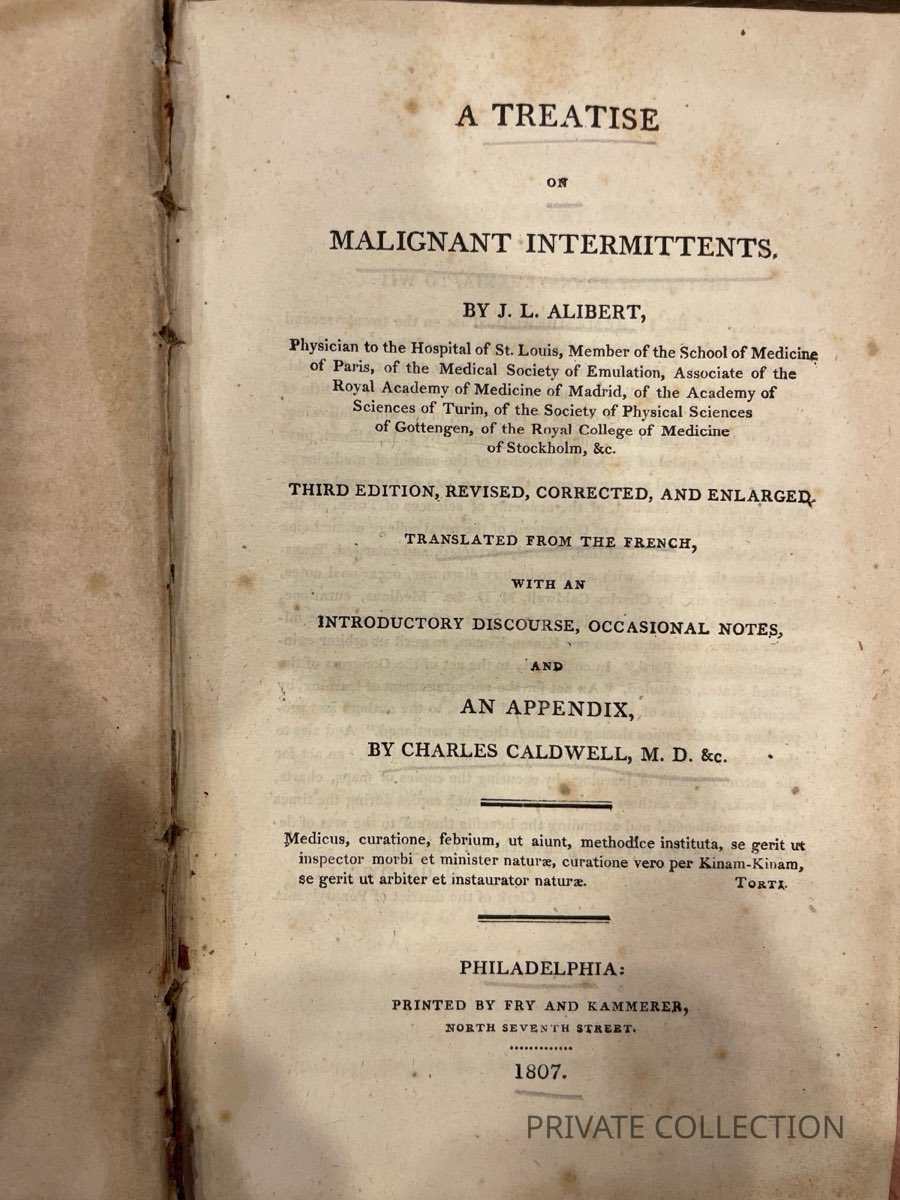
A Treatise on Malignant Intermittants (Third Edition, Translated by Charles Caldwell)
Jean-Louis-Marie Alibert — often called the father of dermatology, chief physician of the Saint Louis Hospital in Paris, and physician to King Louis XVIII — enters the Philadelphia debate through Caldwell's translation, which adds an appendix on the 1805 Philadelphia epidemic. Only one auction record survives for this title, from 1979. The translation is itself evidence of the debate's Atlantic reach: Caldwell imported a European framework to evaluate an American controversy.
Stubbins Ffirth was a University of Pennsylvania student in 1802 and 1803, and he wanted to settle the contagion question experimentally. He injected himself with blood and black vomit from yellow fever victims. He slept in infected bedclothes. He inhaled the vapors. He swallowed the material. He survived, and concluded — correctly — that yellow fever could not be transmitted by direct contact with the bodily fluids of the sick. His dissertation, published in 1804, is one of the most extraordinary documents in the history of medicine: a young man performing on himself what no ethics committee would permit a researcher to perform today.
Ffirth was right for the wrong reasons. He proved that contact with bodily fluids could not transmit the disease. He could not explain how the disease was transmitted, because the explanation -- mosquito bite -- lay entirely outside his experimental framework.
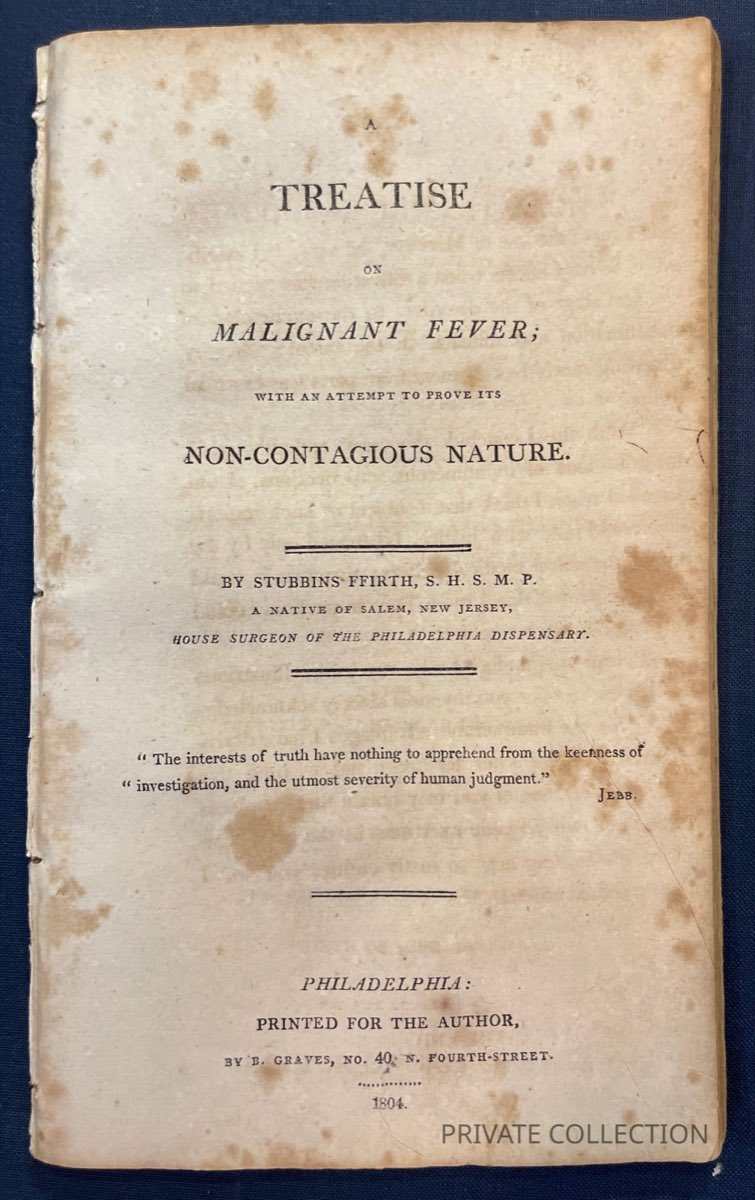
A Treatise on Malignant Fever; with an Attempt to Prove its Non-Contagious Nature
Fifteen self-experiments. Subcutaneous injections of fresh vomit, blood, bile, sweat, saliva, and urine from yellow fever victims. Ingestion of black vomit. Inhalation of its vapors. All survived. Conclusion: the disease is not transmitted by these routes. Correct. Mechanism identified: none. The mechanism was Aedes aegypti mosquitoes. The dissertation is simultaneously a monument to experimental courage and one of the most poignant documents in the history of medicine's long road to germ theory.
Rush's rare 1805 Inquiry — only five copies are known to exist, with no auction record since 2000 — is his final major theoretical statement on epidemic fever. Writing more than a decade after 1793, he had not moved. He was still arguing for domestic origin, still opposing contagion theory, still noting the correlation between standing water and mosquito activity and epidemic outbreaks without connecting them. He was looking directly at the mechanism and describing the symptoms. Jefferson's library held a copy. The collection holds two.
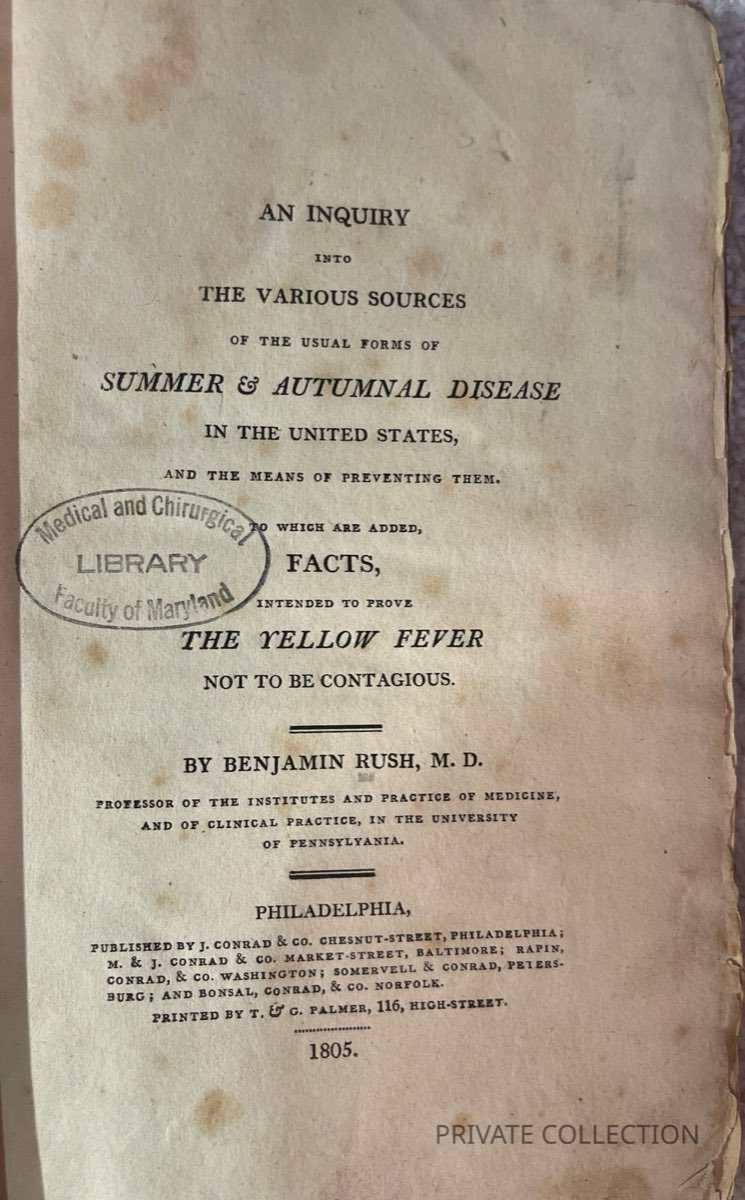
An Inquiry into the Various Sources of the Usual Form of Summer & Autumnal Disease in the United States
Five copies known. No auction record since the Laird Park Sale in 2000. Sowerby 922 places it in Jefferson's library. Rush's most sustained post-1793 statement on epidemic fever theory: the correlations between standing water, mosquito activity, and epidemic onset are all noted; the causal link is not made. He was within observational reach of the mechanism that would not be confirmed until Walter Reed's Cuba experiments in 1900.
An Inquiry into the Various Sources — INSCRIBED BY RUSH to "The Reverend Dr. Wharton from his friend The Author"
The Wharton family appears twice in the collection: the anchor letter (Cat. II.A) was addressed to James Wharton; Rush inscribed his rarest yellow fever publication to the Reverend Dr. Wharton years later. Two copies of the rarest Rush yellow fever title — one plain, one inscribed to a named recipient who appears elsewhere in the collection. This kind of retrospective coherence is the signature of a collection built around an argument.
Rush's last documented letter about yellow fever in the collection is the most incandescent. Writing to Samuel Latham Mitchill in 1811 — two years before his death — he learns that two Philadelphia physicians who had supported his domestic-origin theory have now changed their position. His response, invoking General Charles Lee's famous curse after his court-martial, is one of the finest expressions of Rush's character in any document the collection holds.
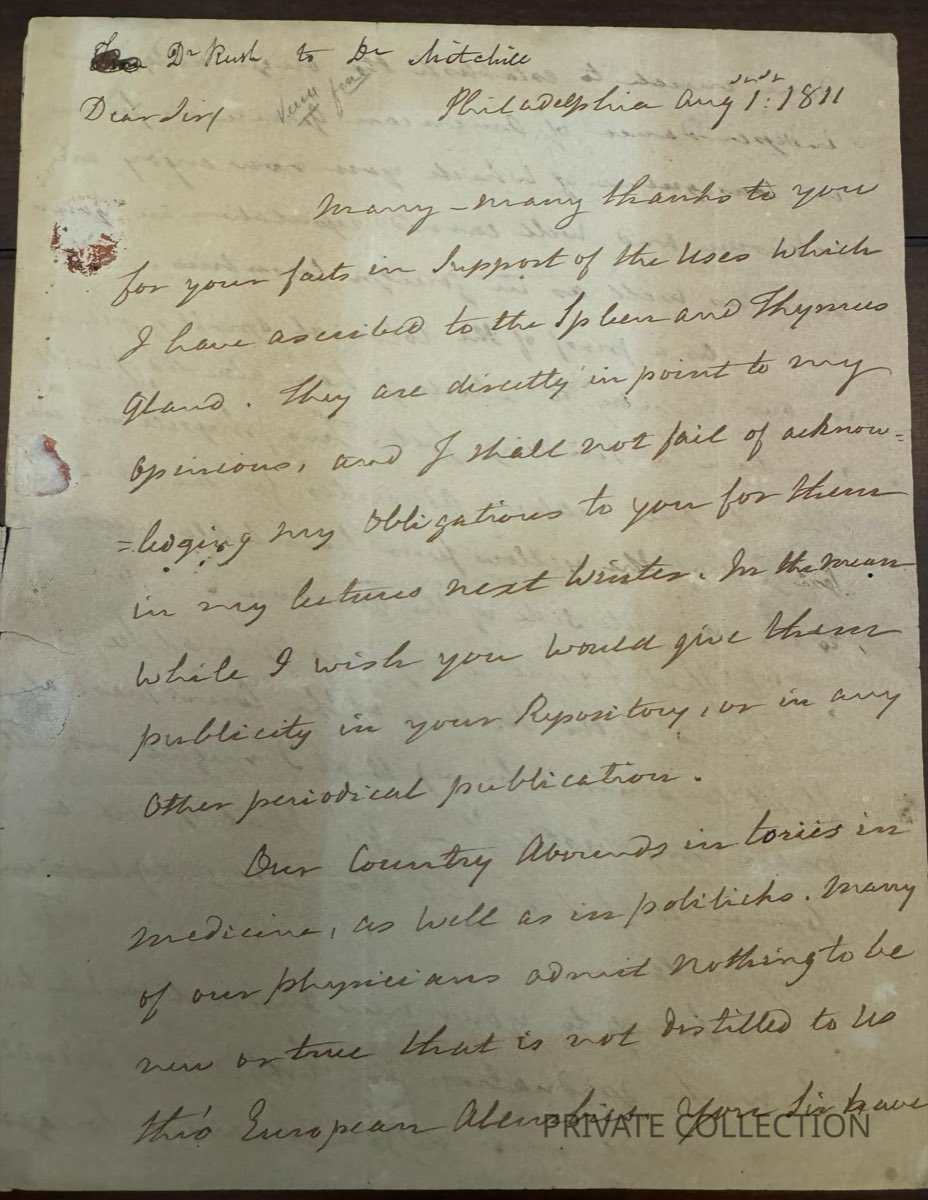
Autograph Letter Signed to Dr. Samuel Latham Mitchill, "Philadelphia Aug 1, 1811"
Two former localists have switched sides. Rush's response: "O! that I were a farmer that I might not call such physicians my bretheren." He also argues against the "colonial spirit of medicine in our country" that defers to European authority, praises Mitchill's Medical Repository for asserting American intellectual independence, and calls for harder medical education standards. Rush died in 1813. He never stopped arguing. This is the last shot.
The Philadelphia Medical and Physical Journal — the city's first medical periodical — published Rush's valedictory address to the University of Pennsylvania's medical graduates in 1805. Someone read it carefully and disagreed with nearly everything. Their marginal annotations survive in the collection's copy, a running argument in ink with a man who had been dead for decades by the time the annotated volume entered the trade.
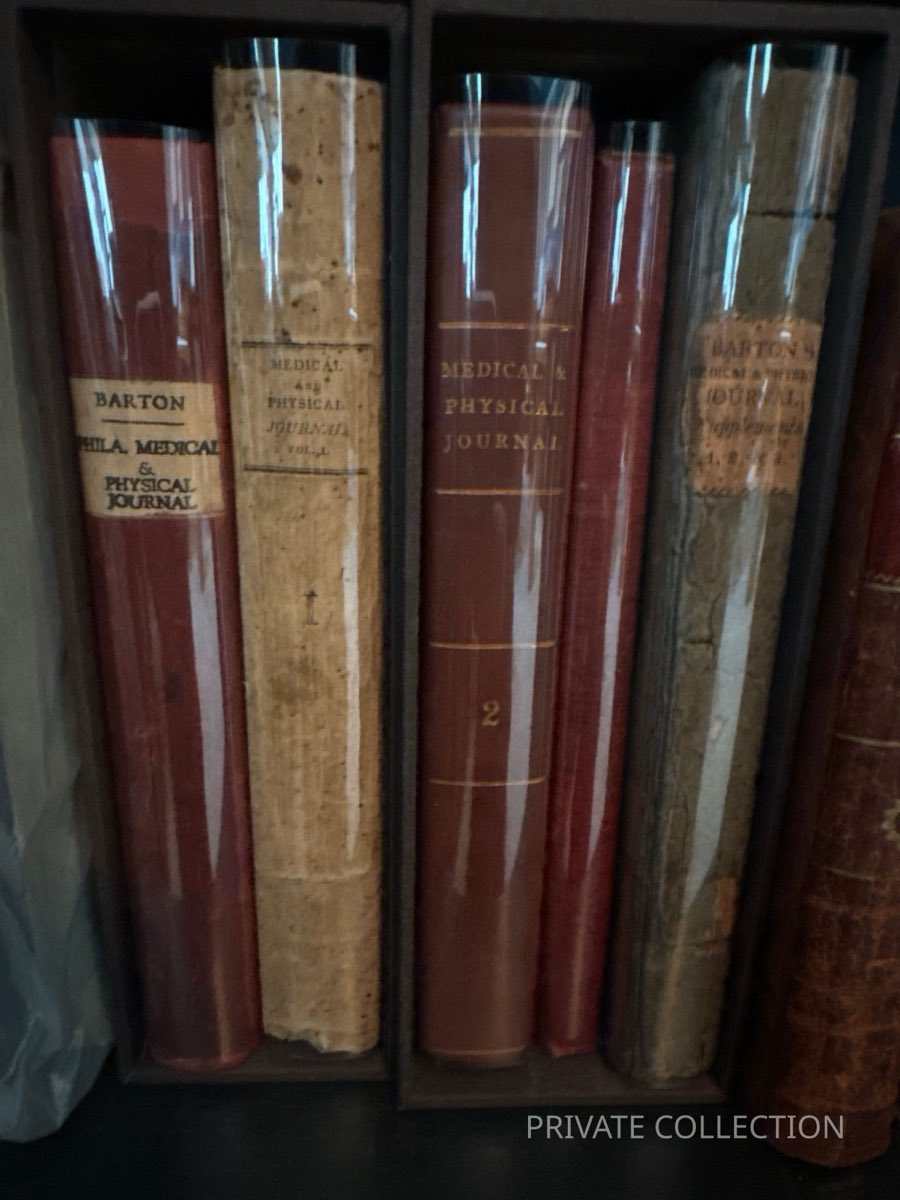
The Philadelphia Medical and Physical Journal — Complete Series: 3 Volumes + 3 Supplements
America's first Philadelphia medical periodical, complete in a run that Fox records no institutional copies of. The annotated Rush valedictory is the collection's most remarkable reading document: Rush's final formal address to the next generation of physicians, met in the margins by a skeptic who talked back. No auction record for a complete series. The first volume is unopened — perhaps never read. The annotated volume has been read with extraordinary attention.