
The Recurring Epidemics
1797–1799: The Disease Returns and the Debate Intensifies
YELLOW fever came back. It came back in 1794, and 1797, and 1798, and 1799 — each recurrence a new test of the competing theories and a new round of publications. The physicians who had debated so fiercely over 1793 now had more data, more dead, and more pamphlets. They had also, by 1798, organized themselves into institutions. Rush and his allies founded the Academy of Medicine of Philadelphia specifically to counter the College of Physicians' influence on public opinion. The institutional architecture of the debate had hardened. And the literature had become international.
The importationist cause received its most powerful outside reinforcement from a Scottish physician in the Caribbean. Colin Chisholm had been watching a disease he believed was novel — neither ordinary yellow fever nor plague, but something carried from the coast of Africa by a specific ship, the Hankey, which had traveled from the island of Bolama to Grenada in 1793 and thence to Philadelphia. If Chisholm was right, the 1793 epidemic was not domestically generated — it was brought in on a vessel. The argument over the Hankey became, in miniature, the argument over the whole epidemic.
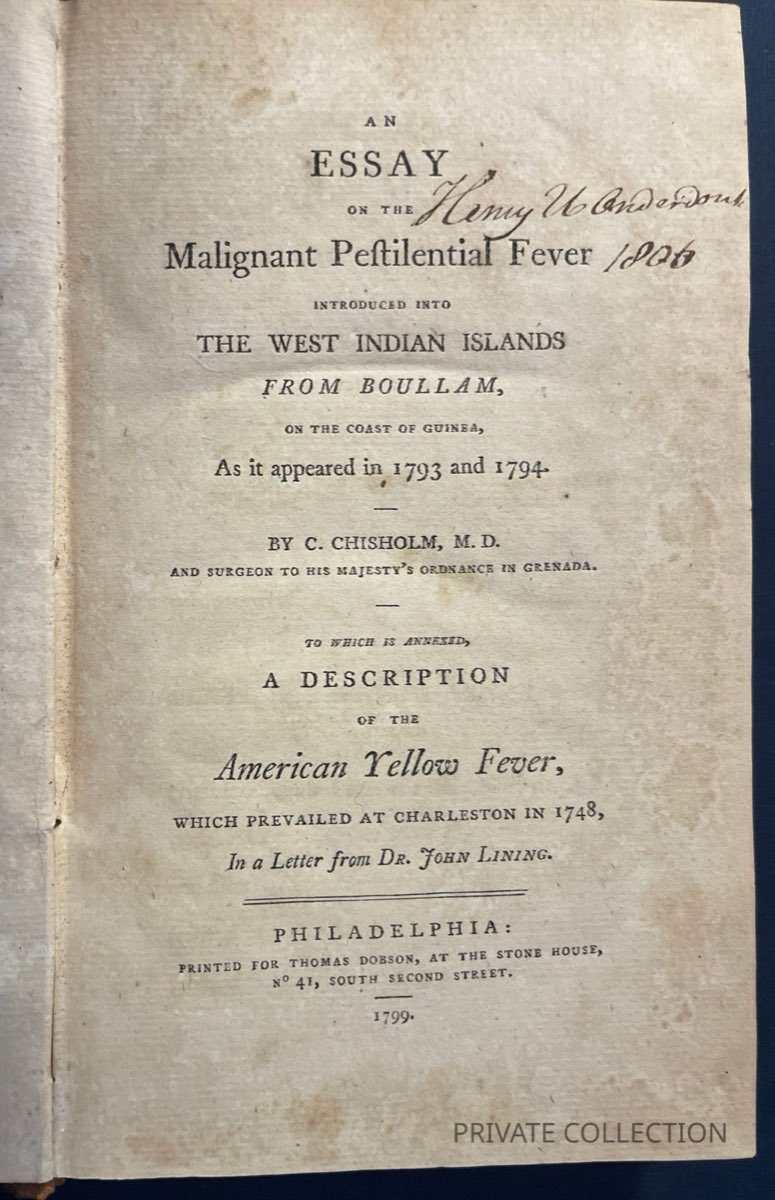
An Essay on the Malignant Pestilential Fever Introduced into the West Indian Islands from Boullam
The most important international contribution to the Philadelphia debate. Chisholm's "Hankey hypothesis" — that a single vessel carried a novel African fever to the Caribbean and thence to Philadelphia — gave the importationists their strongest argument. Rush dismissed it; Currie embraced it. The Chisholm essay is the moment the Philadelphia debate opens into its Atlantic dimensions, connecting to the history of the Haitian Revolution and the Saint-Domingue refugees who had been landing at Philadelphia's wharves all summer.
Noah Webster, the lexicographer and copyright reformer, brought an encyclopedist's method to the epidemic debate. He spent most of 1798 in libraries in Philadelphia, New York, New Haven, and Cambridge, reading everything published on epidemic disease, and by December 1799 he had produced the most comprehensive survey of epidemic and pestilential disease in the English language. Only 950 copies were printed. Osler called it "the most important medical work written in this country by a layman."
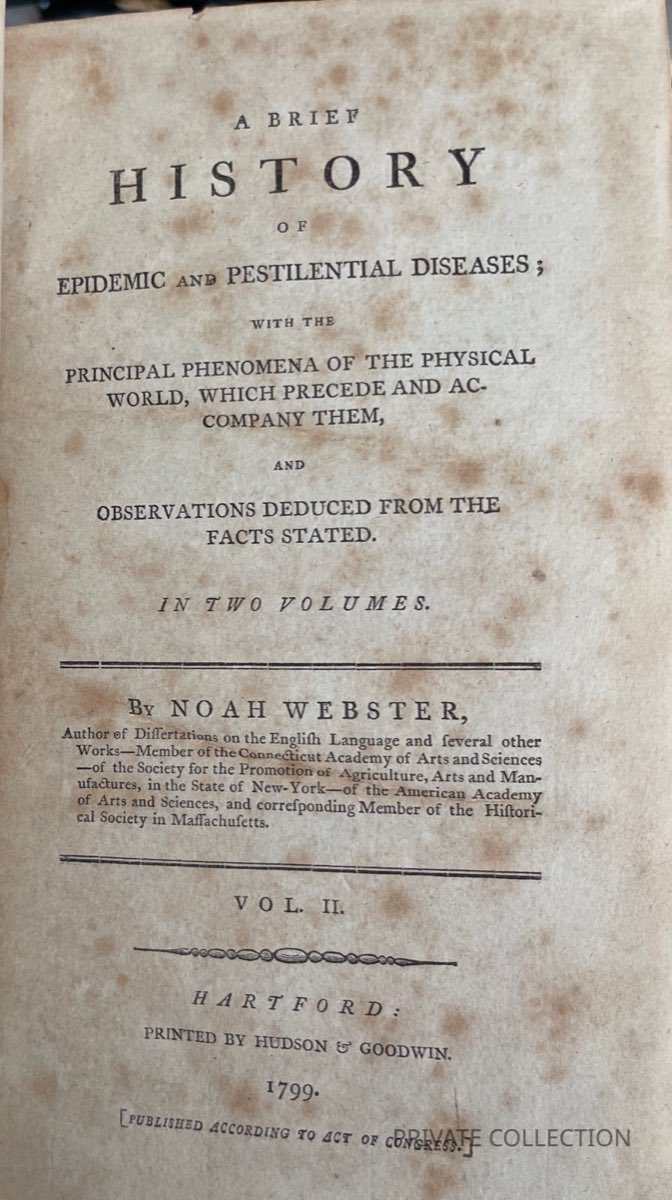
A Brief History of Epidemic and Pestilential Diseases (Two Volumes)
Webster's great contribution is the concept of "epidemic constitution" — changes in the atmosphere produced by some occult quality — and his careful distinction between specific contagion (smallpox), infection (typhus), and epidemic pestilence (yellow fever). He was, as C.E.A. Winslow observed, the best general summary of epidemiological opinion available at the century's turn. The New York medical institution bookplate on the second volume confirms its use in formal medical education.
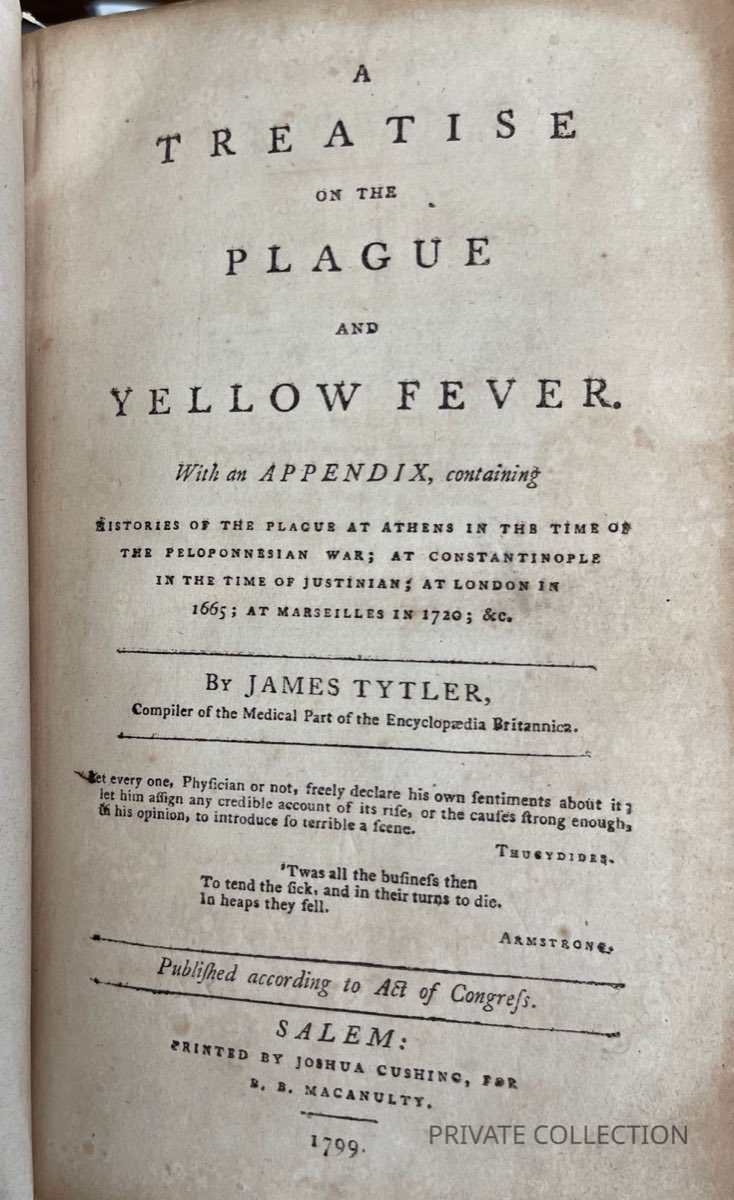
A Treatise on the Plague and Yellow Fever, with an Appendix Containing Histories of the Plague
James Tytler — editor of Encyclopaedia Britannica, second edition, Scottish exile, Salem newspaper editor — compiles the most internationally ambitious of the epidemic's American publications. The folding comparative table at the back ("A Comparative View of the Characters and Most Remarkable Symptoms of the Plague, Yellow Fever, Fever of Boullam, and of Philadelphia in 1793") places the epidemic in global pathological context that none of the combatants in the Philadelphia debate had attempted.
Charles Caldwell occupied the most intellectually honest position in the debate, which also meant the least satisfying to either side. A second-year medical student in 1793 when the epidemic struck, he emerged from it without the prior commitments that drove Rush and Currie to their entrenched positions. His 1799 oration before Rush's own Academy of Medicine argued that neither pure localism nor pure importationism was correct: local conditions were necessary but not sufficient, and some external contributing agent — not human contagion, but foul air from ship ballast — was required to trigger full epidemic spread.
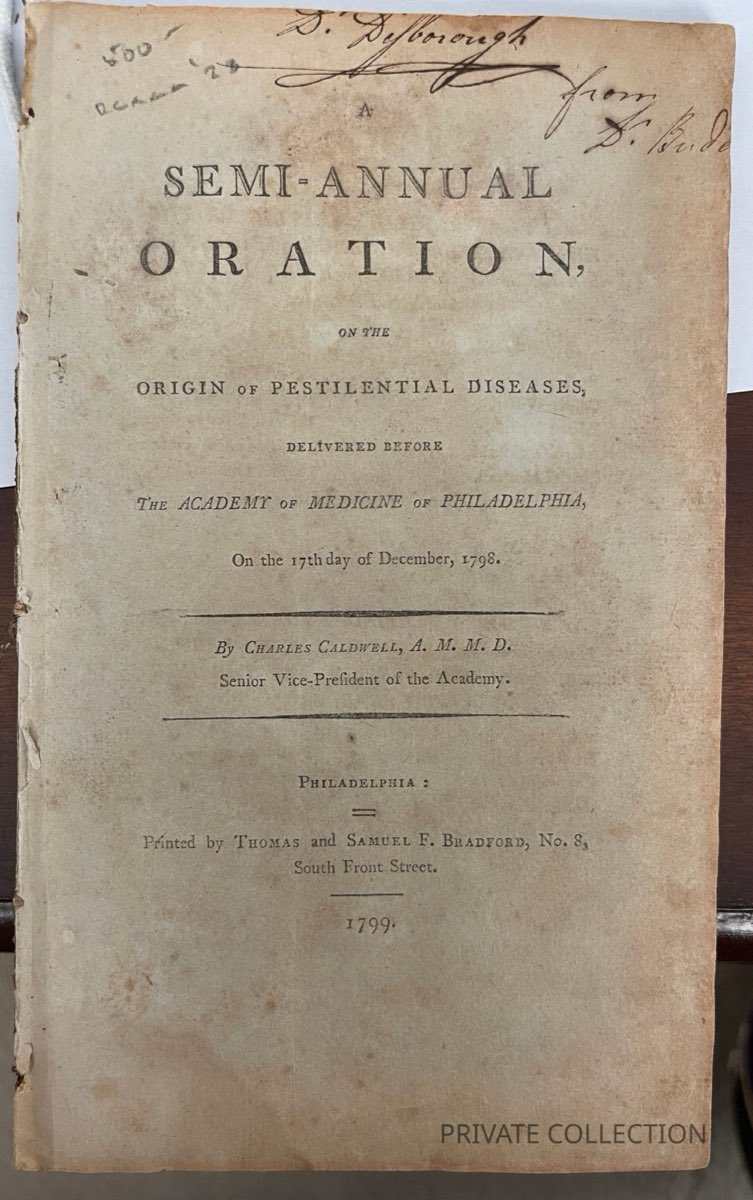
A Semi-Annual Oration on the Origin of Pestilential Diseases, Delivered before the Academy of Medicine
Caldwell's hybrid position satisfied neither Rush nor Currie, but it is in retrospect the most intellectually honest response to what was a genuinely complicated epidemiological picture. He was wrong about the mechanism — it was mosquitoes, not ship-ballast foul air — but he was right that neither pure localism nor pure importationism could account for all the evidence. He later founded the medical department at Transylvania University in Kentucky, spreading Rush's methods into the American interior.
The 1798 epidemic was, if anything, more thoroughly documented than 1793. The institutions were now organized, the publishing infrastructure was established, and both sides had learned how to produce pamphlets quickly. Rush and his allies at the Academy of Medicine published their "Proofs" — a title that said everything about the rhetorical posture. The College of Physicians issued its "Facts and Observations." The Governor's office requested a formal accounting from the hospitals.
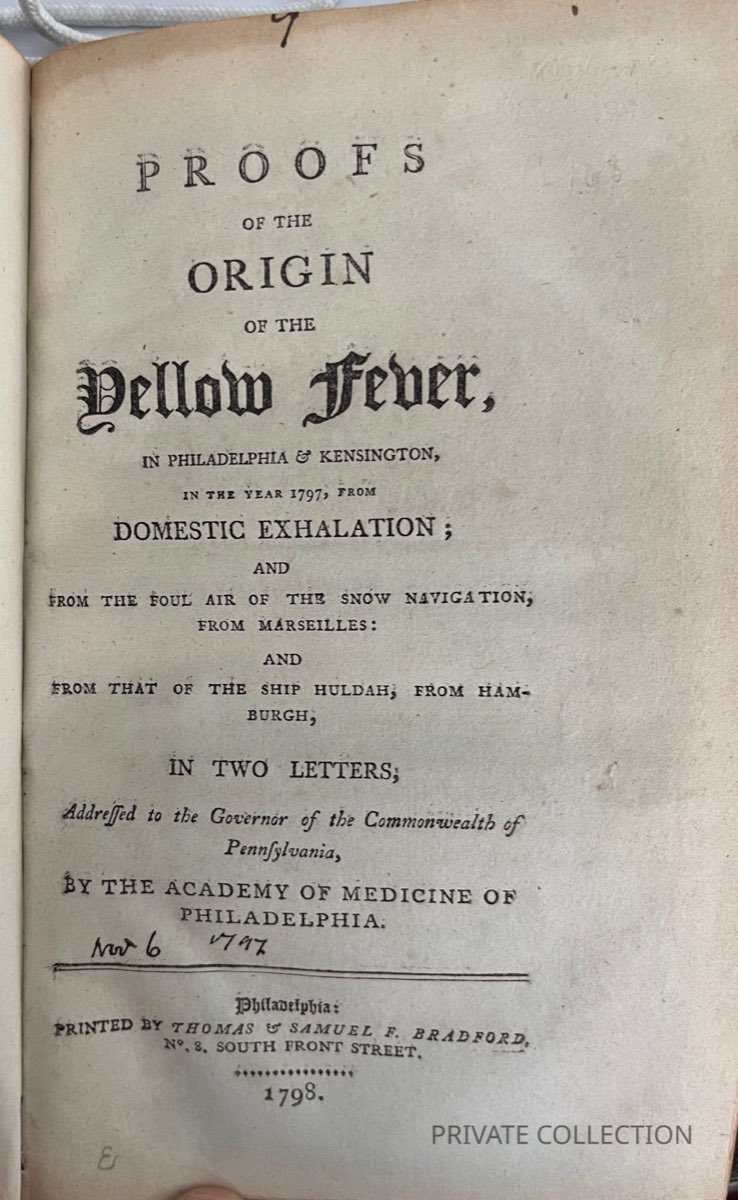
Proofs of the Origin of the Yellow Fever, in Philadelphia & Kensington, in the Year 1797
Rush acknowledged in his Autobiography that these pamphlets "fell dead from the press." They did not: they are here, in two copies (see also Cat. IV.F), documenting the localist position in its most formally organized institutional form. Signed by Rush, Philip Syng Physick, John Redman Coxe, Pascalis, and others — the roll call of Philadelphia localist medicine assembled into an authoritative body that still could not match the College's prestige.
Proofs of the Origin of the Yellow Fever — Second Copy, Part of Yellow Fever Pamphlets Sammelband
A second copy preserved without its preliminaries as part of a larger bound collection of epidemic pamphlets, demonstrating how these publications circulated, were stripped and rebound, and survived in the working libraries of contemporary readers. The existence of two copies — one fine and complete, one worn and incomplete — documents both the pamphlet's importance and its actual use.
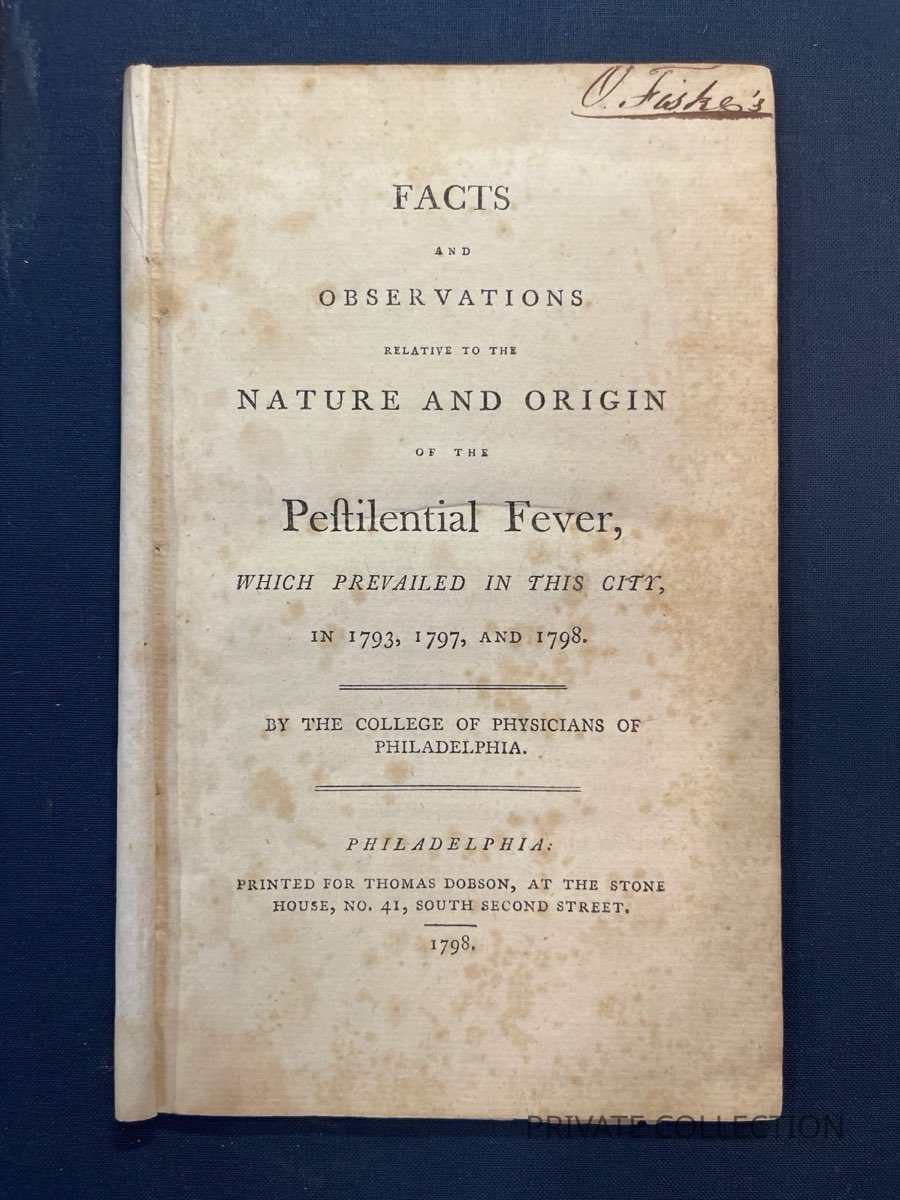
Facts and Observations Relative to the Nature and Origin of the Pestilential Fever
The College's definitive 1798 statement, reiterating after five years that yellow fever was both imported and contagious, and lamenting that no effective quarantine legislation had resulted. The ownership signature of Oliver Fiske, MD — Harvard-trained, Massachusetts Executive Council — confirms the national reach of the Philadelphia debate. Boston physicians were following this argument and acquiring the documentation.
Facts and Observations — Second Copy
A second copy, enabling direct textual comparison. The appendix letters dated December 26, 1798 suggest the complete work may not have been issued until early 1799 — the pamphlet war was moving faster than the dates on the title pages could accurately record.
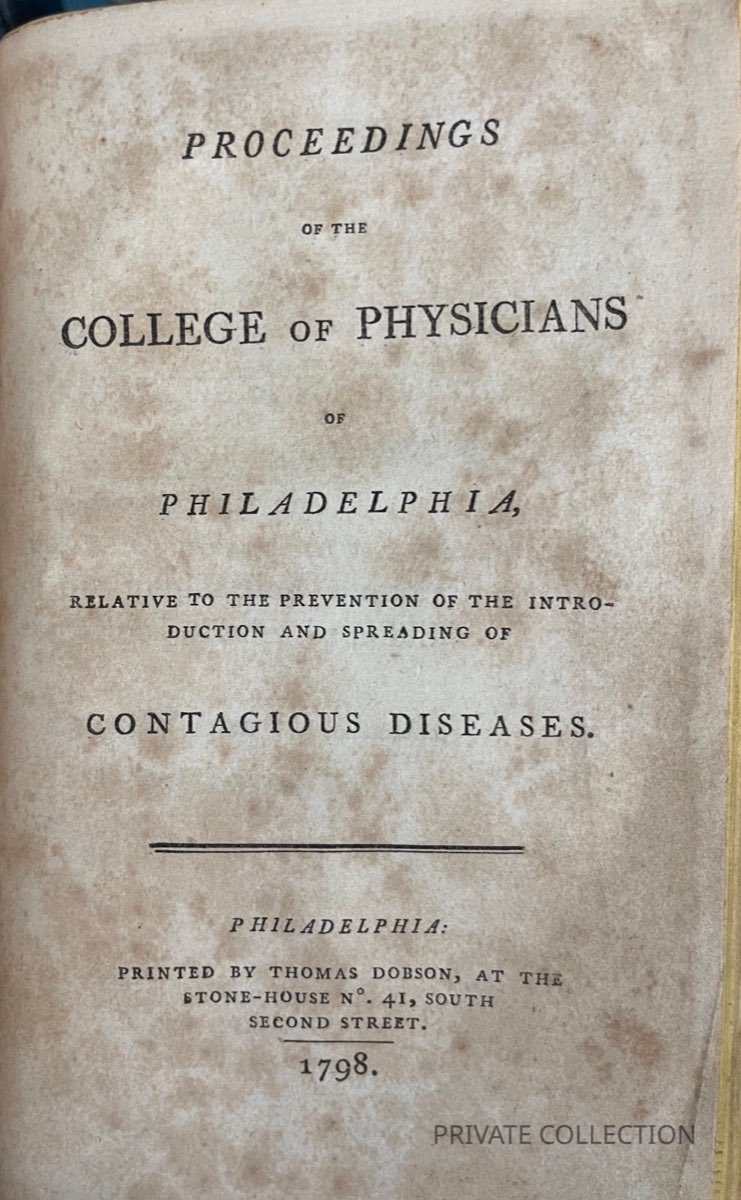
Proceedings of the College of Physicians of Philadelphia, Relative to the Prevention of Contagious Diseases
Four years of minutes, correspondence with Governor Mifflin, and formal recommendations — the institutional memory of the College's engagement with the epidemic. The correspondence with Mifflin reveals the impossible position of the state: consulting both the College and the Academy, receiving contradictory advice from equally credentialed physicians, unable to determine which theory was correct and therefore unable to act definitively on either.
Currie, meanwhile, had continued publishing. His Memoirs of the Yellow Fever documented the 1798 epidemic day by day; his Sketch of the Rise and Progress of the Yellow Fever documented 1799. Together, the four Currie publications in the collection form the most complete record of Rush's most persistent and formidable opponent — a record that has been almost entirely neglected by subsequent historians.
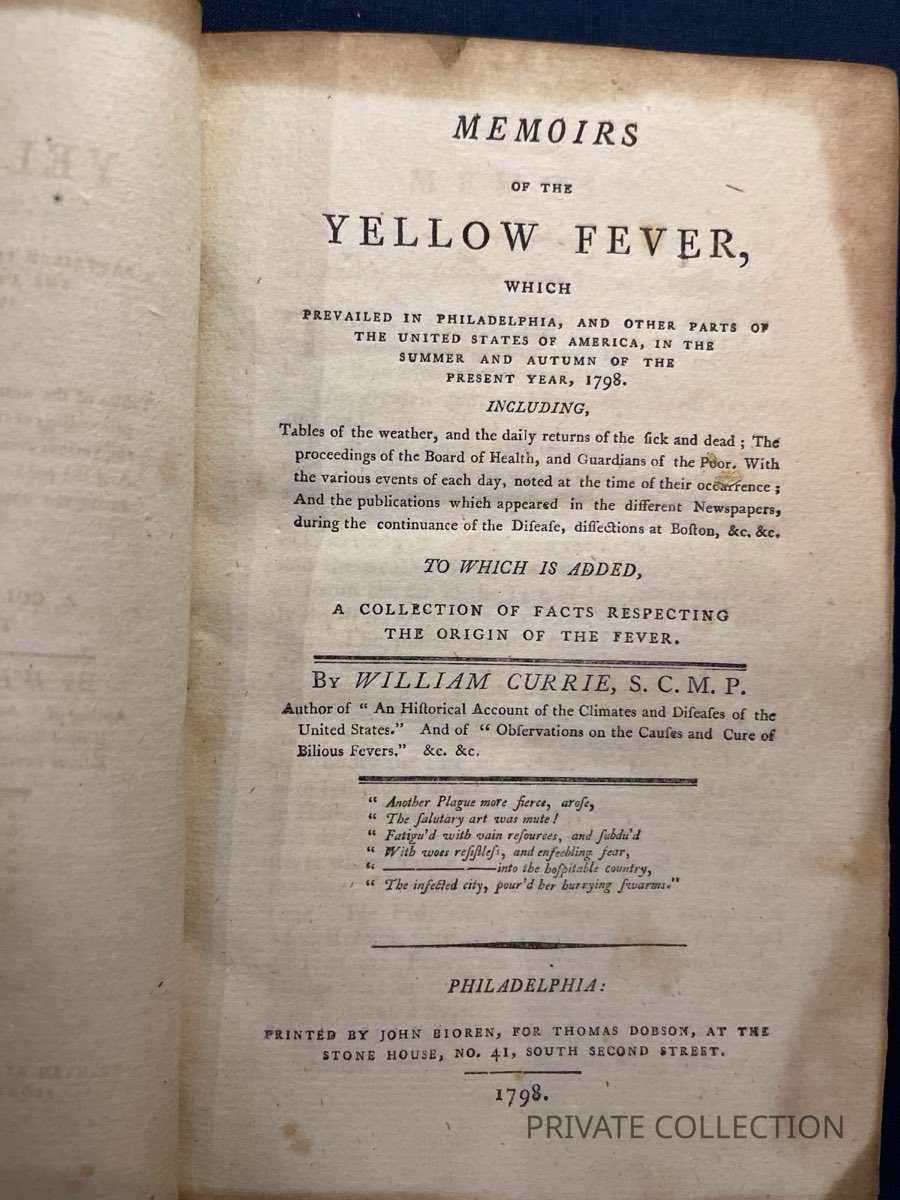
Memoirs of the Yellow Fever, which Prevailed in Philadelphia and other Parts of the United States, in 1798
A daily chronicle of the 1798 epidemic — tables of weather, returns of the sick and dead, newspaper accounts, Board of Health proceedings — that is simultaneously a medical diary, a public health record, and a press archive. Currie notes that his views have evolved since 1793. The willingness to acknowledge intellectual development distinguishes him from Rush; the willingness to publish those acknowledgments may explain why history has treated him less well.
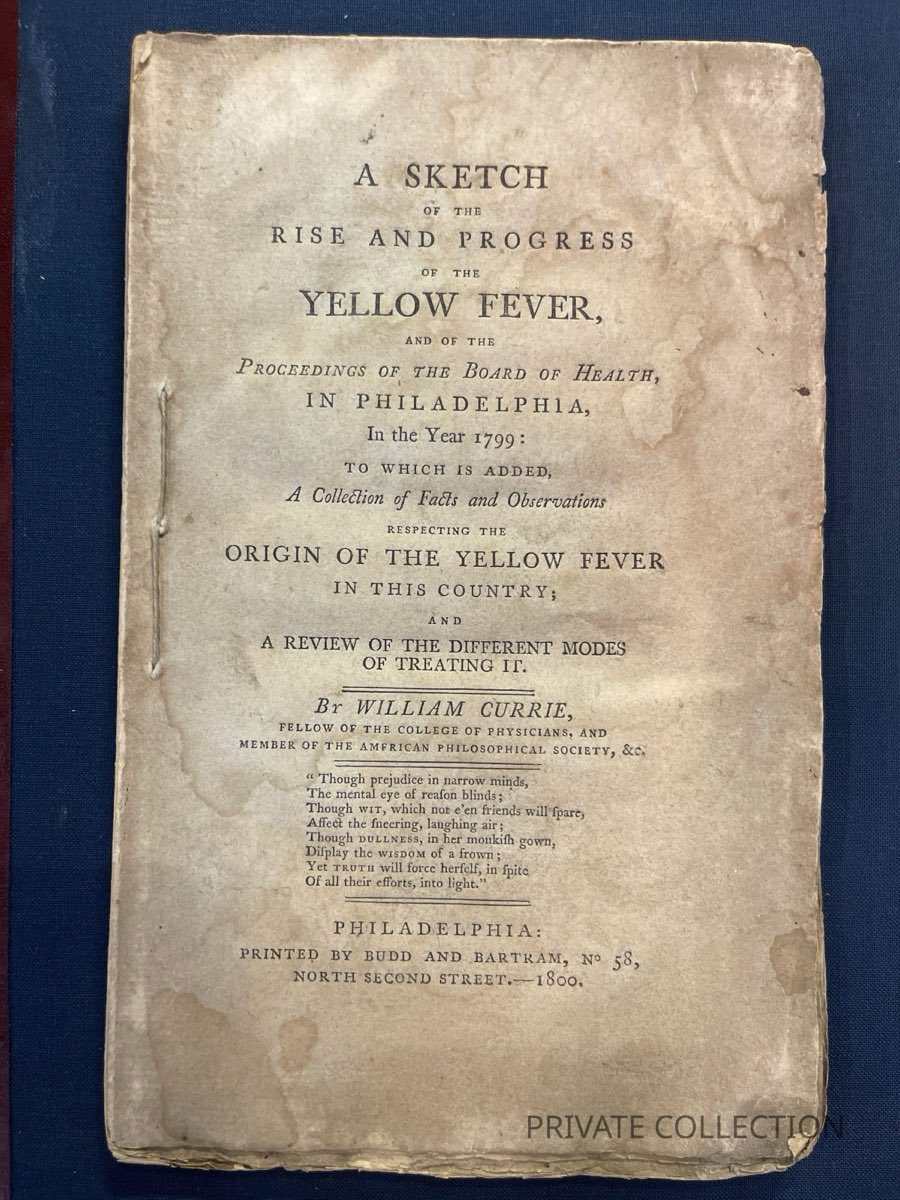
A Sketch of the Rise and Progress of the Yellow Fever, and of the Proceedings of the Board of Health, 1799
The rarest of Currie's yellow fever publications: no copy has been offered at auction since 1969. Includes an appendix on the New York epidemic communicated by David Hosack, the first extension of Currie's work beyond Philadelphia. The Preface acknowledges once more that his views have changed — intellectual flexibility that Currie wore openly and that Rush regarded as weakness.
Rush wrote to his former student McClelland from the sickbed of another epidemic — 1798, the fourth major outbreak — with the same urgency and the same certainty that had characterized his letters from 1793. He was sixty-two years old, treating patients, writing theoretical work on gout and hydrophobia, and still corresponding at enormous volume. The velocity of his engagement with the world even at the moment of maximum personal and professional pressure was one of the most remarkable features of his character.
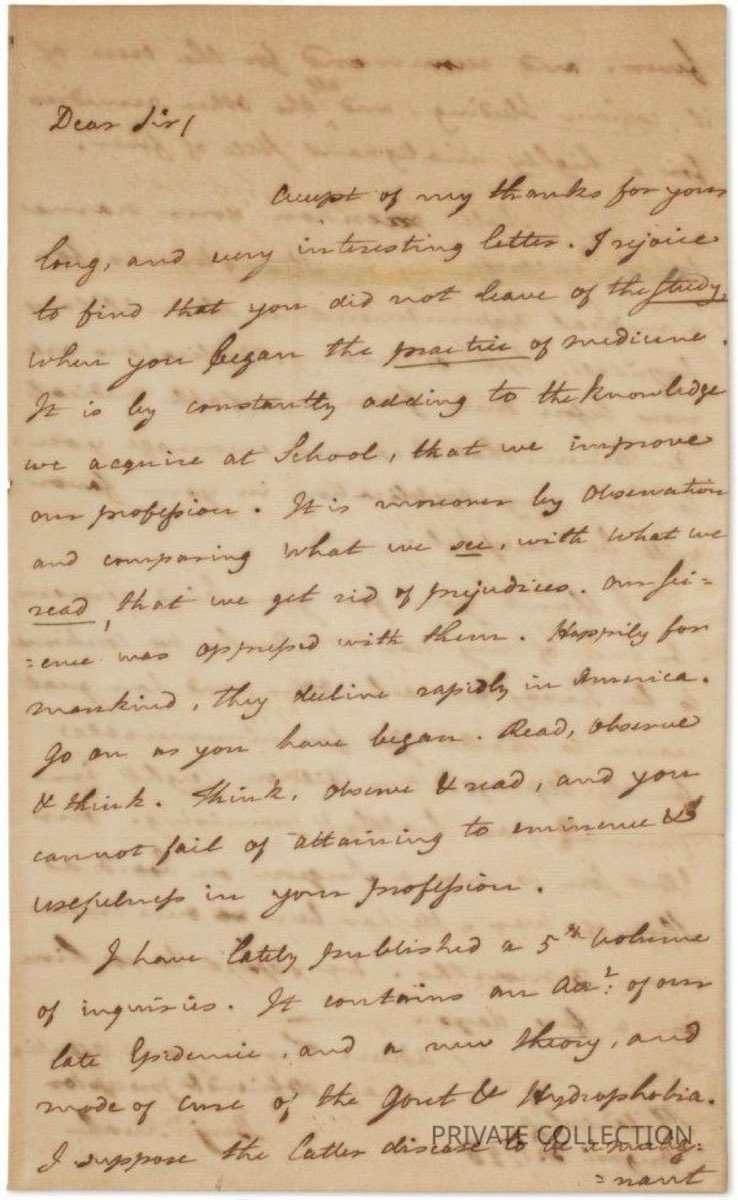
Autograph Letter Signed, "Philadelphia August 2, 1798"
Rush writes to Dr. John McClelland during the 1798 epidemic: advising continued study, announcing his forthcoming fifth volume, reporting his efforts to secure McClelland a military appointment. He mentions his eldest son serving as a ship's surgeon — the son who would later spend years in the Pennsylvania Hospital psychiatric ward, one of the most painful ironies in the life of the physician who wrote America's first treatise on mental illness.
The government attempted to close the question that the physicians could not. Secretary of State Dallas, writing on Governor Mifflin's behalf to the Philadelphia hospitals, requested a formal accounting of the 1798 epidemic's mortality and cost, and asked the hospitals to trace the disease to its origin. The hospitals' reply was frank: they had tried to identify the origin and could not. The state could not settle what the physicians could not agree on.
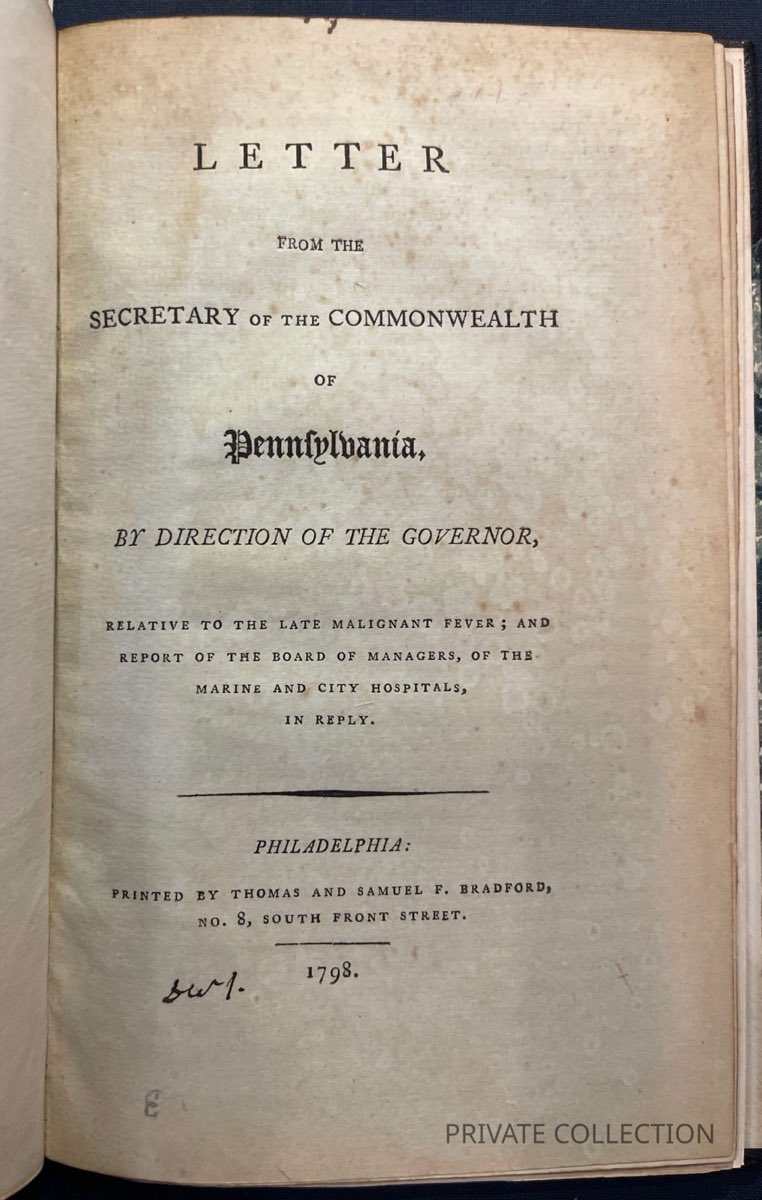
Letter from the Secretary of the Commonwealth of Pennsylvania, Relative to the Late Malignant Fever
The state's formal attempt to resolve a controversy it could not resolve: requesting origin, receiving admission of failure. The recommendation — to interdict commerce from the Mediterranean and West Indies during summer months — represents the practical consequence of the importationist position translated into policy. Whether or not the theory was correct, quarantine was the recommendation, and quarantine was what the importationists had always urged.
The epidemic of 1798 had a face: Hilary Baker, the mayor of Philadelphia, who had refused to flee the city while most of the wealthy and powerful did exactly that. He stayed, kept the city's government functioning as best he could, and contracted yellow fever. He died in office on September 25, 1798. An anonymous broadside elegist found him in the morning papers.
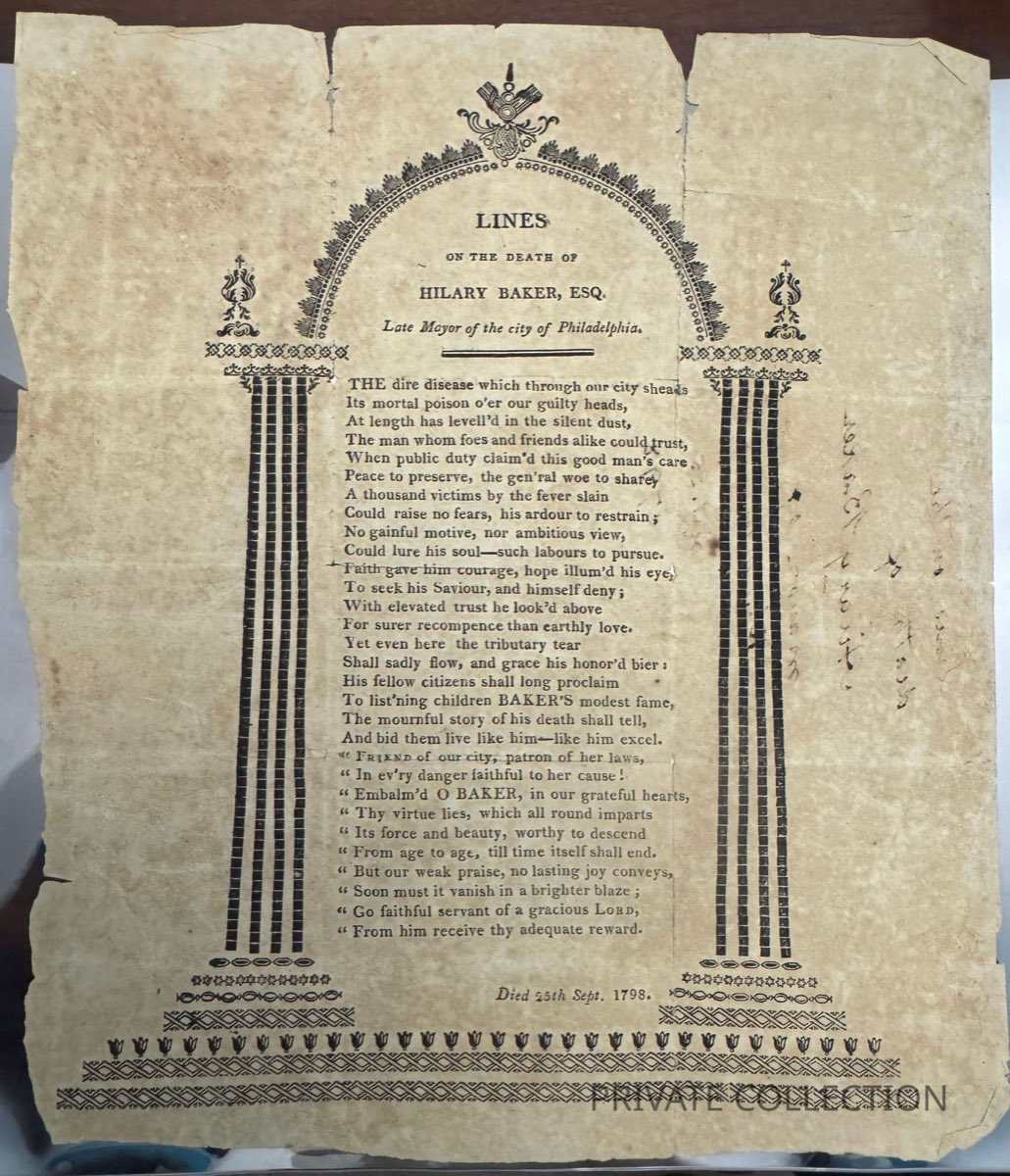
(Broadside) Lines on the Death of Hilary Baker, Esq., Late Mayor of the City of Philadelphia
Unrecorded in all standard bibliographies: a genuine discovery. The thirty-line elegy begins: "The dire disease which through our city sheads / Its mortal poison o'er our guilty heads, / At length has levell'd in the silent dust, / The man whom foes and friends alike could trust..." Baker is the civic counterpart to Rush's physician: the man who stayed when others fled, who chose duty over safety, who died for it. The ornamental border matches one used by Robert Aitken on a Washington elegy in 1800.
Condie and Folwell published the most even-handed account of the 1798 epidemic — a deliberately balanced narrative that included documents from both the College and the Academy, from the Board of Health, from the newspapers — and appended to it something no other publication had attempted: sixty-eight pages listing, by name, all 3,521 people the disease had killed that year.
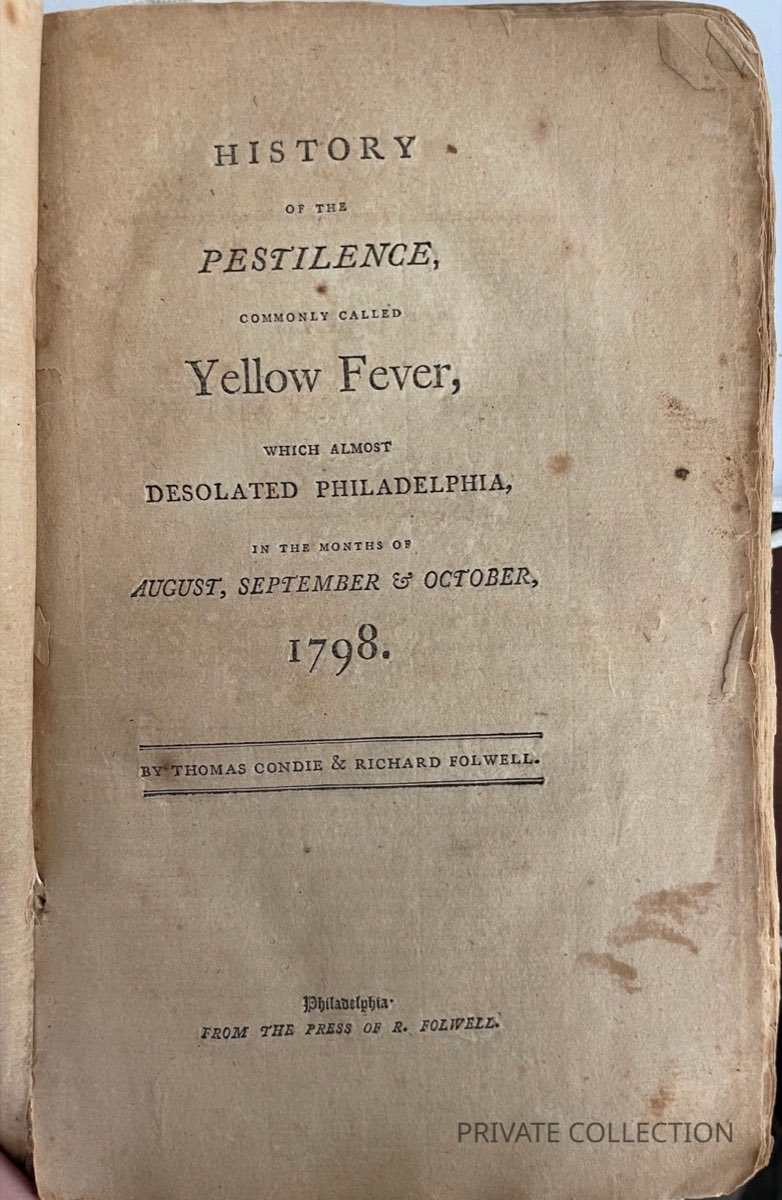
History of the Pestilence, Commonly Called Yellow Fever, which Almost Desolated Philadelphia, August-October 1798
The most useful single-volume account of the 1798 epidemic: balanced where Rush and Currie were partisan, documentary where the physicians were theoretical, and haunted at the end by 3,521 names. The final sixty-eight unnumbered pages — a list of the dead by name — are among the most significant demographic documents of any early American epidemic.
The epidemic's first fiction appeared in 1799. Charles Brockden Brown set his novel Arthur Mervyn in the Philadelphia of 1793, and the epidemic is not atmosphere or background — it is protagonist. Brown had stayed in Philadelphia during the 1793 crisis, unlike Carey. His Mervyn walks into the dying city and survives it, witnessing what most survivors could not bring themselves to describe directly: the silence of streets normally crowded with commerce; the dead carts; the empty hospital at Bush Hill where Deveze was saving patients with the very treatment Rush was dismissing as fatal.
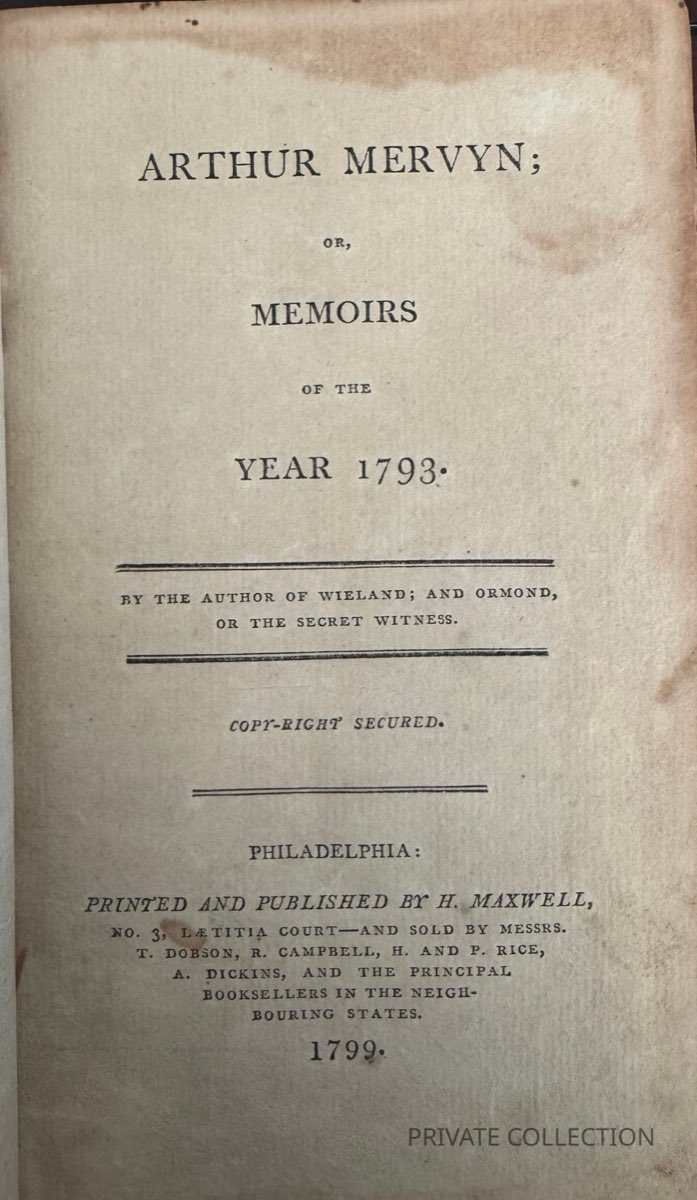
Arthur Mervyn; or, Memoirs of the Year 1793 — By the Author of Wieland and Ormond
The first professional American novelist sets his second book inside the epidemic, and produces the most vivid document of what 1793 Philadelphia felt like from the ground. Brown had been there. His descriptions — Loshe called them "unshrinking realism" — are the medical controversy's emotional reality: not positions in a pamphlet war but the actual experience of a city learning to die. Traded for S. Weir Mitchell books.