 EIS LIBRIS
EIS LIBRIS
EIS LIBRIS
Manuscript, Philadelphia, 9 February 1764. One page, laid down on cloth 1764
BF-2024.132
 Click to enlarge
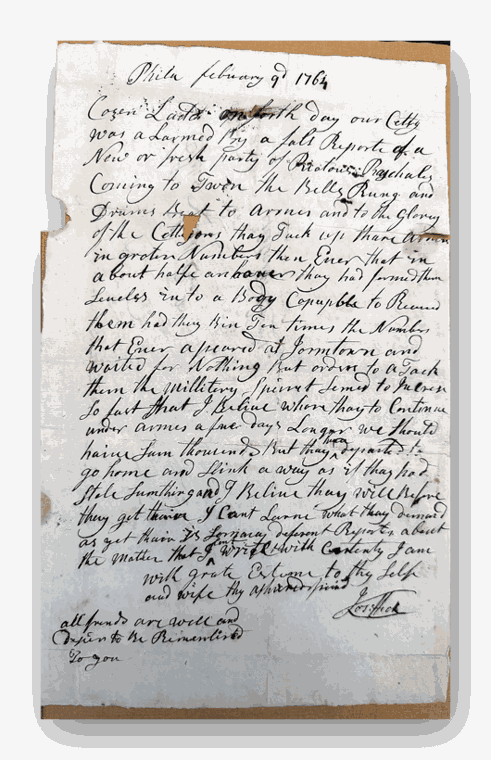
Written two days after Franklin and the Governor's commissioners met the Paxton men at Germantown and persuaded them to go home. On the morning of the fourth day, Wednesday 8 February, a false report ran through Philadelphia that a fresh party was on the road. The writer describes what followed: the bells rung, the drums beat to arms, and to the glory of the citizens they took up their arms in greater numbers than ever, so that within about half an hour they had formed themselves into a body capable of receiving the marchers had they been ten times the number that ever appeared at Germantown, and waited for nothing but orders to attack them. He adds that the military spirit seemed to increase so fast that had they continued under arms a few days longer the city would have had some thousands; but that the Paxton men had departed for home, and would slink away as if they had stole something. He cannot yet learn what they demand, there being so many different reports that he cannot write with certainty.
The letter is a Quaker's. He dates by fourth day, addresses his cousin as thy self, and closes as thy assured friend. That a Friend should report with evident satisfaction that the city had taken up arms is the tension of the whole Paxton crisis in a single sheet, and it is the tension Henry Dawkins mocked in The Paxton Expedition the same year.
The recipient belonged to the Ladd family of Gloucester County, across the Delaware. The senior member, John Ladd, was the justice of the peace to whom Charles Read addressed the open letter that Andrew Steuart printed in Philadelphia in 1764, advising the Jersey magistrates what the law required of them if the Paxton men crossed the river. Read's letter is the official Jersey voice of the crisis. This is the private one, written in the same week.
People in this record
Back to The Beginning of the End