 EIS LIBRIS
EIS LIBRIS
EIS LIBRIS
Burlington, New Jersey, 19 September 1769
BF-2026.007
 Click to enlarge
3 photographs of this object
4pp. manuscript (2 sheets measuring 8 x12.75 in).
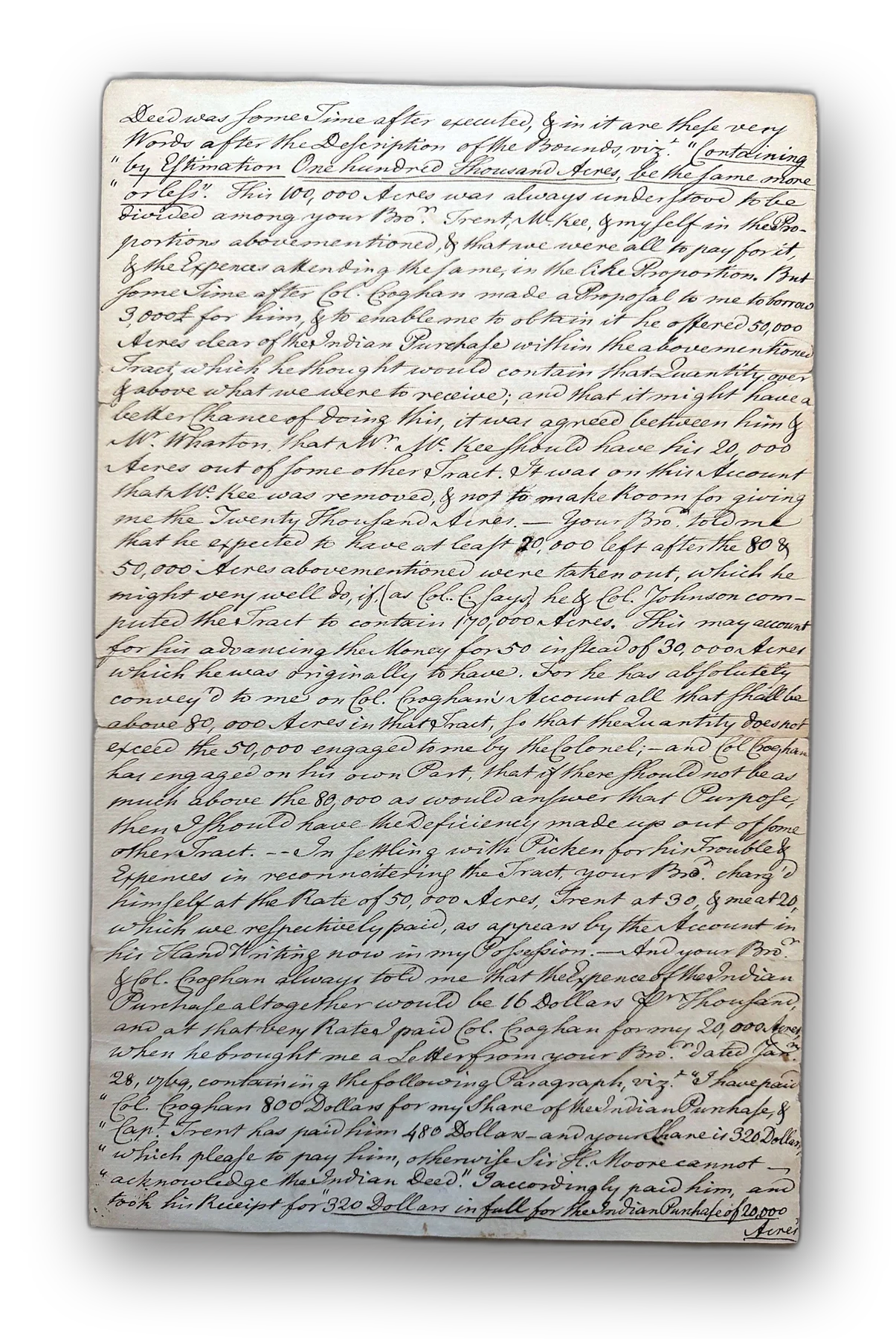
A previously unrecorded letter sent by William Franklin (1730-1813), the last royal governor of New Jersey, to Thomas Wharton the elder (1731-1784), one of his business associates, discussing land speculation, particularly the Otsego (here called “Otaga”) tract in western New York, and the payments owed to and from various parties, including the Burlington Company, Colonel George Croghan (1718-1782), and the Six Nations of the Iroquois. The tract comprised approximately 170,000 acres of Iroquois land, which was to be purchased and split between numerous shareholders, including Croghan, his assistant Alexander McKee (1735-1799), his longtime partner William Trent (1715-1787), a fur trader and land speculator, speculator brothers Thomas and Samuel Wharton (1732-1800), and Benjamin (1706-1790) and William Franklin. This letter is an important witness to the financial maneuvering necessary for British colonial western expansion in the wake of the Fort Stanwix Treaty of 1768.
At the close of the Seven Years’ War, the Proclamation Line of 1763 was established to prevent British colonial settlement on lands west of the Allegheny mountains, ceded by the French as part of the treaty, largely as a measure to pacify the French’s Native American allies. However, numerous British settlements already existed west of the boundary line, in what was called Ohio Country, and many more traders and investors already had claims and grants to large tracts of land which they now found themselves unable to capitalize on. Colonial officials as well as businessmen were implicated in the management of these tracts, and throughout the 1760s, numerous land grant companies were formed to advocate for colonists’ rights to use their investments. Eventually, authority was given to William Johnson (1715-1774), the superintendent of Indian Affairs for the Northern Department, to renegotiate the boundary line with the Native Americans concerned, primarily the Iroquois Confederacy and their allies. A large gathering was held in the autumn of 1768 at Fort Stanwix, in the Mohawk Valley of upstate New York, with some three thousand Native Americans present, as well as colonial officials from Pennsylvania, New Jersey, and Virginia, plus numerous speculators and merchants. William Franklin was among them. In November, a treaty was signed, moving the boundary line further west, running roughly south from Fort Stanwix to Fort Pitt and then southwest following the Ohio River as far as its confluence with the Tennessee River.
This meant that a great deal of land in central and western New York was newly open to British settlement, and the land speculators were ready. Franklin was one of a number of colonial elites with prior claims to the land, as he had been involved in land companies formed before 1763. Legally, only the governor was allowed to purchase Native American land, and could only convey 1000 acres to individuals, but Croghan, Johnson’s deputy superintendent of Indian Affairs, was experienced at circumventing such rules. The present letter concerns some 170,000 acres of land around Lake Otsego, near Fort Stanwix, which had already been surveyed by Croghan, in an arrangement with McKee and Trent. The survey was financially backed by the Franklins, as well as speculator brothers Thomas and Samuel Wharton, all of whom were also partners with Croghan and Trent in various other land companies. (Another man mentioned in the present letter, Picken, had evidently also participated in surveying the tract, but he has not been traced).
However, as William Franklin discusses at length in this letter, there were questions as to the true extent of the land surveyed for him (80,000 vs. 100,000 acres, or more) and which parts were purchased by whom and at what rates, depending on what Croghan had agreed to pay the Native Americans. Franklin was seeking clarity not only for himself, but for the Burlington Company, one of many land grant companies formed in the wake of the Fort Stanwix treaty, comprising some eight well-to-do New Jerseyan shareholders (the other members of the Burlington Company refused to deal with Croghan except through Franklin, as Croghan had a tendency to not pay his debts on time). Moreover, Croghan already owed several thousand pounds to Franklin, who held several of Croghan’s mortgages, and part of the Otsego tract (or adjacent land) was to be conveyed to Franklin in lieu of cash payment. Evidently numerous letters from Croghan, Trent, Thomas Wharton, and Franklin had crossed paths in August and September 1769, and Franklin was writing to Wharton to clarify everything. “I have been more prolix than I intended,” he writes at the bottom of page 3, “but I was not willing to omit any thing that occur’d to me which might tend to explain the matter to you.”
The matter was not easily settled. There are letters held at the American Philosophical Society dated between December 1769 and January 1771, also written by Franklin to the Whartons, continually ironing out the details of who owed what to whom. Some settlement of the tract did occur in the early 1770s (a town of Burlington exists just west of Lake Otsego even today), but many of the figures mentioned in the present letter were Loyalists, and between poor financial management and the political upheaval of the 1770s, none besides the Whartons saw a true return on their western investments. Franklin, who never allied with the patriots (much to his more famous father’s shame), fled to England and subsequently relinquished most legal and financial claims to his American property. Croghan, in ill health for much of 1769, quickly lost control of his lands in New York as various tracts were conveyed back and forth to settle his debts, and he spent most of the 1770s instead speculating in western Pennsylvania and Ohio. Trent and Samuel Wharton had traveled to England in early 1769 to petition for royal grants to the land (thereby circumventing the need to maneuver for a governor’s favor), but ultimately remained in legal limbo in London for 6 years. Trent and the Whartons, also at this time seeking a royal warrant for the Indiana grant, joined forces with other land investment companies to form the Grand Ohio Company, with plans to form a colony called Vandalia in what is now Kentucky and West Virginia. But the Revolution called, and that never came to fruition.
Manuscript letters (as opposed to signed printed documents) from William Franklin are incredibly rare in the trade. Only one other such letter has been traced on the market, and this one is much longer than the 1777 letter found in the Jay Snider collection. Importantly, it provides a great deal of evidentiary material about Franklin’s business dealings and land speculation, an underexplored part of Franklin’s biography. In all, a rare and important manuscript.
People in this record
Back to The Beginning of the End