 EIS LIBRIS
EIS LIBRIS
EIS LIBRIS
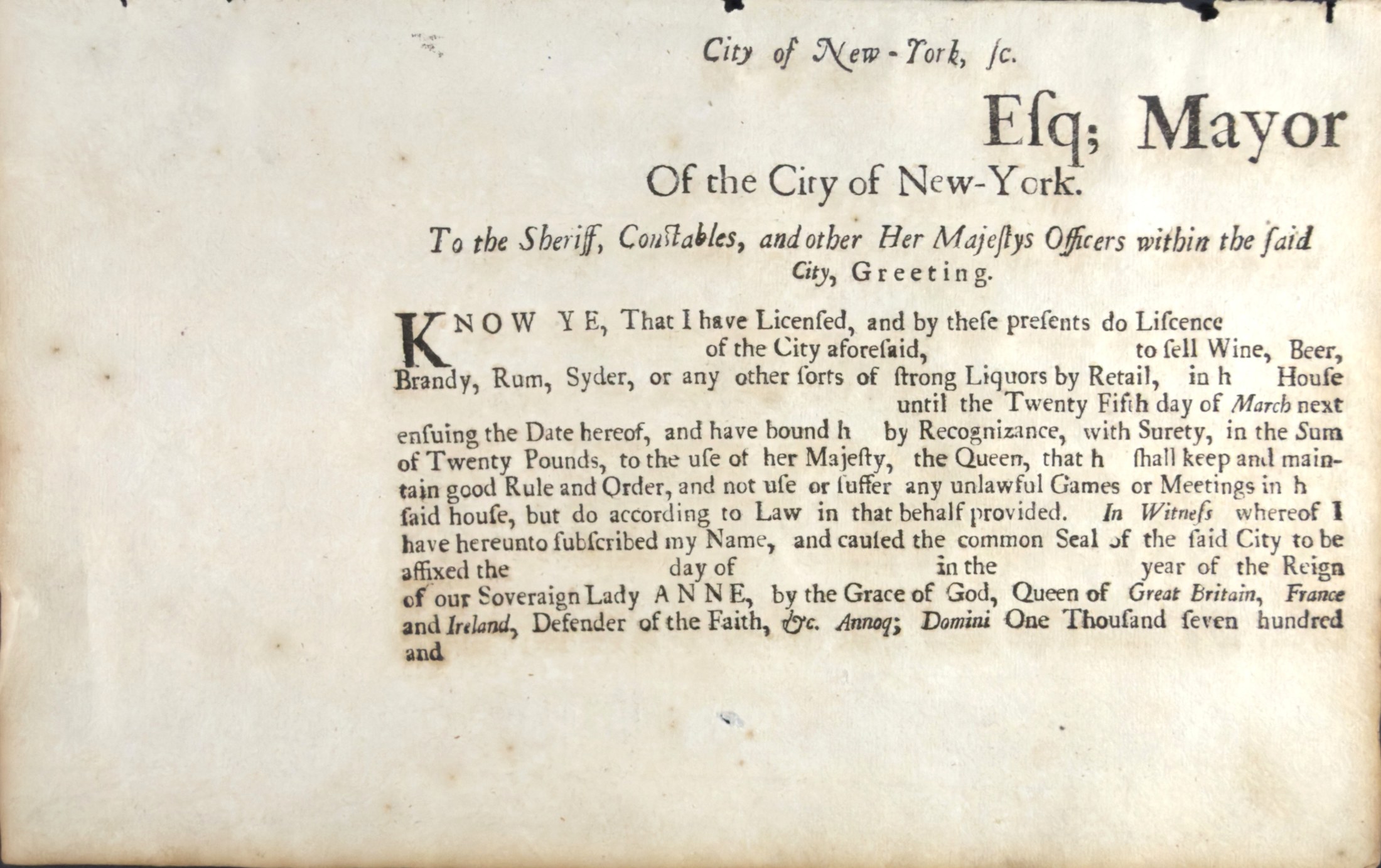
Printed blank form, New York: William Bradford, [1702-1714]
BF-2026.300
 Click to enlarge
1 photograph of this object
Franklin arrived in a Philadelphia that had lost its first printer. William Bradford opened a press there in 1685, two years after the city itself began, and a bookshop in 1688. His printing of Quaker controversy and of George Keith's attacks on the Meeting brought him before the courts, and in 1692 the authorities took his types and paper. New York's council wanted a printer of its own, and in 1693 it got him. He worked there until his death in 1752, and Philadelphia had no press at all for a time after he went.
This sheet is what such a printer lived on. The mayor's office needed licences to sell drink, and it bought them by the ream, printed with gaps for a clerk to fill in. The text licenses a man, his name still blank, to sell "Wine, Beer, Brandy, Rum, Syder, or any other sorts of strong Liquors by Retail" in his house until the twenty-fifth of March next, on a recognizance of twenty pounds with surety, provided he "keep and maintain good Rule and Order, and not use or suffer any unlawful Games or Meetings" there. The blanks for the name, the house, the day and the regnal year were never filled, so the form survives as it left the press.
The date comes from the last lines, which name "our Soveraign Lady A N N E, by the Grace of God, Queen of Great Britain, France and Ireland, Defender of the Faith." Anne reigned from 1702 to 1714, and in those years no one else was printing in New York. The form is therefore Bradford's, and it belongs to the first twenty years of printing in that city.
Evans and Bristol record no copy, and no earlier licence of this kind from a New York press appears to be known. OCLC reports examples at five institutions: the Library Company of Philadelphia, the John Carter Brown Library, Middle Tennessee State University, the New-York Historical Society and the American Antiquarian Society.
Bradford's son Andrew brought the family trade back to Philadelphia in 1712 and published the American Weekly Mercury, the city's first newspaper. He was Franklin's competitor for a quarter of a century, and there is a piece of his job printing in this room as well.
People in this record
Back to The Printing-House