EIS LIBRIS
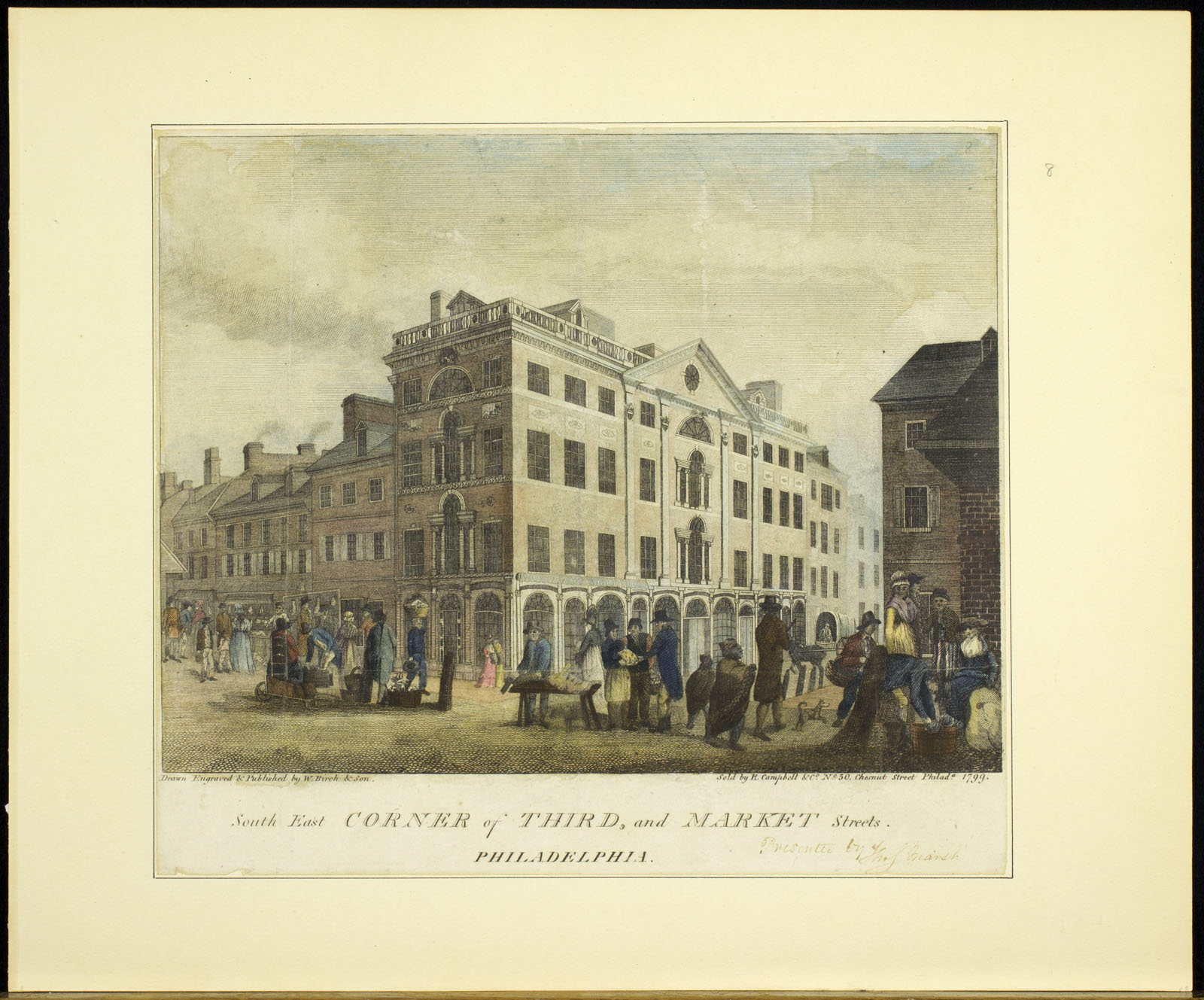
The south-east corner of Third and Market Streets, from Birch's Views of Philadelphia, 1799. Franklin's New Printing-Office stood a few doors from this corner.

Room 1 of 10

The Printing-House

Philadelphia in type, 1718 to 1766

The south-east corner of Third and Market Streets, from Birch's Views of Philadelphia, 1799. Franklin's New Printing-Office stood a few doors from this corner.

A printing-house in the 1730s was a shop of three or four men, one wooden press, a few hundred pounds of type imported from London, and a stock of paper that had to be bought before anything could be printed on it. It made its living not from books but from blanks: bonds, indentures, land warrants, summonses, bills of lading, the forms on which a colony runs. The printers called this job printing. It was dull, it was constant, and it paid for everything else.

A colonial press lived on three kinds of customer: the government, which paid for laws and forms; the religious societies, which paid for tracts and paid promptly; and the private client with a bond to sign or a book to publish. Between 1735 and 1748 Franklin's shop served all three, and served them well enough that at forty-two he could hand the daily work to a partner and walk away rich. The paper of those years is the ordinary paper of a province, rare now, in most cases, precisely because it was ordinary then.

Benjamin Franklin came to the trade young. He was born in Boston in 1706 and apprenticed at twelve to his older brother James, who printed the New-England Courant, one of the first independent newspapers in the colonies. He ran away at seventeen and reached Philadelphia in 1723 with almost nothing, worked for a printer named Samuel Keimer, spent eighteen months in London learning the trade properly, and opened his own shop in 1728. From it came the Pennsylvania Gazette, a weekly newspaper he bought from Keimer in 1729 and made the best in America; Poor Richard, an almanac he wrote and printed every year from 1733; the laws of the Pennsylvania Assembly when the Assembly paid him to print them; and blanks, every other day of the week.

What Franklin chose to print for himself, rather than for a customer, tells you what he valued. In 1744 he issued the first classical text published in the colonies for its own sake, James Logan's translation of Cicero on old age, and set it with a care he gave to nothing else. A year later he printed the first medical treatise written and published in America. Both were, in the commercial sense, failures. Both were the point.

The Great Awakening reached Philadelphia in November 1739 in the person of George Whitefield, and Franklin, who admired the preacher, doubted the doctrine, and could estimate a crowd to the thousand, became his printer. He ran Whitefield's letters in the Gazette and reprinted them as pamphlets. When the critics complained that no Philadelphia printer would print anything against the evangelist, Franklin printed the critics. The press was neutral, and neutrality paid.

He was not alone in the trade. Andrew Bradford had been printing in Philadelphia since 1712 and published the American Weekly Mercury, the city's first newspaper, from the Sign of the Bible in Front Street. He was also the postmaster, which mattered a great deal, because the post carried the newspapers and a printer who controlled it could keep a rival's paper off the roads. Franklin took the postmastership from him in 1737 and the two fought for the same customers until Bradford died.

As with Franklin learning the trade from his brother, Philadelphia printing was a family business. After Bradford died in 1742 his widow Cornelia carried the Mercury on for four years, at first in partnership with his former apprentice Isaiah Warner, and his nephew William Bradford III opened a rival paper, the Pennsylvania Journal, in Second Street and stayed Franklin's competitor for the next twenty years. In Germantown, five miles up the road, Christopher Saur printed in German for the largest German-speaking population in the colonies, and his son printed after him. Franklin answered with a succession of German partners, Crellius, Bohm and Armbruster, and never caught him.

None of it could happen without supplies. The paper came from mills on the Wissahickon Creek and from Thomas Willcox at Ivy Mills in Chester County. The type came from William Caslon in London, ordered through Franklin's friend and agent William Strahan, because no type was cast in America until the 1770s. The ink Franklin made himself from lampblack and varnish, and sold to other printers. This room follows all of it, from a book printed in Keimer's shop while Franklin was working there to the last sheets carrying his name in January 1766.

No press stood alone. Franklin's shop had rivals it displaced, partners it financed, and heirs it trained. The press he sent to Antigua came home to Burlington, where James Parker used it in 1765 to print the first history of New Jersey, sold in Philadelphia by David Hall: the Franklin network, complete in one imprint. Benjamin Mecom, the son of Franklin's sister Jane, failed on four presses his uncle set up for him. He had Franklin's blood and none of his luck. In Newport, Rhode Island, the press James Franklin carried from Boston passed to his widow Ann, and then to their son.

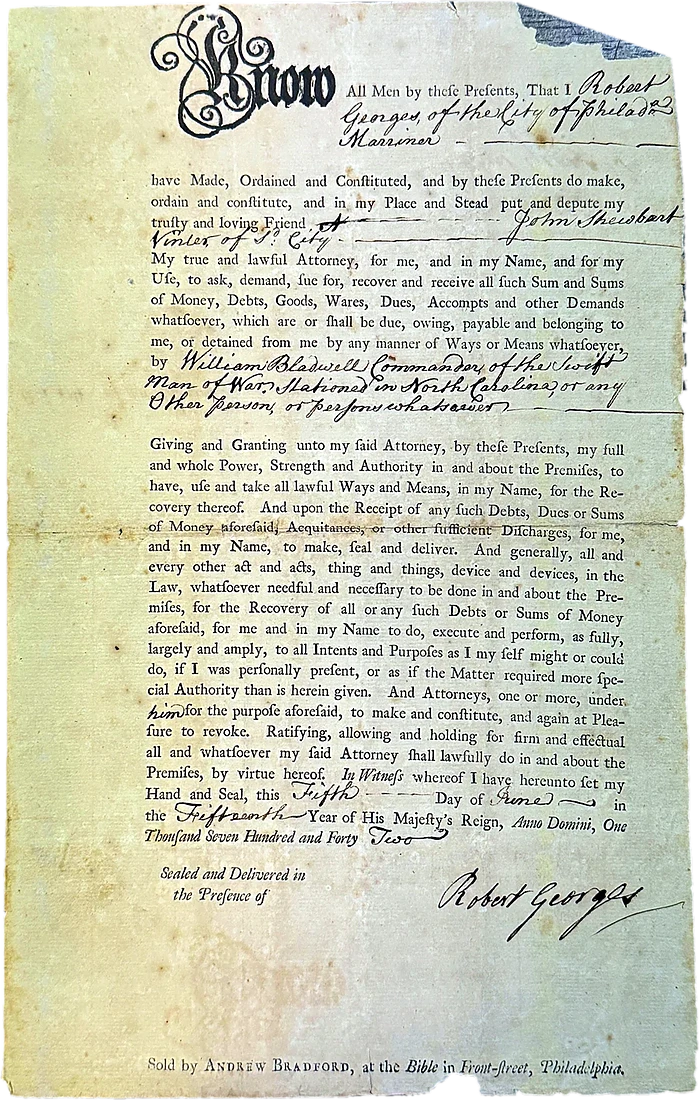
Know All Men by These Presents: a mortgage bond of the General Loan Office, 1729

Know All Men by These Presents: a mortgage bond of the General Loan Office, 1729
BF-2024.002

Boston, 1718 to 1723, and the Road to Philadelphia

Franklin's printing begins in his brother's shop. James Franklin came home from London in 1717 with a press and a font of type, and in August 1721 he began the New-England Courant, which quarrelled with the ministers of Boston from its first number. Benjamin, apprenticed to him at twelve, set the type and carried the papers through the streets.

Smallpox reached the town that year, and the Courant and the men behind it took the side against inoculation. A pamphlet against it came out of that shop in 1722. Franklin left the indenture the next year, at seventeen, and never worked for his brother again. The days of the journey to Philadelphia, which his Autobiography leaves undated, survive in a note he made in Paris sixty years afterward.
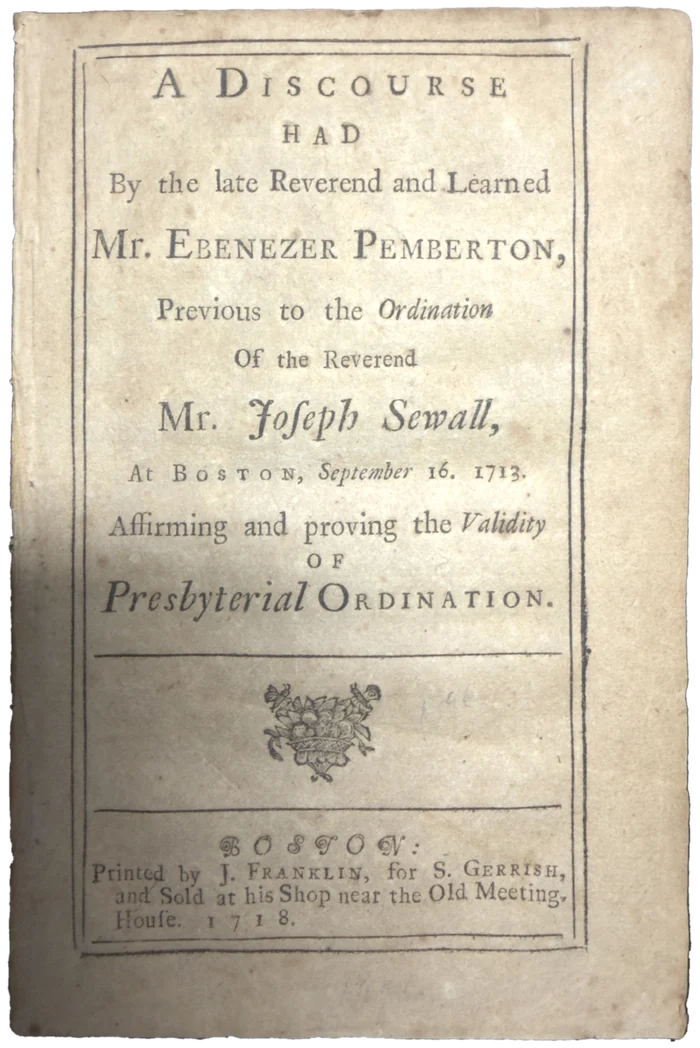
Ebenezer Pemberton, A Discourse Previous to the Ordination of the Reverend Mr. Joseph Sewall, title page, Boston, 1718

Ebenezer Pemberton, A Discourse Previous to the Ordination of the Reverend Mr. Joseph Sewall

Boston: printed by J. Franklin, for S. Gerrish, 1718
BF-2026.207

Ebenezer Pemberton, minister of the Old South Church, preached this discourse at the ordination of his colleague Joseph Sewall in 1713 and argued that ordination by a presbytery is valid. It was printed after his death, in 1718, by James Franklin for the Boston bookseller Samuel Gerrish. That was the year the twelve-year-old Benjamin was bound to his brother, and the sermon comes from the shop where he began. It is certainly one of the first one or two pieces Benjamin ever worked on, and the only one known in private hands.

Read the full entry

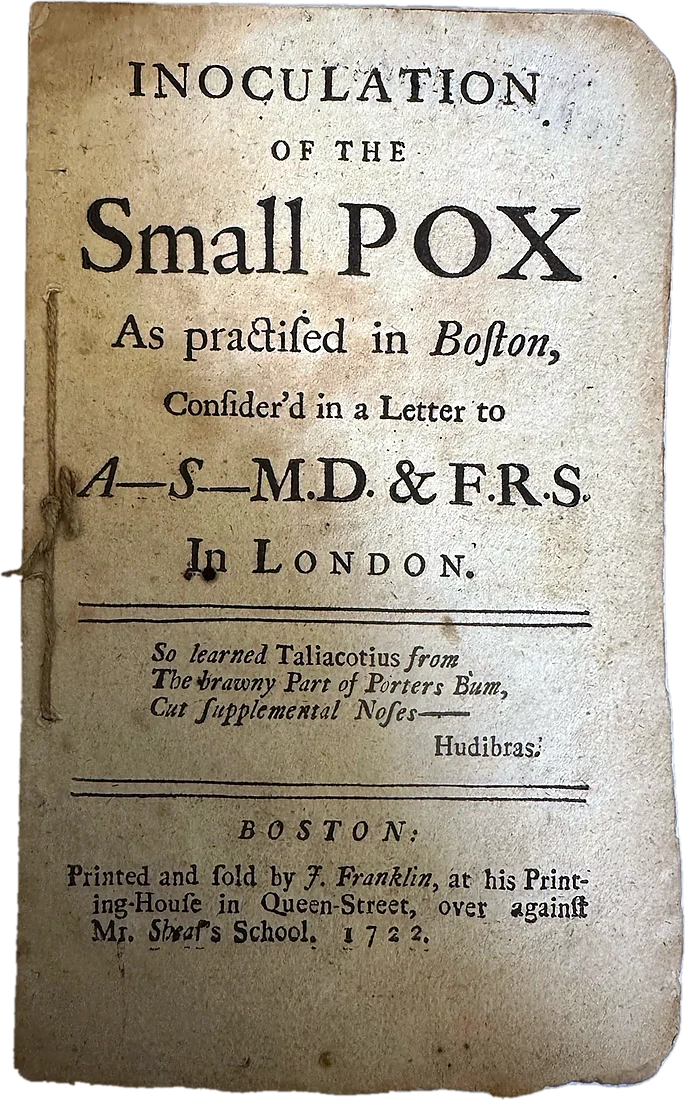
William Douglass, Inoculation of the Small Pox as Practised in Boston

William Douglass, Inoculation of the Small Pox as Practised in Boston

Boston: printed by J. Franklin, 1722
BF-2025.016

William Douglass, Inoculation of the Small Pox as Practised in Boston, printed by James Franklin, Boston 1722. Four years after the Pemberton sermon, Franklin was sixteen, apprenticed to his brother, and setting type in the shop that produced it. Boston was in the middle of a smallpox epidemic; Cotton Mather had persuaded Zabdiel Boylston to inoculate, and Douglass, the only university-trained physician in the town, published four pamphlets against it, fearing inoculation would spread the disease rather than contain it. The first medical controversy in American printing, argued in the shop where Franklin learned the trade.

Read the full entry

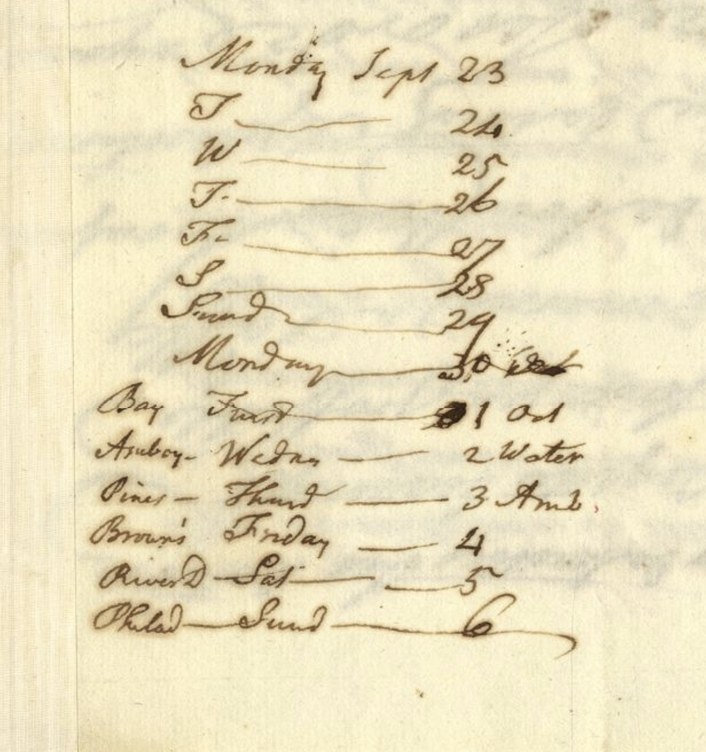
Franklin's memorandum of the road to Philadelphia, 1723

Franklin's memorandum of the road to Philadelphia, 1723

Autograph memorandum on the back of a letter of 29 November 1783
American Philosophical Society

The days of the week and the dates of the month from Monday 23 September to Sunday 6 October, with the bay, Amboy, the Pines, Brown's and a river stop set against the last six days, and Philadelphia on the Sunday. It is Franklin remembering where he was on each day of his journey from Boston to Philadelphia in 1723, and it fixes the dates the Autobiography leaves out. He wrote it sixty years afterward in Paris, on the back of a letter from his banker.

Courtesy of the American Philosophical Society, Benjamin Franklin Papers, Mss.B.F85.

Read the full entry · 4 photographs

The Competition

Philadelphia supported two printers when Franklin arrived in 1723. Andrew Bradford, whose father William had opened the first press in the middle colonies in 1685, published the American Weekly Mercury and held the postmastership. Samuel Keimer, a London printer who had been a bankrupt, a Quaker and one of the French Prophets by turns, was Franklin's first employer in the city and the man he later bought the Gazette from.

Franklin worked for Keimer, went to London in 1724, came back to him in 1726, and in 1728 set up with Hugh Meredith. Their first large job was a book Keimer had failed to finish. From then on the shops competed for the same lawyers, magistrates and merchants, and the Bradford name outlasted Andrew: his nephew William's Pennsylvania Journal competed with the Gazette to the end of the partnership with Hall. The pieces here are the rivals' own work, and the career Keimer had behind him before he reached the Delaware.

The rivalry ran through the public printing too. The New Jersey session laws of 1748, shown under Job Printing and Public Business, are the last official work Franklin did for that colony before William Bradford took it over.

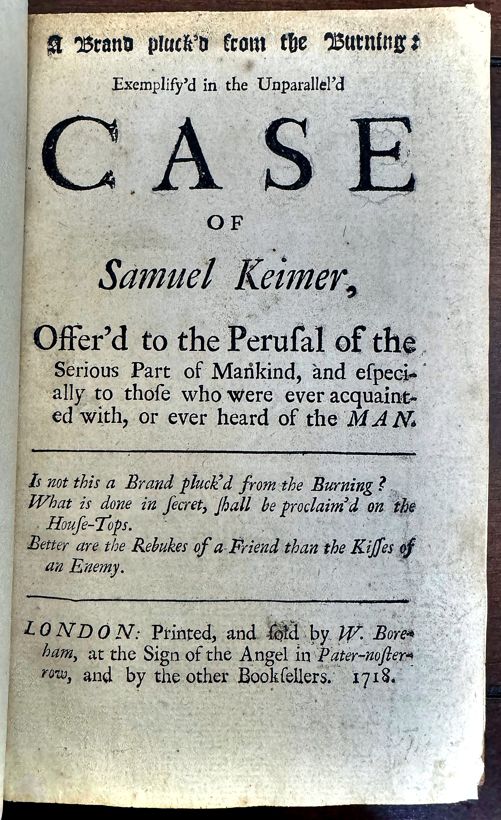
Samuel Keimer, A Brand Pluck'd from the Burning

Samuel Keimer, A Brand Pluck'd from the Burning

London: W. Boreham, 1718
BF-2024.133

Keimer's own account of his life, printed in London three years before he sailed for Pennsylvania. He had been a printer's apprentice, a follower of the French Prophets, a convert to the Quakers and a job printer for Daniel Defoe, and the debts that followed sent him to the Fleet prison, where the second half of the book is set. Franklin's Autobiography remembers him as an eccentric who wore his beard at full length and kept the seventh-day Sabbath. Here the man speaks for himself, ten years before his shop lost its largest job to his own workmen. A twelve-page tract by the prophet John Lacy is bound in at the end.

Read the full entry

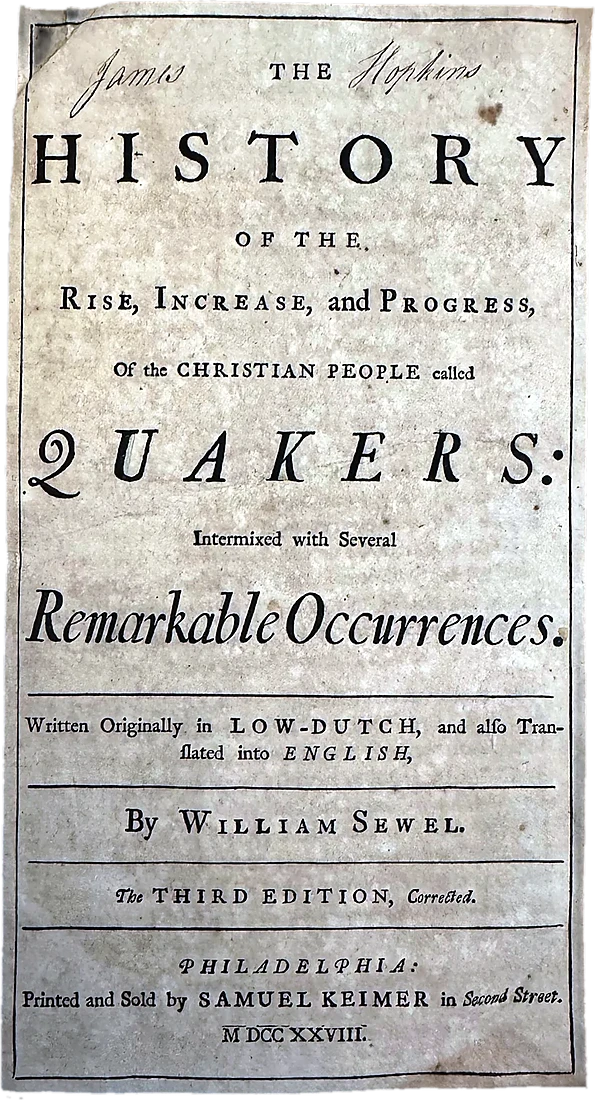
William Sewel, The History of the Rise, Increase and Progress of the Christian People Called Quakers

William Sewel, The History of the Rise, Increase and Progress of the Christian People Called Quakers

Philadelphia: Samuel Keimer [and Benjamin Franklin], 1728
BF-2025.006

In 1723 the Philadelphia Monthly Meeting gathered five hundred subscriptions for an American edition of William Sewel's history of the Quakers. Andrew Bradford was asked first and let the work lag, since importing copies from England looked more profitable. Keimer took it up instead, brought paper and type from London on the Meeting's advances, and fell far behind on a folio of nearly seven hundred pages.

In 1728 Franklin and Hugh Meredith left his shop, set up their own, and persuaded the Friends to give them the rest. The Autobiography recalls the pace: Franklin set a sheet a day and Meredith worked it off at the press, often until eleven at night. From about page 553 to the end, some 178 pages, the book is probably theirs. It is the first American edition, the first large book from Franklin's own press, and the record of how a young printer took a job from his former master. This copy descended in a New Jersey Quaker family with a connection to Franklin.

Read the full entry · 3 photographs

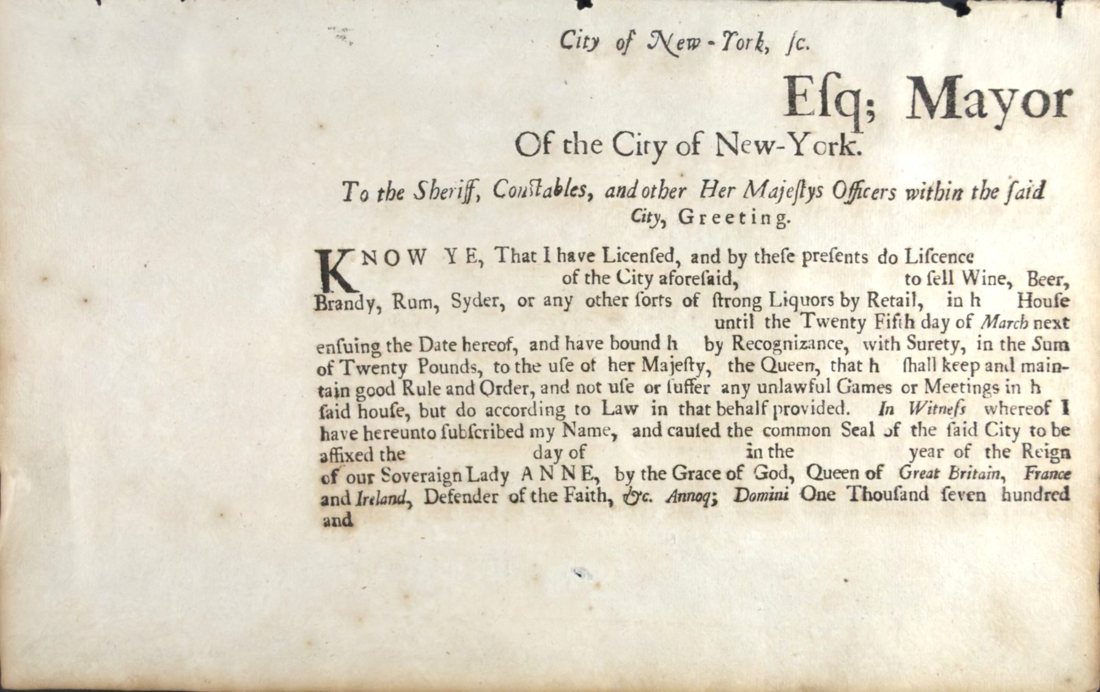
A licence to sell strong liquors by retail, City of New-York

A licence to sell strong liquors by retail, City of New-York

Printed blank form, New York: William Bradford, [1702-1714]
BF-2026.300

Philadelphia's first printer left it. William Bradford set up a press in the city in 1685, and after the quarrels and the prosecution that followed, and the seizure of his types and paper in 1692, he accepted the New York council's invitation in 1693 to print the acts of its assembly. He stayed there for the rest of his working life. His son Andrew came back to Philadelphia in 1712 and was the rival Franklin found waiting for him.

This is the trade Bradford practised in New York: a blank licence from the mayor's office allowing a named man to sell wine, beer, brandy, rum and cider by retail on a surety of twenty pounds, the blanks left for the name, the house and the date. The closing lines name Queen Anne, which fixes the printing between 1702 and 1714, when Bradford was the only printer at work in New York. Not in Evans or Bristol. No earlier licence form printed in New York has been recorded.

Read the full entry

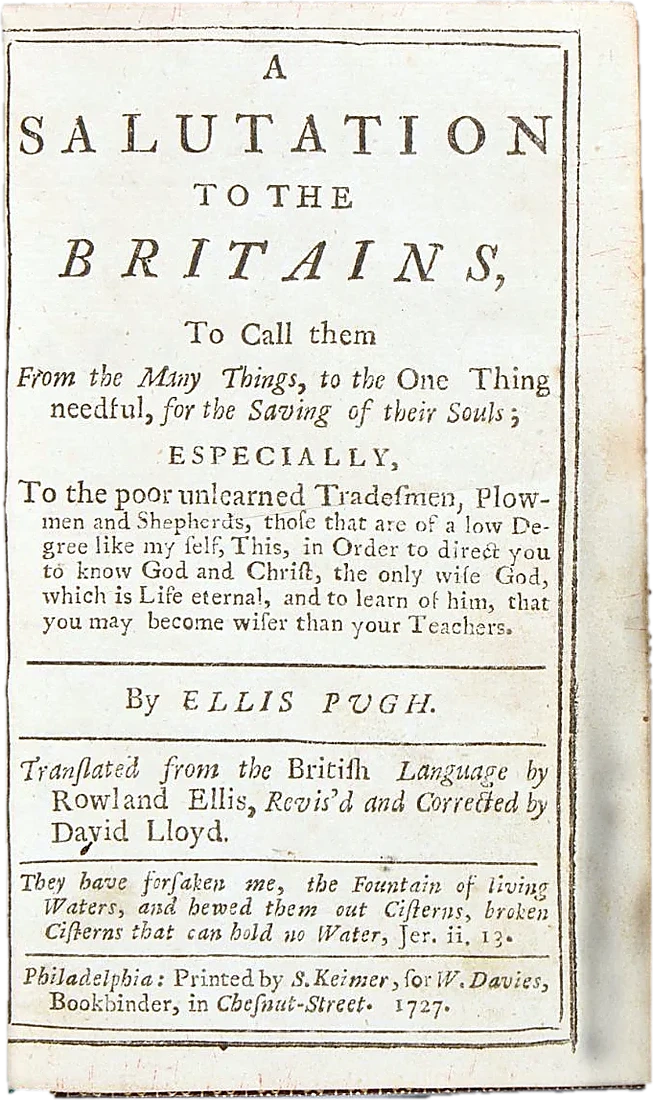
Ellis Pugh, A Salutation to the Britains

Ellis Pugh, A Salutation to the Britains

Philadelphia: printed by S. Keimer, 1727
BF-2026.010

Printed by Samuel Keimer, the man who put a composing stick in Franklin's hand in 1723 and employed him again in 1727, the year this book came off the press. It is where the story starts. A year later Franklin had a shop of his own, and Keimer's newspaper the year after that.

Read the full entry · 2 photographs

Andrew Bradford, printed legal form, 1742

Andrew Bradford, printed legal form, 1742

Philadelphia: A. Bradford, completed June 1742
BF-2026.012

A printed legal form from the shop of Franklin's first Philadelphia rival, filled in and signed in June 1742, the year Bradford died. His blanks and Franklin's sat in the same lawyers' drawers; the two presses competed for the same customers for fourteen years.

Read the full entry · 2 photographs

Job Printing and Public Business

A colonial printer lived on forms. The shop printed bonds, indentures, warrants, commissions, writs and the session laws of the governments that paid it, and the blanks sold every week while books sold slowly if at all. Franklin took the public printing of Pennsylvania in the early 1730s and added the paper money of neighbouring colonies, and by the time Hall became his partner in 1748 the shop was the steadiest in the province.

The work was physical as much as commercial. It needed paper from the mills on the Wissahickon, ink and type, and the signatures of the sheriffs and governors who made a blank mean something. The sheets here are the ones nobody kept.

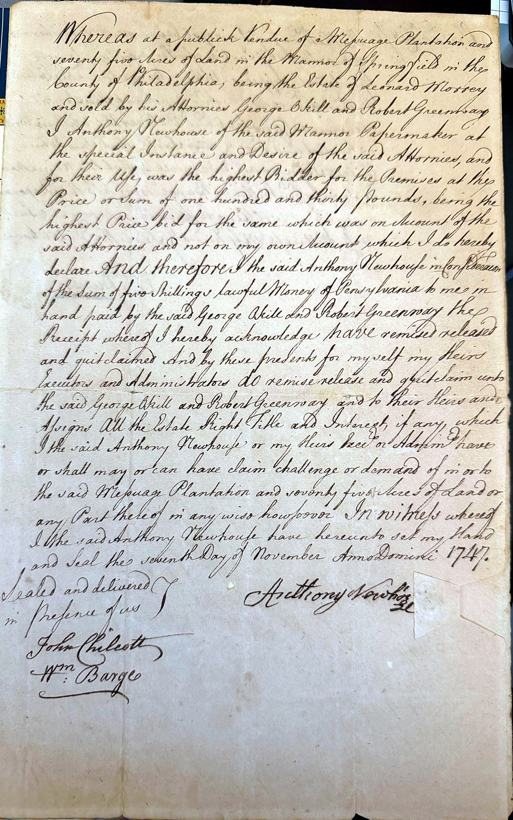
Anthony Newhouse, document signed, Philadelphia, November 7, 1747

Anthony Newhouse, document signed, Philadelphia, November 7, 1747

Manuscript, Philadelphia, 7 November 1747
BF-2026.004

A legal document of 7 November 1747 signed by Anthony Newhouse, papermaker, and by William Dewees, then Sheriff of Philadelphia, whose father and grandfather had both made paper for Franklin on the Wissahickon. Newhouse was Franklin's most important supplier of the 1740s. He had been Dewees’s foreman at the Germantown mill, and the accounts show him and Franklin experimenting with the ingredients of the paper used for Pennsylvania currency in an effort to defeat counterfeiters. The third name on the sheet is Robert Greenway, a wine merchant who from 1746 until his death in 1763 was Librarian of the Library Company, ordered by the directors to renumber every book and to prepare a new catalogue of the collection. Three men on one piece of paper: the trade that supplied the press, the office that enforced the law, and the library the club had built.

Read the full entry · 3 photographs

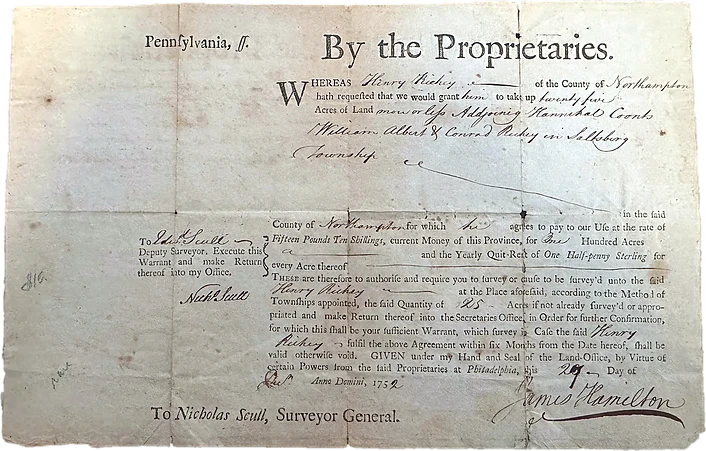
By the Proprietaries: a surveyor's warrant to Nicholas Scull

By the Proprietaries: a surveyor's warrant to Nicholas Scull

Philadelphia: B. Franklin, [1748 or later]
BF-2025.050

A Land Office warrant on a form printed by Franklin and Hall, signed by Governor James Hamilton and endorsed by Nicholas Scull, Surveyor General and a founding member of the Junto. Job printing of exactly this kind, not books, was what kept the shop alive.

Read the full entry · 2 photographs

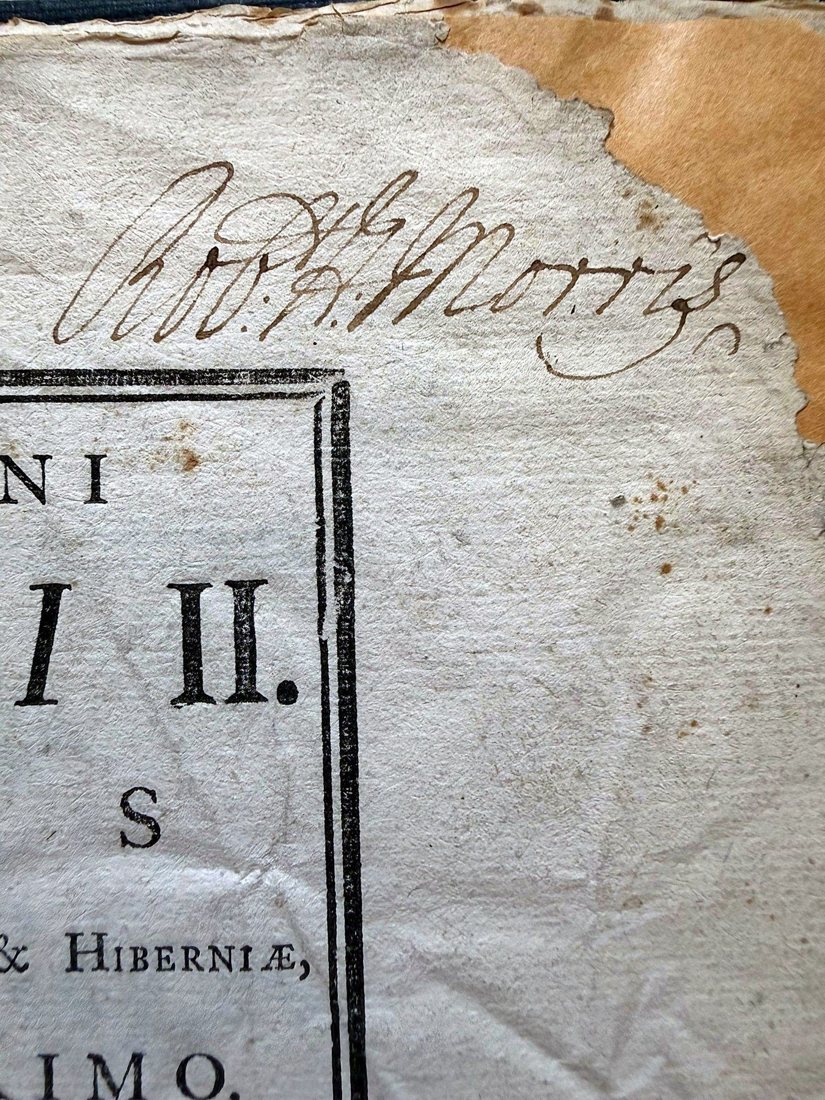
The New Jersey General Assembly session laws

The New Jersey General Assembly session laws

Philadelphia: B. Franklin, 1748
BF-2026.013

Anno Regni Georgii II ... At a General Assembly of the Colony of New-Jersey. Philadelphia: printed by B. Franklin, 1748. Sixteen acts of 1747 and 1748, on livestock, slander, counterfeiters, the importation of rum, and the pardon and suppression of the Clinker Lot Right Men of the 1746 land riots. This is the last official printing Franklin did for New Jersey before William Bradford took the work over, and among the acts is one approving payment of the colony's printer, named in the text as B. Franklin. A printer printing the record of his own last payment and handing the contract to his rival. The copy carries the ownership signature of Robert Hunter Morris, then Chief Justice of New Jersey, who as deputy Governor of Pennsylvania would spend years fighting Franklin and the Assembly over the taxation of Penn family lands. From the Jay T. Snider collection, sold at Sotheby's in June 2026.

Read the full entry · 5 photographs

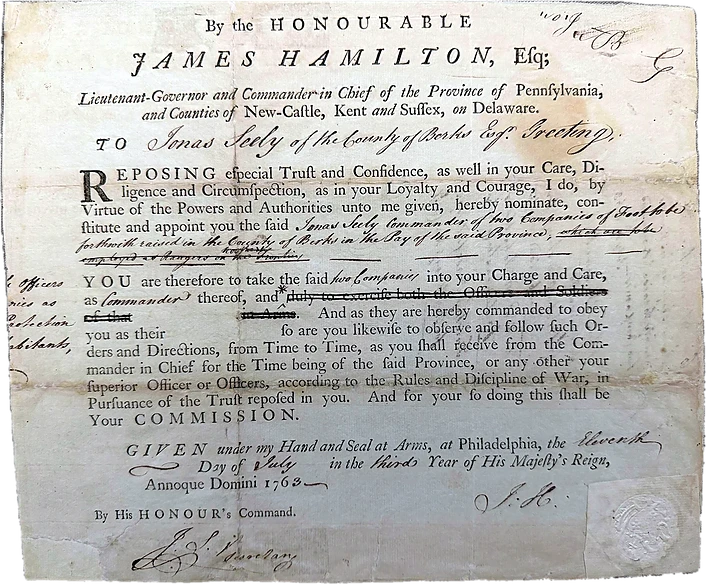
By the Honourable James Hamilton: a proclamation form

By the Honourable James Hamilton: a proclamation form

Philadelphia: B. Franklin and D. Hall, [about 1763]
BF-2026.005

A wholly unrecorded Franklin printing. In the Governor's name, By the Honourable James Hamilton, Esq., Lieutenant-Governor and Commander in Chief: a blank commission for two foot companies, printed by Franklin and Hall during the French and Indian War and completed by hand for Jonas Seely, who had served as a captain in the Pennsylvania Provincials from 1755 to 1759. A variant of Miller 741 and recorded in no bibliography. This is the room's argument in a single sheet. The press made its living raising companies, conveying land and naturalising subjects, not printing Poor Richard, and the sheets that did that work survive by accident when they survive at all.

Read the full entry · 3 photographs

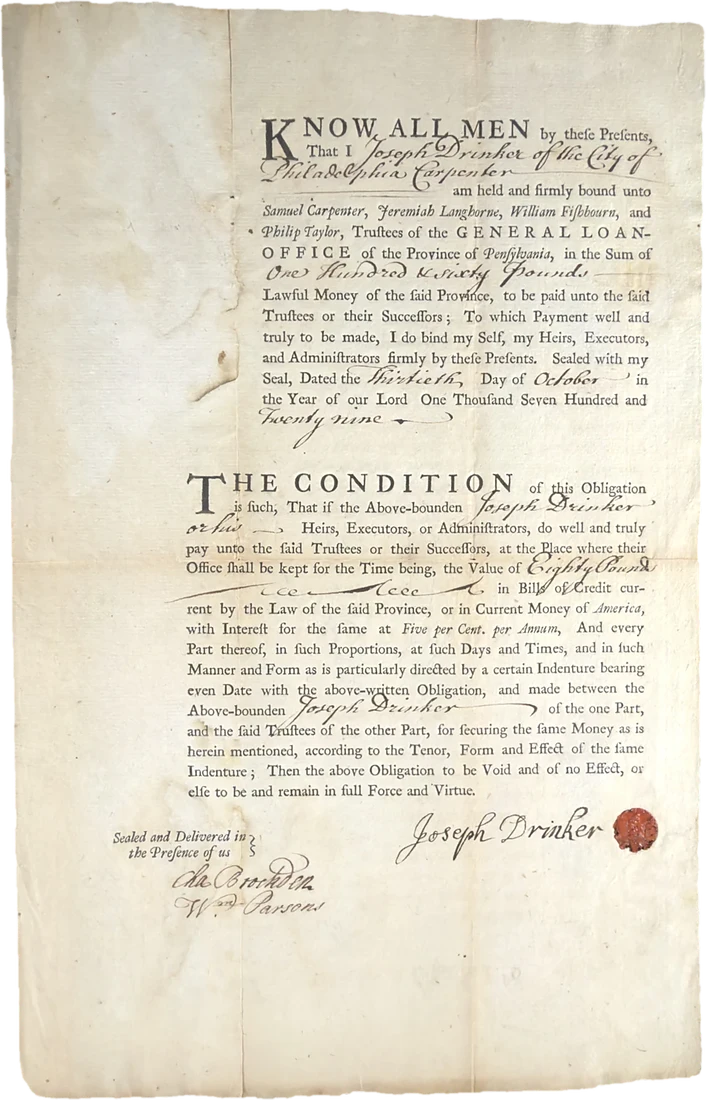
Know All Men by These Presents: a mortgage bond of the General Loan Office, 1729

Know All Men by These Presents: a mortgage bond of the General Loan Office, 1729

Philadelphia: B. Franklin, 1729
BF-2024.002

A printed mortgage form of the Pennsylvania General Loan Office, completed on 30 October 1729 when Joseph Drinker, a Philadelphia carpenter, borrowed money at five per cent from the office's trustees. Charles Brockden, the office's clerk, and William Parsons, the surveyor-general and a member of the Junto, witnessed it. It comes from the first year of Franklin's printing office.

C. William Miller describes the form as the one the province's borrowers signed in great numbers, reprinted by Franklin and later by Franklin and Hall as the stock ran out. The collection holds several variant printings of it, all of them Miller 10. Another, from 1735, is described on its own page.

Read the full entry · 4 photographs

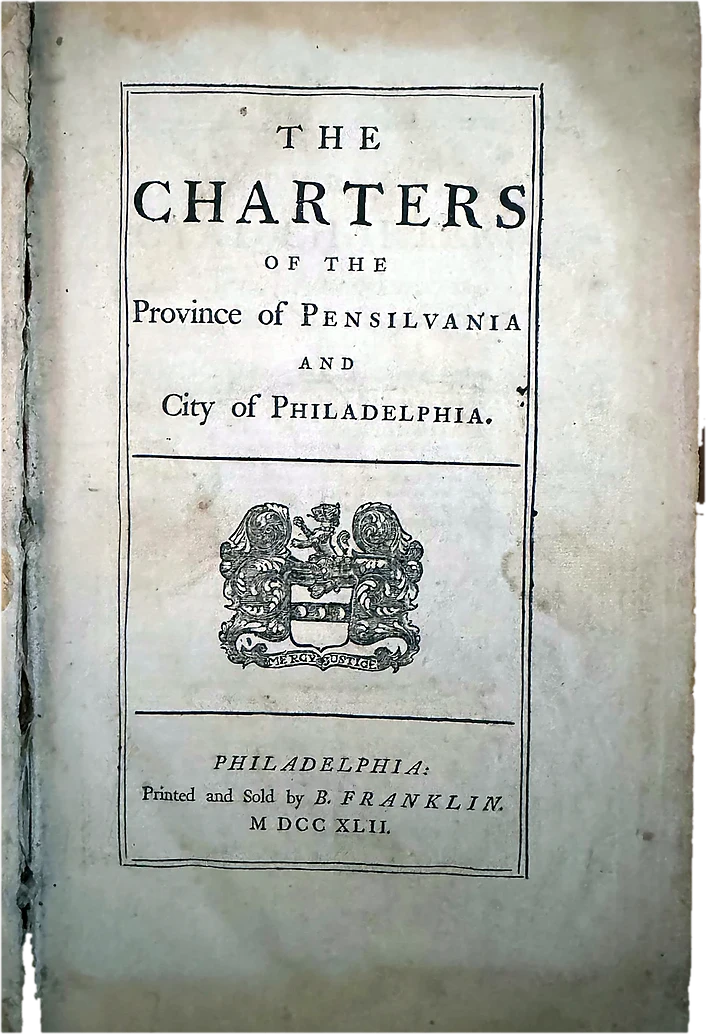
The Charters of the Province of Pensilvania and City of Philadelphia

The Charters of the Province of Pensilvania and City of Philadelphia

Philadelphia: B. Franklin, 1742
BF-2023.001

Franklin's folio of the Pennsylvania charters and laws, printed by order of the Assembly and issued in 1743 under a title page dated 1742. The volume binds three works from his press: the charters of the province and the city, a collection of all the laws then in force, and an appendix summarising the acts that had expired, been altered or been repealed.

It is the first edition. The Assembly allotted 120 copies for public use. This was the working book of the province, the volume a magistrate, a lawyer or an assemblyman reached for to learn what the law was. The copy carries an owner's inscription dated 1754 and later belonged to the Philadelphia publisher Zachariah Poulson Jr.

Read the full entry · 5 photographs

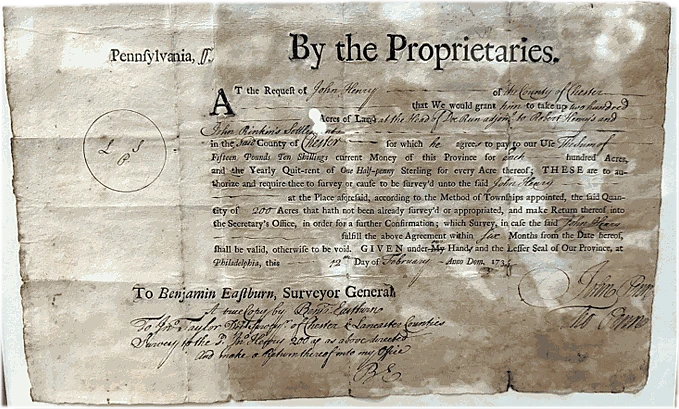
By the Proprietaries: a surveyor's warrant to Benjamin Eastburn

By the Proprietaries: a surveyor's warrant to Benjamin Eastburn

Philadelphia: B. Franklin, 1734
BF-2024.135

A printed land warrant signed by John and Thomas Penn, sons of William Penn and proprietors of the province, dated 12 July 1734. It directs the surveyor-general, Benjamin Eastburn, to lay out two hundred acres at the head of Doe Run in Chester County for John Henry, and Eastburn has added a note sending it on to a deputy surveyor. Miller assigns the form to Franklin's press from its type and the entries in the shop books, and counts at least seven versions with variant settings.

The sheet carries an irony. The Penns signed a blank that Franklin had printed for them, and he went on to fight their family in the Assembly over the taxation of the proprietary estates. In 1757 he crossed the Atlantic to argue the Assembly's case against them.

Read the full entry · 5 photographs

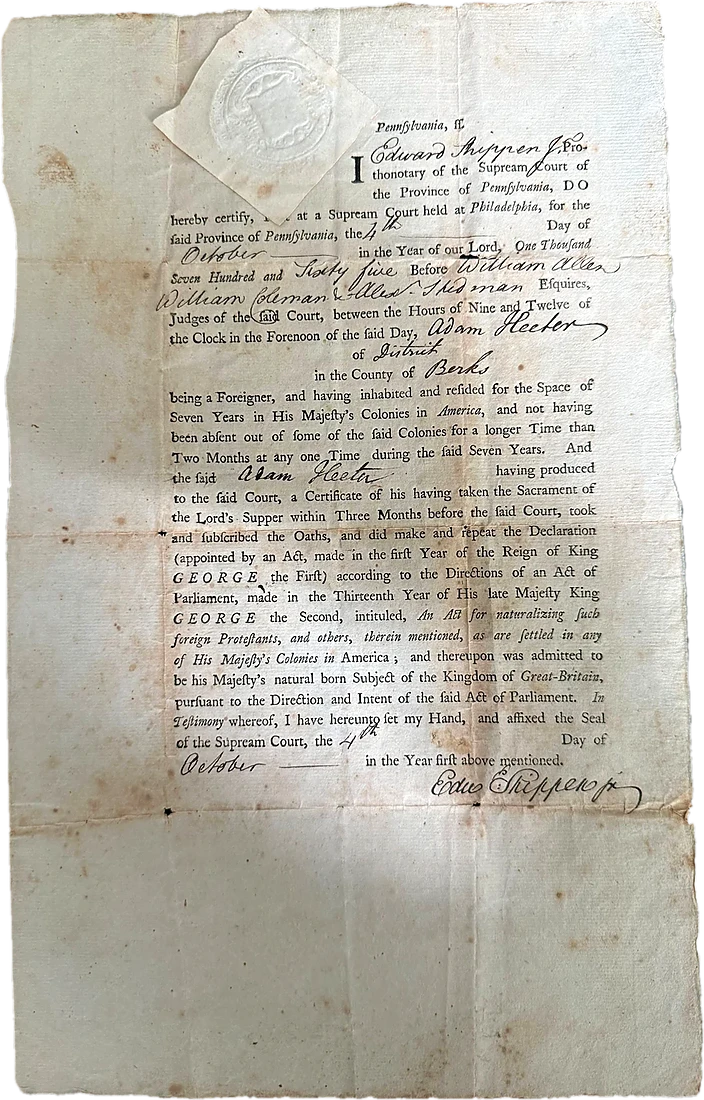
Certificate of naturalization and oath of allegiance

Certificate of naturalization and oath of allegiance

Philadelphia: B. Franklin and D. Hall, 1765
BF-2024.004

A printed form of Franklin and Hall, completed by hand and signed by Edward Shippen Jr. on 4 October 1765. The Act of Parliament it cites required a foreign Protestant who wished to be naturalised to bring proof that he had taken the sacrament within three months, and to take the oaths and repeat the declaration before a court. Shippen later became chief justice of Pennsylvania, and his daughter married Benedict Arnold. Forms like this were printed for the court's use and thrown away once filed, and few survive.

Read the full entry

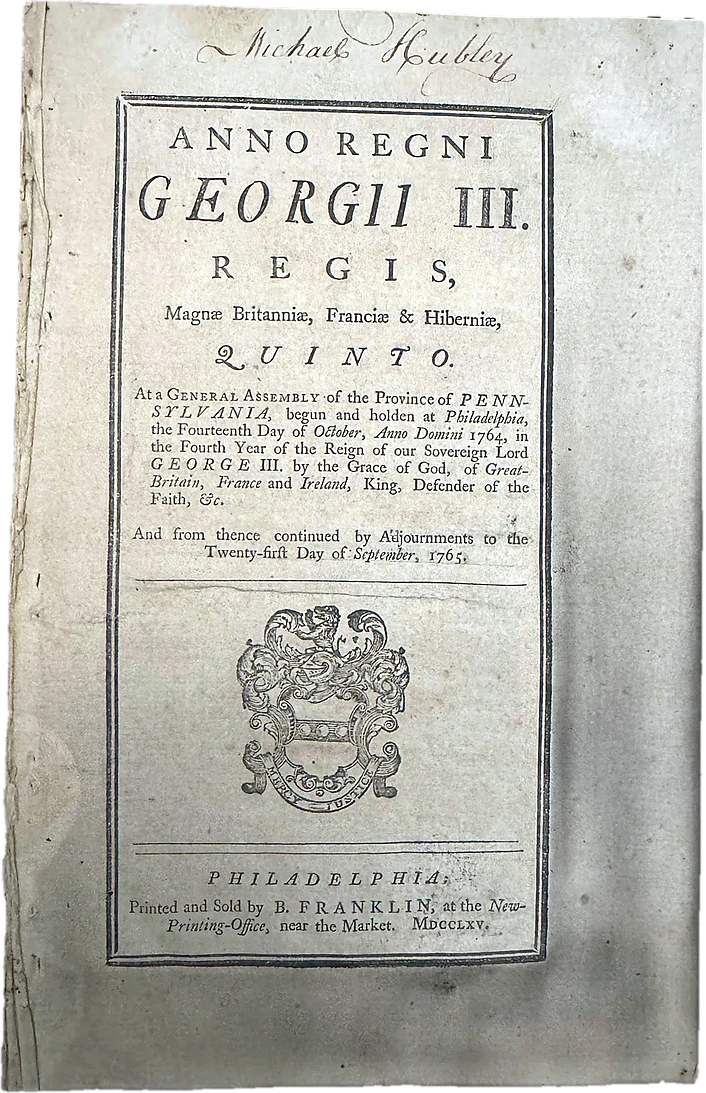
Anno Regni Georgii III: the Pennsylvania session laws

Anno Regni Georgii III: the Pennsylvania session laws

Philadelphia: B. Franklin and D. Hall, 1765
BF-2025.003

Twenty pages, 429 to 448, of the laws passed by the Pennsylvania Assembly in its session of 1764 and 1765, in the fifth year of George III. The acts include one to support a nightly watch in Lancaster, one on the recovery of legacies, one for a bridge over Skippack Creek and one amending the law for the relief of insolvent debtors.

Franklin and Hall printed for the Assembly, and in 1765 Franklin was in London as its agent while Hall ran the shop. The laws were printed to be used, not kept, and a portion like this is uncommon.

Read the full entry

Religion

After the government, religion was the shop's best customer. Quakers, Presbyterians, Baptists, Lutherans, Moravians and the followers of Whitefield all wanted tracts, confessions and sermons in print, and their congregations paid. Franklin had no doctrine to push. He had set Wollaston's Religion of Nature in London, answered it in print at nineteen, and come away a deist, and he printed his customers' faiths with the same care he gave their bonds.

The first large book from his own press was a Quaker history. After it came the sermons of the Awakening, the devotional manuals of the German settlers and the controversial literature of every sect that could afford a printer. Several of the books here came from other presses, Palmer's in London and Keimer's in Philadelphia, and they belong in the room because Franklin worked at one and competed with the other.

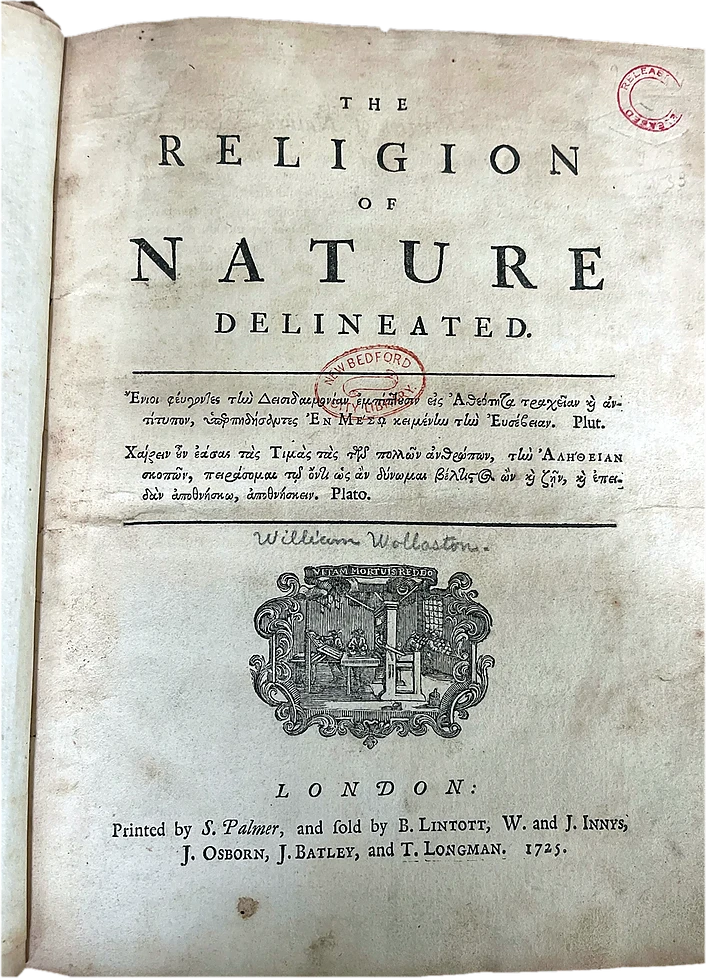
The Religion of Nature Delineated

The Religion of Nature Delineated

London: Samuel Palmer, 1726
BF-2025.110

Franklin reached London on Christmas Eve of 1724, eighteen years old, and went straight to work at Samuel Palmer's printing-house in Bartholomew Close. There, he wrote in the Autobiography, “I was employed in composing for the second edition of Wollaston's Religion of Nature.” This is that edition.

It is not a rare book. It is an important one. Setting Wollaston's arguments letter by letter, the young compositor decided they were wrong, and wrote and printed his own reply, A Dissertation on Liberty and Necessity. It was the first thing he ever published, and he later burned most of the copies.

Read the full entry · 2 photographs

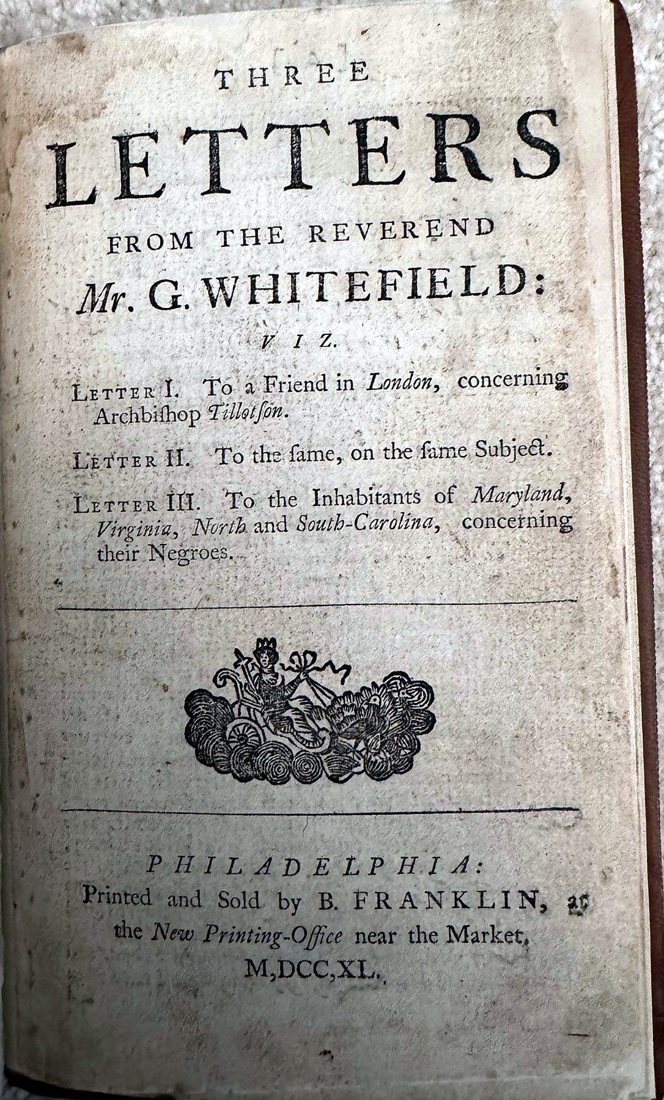
Three Letters from the Reverend Mr. George Whitefield

Three Letters from the Reverend Mr. George Whitefield

Philadelphia: B. Franklin, 1740
BF-2023.045

The three letters Franklin ran in the Pennsylvania Gazette of April 10 to 24, 1740, and then as a pamphlet: on Archbishop Tillotson, who Whitefield said knew no more of Christianity than Mahomet; on justification; and to the slaveholders of the southern colonies. Franklin printed Alexander Garden's reply the next year to disprove the charge that Whitefield had "engag'd all the Printers." The auction record shows four copies, one since 1920.

Read the full entry · 4 photographs

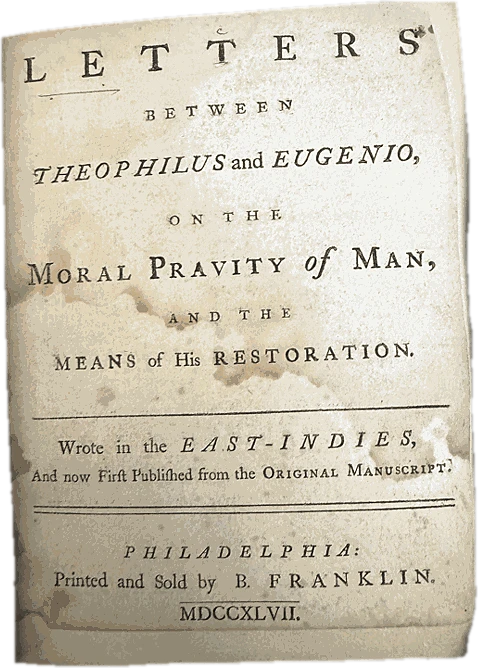
Letters between Theophilus and Eugenio on the Moral Pravity of Man

Letters between Theophilus and Eugenio on the Moral Pravity of Man

Philadelphia: B. Franklin, 1747
BF-2025.007

A London book of moral dialogue that Franklin reprinted in 1747. The bibliographer Sabin once attributed it to Franklin himself, and Miller corrected the error and located ten copies. This one carries the bookplate of the Americanist George Brinley and sold at the Stuart Karu sale at Sotheby's in 1992. Copies that have come to auction since then, in 2008, 2017 and 2019, were stained or damaged, and this one is sound.

Read the full entry · 2 photographs

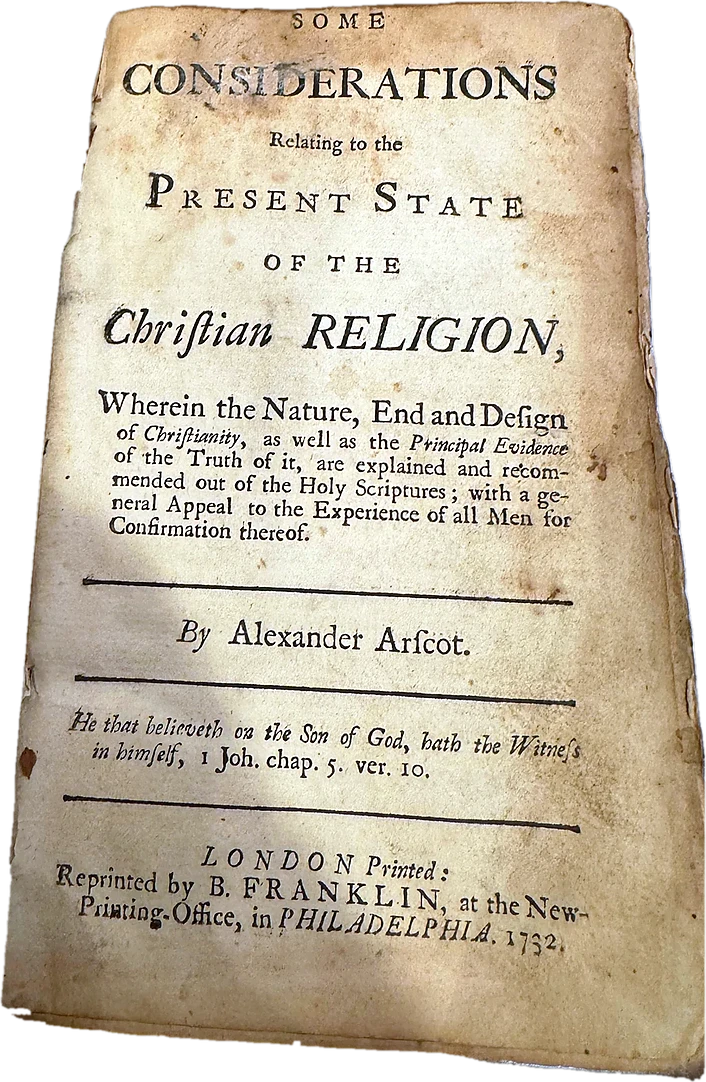
Alexander Arscott, Some Considerations Relating to the Present State of the Christian Religion

Alexander Arscott, Some Considerations Relating to the Present State of the Christian Religion

Philadelphia: B. Franklin, 1732
BF-2024.134

Arscott's apologetic work appeared first in London in 1730 and 1731. Franklin printed the first part in 1731 and both parts together in 1732, resetting the earlier text. The binder was Stephen Potts, and this is the earliest Franklin imprint in the collection for which every craftsman who made the book can be named.

The two parts are bound in one volume, though Evans lists them separately and the American Antiquarian Society holds only the first, which suggests that not every copy was bound together. The last copy sold at auction in 2008.

Read the full entry · 3 photographs

Franklin's Press

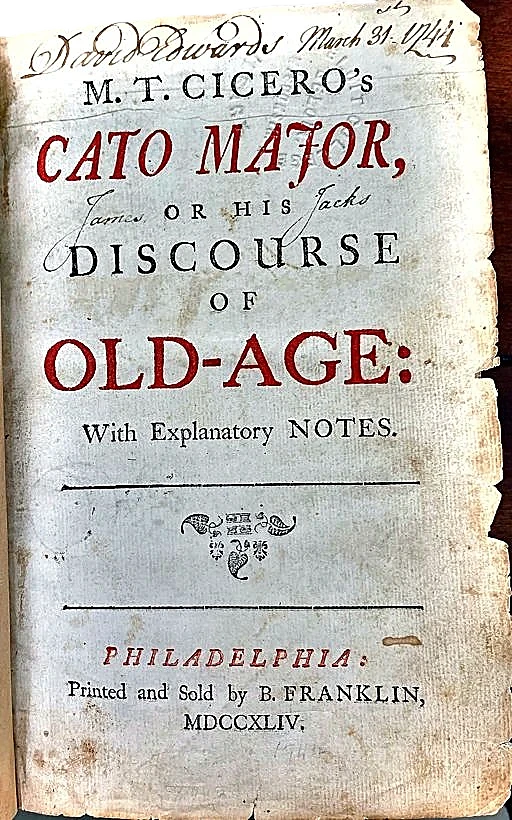
What Franklin printed for himself, for a market he chose, shows what he wanted the press to do. The Cato Major of 1744 was set in Caslon with wide margins to show that an American shop could make a handsome book. In 1748 he adapted a London handbook for American apprentices and clerks as The American Instructor. In 1751 he and Johann Böhm produced Johann Arndt's devotional work for the German settlers, 1,356 pages with 64 engraved plates, and in 1755 he printed Lewis Evans's map and essays on the middle colonies, with an engraving by James Turner of Boston.

Cicero, Cato Major, or His Discourse of Old Age

Cicero, Cato Major, or His Discourse of Old Age

Philadelphia: B. Franklin, 1744
BF-2022.021

Cicero's Cato Major, 1744, the handsomest book Franklin printed and the one he was proudest of. He set it in Caslon with generous margins to show what an American press could do.

Read the full entry

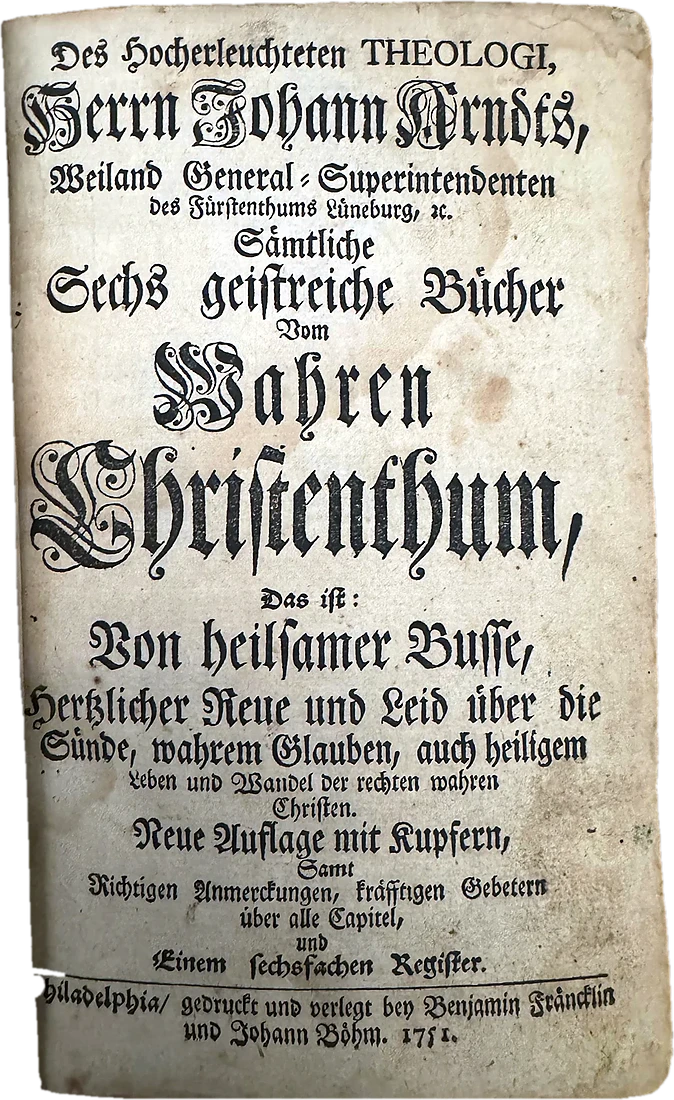
Johann Arndt, Des Hocherleuchteten Theologi

Johann Arndt, Des Hocherleuchteten Theologi

Philadelphia: B. Franklin and J. Böhm, 1751
BF-2024.130

Arndt's devotional work, first printed in German between 1605 and 1609, was the book the Lutheran settlers of Pennsylvania read in their houses. Franklin and his partner Johann Böhm obtained the plates of the earlier edition and printed this one for subscribers: 1,356 pages with 64 engraved plates, one of them showing a printing press. It is the first American edition and the fifth overall, and one of the most ambitious partnerships of colonial printing.

This copy is complete with the double frontispiece and the subscribers' list, and it is the best copy known. It is Miller 520.

Read the full entry · 5 photographs

Medicine and Science

Franklin printed the first American medical writing of any consequence, and the list shows a printer who followed the field. Thomas Cadwalader's essay on the dry gripes in 1745 was the earliest American medical text based on original research. Armstrong's poem on health, a London success reprinted the same year, was medicine for the general reader. In 1751 Franklin and Hall printed Thomas Short's Medicina Britannica with the botanist John Bartram's additions. The Boston pamphlet that began the line is here too.

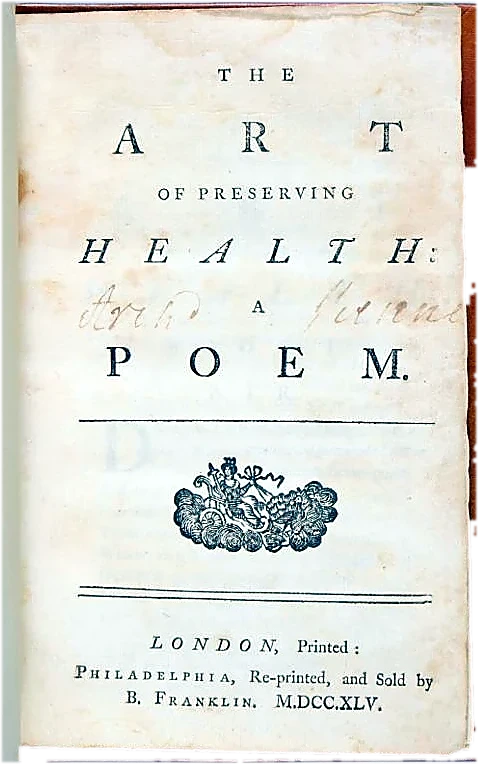
John Armstrong, The Art of Preserving Health: A Poem

John Armstrong, The Art of Preserving Health: A Poem

Philadelphia: B. Franklin, 1745
BF-2026.008

John Armstrong, The Art of Preserving Health: A Poem, printed by Franklin, 1745. A long poem in blank verse on air, diet, exercise, sleep and the passions, written by a Scottish physician and hugely popular on both sides of the Atlantic. It is medicine as literature, which is how most people met medicine before there were medical schools, and it is the sort of book a printer took on because it would sell. From the Jay T. Snider collection, sold at Sotheby's in June 2026.

Read the full entry

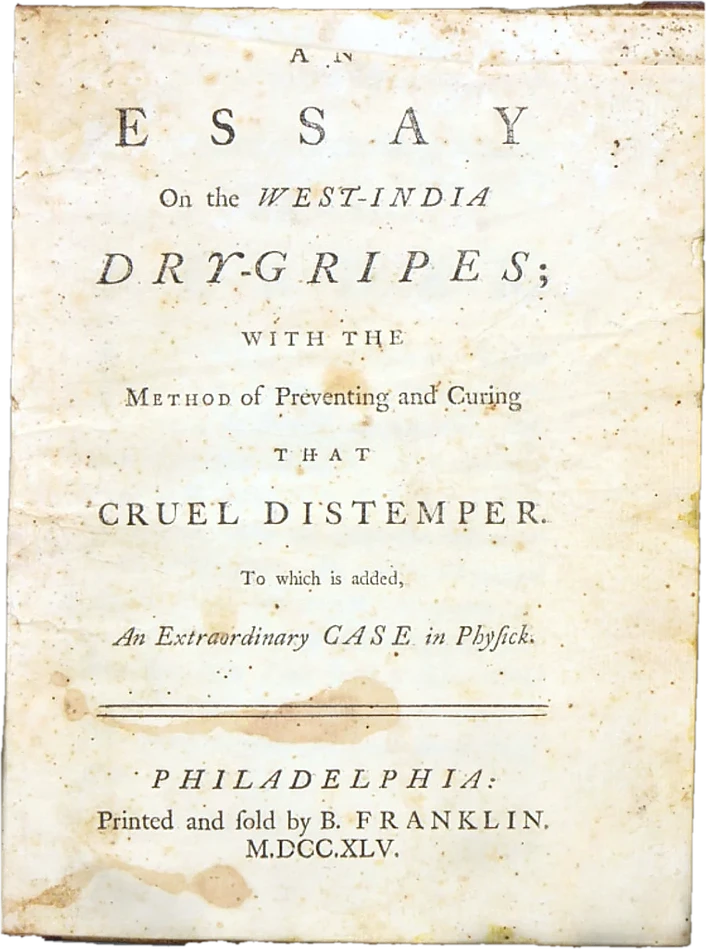
Thomas Cadwalader, An Essay on the West-India Dry Gripes

Thomas Cadwalader, An Essay on the West-India Dry Gripes

Philadelphia: B. Franklin, 1745
BF-2026.009

Thomas Cadwalader, An Essay on the West-India Dry Gripes, printed by Franklin, 1745. The earliest text by an American physician based on original research into the pathology of a single illness and its treatment, and the earliest published description of an autopsy in America. Cadwalader traced the dry gripes to Jamaican rum distilled through lead pipes, which is to say he identified lead poisoning, and appended the post-mortem of a woman whose bones had softened. He was a founder of the Pennsylvania Hospital, a director of the Library Company, and the man whose signature appears on the Hospital notes in the next room. Franklin printed it. Two copies have come to auction since 1998. From the Jay T. Snider collection, sold at Sotheby's in June 2026.

Read the full entry

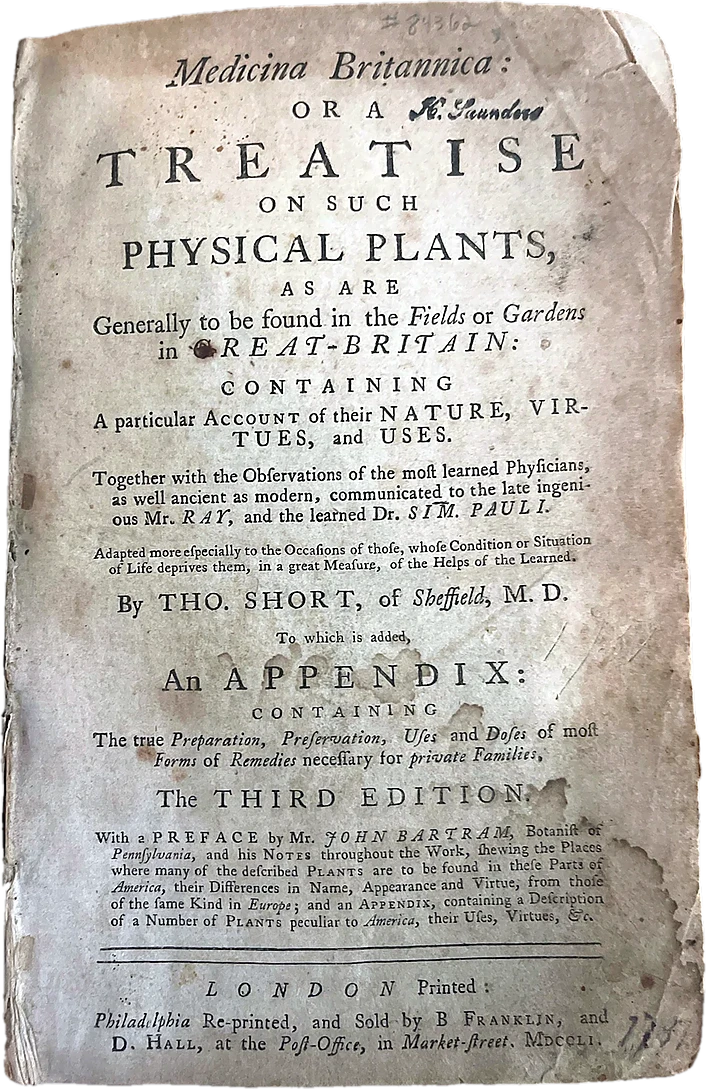
Medicina Britannica: A Treatise on Such Physical Plants

Medicina Britannica: A Treatise on Such Physical Plants

Philadelphia: B. Franklin and D. Hall, 1751
BF-2023.049

Franklin and Hall reprinted Thomas Short's London handbook of medicinal plants from the second edition of 1747. John Bartram added a preface, notes throughout on the American counterparts of the European plants, and a second appendix, which makes this printing one of the earliest American botanical works. It is the only edition of the book that Franklin and Hall printed.

Read the full entry · 11 photographs

Almanacs

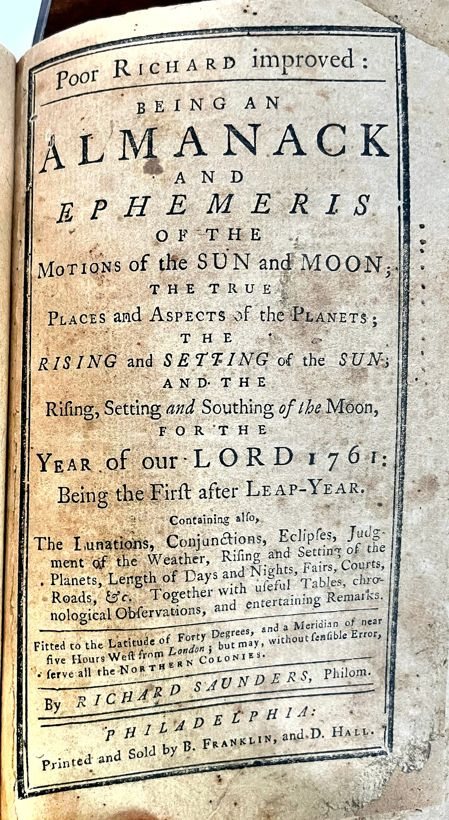
Almanacs were the best-selling thing a colonial press made, and Franklin's made his name. John Jerman's for 1731, printed by Franklin the year before Poor Richard, shows the trade he entered. He began Poor Richard in December 1732 for the year 1733, wrote it himself through the issue for 1758, whose preface became The Way to Wealth, and the shop went on printing it as Poor Richard Improved until the partnership with Hall ended in 1766.

The pocket almanacs were made to be carried and were worn out. The Paris edition of The Way to Wealth is here as the book's afterlife, a French printing of 1795 and not a Franklin imprint.

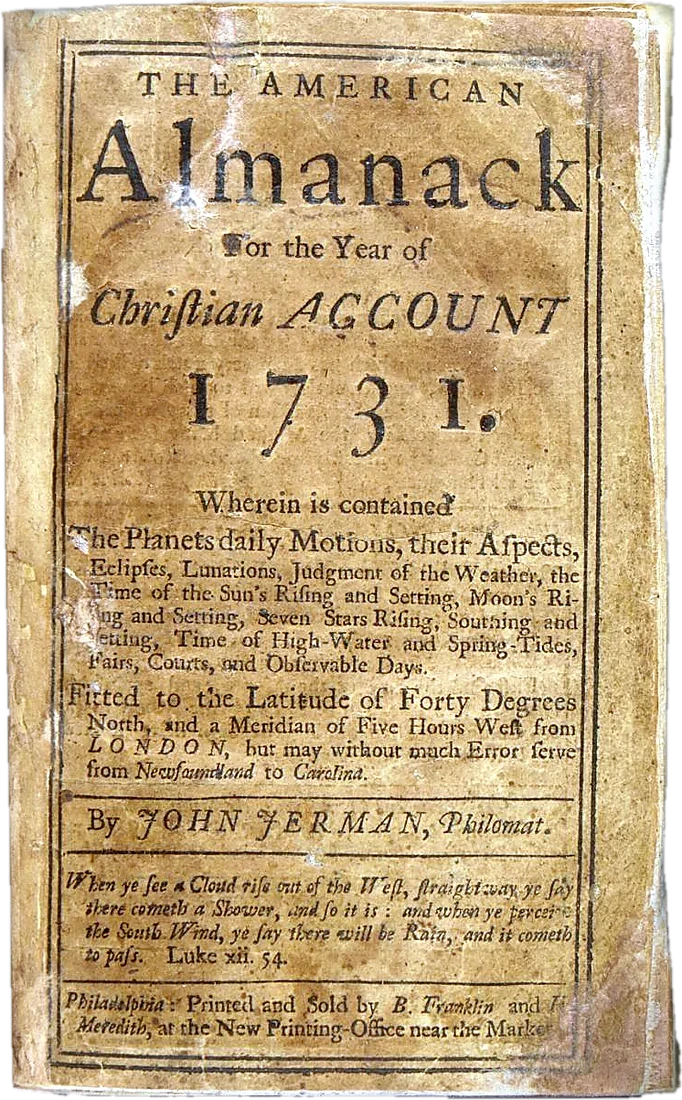
John Jerman, The American Almanack for the Year 1731

John Jerman, The American Almanack for the Year 1731

Philadelphia: printed and sold by B. Franklin, [1730]
BF-2026.011

John Jerman's The American Almanack for the Year 1731. An almanac gave a farmer the phases of the moon, the times of sunrise and sunset, the dates of the fairs and the courts, and a weather forecast nobody believed; it was the one book many households bought every year, which is why almanacs were the annual bread of every colonial press. Jerman was one of the writers Franklin printed for, and also one he competed with. This is the only copy of the 1731 issue known in private hands. From the Jay T. Snider collection, sold at Sotheby's in June 2026.

Read the full entry · 2 photographs

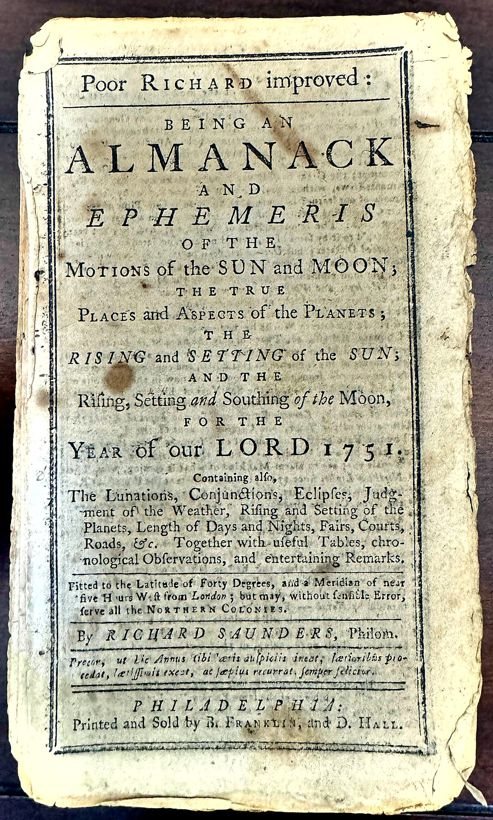
Poor Richard's Almanack for 1751, a presentation copy

Poor Richard's Almanack for 1751, a presentation copy

Philadelphia: B. Franklin and D. Hall, [1750]
BF-2022.026

A presentation copy of Poor Richard's Almanack for 1751, in a case inscribed by the bookbinder and historian Willman Spawn to C. William Miller, whose bibliography of Franklin's Philadelphia printing is the standard reference and the source of the Miller numbers in this collection. Almanacs were the bread of a colonial press. Every household bought one, every year, and Poor Richard was the crown of the trade.

Read the full entry · 3 photographs

Poor Richard's Almanack 1761

Poor Richard's Almanack for 1761

Philadelphia: B. Franklin and D. Hall, 1760
BF-2022.028

With an essay on pages 2 to 5 on smallpox and inoculation, "of all the Improvements, none have been found equal" to it. Franklin had lost his son Francis to the disease in 1736 and never forgave himself for the delay. The apprentice who set Douglass's pamphlets against inoculation in Boston in 1722 put the case for it into every farmhouse in Pennsylvania in 1761.

Read the full entry

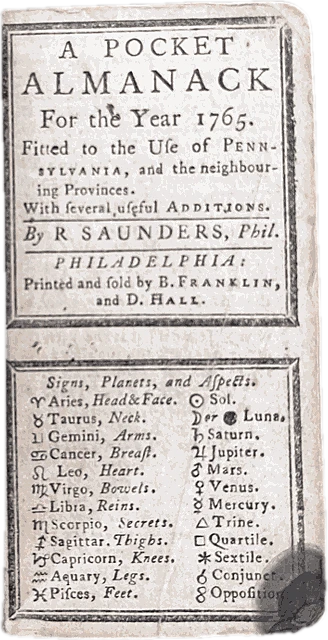
Pocket Almanac for the Year 1765.

Pocket Almanac for the Year 1765

Philadelphia: B. Franklin and D. Hall, 1764
BF-2022.025

Franklin's pocket almanacs were made to be carried, and so they were worn out, lost and thrown away. Miller locates only six copies of this one. Almanacs were, after the Gazette, the most profitable thing Franklin and Hall printed.

This copy was a working tool. Its eight blank interleaves are filled with the accounts of a Philadelphia bookseller: money received for books, pasteboard bought for binding, and three copies of Longinus sold in February, one of them to Dr. Phineas Bond.

Read the full entry · 4 photographs

The Franklin Network

Franklin trained printers and set them up. He lent presses, took a share of the profits and sent type from London. James Parker had New York, Thomas Smith had Antigua, and Benjamin Mecom, his sister Jane's son, had Antigua, Boston, New York and New Haven in turn and failed at all of them. David Hall, his foreman, became his partner in 1748 and took over the business when the partnership ended in 1766.

The family had a trade of its own as well. James Franklin carried the press from Boston to Newport, his widow Ann kept it going, and their son James Jr. printed the colony's laws on it. The sequence here runs from Ann's elegy of 1744 to the press Franklin sent to Antigua, which came home to Burlington and printed the first history of New Jersey. A New Haven newspaper twenty years after Mecom's last shop prints Franklin's own words at the close of the Federal Convention.

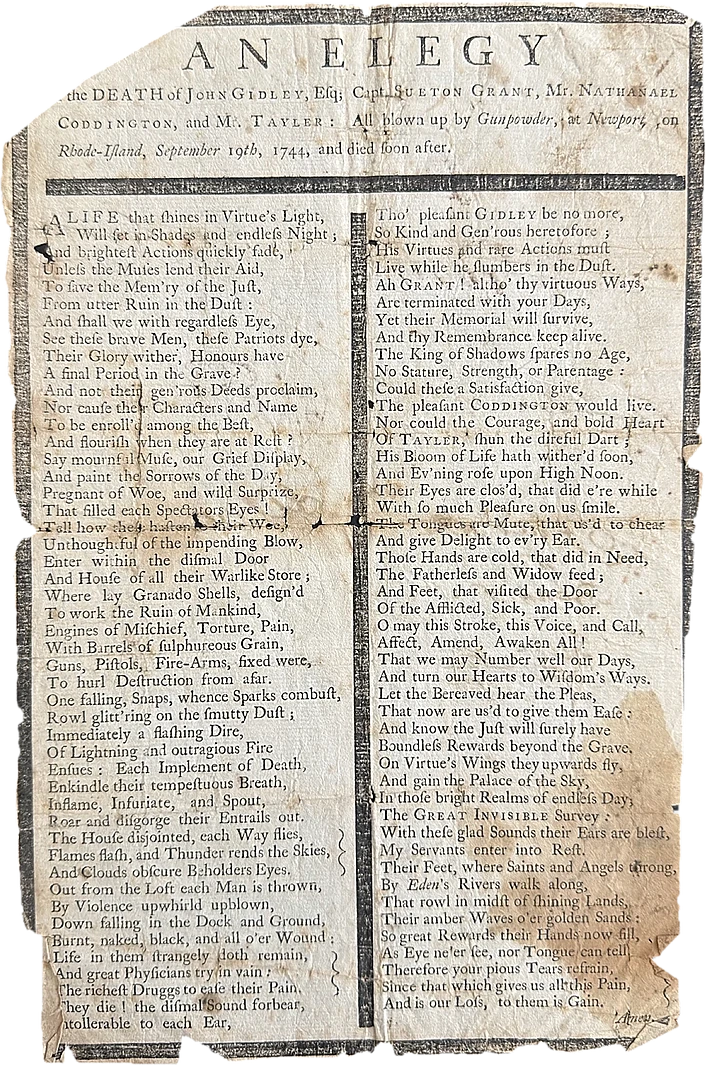
An Elegy on the Death of John Gidley, Esq; Capt. Sueton Grant, Mr. Nathanael Coddington, and Mr. Tayler, broadside, Newport, 1744

An Elegy on the Death of John Gidley, Esq; Capt. Sueton Grant, Mr. Nathanael Coddington, and Mr. Tayler

Newport, Rhode Island: Ann Franklin, [1744]
BF-2026.205

On 19 September 1744 about five hundred pounds of gunpowder blew up in the warehouse chamber of the privateer Prince Frederick at Newport. The elegy mourns four men, three of them the vessel's owners. The elegy was printed in two columns inside heavy black rules by Ann Franklin, widow of Benjamin's brother James and the only printer in Rhode Island.

No other copy has been traced. The Newport press is where the family trade began its second line, and the sheet is the earliest piece of it in the collection.

Read the full entry

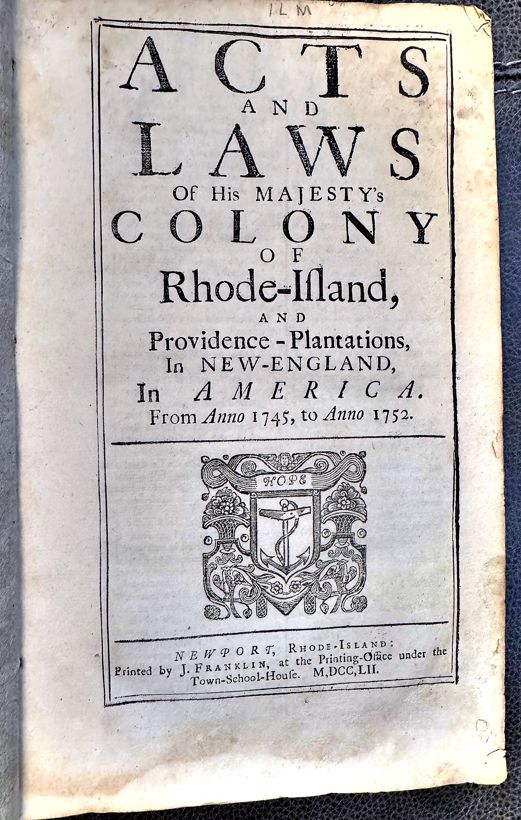
Acts and Laws of His Majesty's Colony of Rhode-Island, 1752

Acts and Laws of His Majesty's Colony of Rhode-Island, 1752

Newport: J. Franklin, 1752
BF-2025.013

Rhode Island's laws had been revised three times by 1752, in Boston in 1719 and at Newport in 1730 and 1745. This volume carries the 1745 revision forward by session to 1752. Its printer was James Franklin Jr., the son of Benjamin's brother James and of Ann Smith Franklin, who kept the Newport press running after her husband's death in 1735. He had been his uncle's apprentice in Philadelphia and later founded the Newport Mercury.

The elegy of 1744 above came from the same shop under his mother's name. The Newport press is the oldest branch of the family trade.

Read the full entry

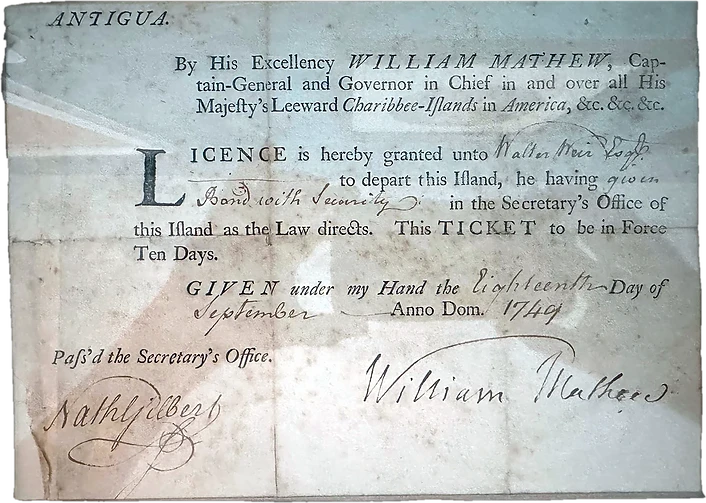
A printing from Franklin's press in Antigua

A printing from Franklin's press in Antigua

Antigua, [after 1748]
BF-2025.051

A printing from the press Franklin sent to Antigua, first under Thomas Smith, then from 1752 under his nephew Benjamin Mecom, who failed there as he failed everywhere. The press itself came home: Parker used it at Burlington in 1765 to print Samuel Smith's history of New Jersey. A rare survival of Franklin's Caribbean venture.

Read the full entry

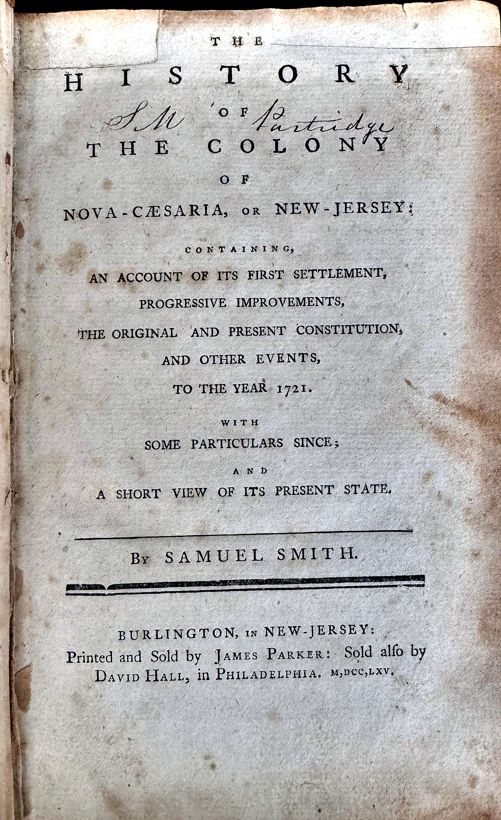
Samuel Smith, The History of the Colony of Nova-Caesaria, or New-Jersey

Samuel Smith, The History of the Colony of Nova-Caesaria, or New-Jersey

Burlington: James Parker, sold also by David Hall, 1765
BF-2024.052

The first general history of New Jersey, printed by the colony's first printer on a press that belonged to Benjamin Franklin and had formerly served Mecom in Antigua. Parker moved from Woodbridge to Burlington to keep a long-standing promise to Smith; the press was shipped from New York in April 1765. Sold in Philadelphia by Hall. The Franklin network, complete in one imprint.

Read the full entry · 2 photographs

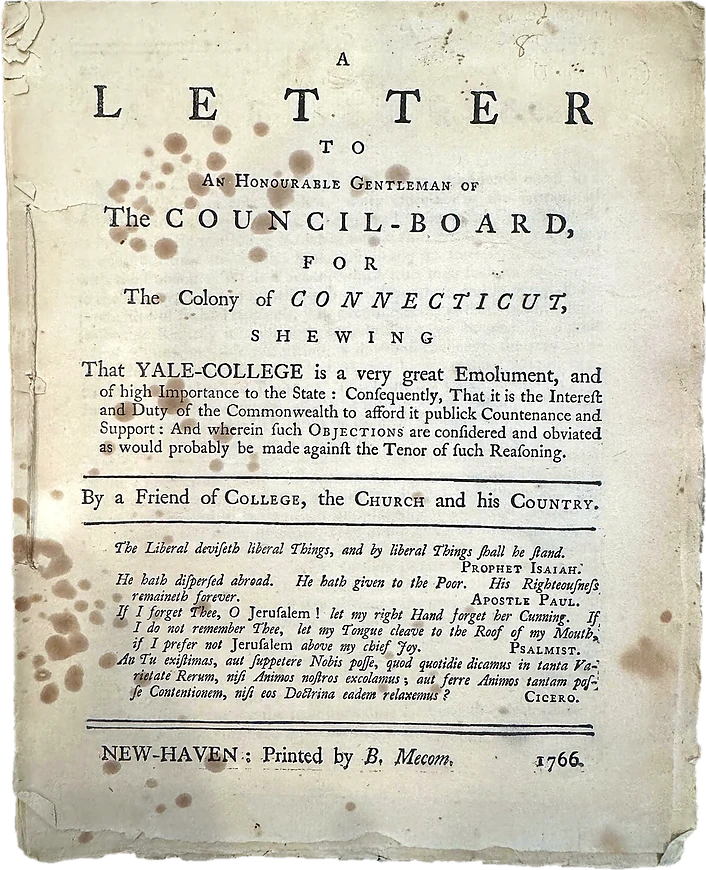
A Letter to an Honourable Gentleman of the Council-Board

A Letter to an Honourable Gentleman of the Council-Board for the Colony of Connecticut

New Haven: printed by B. Mecom, 1766
BF-2024.131

An argument for public support of Yale from the New Haven press of Franklin's nephew Benjamin Mecom, the last of the shops his uncle set up for him after Antigua, Boston and New York. Mecom had apprenticed with Parker. He had Franklin's blood and none of his luck.

Read the full entry

Further Reading

Where the story of this room is told at length.

The Cast of This Room

The people whose names are on the objects in this room. Each opens a short life in the Dramatis Personae, with the institutions that person belonged to and every other object in the collection that carries the name.

Benjamin FranklinBenjamin RushDeborah Read FranklinAnn FranklinJames FranklinJoseph BreintnallHugh MeredithNicholas ScullCharles BrockdenSamuel KeimerAndrew BradfordDavid HallJames ParkerChristopher SaurAnthony NewhouseMathew CareyJames TurnerJohann BöhmNathaniel Ames, father and sonPhineas BondThomas CadwaladerWilliam DouglassPeter CollinsonJohn BartramJames LoganThomas PennJames HamiltonCharles Read, father and sonGeorge WashingtonRobert Morris