 EIS LIBRIS
EIS LIBRIS
EIS LIBRIS
1799
YF-2023.009
 Click to enlarge
2 photographs of this object
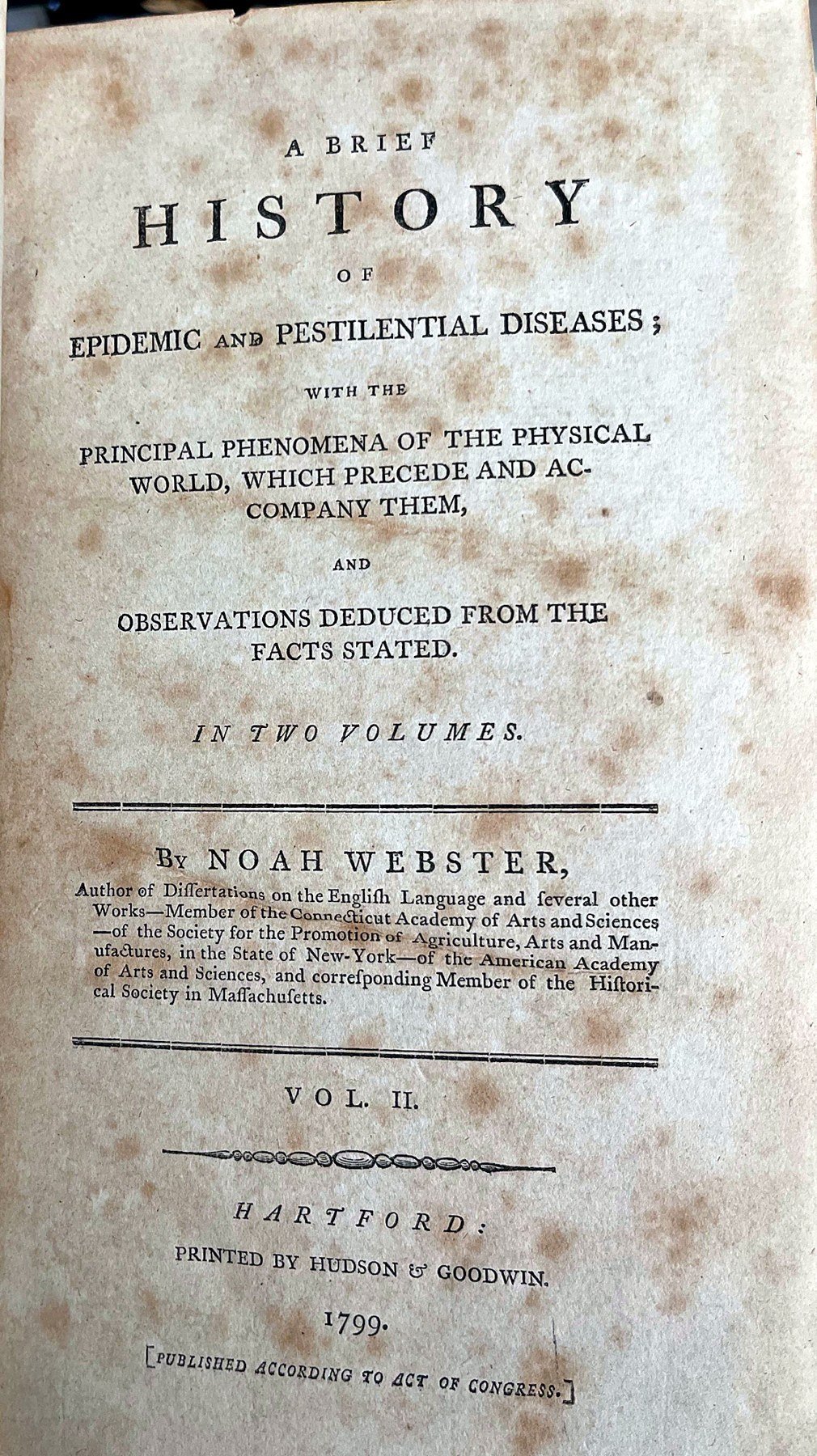
398. Webster, Noah, 1758-1843. A brief history of epidemic and pestilential diseases; with the principal phenomena of the physical world, which precede and accompany them, and observations deduced from the facts stated... Hartford: Printed by Hudson & Goodwin. 1799... 2 vols. (xii, [9]-348 ; [4], 352 p.) ; 22 cm. (8vo) The remarkable Noah Webster was a lawyer, publisher, lexicographer, the force behind America's first copyright legislation, and the author of books on politics, economics and the physical sciences. His American Spelling Book appeared in 60,000,000 copies by the end of the 19th century, and hisAmerican Dictionary of the English Language (1828) remains a milestone in American culture. Medical matters were not outside the range of Webster's encyclopedic interests. The threat to public health from pestilential disease was at the fore of public thinking following outbreaks of yellow fever along the East Coast throughout the 1790s. In January 1798 Webster began to gather materials for this work from libraries in Philadelphia, New York, New Haven and Cambridge. He began writing in April 1798, and published the Brief history in December of the following year. C.E.A. Winslow characterized the book as "the best general summary of epidemiological opinion at the beginning of the 19th century which is extant," and recognized it as an unsurpassable summary of earlier speculations. In the introduction to the first volume, Webster treats plague and yellow fever as different forms of the same disease, labelling the one "Levant plague" and the other "American plague." He also provides an important distinction between specific contagion and infection. In Section I. Webster introduces the key concept of "epidemic constitution," i.e., changes in the atmosphere produced by some "occult quality" rendering it pestilential. Sections II-VIII. of the first volume provide a chronological review of epidemiological thought from Biblical times to the end of the 18th century intended to support the theory of epidemic constitution. The final section traces yellow fever's appearance along the eastern coast of the United States from 1788 to 1799. The second volume is a collection of loosely related essays on such topics as the relation of natural phenomena (volcanic eruptions, earthquakes, etc.) to pestilential outbreaks; pestilential periods; the succession of diseases which precede epidemic outbreaks; a lengthy discussion of contagious disease (e.g., smallpox), infectious disease (e.g., typhus), and epidemic pestilence (e.g., yellow fever); the prevention and mitigation of epidemics, etc. The" best general summary of epidemiological opinion at the beginning of the 19th century...and few works surpass it as a compendium of earlier speculations in the field."Osler called the work the" most important medical work written in this country by a layman."Webster studies the weather and other phenomena year by year (even month by month). Also see Thomas A. Apel “feverish Bodies, Enlightened Minds” chapter 2 for long discussion of Webster and Tytler
Back to 1793: The City in the Fever