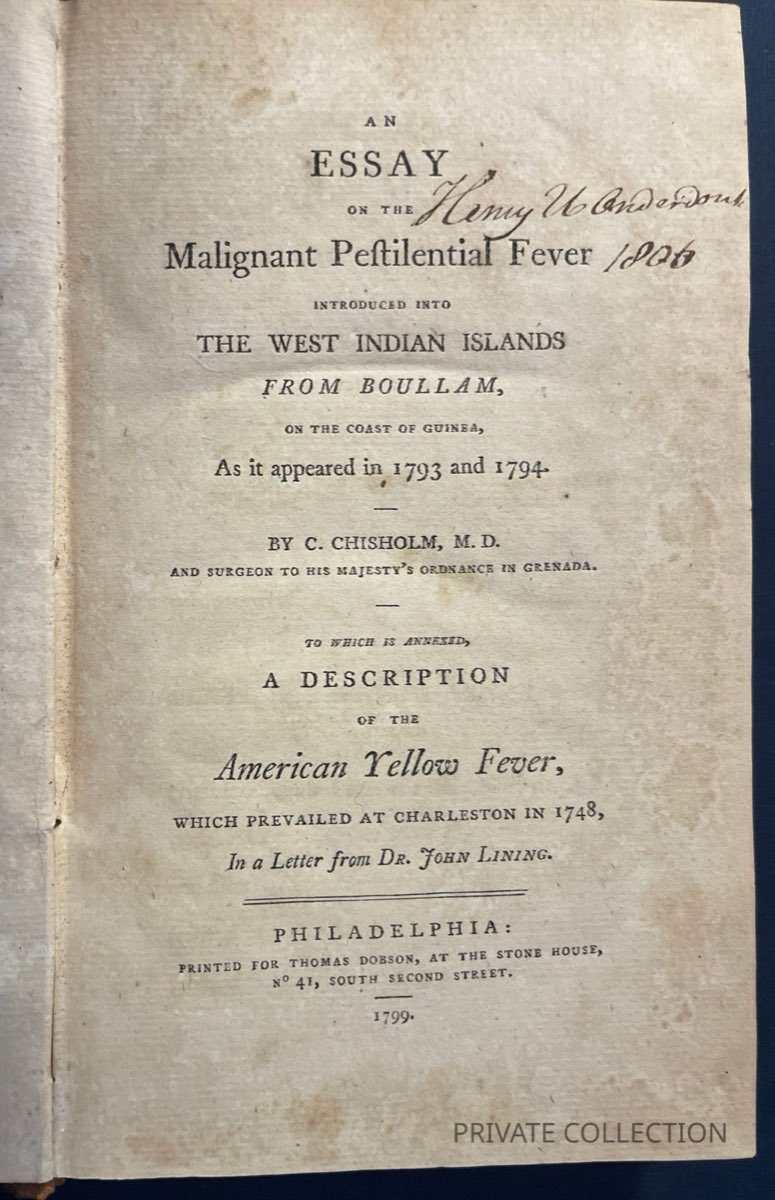
Chisholm, Colin, 1755-1825. An essay on the malignant pestilential fever introduced into the West Indian Islands from Boullam, on the coast of Guinea, as it appeared in 1793 and 1794...To which is annexed, A description of the American yellow fever, which prevailed at Charleston in 1748, in a letter from Dr. John Lining. Philadelphia: Printed for Thomas Dobson... 1799.
"A page-for-page reprint of the London edition of 1795, to which is here added... Dr. Lining's 'A description of the American yellow fever, in a letter... to Dr. Robert Whytt."
Though many authors later equated the two, Chisholm distinguished the "malignant pestilential fever" from the "yellow fever of the West Indies." The former he regarded as contagious-a disease which was spread by inhaling effluvia discharged from diseased lungs, by contact with body fluids, or by touching the personal effects of infected persons. He thought yellow fever to be endemic, to arise from climatic conditions and vitiated atmosphere, and to be non-contagious.
Chisholm was convinced, however, that the malignant pestilential fever of Grenada and the fever described by Benjamin Rush as prevalent at Philadelphia in 1793 (#337) were the same disease. Chisholm's argument for the contagiousness of the "malig-nant pestilential fever" centers on his account of the Hankey, which sailed from the island of Bolama on the western coast of Africa in 1793, and which, according to Chisholm, brought the fever to Grenada. This fever, which he states had never before been known in the Caribbean, later spread to Jamaica, Santo Domingo and Philadelphia by means of infected vessels. Among those authors who later equated Chisholm's "malignant pestilential fever" with yellow fever, the incident of the Hankey became the centerpiece of contention between contagionists and non-contagionists.
From Catalog I
The most important international contribution to the Philadelphia debate. Chisholm's "Hankey hypothesis" -- that a single vessel carried a novel African fever to the Caribbean and thence to Philadelphia -- gave the importationists their strongest argument. Rush dismissed it; Currie embraced it. The Chisholm essay is the moment the Philadelphia debate opens into its Atlantic dimensions, connecting to the history of the Haitian Revolution and the Saint-Domingue refugees who had been landing at Philadelphia's wharves all summer.