 EIS LIBRIS
EIS LIBRIS
EIS LIBRIS
Philadelphia: Samuel Keimer [and Benjamin Franklin], 1728
BF-2025.006
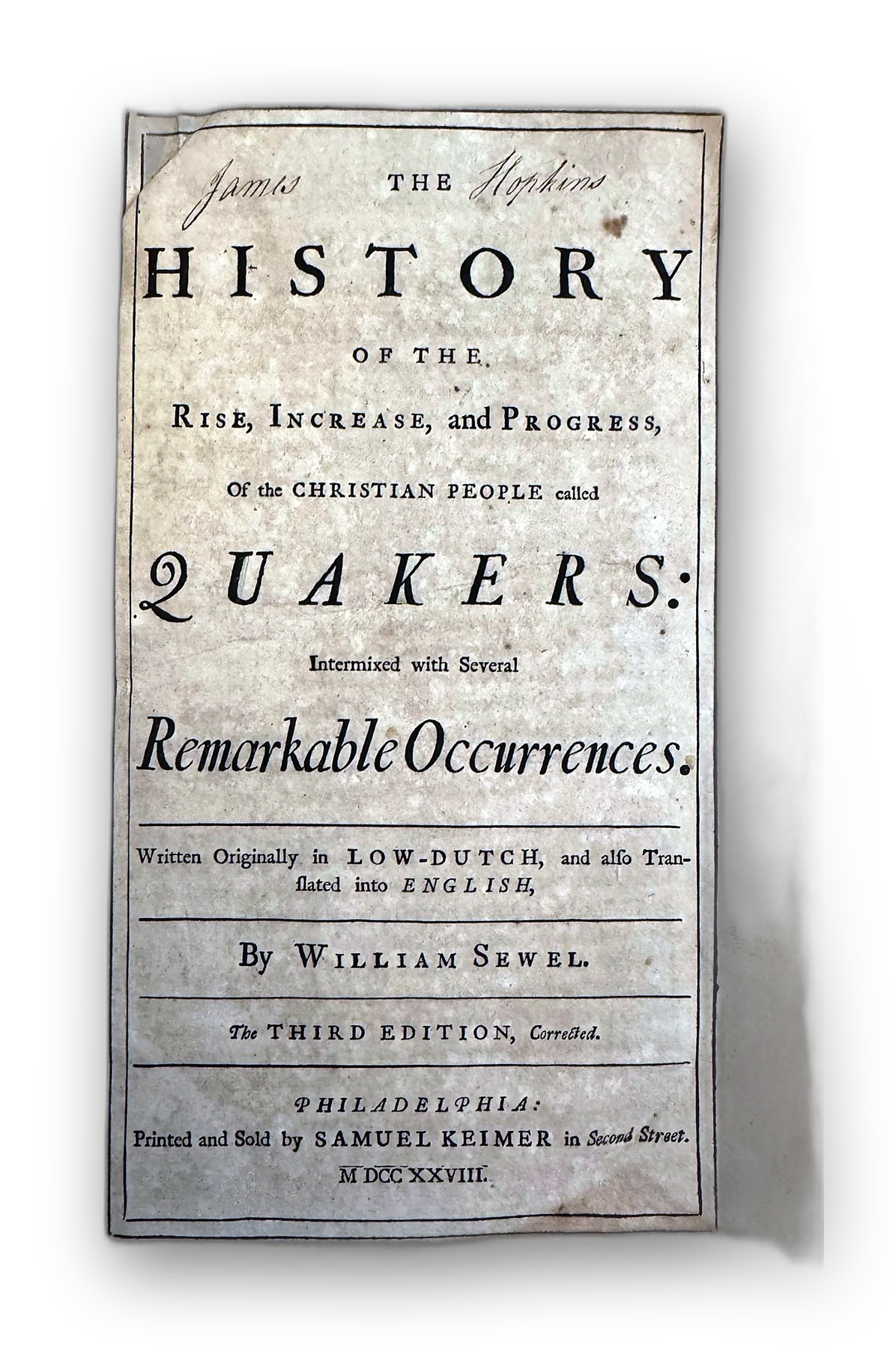 Click to enlarge
3 photographs of this object
Philadelphia: Samuel Keimer [and Benjamin Franklin], 1728.
[12], 694, [16]pp.
The first product of Franklin's Philadelphia press, this copy with provenance to a prominent family of New Jersey Quakers with a link to Franklin.
Franklin and his partner Hugh Meredith took over part of the publication of this large book from their former employer, Samuel Keimer, who had fallen so far behind that the Philadelphia Quakers who had commissioned the work were forced to turn elsewhere to complete the job. Franklin and Meredith are most likely responsible for printing the text from page 553 on.
Franklin notes in his autobiography that he composed the book while Meredith printed it. This is the first American edition, and one of the most imposing books from an American press of the period.
William Sewel first published his noted history of the Quakers in 1722 in London. In 1723 the Philadelphia Monthly Meeting obtained five hundred subscriptions for a Philadelphia edition of the work. Initially they reached an agreement with Quaker printer Andrew Bradford to produce the work; however, Bradford, believing it more profitable to have the work printed by his aunt in England and imported, delayed the American edition. The Meeting therefore turned to Philadelphia printer Keimer and his young assistant Franklin.
Importing paper and supplies from England to print the work (among the largest books printed in Philadelphia to that date) put Keimer in debt to the Meeting, who had advanced him funds against the sales. however, the job would prove too large for Keimer to handle.
"In 1728 Franklin [and his partner Hugh Meredith] left Keimer's employ, set up his own shop, convinced the Friends to turn the job over to him, and finished off the last forty-four and a half sheets (178 pages) of the book in a matter of weeks. Thus Franklin got his start by stealing a job from his former boss" - Green & Stallybrass.
Franklin notes in his autobiography that he composed the book while Meredith printed it: "upon this work'd exceeding hard, for the Price was low. It was a Folio, Pro Patria-size, in Pica with Long-Primer Notes. I compos'd of it a Sheet a Day, and Meredith work'd it off at Press. it was often 11 at Night and sometimes later, before I had finish'd my Distribution for the next days Work."
The contemporary binding of this copy includes a stamp and fillet attributed by William Spawn to Philadelphia bookbinder William Davies (see appendix 3 of Miller). Miller notes that Davies received £125 for binding the work from the Yearly Meeting of Friends in Philadelphia.
This copy has provenance to a prominent family of New Jersey Quakers with a link to Benjamin Franklin. Laid in at rear is a detached and torn blank leaf bearing the following ink inscription: "John Estaugh to his Kinsman Ebenezer Hopkins 1739." Born in England, John Estaugh (1676-1742) was a Quaker minister and missionary who later settled in America. In 1702 he married Elizabeth Haddon (1680-1762), who a year earlier had arrived in New Jersey to oversee and manage the properties owned there by her father, John Haddon, a London Quaker (the legend of the couple's courtship and marriage were later immortalized in Henry Wadsworth Longfellow's Tales of a Wayside Inn). The Estaughs had no children of their own. In 1723, however, following a trip to England, the couple returned to America with their five-year-old nephew, Ebenezer Hopkins (1718-1757), son of Elizabeth's sister Sarah, whom they effectively adopted, raising and educating him to his future role as heir to the Haddon family's New Jersey estate. "In 1739 when Ebenezer came of age, John presented him with one hundred acres of land" and also, apparently, with this copy of Sewel's History (Taylor). Three years later, in 1742, Estaugh died while on a religious mission to Tortola in the West Indies. As the ANB explains, following John's death, "Elizabeth gave Benjamin Franklin her husband's manuscript," which Franklin published in 1744 as A Call to the Unfaithful Professors of Truth (Miller 348).
The title page of this copy also bears the ink inscription of one James Hopkins, possibly Ebenezer's grandson, and an inscription on the verso reads "Jos. Saunders's Book Bot at the vendue of the effect of Nancy Hopkins [decd?] widow of James Hopkins [decd?] [June?] 27 1851."
The book was acquired by H. Richard Dietrich II from James McCloskey in 1970; it had remained in the collection of the Dietrich American Foundation since then.
An excellent copy of the first product of Franklin's Philadelphia press.
People in this record
Back to The Printing-House