 EIS LIBRIS
EIS LIBRIS
EIS LIBRIS
BF-2025.010
 Click to enlarge
5 photographs of this object
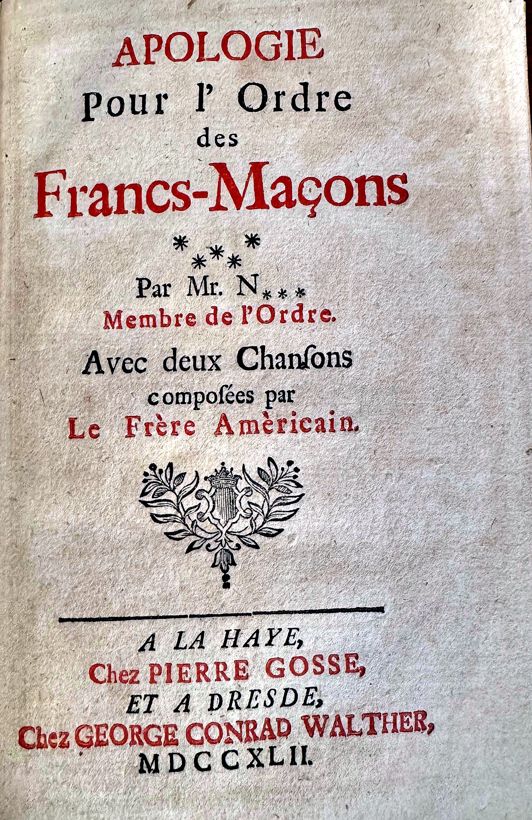
The Hague: Chez Pierre Gosse & Dresden: Chez George Conrad Walther, 1742. 1st ed.
First edition of one of the earliest apologies for the Order of Freemasons, containing two American Masonic songs attributed to Benjamin Franklin.
This is one of the key 18th-century texts delineating the exclusivity of the Masonic Order to Christians: "The Order admits only Christians. Out of the Christian Church one can not and should not be received as a Freemason. That is why the Jews, Mohammedans, and Pagans are excluded as infidels" (translated from the French).
The two songs, credited on the title page to "le Frère Américain," are also of considerable note. One candidate for the author of the main text is Johann Lorenz Natter (1705-63), the German goldsmith, gem-cutter, and lapidary who was accepted to the Florence Masonic Lodge as a disciple of the antiquarian Baron Philipp von Stosch, the founder of the lodge, in 1733. Natter was the most celebrated and talented engraver of his time, and so much so that his talent was even eulogized by Goethe. Natter's book about gem-engraving was published in London in 1754, in both English and French. Natter's contribution in spreading Masonic knowledge is well-known and important: "...on his travels [he] left copies of the various manuscripts at the court of William IV in The Hague, in London, Copenhagen and Stockholm. In St. Petersburg Natter joined some Roiscrucians, and the documents he had brought became their basic study material. Later, in 1763 this same knowledge was imparted to Johann August Starck, when he went to St. Petersburg as a teacher of Oriental languages. He contacted the Freemasons there, who had incorporated much of Natter's legacy. Starck, in turn, shared his special 'secret knowledge,' once he had returned to Germany, with the existing Masonic Order of the Strict Observance with which he associated himself. Since this Order had many affiliations, not least in France, the Florentine scriptures thus provided some of the most seminal sources in the hermetic-rosicrucian tradition of that day" (Ida Potsma, THE BIRTH OF A NEW ORDER; 1980)
Benjamin Franklin joined the newly-opened Philadelphia Masonic Lodge in 1731 and was a lifelong member and supporter of the Order. August Wolfstieg attributes the two pieces to Jacques Christophe Naudot (ca. 1690-1762), a French composer and member of the Masonic lodge Satine-Genevieve and Coustos Villeroy in Paris. The Italian musicologist Alberto Basso, however, attributes them to Franklin, which certainly makes more sense since the composer is identified as "le frère Amèricain" in the title. He stresses the primary import of the songs in the work, writing: "In this case it is not important for us to find out who the author of the book could be, but to emphasize that the two songs...are the work of Benjamin Franklin, who worked on the Masonic scene a dozen years now" (L'invenzione della gioia. Musica e massoneria nell'eta dei Lumi; 1994).
A rare piece. According to Rare Book Hub it has appeared at auction only once in the last century-plus, in 1922. Institutional copies are held by the Bibliothèque nationale de France, the Morgan Library and several German libraries.
Back to Memory