 EIS LIBRIS
EIS LIBRIS
EIS LIBRIS
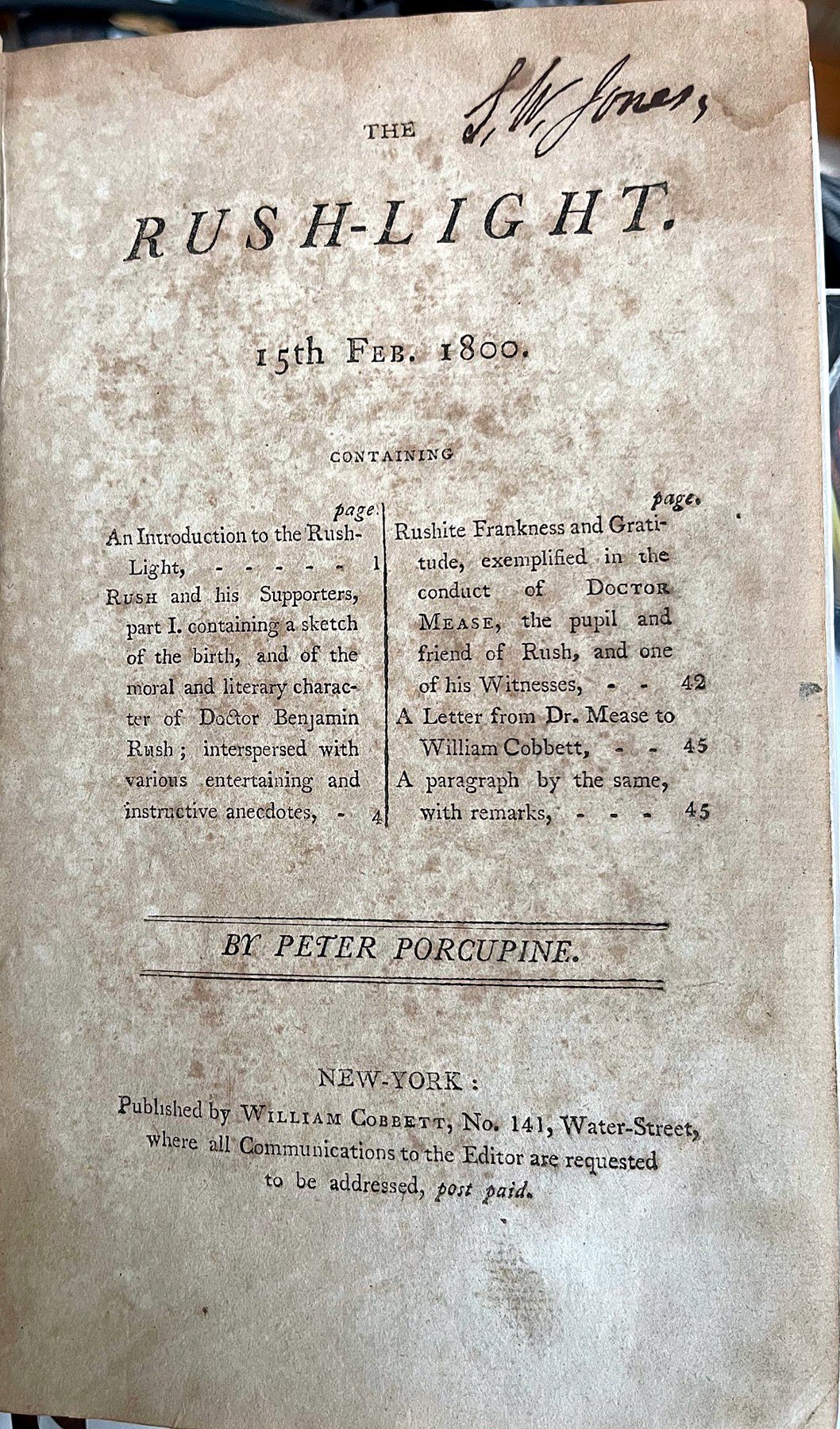
Five numbers complete. New York: published by William Cobbett, 1800
BR-2023.044
 Click to enlarge
12 photographs of this object
William Cobbett came to Philadelphia in 1792 with a wife, a grudge against the French Revolution and no settled politics, and within four years he was the most feared pen in America. Writing as Peter Porcupine, he attacked the Republican interest wholesale: Jefferson, whom he cast as a French-struck philosopher unfit to govern; Priestley, newly landed and welcomed by the democratic societies; Thomas McKean on the bench; and the newspapers that carried them. He printed and sold his own work from a shop on Second Street with portraits of George III in the window, and he was sued, prosecuted and bound over more than once for what he wrote.
His steadiest target was Benjamin Rush. Through the autumn of 1797, while the yellow fever ran again in Philadelphia, Porcupine's Gazette called Rush "Doctor Sangrado," after the bleeding quack in Gil Blas, and a "remorseless bleeder" whose method of copious bleeding and purging was one of the great discoveries that had contributed to the depopulation of the earth. He counted Rush's patients among the dead and named them. The attack was political as much as medical, since Rush was a Republican and a friend of Jefferson, but it was made in the language of the sickroom, and it cost Rush his practice.
Rush had answered his critics in print for twenty years. This time he went to law. The case came to trial in December 1799 before Chief Justice Edward Shippen, When the jury returned five thousand dollars on the Saturday, the largest libel award in the country to that date, the courtroom broke into applause. Cobbett's Philadelphia stock was seized and sold at auction to pay it, including sheets of his own Works.
The Rush-Light is his answer, written in New York while he packed for England. Five numbers appeared between 15 February and August 1800, devoted almost entirely to the verdict, the trial, and the character of Benjamin Rush: the bleeding, the fever of 1793, the evidence he said the court would not hear, and a long defence of the publications on which the action had been grounded. He opens by telling his readers why he had meant to be silent after the suit, and why he could not be. He wrote it knowing he would sail before the last number appeared, which he did. Rush gave the five thousand dollars to charity. Neither man got the last word he wanted, and both sides of the quarrel are in this room.
A complete set of the five numbers, with an early ownership signature of S. W. Jones on the title page of the first.
People in this record
Back to Rush