 EIS LIBRIS
EIS LIBRIS
EIS LIBRIS
1787
BR-2024.024
 Click to enlarge
4 photographs of this object
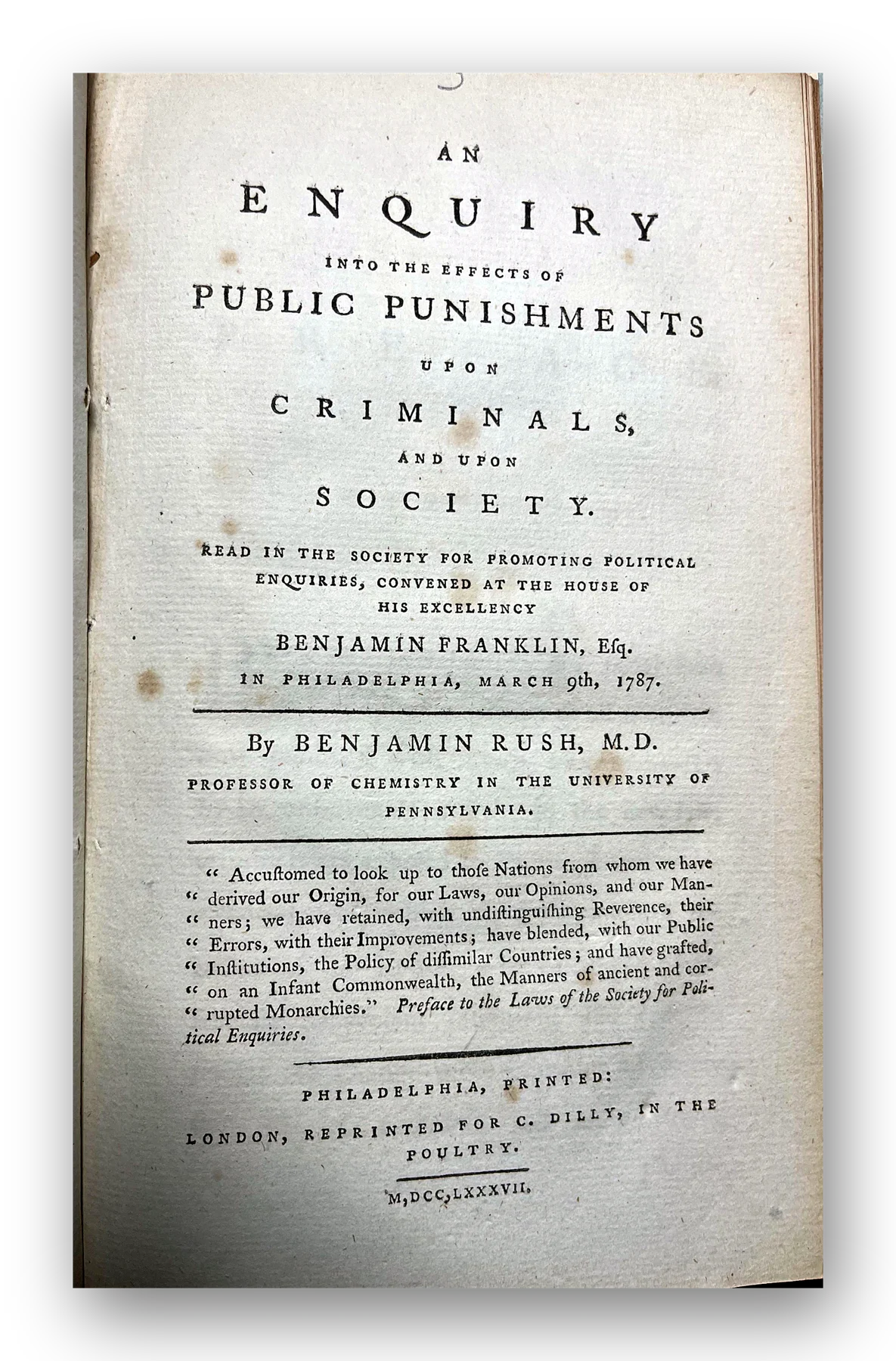
Rush (Benjamin) An Enquiry Into the Effects of Public Punishments upon Criminals, and upon Society. Read in the Society for Promoting Political Enquiries, convened at the house of His Excellency Benjamin Franklin, in Philadelphia, March 9th, 1787. Philadelphia, printed: London, reprinted, for C. Dilly, 1787, Rush's interest in social reform was aroused when he joined the staff of the Pennsylvania Hospital, "stirred moreover by the idealism of the Revolution, he now became a sponsor of the various ameliorative movements which were to remould America in the ensuing century. He established the first free dispensatory in the country (1786), became the President of the Pennsylvania Society for the Abolition of Slavery, condemned public and capital punishments, and demanded real "penitentiaries" by way of prison reform' (DAB). Rush had read Cesare Beccaria's On Crimes and Punishments and John Howard's The State of the Prisons, and Dufriche de Valaze's Lois penales dan leur ordre naturel, then the leading French commentary. In other words, Rush was well acquainted with state-of-the-art thinking in regard to punishment. But none of this information prepares us for what he has to say in his paper, for basically what he advocates is a form of radically private punishment. In order to grasp what is meant by this term, we need to first grasp what is meant by "public" punishment in the late eighteenth century' (Robert R. Sullivan, The Birth of the Prison: The Case of Benjamin Rush). Although the topic of capital punishment is not mentioned in the title, it is discussed here.
Back to Rush