![FRANKLIN, WILLIAM. Autograph letter addressed “Dear Friend” [Thomas Wharton], dated 19 September 1769, Burlington, NJ](../images/franklin-william-autograph-letter-addressed-dear-friend-thomas-wharton-dated-19.jpg)
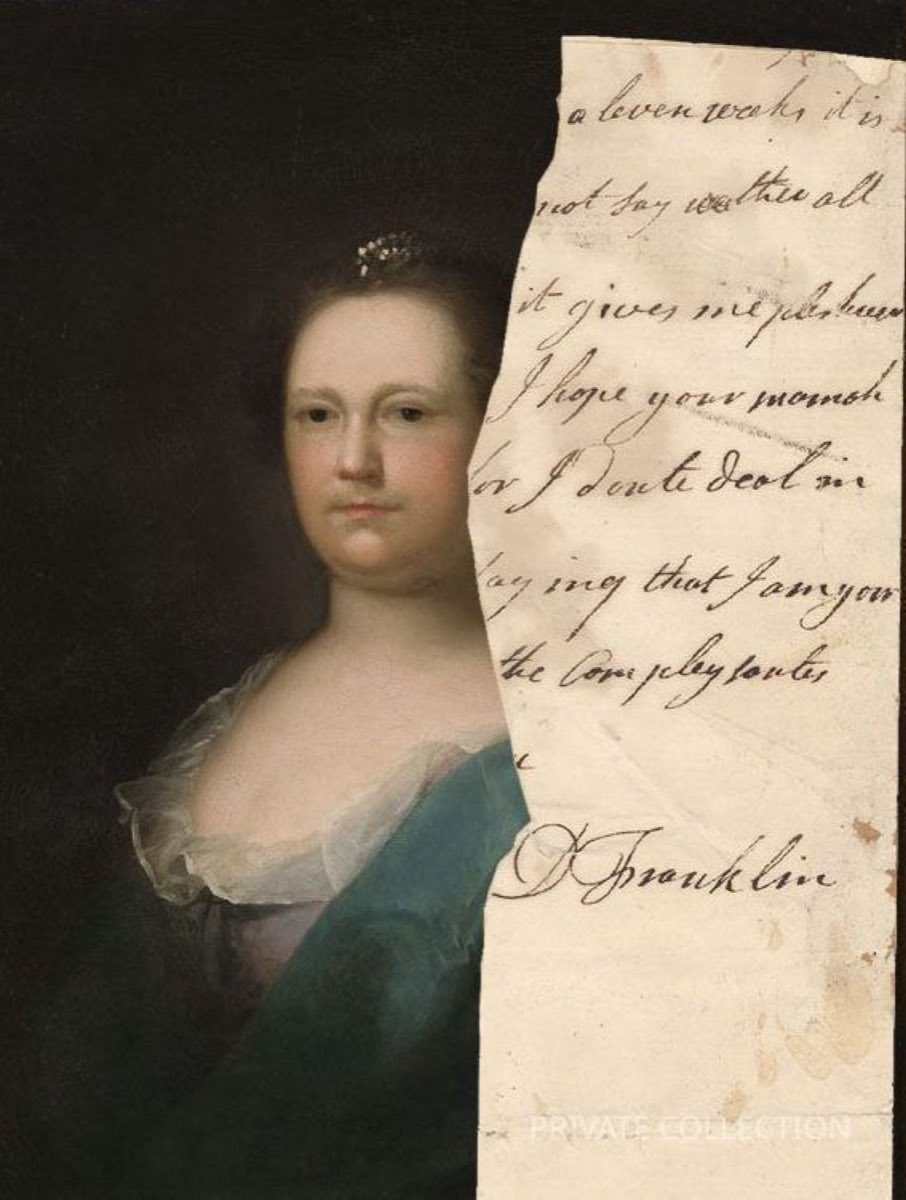
FRANKLIN, WILLIAM. Autograph letter addressed “Dear Friend” [Thomas Wharton], dated 19 September 1769, Burlington, NJ
FRANKLIN, WILLIAM. Autograph letter addressed “Dear Friend” [Thomas Wharton], dated 19 September 1769, Burlington, NJ.
4pp. manuscript (2 sheets measuring 8 x12.75 in).
A previously unrecorded letter sent by William Franklin (1730-1813), the last royal governor of New Jersey, to Thomas Wharton (1735-1778), one of his business associates, discussing land speculation, particularly the Otsego (here called “Otaga”) tract in western New York, and the payments owed to and from various parties, including the Burlington Company, Colonel George Croghan (1718-1782), and the Six Nations of the Iroquois. The tract comprised approximately 170,000 acres of Iroquois land, which was to be purchased and split between numerous shareholders, including Croghan, his assistant Alexander McKee (1735-1799), his longtime partner William Trent (1715-1787), a fur trader and land speculator, speculator brothers Thomas and Samuel Wharton (1732-1800), and Benjamin (1706-1790) and William Franklin. This letter is an important witness to the financial maneuvering necessary for British colonial western expansion in the wake of the Fort Stanwix Treaty of 1768.
At the close of the Seven Years’ War, the Proclamation Line of 1763 was established to prevent British colonial settlement on lands west of the Allegheny mountains, ceded by the French as part of the treaty, largely as a measure to pacify the French’s Native American allies. However, numerous British settlements already existed west of the boundary line, in what was called Ohio Country, and many more traders and investors already had claims and grants to large tracts of land which they now found themselves unable to capitalize on. Colonial officials as well as businessmen were implicated in the management of these tracts, and throughout the 1760s, numerous land grant companies were formed to advocate for colonists’ rights to use their investments. Eventually, authority was given to William Johnson (1715-1774), the superintendent of Indian Affairs for the Northern Department, to renegotiate the boundary line with the Native Americans concerned, primarily the Iroquois Confederacy and their allies. A large gathering was held in the autumn of 1768 at Fort Stanwix, in the Mohawk Valley of upstate New York, with some three thousand Native Americans present, as well as colonial officials from Pennsylvania, New Jersey, and Virginia, plus numerous speculators and merchants. William Franklin was among them. In November, a treaty was signed, moving the boundary line further west, running roughly south from Fort Stanwix to Fort Pitt and then southwest following the Ohio River as far as its confluence with the Tennessee River.
This meant that a great deal of land in central and western New York was newly open to British settlement, and the land speculators were ready. Franklin was one of a number of colonial elites with prior claims to the land, as he had been involved in land companies formed before 1763. Legally, only the governor was allowed to purchase Native American land, and could only convey 1000 acres to individuals, but Croghan, Johnson’s deputy superintendent of Indian Affairs, was experienced at circumventing such rules. The present letter concerns some 170,000 acres of land around Lake Otsego, near Fort Stanwix, which had already been surveyed by Croghan, in an arrangement with McKee and Trent. The survey was financially backed by the Franklins, as well as speculator brothers Thomas and Samuel Wharton, all of whom were also partners with Croghan and Trent in various other land companies. (Another man mentioned in the present letter, Picken, had evidently also participated in surveying the tract, but we have been unable to trace him).
However, as William Franklin discusses at length in this letter, there were questions as to the true extent of the land surveyed for him—80,000 vs. 100,000 acres, or more—and which parts were purchased by whom and at what rates, depending on what Croghan had agreed to pay the Native Americans. Franklin was seeking clarity not only for himself, but for the Burlington Company, one of many land grant companies formed in the wake of the Fort Stanwix treaty, comprising some eight well-to-do New Jerseyan shareholders (the other members of the Burlington Company refused to deal with Croghan except through Franklin, as Croghan had a tendency to not pay his debts on time). Moreover, Croghan already owed several thousand pounds to Franklin, who held several of Croghan’s mortgages, and part of the Otsego tract (or adjacent land) was to be conveyed to Franklin in lieu of cash payment. Evidently numerous letters from Croghan, Trent, Thomas Wharton, and Franklin had crossed paths in August and September 1769, and Franklin was writing to Wharton to clarify everything. “I have been more prolix than I intended,” he writes at the bottom of page 3, “but I was not willing to omit any thing that occur’d to me which might tend to explain the matter to you.”
The matter was not easily settled. There are letters held at the American Philosophical Society dated between December 1769 and January 1771, also written by Franklin to the Whartons, continually ironing out the details of who owed what to whom. Some settlement of the tract did occur in the early 1770s—a town of Burlington exists just west of Lake Otsego even today—but many of the figures mentioned in the present letter were Loyalists, and between poor financial management and the political upheaval of the 1770s, none besides the Whartons saw a true return on their western investments. Franklin, who never allied with the patriots (much to his more famous father’s shame), fled to England and subsequently relinquished most legal and financial claims to his American property. Croghan, in ill health for much of 1769, quickly lost control of his lands in New York as various tracts were conveyed back and forth to settle his debts, and he spent most of the 1770s instead speculating in western Pennsylvania and Ohio. Trent and Samuel Wharton had traveled to England in early 1769 to petition for royal grants to the land (thereby circumventing the need to maneuver for a governor’s favor), but ultimately remained in legal limbo in London for 6 years. Trent and the Whartons, also at this time seeking a royal warrant for the Indiana grant, joined forces with other land investment companies to form the Grand Ohio Company, with plans to form a colony called Vandalia in what is now Kentucky and West Virginia. But the Revolution called, and that never came to fruition.
Manuscript letters (as opposed to signed printed documents) from William Franklin are incredibly rare in the trade. This is only the second such letter we have seen on the market, and is much longer than the 1777 letter found in the Jay Snider collection. Importantly, it provides a great deal of evidentiary material about Franklin’s business dealings and land speculation, an underexplored part of Franklin’s biography. In all, a rare and important manuscript.
William Franklin, royal governor of New Jersey and Benjamin's only surviving son, writes to the Philadelphia merchant Thomas Wharton — a member of the Indiana Company land venture in which father, son, and Wharton were all invested. The letter belongs to the last years in which the Franklins' interests ran together. By 1776 William was in a Connecticut jail and his father had stopped answering his letters.
- Date
- Burlington, New Jersey, 19 September 1769
- Author / maker
- Franklin, William
- Condition
- Old fold lines, minor wear to edges, else remarkably well-preserved. Very good.
- Notes
- TRANSCRIPTION OF LETTER Burlington Sept. 19th 1769 Dear Friend, On Sunday last I receiv’d yours enclosing Col. Coghan’s Letter of the 28th of August since which I have rec’d two Letters from him, dated Sept 7 & 8. What he can mean by saying he is “changed in your Letter with deceiving your Brother of the Gent. Concerned in the Otaga Tract,” I cannot comprehend. You read to me your letter when I was in town, & I do not recollect any expression in it that would admit of that construction, nor was there any thing of the kind in my Letters to him. These, however, he had not received when he wrote to you. I observe that he says that your Bro. agreed to pay the Indians 16,00 Dollars for 80,000 Acres & that whatever the Tract held out more they were to be paid in Proportion for it, and that this agreement appears by a paper in your Brother’s own Hand writing. I know not what to think of this assertion. I can scarcely imagine that Col. Croghan would allege any thing so positively without being able to prove it. Yet not only my memory, but every paper I have by me relative to the affair, tend to convince me to the contrary. If I may venture to trust my Memory at all in what respects this transaction (which, however, has been oftener contradicted than on any other occasion) the fact is as follows. Your bro. Capt. Trent & Mr. McKee were offered by Col. Croghan to be interested in a purchase of the Indians to be made at Fort Stanwix. Your Bro. & Trent 30,000 acres each & McKee 20,000. When I met your Bro. there, he told me that Col. Croghan, as a Mark of his friendship, was willing, if I chose it, to interest me likewise in a purchase for 20,000 acres, and that I might have it in my choice either to be concern’d with him, Trent & McKee, or in any of the other purchases then about to be made. I afterwards thank’d Col. Croghan for his offer, & inform’d him that I chose to be concern’d in the same purchase with Mr. Wharton & his company, as I knew them, and as we liv’d near together we could more easily manage our concern. Picken was afterwards employ’d to reconnoitre the tract, & he having represented that it certainly contain’d above 100,000 acres, we concluded that we might safely venture to purchase that quantity. Accordingly it was agreed by Mr. Wharton & Col. Croghan, as they inform’d me, to give the Indians 15,00 dollars for that quantity, & 100 dollars to the two Chiefs who were to negotiate the purchase (in the whole 16,00 dollars) and if the Tract on a survey turn’d out more, as it was thought it would, they were to be paid at the same rate for it. The Indian deed was [catch word] [end of p.1] [p.2] Deed was some time after executed, & in it are these very words after the description of the bounds, viz. “Containing by estimation one hundred thousand acres, be the same more or less.” This 100,000 acres was always understood to be divided among your Bro. Trent, McKee, & myself in the proportions above mentioned, & that we were all to pay for it, & by the expenses attending the same, in the like proportion. But some time after Col. Croghan made a proposal to me to borrow 3,000 £ for him, & to enable me to obtain it he offered 50,000 acres clear of the Indian purchase within the above mentioned tract, which he thought would contain that quantity over & above what we were to receive; and that it might have a better chance of doing this, it was agreed between him & Mr. Wharton, that Mr. McKee should have his 20,000 acres out of some other tract. It was on this account that McKee was removed, & not to make room for giving me twenty thousand acres – your Bro. told me that he expected to have at least 20,000 left after the 80 & 50,000 acres above mentioned were taken out, which he might very well do, if (as Col. C. says) he & Col. Johnson computed the tract to contain 170,000 acres. This may account for his advancing the money for 50 instead of 30,000 acres which he was originally to have. For he has absolutely convey’d to me on Col. Croghan’s account all that shall be above 80,000 acres in that tract, so that the quantity does not exceed the 50,000 engaged to me by the Colonel; - and Col. Croghan has engaged on his own part, that if there should not be as much above the 80,000 as would answer that purpose, then I should have the deficiency made up out of some other tract.-- In settling with Picken for his trouble & expences in reconnoitering the tract, your Bro. charg’d himself at the rate of 50,000 acres, Trent at 30, & me at 20, which we respectively paid, as appears by the account in his handwriting now in my possession.-- And your Bro. & Col. Croghan always told me that the expence of the Indian purchase altogether would be 16 dollars per thousand, and at that very rate I paid Col. Croghan for my 20,000 acres when he brought me a letter from your Bro. dated Jan 28, 1769, containing the following paragraph, viz “I have paid Col. Croghan 800 dollars for my share of the Indian purchase, & Capt. Trent has paid him 480 dollars and your share is 320 dollars which please to pay him, otherwise Sir H. Moore cannot acknowledge the Indian Deed.” I accordingly paid him, and took his receipt for “320 dollars in full for the Indian purchase of 20,000 acres [catch word] [end of p.2] [p.3] Acres,” which is but 16 dollars per thousand. And what shews that the Col. himself understood the purchase to be at that rate, is the letter he wrote to me requesting me to borrow the 3,000£ for him, in which he says, “I will give you a deed for that quantity of land (i.e. 50,000 acres) clear of the Indian purchase which is 320£.” Now 800 dollars are just 320£ York currency. But in his last letter to you I observe he says he was to pay the Indians but 750 dollars for the 50,000 acres, which, if we paid 15,00 (exclusive of the 100 dollars gratuity) for the purchase of 100,000 acres is right enough. But if we paid 15,00 dollars for the purchase only of 80,000 acres as Col. C. contends, how comes it to pass that he is to pay but 750 for 50,000 acres, when he acknowledges that he was to pay the Indians in the same proposition as they were paid for the eighty thousand? Upon the whole, I think it evident from the Indian deed itself from your Bro.’s settlement with Picken, from Col. Croghan’s Letter to me & his receipt for my share of the Indian purchase well as from many other circumstances – that we all understood that 15,00 dollars purchaser money, & 100 dollars gratuity, were actually given for 100,000 acres; & that 20,000 acres thereof which were originally intended for McKee were afterwards appropriated towards making up the 50,000 acres engaged by Col. Croghan to be given for the loan of the money I borrow’d for him. What agreements there may be between Col. Croghan & your Brother I know not, but I understood from the latter that in case the tract contain’d more than the 130,000 acres before mention’d, he was to have all the overplus to his own share. I likewise understood that the Indians were to be paid for all above 100,000 acres at the same rate as for the 100,000 acres & yet their deed expressly says that they sell all within that bounds, (100,000 acres more or less) for 15,00 dollars, which makes it probable that had the tract even held out 170,000 acres as was talk’d of at first, yet no further conversation was intended to be made them. However, that is left known to the Colonel. I have been more prolix than I intended, but I was not willing to omit any thing that occur’d to me which might tend to explain the matter to you. Col. Croghan in his letter to me agrees to let the Burlington Company into a part of his tract as they define. He says likewise, that he has just receiv’d some letter which [catch word] [end of p.3] [p.4] which he believes will occasion his coming down to New York sooner than he intended, & he wants me to meet him there, but as I am to meet the Assembly soon it will not be in my power. I shall therefore endeavor to persuade him to come as far as Burlington, that we may settle every thing in person. My wife joins in best regards to you with Dear Sir, Your Sincerely affectionate Humble Servant Wm. Franklin [signature]. P.S. The packet is come but I have no letters at all- If you have any thing particular do write to me by the boat tomorrow. The Colonel’s letter to you I return enclos’d. Mr. LeGay returns here on Friday or Saturday. Wm Franklin Burlington Sept 19, 1769