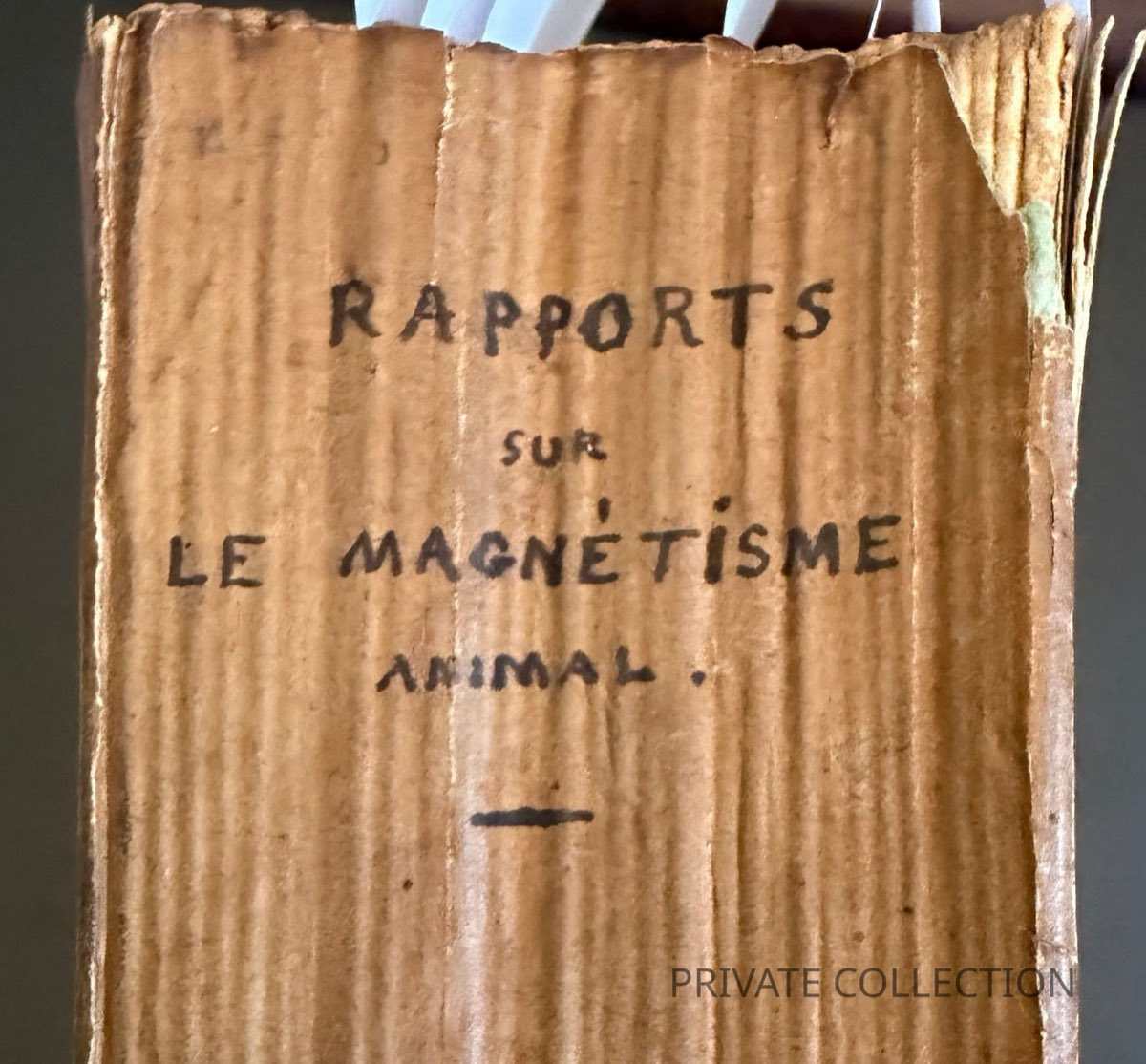
Various imprints, 1784-1785. Orig. printed paper wrappers. Mild foxing, some wear to spine and edges, else very good.
In 1784, in response to growing interest about the magnetic fluid theories of the German doctor Franz Mesmer (1734-1815) and his French disciple Charles-Nicolas d'Eslon (1750-1786), Louis XVI appointed two separate commissions to investigate what was then called "animal magnetism," a pseudo-scientific theory of energy-based healing, which made use of electric currents and was later often associated with hypnotism. The first commission, made up of members of the Paris Faculty of Medicine and the Royal Academy of Sciences, included as its chairman Benjamin Franklin, then in Paris as the US ambassador, and thus is known to historians of science as"the Franklin commission."
Franklin had previously been aware of Mesmer's approach due to his own experiments with magnetism and electricity, and had even dined with him, though the eventual report made clear that their work would not be of equal importance to scientific development.
The second commission included doctors from the Royal Society of Medicine ("the Society commission"). Established in the spring of 1784, both groups presented their reports to the king in August. The Franklin commission performed a controlled study of various patients of d'Eslon's at Franklin's resident at Passy, and found no results for his method that could not otherwise be explained by the natural human susceptibility to suggestion, thus being one of the first scientific demonstrations of the placebo effect. The evenhandedness of their report considered a model for rational application of the scientific method to pseudoscientific theories. The Society commission, who performed fewer experiments, issued a shorter report a week later, reiterating the conclusions of the Franklin commission.
The reports were widely reprinted and read in France and across Europe, and Mesmer's reputation was quite damaged in spite of his insistence that the commissions were only responding to d'Eslon's work. Nevertheless, some of the commission members disagreed with the truth of the reports and other public figures leapt to defend animal magnetism in print, and the theory persisted on the fringes of medical science for another hundred years.
Any edition of the Franklin Commission report is now scarce in the trade, despite their initial popularity, and the other pamphlets included here even more so. The seven pamphlets included in this report are:
1. [BAILLY, Jean Sylvain, ed. ]. Rapport des commissaires charges par le roi de l'examen du magnétisme animal... Paris: Chez Moutard, 1784. 2nd ed. 80pp. Ford 360, Crabtree 31. The Franklin Commission's report on their controlled trial with the patients of d'Esion.
2. POISSONNIER, Pierre Isaac, et al.]. Rapport des commissaires de la société royale de médicine, nommes par le roi. Pour faire l'examen du magnétisme animal... Paris: Chez Moutard, 1784. 47pp. Crabtree 101. The Society Commission's report.
3. [JUSSIEU], Antoine Laurent de]. Rapport de l'un des commissaires charges par le ro, de l'examen du magnetisme animal. Paris: Chez la Veuve Herissant; Theophile Barrois, 1784. 79 pp. Crabtree 72 (ref). A further discussion of the findings of the commissions, offering a dissenting view: while the mechanics of animal magnetism as proposed by d'Eslon were roundly disproven by the commission's own experiments, Jussieu believed that dismissing the theory entirely was misguided and there may yet be a rational explanation for some of d'Eslon's results.
4. [SERVAN, Joseph Michel Antoine]. Doutes d'un provincial, proposed a messieurs les medecines-commissaires charges par le roi de l'examen du magnetisme animal... Lyon: Chez Prault, 1784. 134pp. Crabtree 111. Lengthy critique of the Franklin commission (see the first pamphlet), by the former avocat-general of the provincial parliament of Grenoble, who had himself been cured by mesmerism. One of the more thoughtful contemporary methodological critiques of the Franklin Commission.
5. Récit de l'avocat général de *** aux chambres assemblées du public, sur le magnétisme animal... Philadelphia and Paris: Chez P.J. Duplain, 1785. 39pp. Crabtree 149. Appears to be an anonymous summary of consideration of the problem. Rare; we can find no records of it in commerce.
6. [LANDRESSE, C. del. Le cri de la nature ou le magnétisme au our... Paris: Chez les Marchands, 1784. 40pp. Crabtree 74. Written by a patient of d'Eslon's who felt called to defend animal magnetism. Written by a patient of d'Eslon's who felt called to defend animal magnetism Rare; we can find no records of it in commerce.
7. [TARDY DE MONTRAVEL, A. A.]. Essai sur la théorie du somnambulisme magnétique... London [but Paris or Strassbourg], 1785. xxxii, 86pp. Written by a student of Mesmer, Tardy de Montravel was interested in the correspondences between sleepwalkers and practitioners of mesmerism, often called "magnetizers," and how they could jointly channel magnetic fluid to effect healing. One of the most influential treatises on this offshoot in mesmerism.