William Chancellor ALS
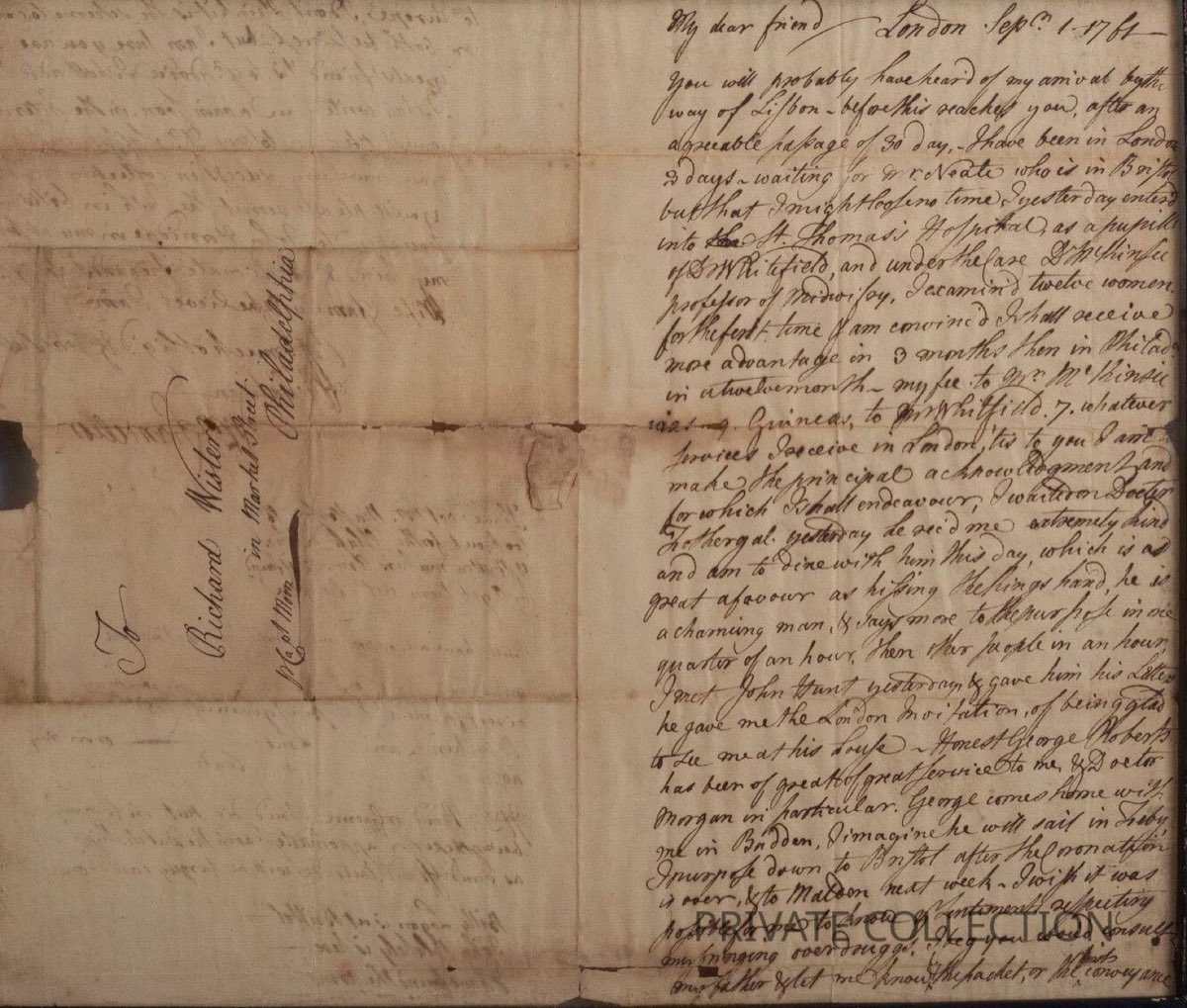
Chancellor, Dr. William. 1 September, 1761. 2 pages. 14.25" x 12".
Autograph letter signed ("Wm. Chancellor"), with reference to the transatlantic slave trade.
Addressed to Richard Wister, a merchant on Market Street in Philadelphia. Chancellor writes to Vister with news of his arrival in London, as well as his ongoing studies with surgeons and at hospitals to advance his medical knowledge. He laments the poor education he received in Philadelphia and states that he will see more patients in one month in London than in twelve in Philadelphia. In a postscript below his signature, Chancellor adds:
"If Dr. Bond or Greme [Graeme] should die put in for my being the person appointed to search the Dutch ships as I understand the trade will be largely carried on." Chancellor may refer here to the continuation of the slave trade despite the ongoing French and Indian War. The position which he seeks in Philadelphia is an appointment by the assembly as an inspector of unhealthy ships, specifically ones arriving with cargo consisting of enslaved men, women, and children from Africa.
William Chancellor worked as a doctor on board the sloop "Wolf" when it departed New York in September 1749 as part of a 20-month slaving voyage to the coast of West Africa. The surviving volume of the diary he kept while on board documents the misery he witnessed amongst those imprisoned on the ship. That diary, along with one other letter written to a friend on 6 September 761, are the only other manuscripts by Chancellor known still to exist. Creasing, tears at folds, mall losses not affecting text. Overall good condition. Scarce correspondence from a doctor who worked aboard slave ships and documented the horrors of the Transatlantic Slave Trade.
However, this letter may be of the utmost historical importance as it may piece together the founding of the Pennsylvania Hospital Medical Library. As per David L. Crosby's article (see reference below) Chancellor went to London and met with Dr. John Fothergill. It was just after this (in the time of that era) that Fothergill famously send back anatomic drawings to the PA hospital for use in teaching. it is surmised that Chancellor brought the letter from Israel Pemberton to Fothergill requesting funds for the hospital to which Fothergill sent the drawings instead. This would be a logical conclusion as a straight line can be drawn from Pemberton to Fothergill through Chancellor at the correct time.
- Date
- 1761
- Condition
- Creasing, tears at folds, mall losses not affecting text. Overall good condition.
- Notes
- Richard Wistar WISTAR, Richard, merchant, born in Philadelphia, Pennsylvania, 20 July, 1756; died there, 6 June, 1821. He was the grandson of Caspar Wistar, who came to this country from Germany in 1717 and established near Salem, New Jersey, what is believed to have been the first glass-factory in the colonies, in the management of which his son was also associated. In early life Richard turned his attention to commerce, in which he was eminently successful. He built a large four-storied store in 1790, where he conducted an iron and hardware business, and with the profits of this undertaking purchased lands and houses in the vicinity of Philadelphia, which became exceedingly valuable. During the Revolutionary war he advocated the defense of his property by arms, which resulted in his being disowned by the Society of Friends. He was an inspector of prisons, and was one of the early friends and supporters of the Philadelphia library company and the Pennsylvania hospital. --His brother, Caspar Wistar, physician, born in Philadelphia, Pennsylvania, 13 September, 1761; died there, 22 January, 1818, was educated at the Friends' School in his native city, where he received a thorough classical training. His interest in medicine began while he was aiding in the care of the wounded after the battle of Germantown, and he made his first studies under the direction of Dr. John Redman. He attended lectures at the medical department of the University of Pennsylvania, and received the degree of bachelor of medicine in 1782.