EIS LIBRIS
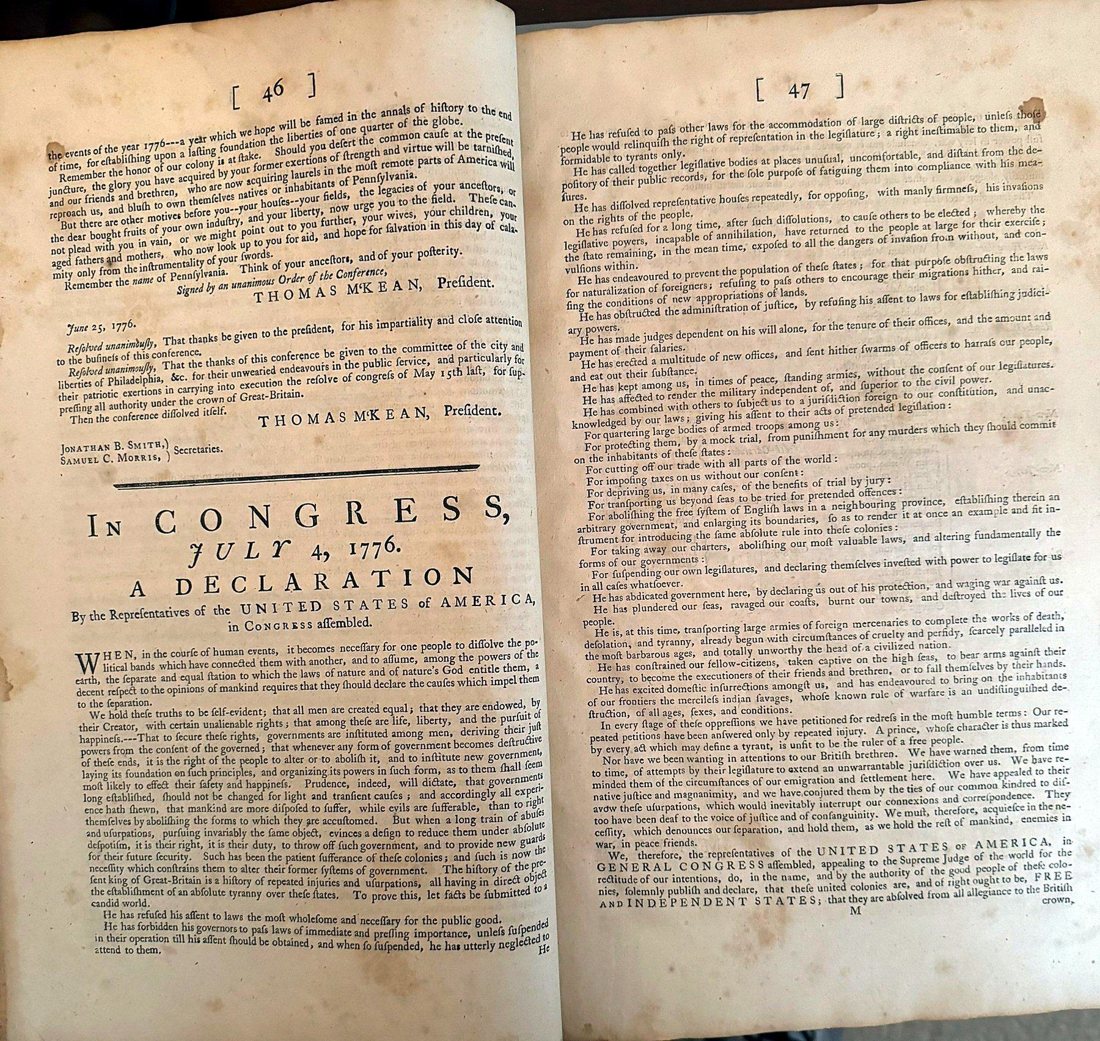
The back of the State House, Philadelphia, from Birch's Views, 1799. Library of Congress.

Room 6 of 10

The Cockpit and the Break

Franklin, his son, and the Revolution, 1774 to 1783

The back of the State House, Philadelphia, from Birch's Views, 1799. Library of Congress.

On 29 January 1774 Franklin stood for an hour in a room at Whitehall called the Cockpit, because it had been built on the site of Henry VIII's cockfighting pit, while the Solicitor General abused him before the Privy Council. He had obtained and sent to Boston a set of private letters in which the royal governor of Massachusetts urged London to curtail colonial liberties, and the letters had been published. Franklin stood silent through the whole of it, went home, and was dismissed from his post as deputy postmaster general of North America the next day. He had spent sixteen years in London trying to hold the empire together. He sailed for Philadelphia in March 1775 a revolutionary, and arrived the day after the fighting at Lexington.

Franklin, in a suit of Manchester velvet, stood through Wedderburn's hour without a word while the assembled lords laughed. He is said to have worn the same suit to sign the treaty of alliance with France four years later; the story rests on Silas Deane and is treated with caution. Franklin's own name for the moment was simpler. It was the day he gave up on the empire.

The break ran through his own family. His son William, born to him before his marriage and raised in his house, had been made royal Governor of New Jersey in 1762 and stayed loyal to the King. He was arrested in June 1776 and imprisoned in Connecticut for two years while his father sat in the Continental Congress and signed the Declaration of Independence. They met once more, in England in 1785, and parted for good. Franklin took William's son Temple with him to Paris instead and made him secretary of the American mission there.

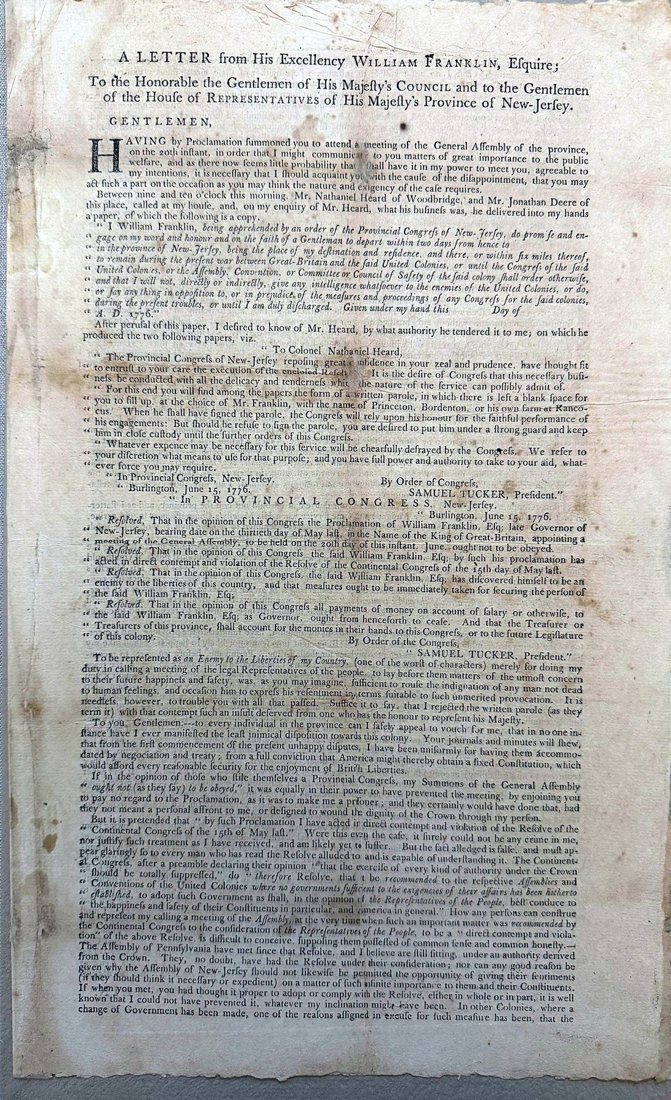
On June 15, 1776, the Continental Congress declared William Franklin "a virulent enemy to this country" and ordered his arrest. His answer of June 17, printed at Burlington with a postscript of June 22, is a proud, lawyerly, doomed document: the governor of a royal province refusing to recognize a Provincial Congress he called an illegal assembly. That assembly arrested him on June 26. He was in a Connecticut jail when his father signed the Declaration a week later.

This room holds both sides. The Governor's last address to the Assembly that was about to depose him, printed as a broadside in 1776. His letters. The prints, French and German, through which Europe watched the war. The writings of Thomas Paine, whom Franklin had sent to Philadelphia in 1774 with a letter of introduction. And the Franklin stove and Poor Richard explained to a French audience at the height of his fame in Paris, where he was better known than any American has been since.

In 1785, on his way home from Paris, Franklin stopped at Southampton and met his son for the first time in a decade. The meeting settled the sale of some New Jersey land and nothing else. Franklin's will, five years later, left William almost nothing, "the part he acted against me in the late war" being, he wrote, too well known to require explanation. This room holds the father's triumphs and the son's answer to Congress, printed in the two weeks between his defiance and his arrest. Read together they are the Revolution at the scale of a family, which is the scale at which most people lived it.

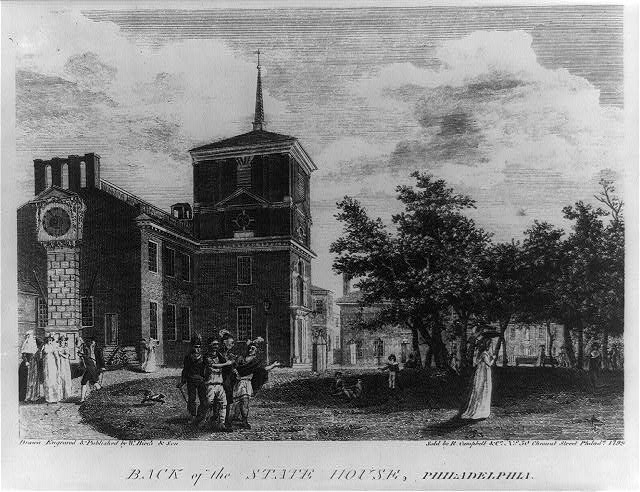
A Letter from His Excellency William Franklin to the Provincial Congress

FRANKLIN, William. A Letter from His Excellency William Franklin, Esquire; To the Honorable the Gentlemen of His Majesty’s Council and to the Gentlemen of the House of Representatives of His Majesty’s Province of New-Jersey.
BF-2026.006

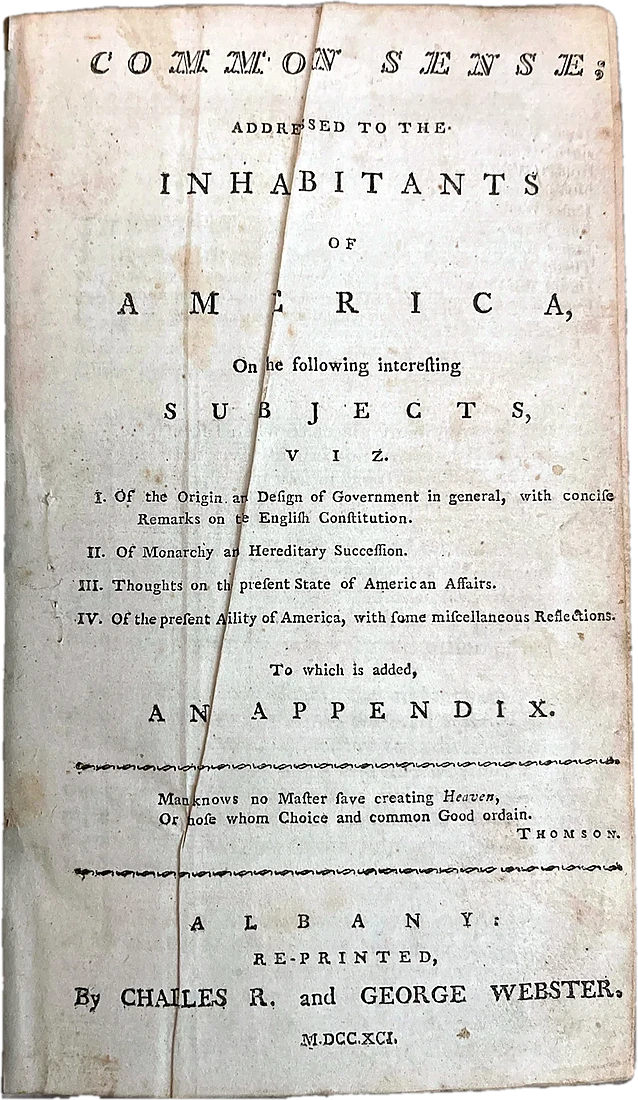
The Writings of Thomas Paine

The Writings of Thomas Paine

1792
BR-2022.025

Thomas Paine came to Philadelphia in November 1774 carrying a letter of introduction from Franklin, the second such letter in this collection to change a life, after the one that sent Rush to Edinburgh. Fourteen months later he published Common Sense, and the argument that had been about taxation became an argument about independence.

Read the full entry · 4 photographs

A Letter from His Excellency William Franklin to the Provincial Congress

A Letter from His Excellency William Franklin to the Provincial Congress

Burlington: Isaac Collins, 1776
BF-2026.006

Franklin's reply to the Continental Congress's declaration of 15 June 1776 that he was a virulent enemy to his country. He wrote it on 17 June, addressed to the Council and the Assembly of New Jersey, and it is printed here at Burlington with a postscript dated 22 June. He answers the charges against him and refuses to recognise the Provincial Congress, which he calls an illegal assembly.

The reply did not prevent his arrest. The Provincial Congress took him into custody on 26 June and he was sent to Connecticut, where he spent the next two years in prison. His father signed the Declaration of Independence a week later. This copy is a folio broadside, fully untrimmed, from the library of Richard Smith, with a contemporary note on the back of the last page. It is exceptionally rare.

Read the full entry · 4 photographs

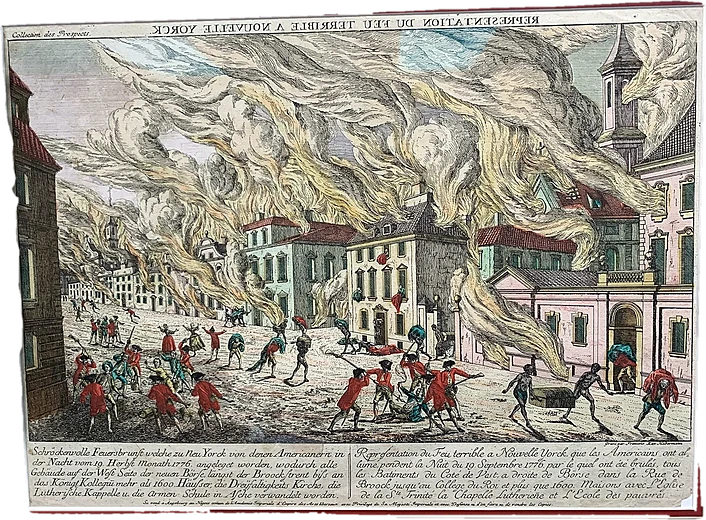
Représentation du Feu Terrible à Nouvelle Yorck

Représentation du Feu Terrible à Nouvelle Yorck

1776
P1

The great fire of September 21, 1776, which burned a quarter of New York a week after the British occupied it, as a European peepshow print imagined the scene. Each side blamed the other, and the truth was never established. Made to be viewed through a lens, by an artist who had never crossed the Atlantic.

Read the full entry

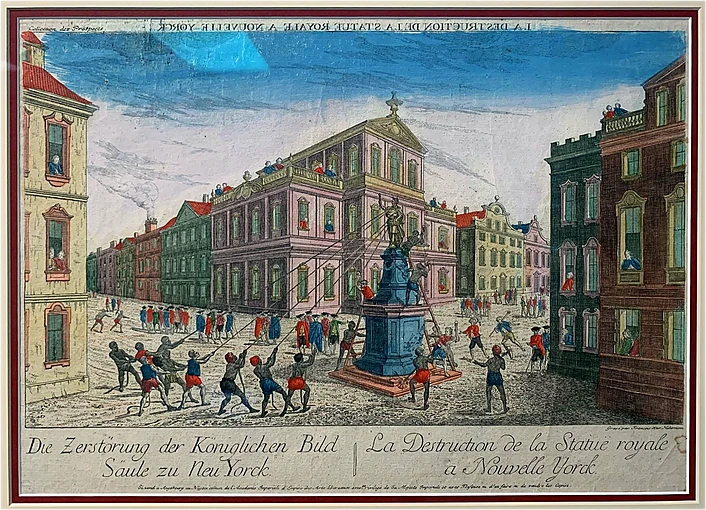
La Destruction de la Statue Royale à Nouvelle Yorck

La Destruction de la Statue Royale à Nouvelle Yorck

1778
P3

A Parisian printmaker's imagining of the crowd pulling down the equestrian statue of George III on Bowling Green on July 9, 1776, five days after the Declaration. The artist had never seen New York and gave it a European skyline; the enthusiasm is authentic. The statue's lead became 42,088 musket balls.

Read the full entry

Journals of the House of Representatives of the Commonwealth of Pennsylvania

Journals of the House of Representatives of the Commonwealth of Pennsylvania

Philadelphia: printed by John Dunlap, 1782. Volume the first
BF-2023.055

The Assembly's own record of the Revolution, from November 1776 to October 1781, printed by John Dunlap, the man who had set the Declaration in type on the night of 4 July 1776. Bound in at the front, with the proceedings of the committees and conventions, are the Articles of Confederation and the Declaration itself, shown here at the opening.

Franklin sat in this house as a clerk, then as a member, then as its Speaker's colleague and agent in London, and he was in Paris when this volume was printed. The room's quarrel ends on the page where Pennsylvania entered its own founding document into the minutes.

Read the full entry · 3 photographs

Further Reading

Where the story of this room is told at length.

The Cast of This Room

The people whose names are on the objects in this room. Each opens a short life in the Dramatis Personae, with the institutions that person belonged to and every other object in the collection that carries the name.

Benjamin FranklinBenjamin RushWilliam FranklinWilliam Temple FranklinJohn DunlapMathew CareyThomas Wharton the elderSamuel WhartonGeorge CroghanWilliam TrentRichard SmithThomas PaineRobert MorrisWilliam Bradford Jr.