
Against the Gallows and the Whipping Post
Rush on Punishment, Law, and the Reform of the Republic
IN March 1787, two months before the Constitutional Convention assembled in Philadelphia, Rush addressed the Society for Promoting Political Enquiries — a club of intellectuals and reformers that met in Franklin's home. His subject was the reform of criminal punishment. His audience included Franklin himself and a number of the men who would shortly be writing the new republic's foundational document. The timing was deliberate: Rush was arguing that the new nation's legal foundations required a systematic rethinking of how crime was punished, from first principles.
Rush's argument against public punishment — the whipping post, the pillory, the stocks, and the public execution — was simultaneously moral and medical. Publicly inflicted pain, he contended, produced not moral improvement in the punished or moral instruction for the watching public, but precisely the opposite: it hardened the punished, brutalizing people who might otherwise be reformable, and corrupted the public, accustoming observers to violence and degrading their capacity for sympathy. The physician who could describe the psychological effects of pain — on the body, on the social environment in which the body lived — had standing in this debate that the mere moralist or lawyer did not.
His campaign against capital punishment developed in parallel, drawing on the same Enlightenment reform tradition — Beccaria's On Crimes and Punishments (1764), Howard's State of the Prisons (1777), Bentham's emerging utilitarianism — but applied specifically to the American republican context. The death penalty violated the inalienable right to life; it demonstrably failed to deter murder; it corrupted the moral sensibility of the society that administered it. Pennsylvania became the first state to restrict capital punishment to first-degree murder in 1794, a reform Rush's sustained campaign helped produce.
The Walnut Street Prison, opened in 1790 on principles that Rush helped develop, was the practical alternative to public punishment: a reformatory institution whose architecture and regime were designed to produce internal moral change rather than public spectacle. The collection holds the essential documentary record of Rush's penal reform campaign across four publications.
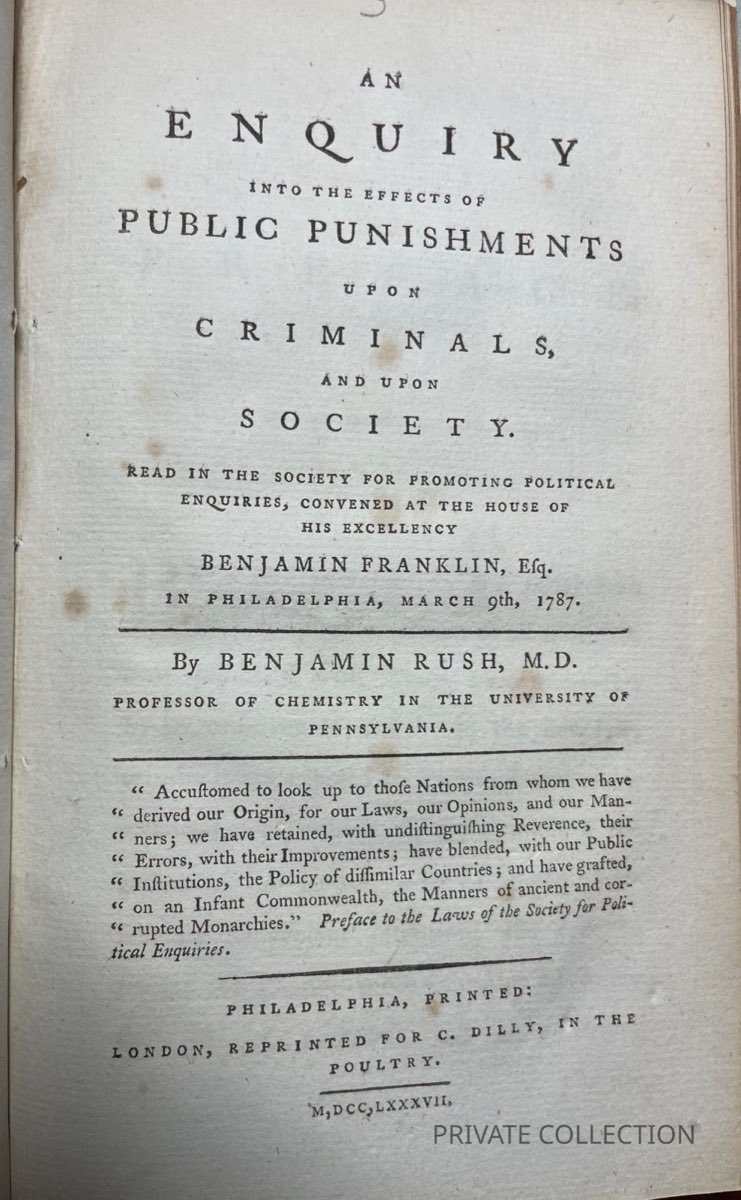
An Enquiry into the Effects of Public Punishments upon Criminals and upon Society
Rush's entry into the Enlightenment debate about criminal justice reform, delivered before Franklin's Society for Promoting Political Enquiries in 1787. The pamphlet engages with Beccaria, Bentham, and Howard while arguing that public punishment is specifically incompatible with republican principles. "The design of punishment," Rush writes, "is to reform the criminal, and to prevent crime." Public punishment achieves neither. The Walnut Street Prison experiment, which Rush was instrumental in developing, was the practical demonstration of his alternative.
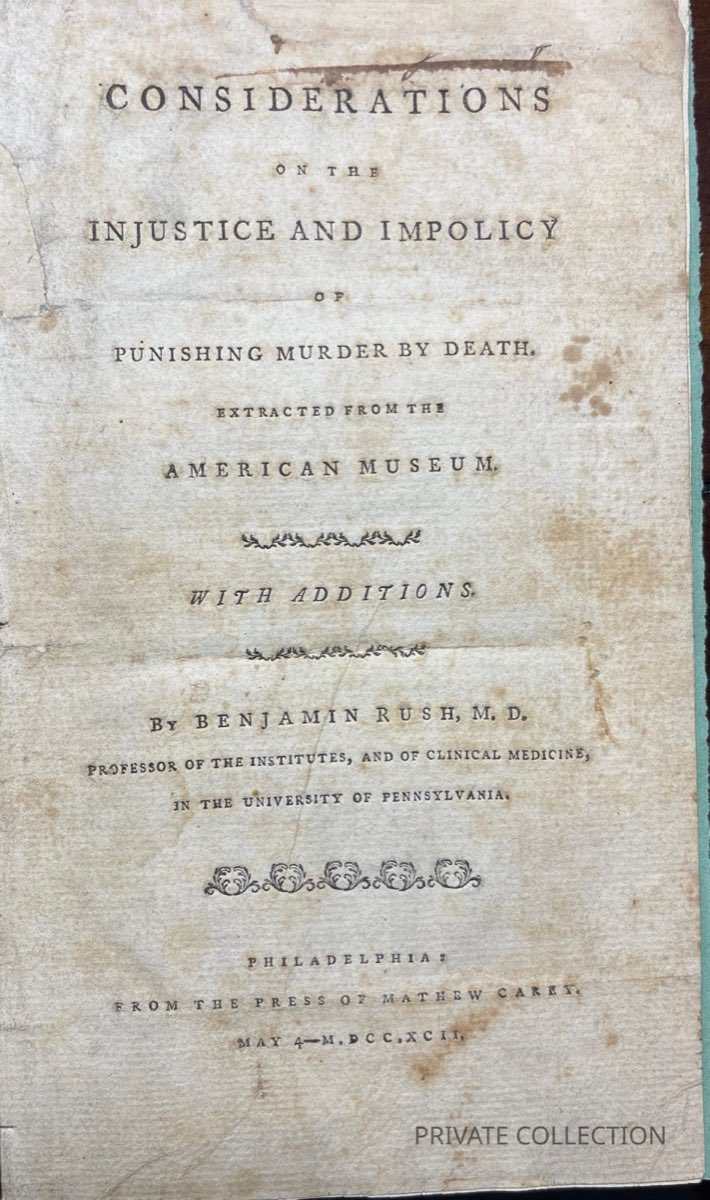
Consideration on the Injustice and Impolicy of Punishing Murder by Death
Rush's most sustained argument against capital punishment. He contends on three grounds: theological (the Mosaic law applies to a theocracy, not a republic), philosophical (the right to life is inalienable even by the state), and empirical (capital punishment demonstrably fails to deter murder and corrupts the moral sensibility of those who witness it). Pennsylvania's restriction of capital punishment to first-degree murder in 1794 represented a partial victory; Rush continued arguing for complete abolition until his death. The pamphlet is Rush at his most characteristic: the physician applying clinical thinking to a social problem.
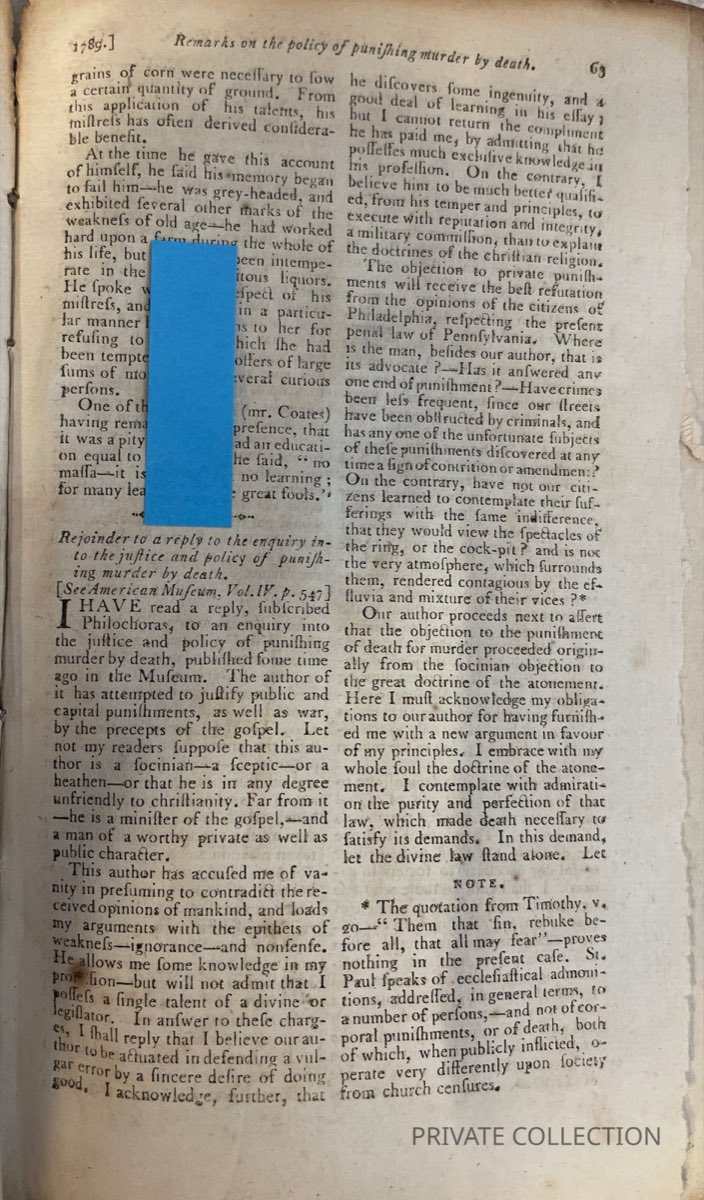
Rush — Rejoinder to "Murder by Death"
Rush's response to critics of his capital punishment arguments, demonstrating that the debate was not one-sided and that Rush was willing to engage his opponents directly in print. The same polemical style that characterized his yellow fever publications — confident, data-citing, morally absolute — appears here in the legal context. Rush had the same relationship to his opponents in the punishment debate that he had to his opponents in the epidemic debate: he was right, they were wrong, and he was willing to say so.
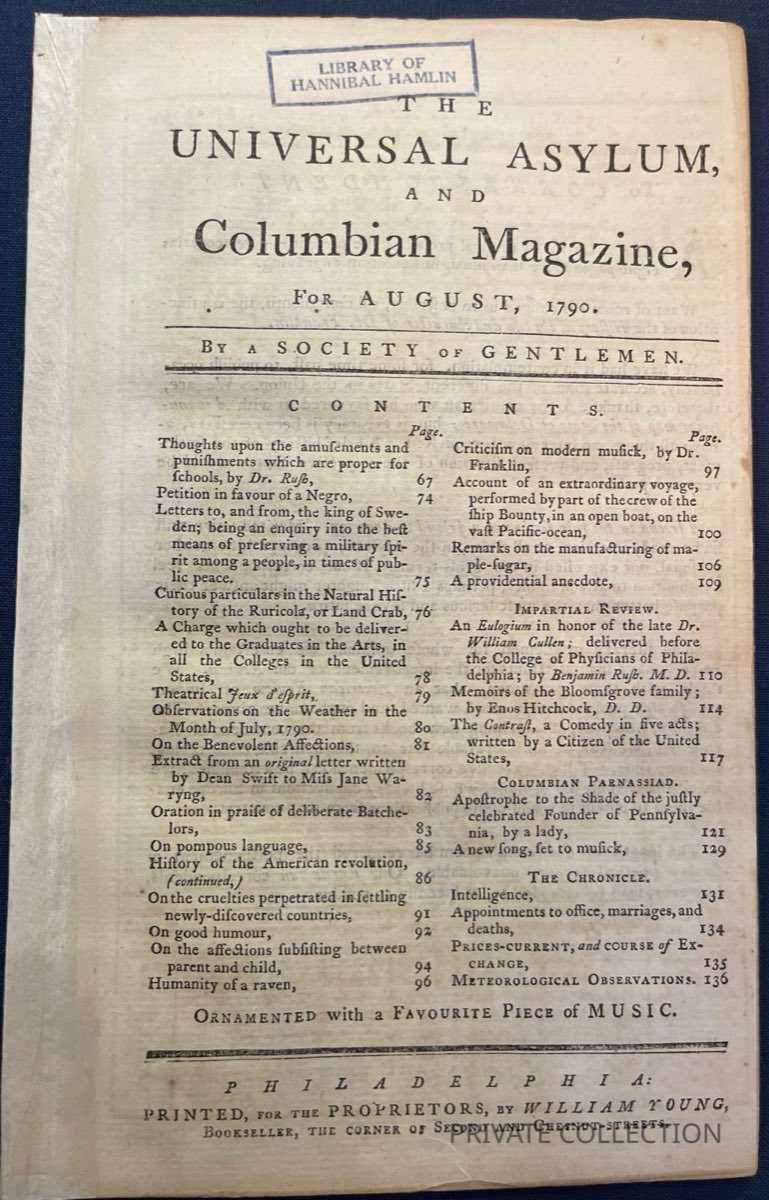
Thoughts Upon the Amusements and Punishments which are Proper for Schools
Rush extended his arguments about punishment from the penitentiary to the schoolroom: the same principles that made public flogging counterproductive in criminal justice made corporal punishment counterproductive in education. Children, like criminals, were to be reformed through structured moral environments — not degraded through pain. The pamphlet is characteristic of Rush's reach: he saw no category boundary between medical reform, penal reform, and educational reform. They were all aspects of the same project — building a republic of virtuous citizens — and medicine, properly understood, had something to say about all of them.