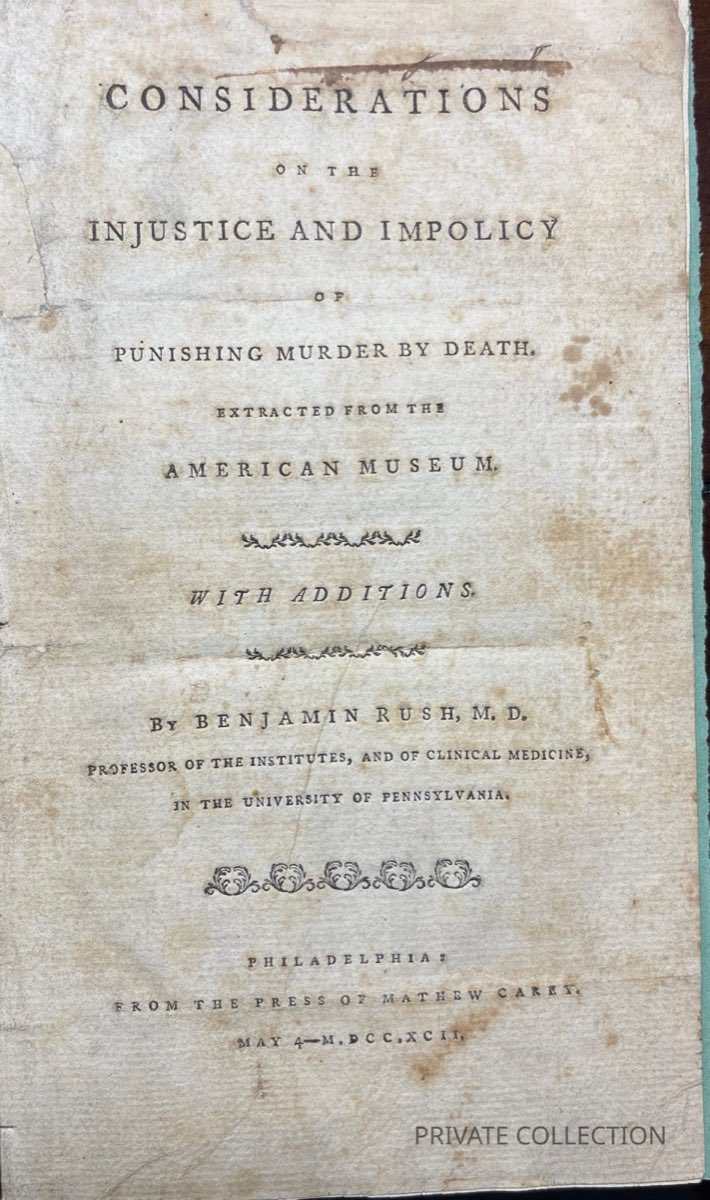
Consideration on the Injustice and Impolicy of Punishing Murder by Death
BR-2022.014
One of the rarest of Rush's publications, if not the rarest. The last auction record we can find is the 1909 Pennypacker Sale. Dr. Benjamin Rush, a signer of the Declaration of Independence and founder of the Pennsylvania Prison Society, challenged the belief that the death penalty served as a deterrent. Rush believed that having a death penalty actually increased criminal conduct. Indeed, he believed public punishments, then common, to be counterproductive, proposing private containment, labor. solitude, and religious instruction for criminals. He gained the support of Benjamin Franklin and Philadelphia Attorney General William Bradford. Pennsylvania became the first state to consider degrees of murder based on culpability. In 1794, Pennsylvania repealed the death penalty for all offenses except first-degree murder.
No copies are listed in RareBookHub. Fox lists only 3 copies
Rush's most sustained argument against capital punishment. He contends on three grounds: theological (the Mosaic law applies to a theocracy, not a republic), philosophical (the right to life is inalienable even by the state), and empirical (capital punishment demonstrably fails to deter murder and corrupts the moral sensibility of those who witness it). Pennsylvania's restriction of capital punishment to first-degree murder in 1794 represented a partial victory; Rush continued arguing for complete abolition until his death. The pamphlet is Rush at his most characteristic: the physician applying clinical thinking to a social problem.
- Accession
- BR-2022.014
- Date
- 1792 — First Edition
- Author / maker
- Rush, Benjamin
- Condition
- Extracted from the American Museum. With Additions. Phila.: From the Press of Matthew Carey, 1792. 1st ed. 19pp. Later paper-backed boards, brown morocco spine label. Small amount of faint scattered foxing, else near fine.
- References
- Evans 24762. Sabin 74210 Fox (1792-3)
- Notes
- From Fox: "An Enquiry into the Justice and Policy of Punishing Murder by Death--By the Author of the Enquiry into the Effects of Public Punishments upon Criminals and upon Society." American Museum 4 (July 1788): 78-82. Included in Essays, Literary, Moral and Philosophical (see 1798-1). Butterfield (Letters, 480, n. 1) says that "this was the earliest form of BR's assault on capital punishment, an assault that was to become a fierce and protracted campaign... As a result of the movement he had initiated, BR could announce in a postscript to his article when it was reprinted in his Essays (1798) that capital punishment had been abolished in Pennsylvania for all crimes except first-degree murder." A critical reply to Rush's "Enquiry," written by Robert Annan under the pseudonym "Philochoras," appeared in the American Museum 4 (November 1788):-54, and (December 1788): 547-53. For Rush's "Rejoinder" to Annan's "Reply," see RUSH- FOX:1789(23) in this collection.