
The Moral and Physical Thermometer
Rush on Temperance, Health, and the Body Politic
RUSH understood the body as a political object. The health of citizens was not merely a medical matter — it was a civic one. Alcohol destroyed families, communities, and the republic; tobacco corrupted judgment; idleness weakened the constitution. The physician who refused to address these moral-physical connections was failing his patients and his society. In this conviction, Rush was Franklin's heir in the most direct sense: Franklin had spent a lifetime arguing in Poor Richard's Almanac and the Pennsylvania Gazette that private virtue and public health were inseparable, and that the press was an appropriate vehicle for their promotion.
Rush's "Moral and Physical Thermometer," first published in 1789, is the most celebrated visual argument in the history of American public health. The graphic maps the moral and physical consequences of drinking choices on a graduated scale: water and milk at the healthy extreme, distilled spirits at the destructive end, with the consequences laid out in two columns running alongside the thermometer's gradations. Temperance produces serenity, wealth, health, and a long life. Intemperance produces poverty, disease, crime, and death. The argument is presented not as moral suasion but as clinical evidence.
The Thermometer has been reproduced in temperance literature from 1789 to the present day, but its original argument is more subtle than its subsequent use suggests. Rush was not a prohibitionist. He acknowledged the medicinal uses of alcohol and recommended wine and cider as moderate alternatives to spirits. His target was distilled liquor — whiskey, rum, gin — whose concentrated alcohol content he believed produced specific physiological damage that fermented beverages did not. He coined the term "dipsomania" and was among the first physicians to describe habitual drunkenness as a disease rather than a moral failing, a position that puts him nearly two centuries ahead of the mainstream medical and public health consensus.
W.J. Rorabaugh, in The Alcoholic Republic (1979), notes that Rush's temperance writings constituted the first systematic public health campaign in American history — a campaign that framed drinking not as a private moral matter but as a social and medical problem requiring organized response. The Thermometer's graphic format was itself part of this argument: it presented clinical conclusions in a form accessible to any literate household, bypassing the medical profession entirely and speaking directly to the people it was designed to protect.
The campaign began seventeen years before the Thermometer, in a pamphlet Rush published anonymously at twenty-six. Sermons to Gentlemen upon Temperance and Exercise appeared in Philadelphia in 1772, with a dedication dated January 2 — before the London edition, which dropped the preface — and it is Rush's first sustained argument that health is a matter of conduct: what a gentleman drinks, and how he moves. The section on active exercise weighs walking, running, dancing, fencing, and swimming, and in a footnote explains an exotic Scottish game Rush had watched on the links during his Edinburgh years. It is the first printed reference to golf in an American book. 'Dr. M'Kenzie,' the footnote reports, 'used to say that a man would live ten years the longer for using this exercise once or twice a week.'
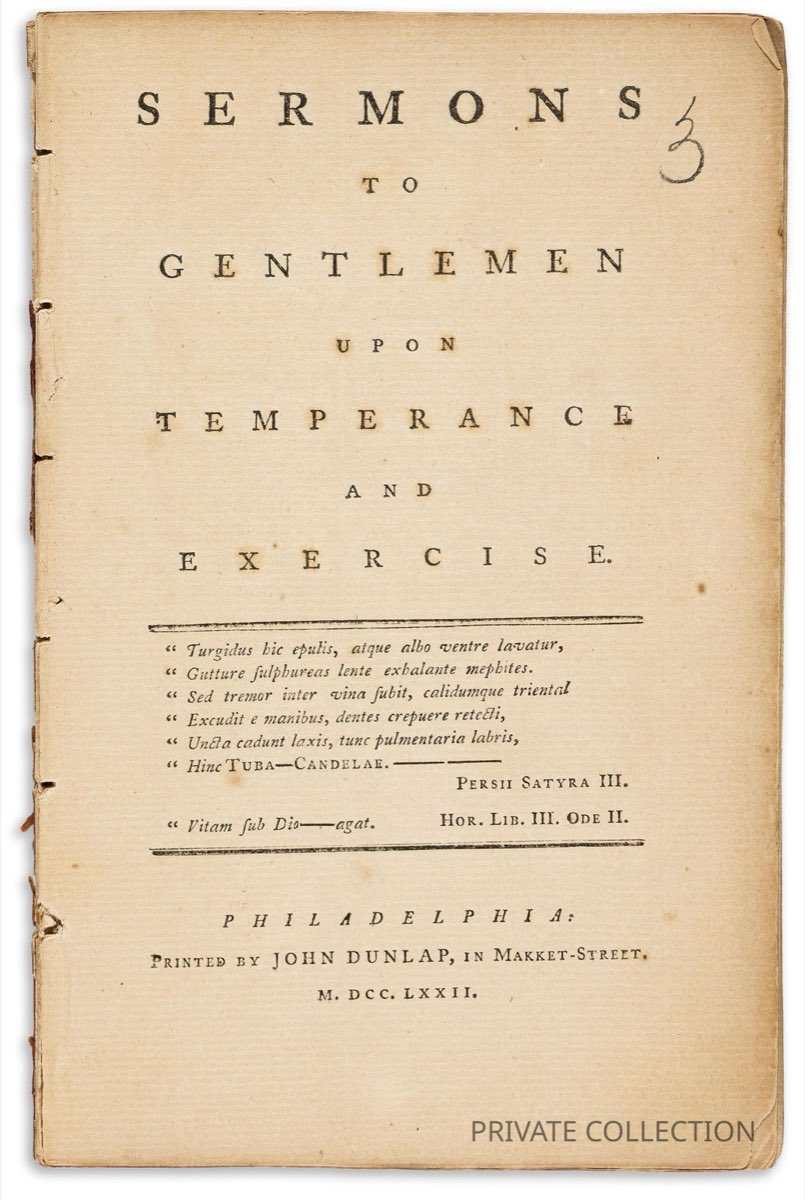
Sermons to Gentlemen upon Temperance and Exercise
First edition of the first American book to mention golf, and the beginning of Rush's forty-year campaign for temperance. Issued anonymously and attributed to Rush from the start, it considers the merits of every exercise a gentleman might take; the footnote on page 33 describes golf as played 'by the Gentlemen in Scotland' with 'little leather balls stuffed with feathers.' Rush thought running 'too violent to be used often'; the pamphlet's original owner disagreed in the margin: 'running in moderation is truely salutary.' One other complete copy traced at auction since 1964.
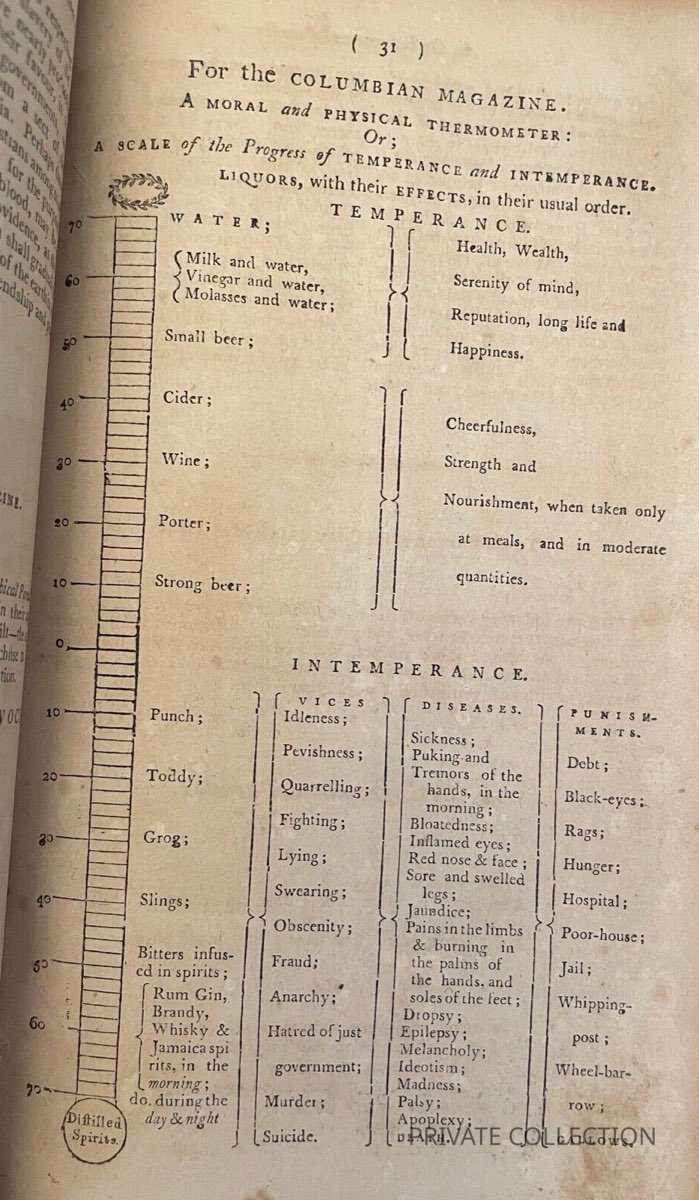
A Moral and Physical Thermometer — 1st American Edition
The founding document of the American temperance movement. Rush maps the moral and physical consequences of drinking choices on a graduated thermometer scale, with water and milk at the healthy end and strong spirits at the destructive extreme. Water: serenity, wealth, health, long life. Rum: disease, crime, poverty, death. The consequences are laid out with clinical precision; the format makes them immediately comprehensible to the non-medical reader. The Thermometer has been reprinted in temperance literature for more than two centuries, but its original argument — targeted at distilled spirits, not fermentation; disease-based, not morality-based — is more sophisticated than its subsequent appropriations suggest.
Effect of Spirituous Liquors on the Human Body and Mind
Rush's extended argument for temperance — less graphically dramatic than the Thermometer but more analytically detailed — traces the physiological mechanisms through which alcohol damages the body (stomach, liver, nervous system) and the social mechanisms through which habitual drinking destroys families, communities, and civic life. The pamphlet reflects Rush's characteristic method: clinical observation in the service of moral argument. He had seen the effects of alcohol abuse at the Pennsylvania Hospital for decades; this pamphlet translates those clinical observations into a reform program addressed to the public rather than the medical community.

Essays, Literary, Moral, and Philosophical
Rush's collected occasional writings, serving as the best single introduction to him as a public intellectual. The essay "Influence of Physical Causes upon the Moral Faculty" is among the most important theoretical documents in the collection: Rush's argument that moral behavior is shaped by physical conditions (diet, climate, exercise, social environment) and is therefore susceptible to physical intervention. This is the theoretical foundation for the entire reform project — temperance, penal reform, educational reform — that the previous chapters document. The physician's authority extends to social policy because the body is a political object.
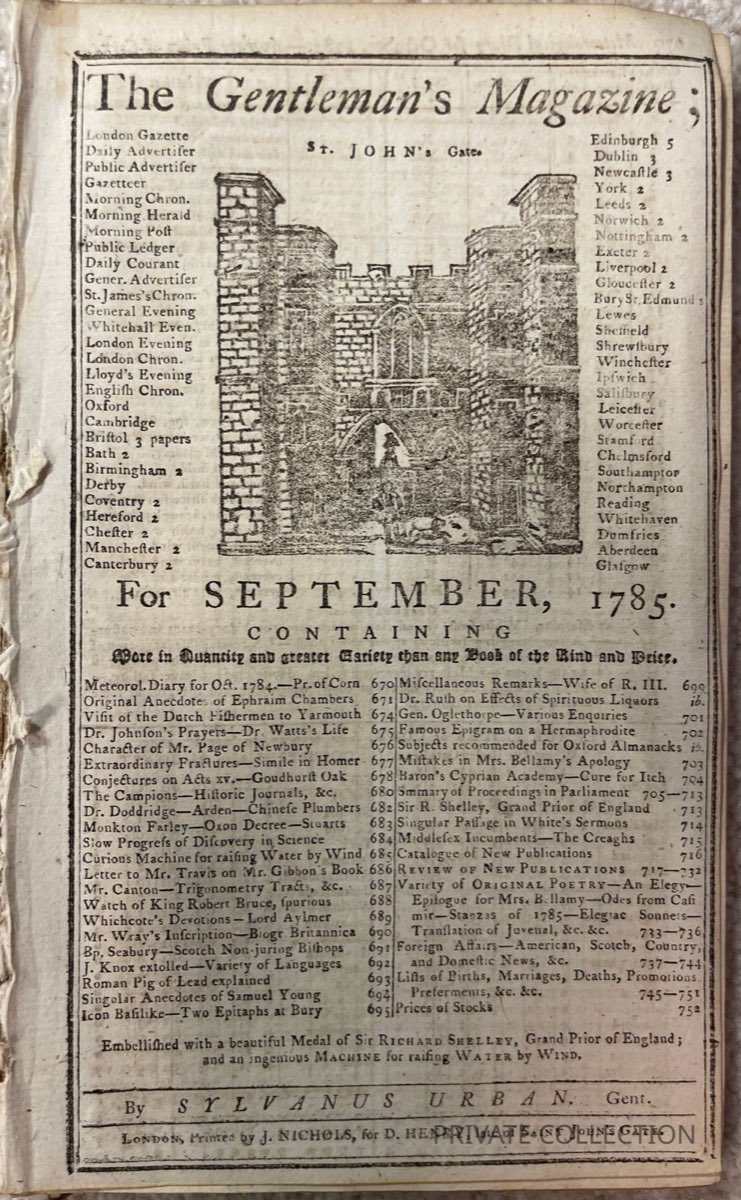
The Thermometer travelled. Lettsom had it reprinted in the Gentleman's Magazine within four months of its first appearance, and later had it printed on his own stationery, so that for a time the London physician was credited with inventing it; Pettigrew's Memoirs of Lettsom restored the authorship to Rush. And in 1811, in New York, a publisher named Francis Pell issued the Thermometer as a large illustrated broadside for public display — a printing unrecorded until this copy surfaced, and one of only two known in broadside form.
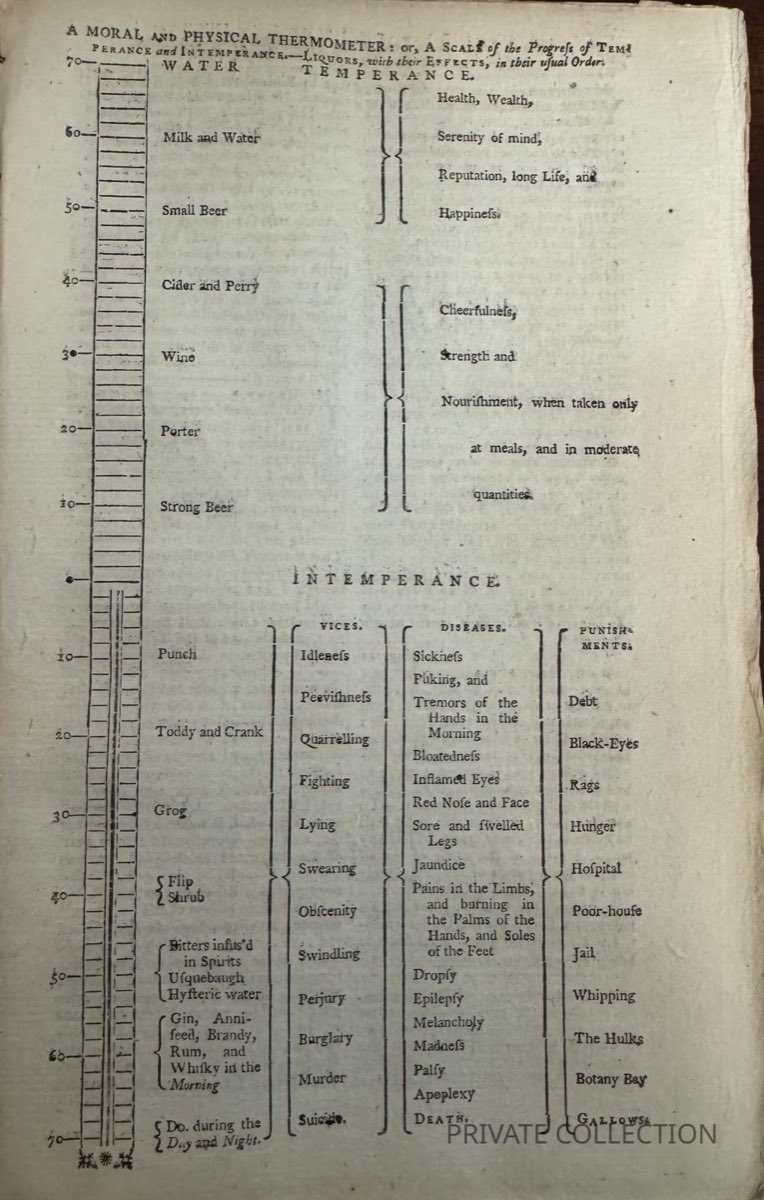
The Gentleman's Magazine, May 1789 — the First British Printing of Rush's Thermometer
Lettsom, to whom Rush had sent the Thermometer that spring, had it reprinted in the Gentleman's Magazine at once — the beginning of its long life in Britain, and of the confusion over who had invented it. The American device in its first European appearance, four months after the Columbian Magazine.
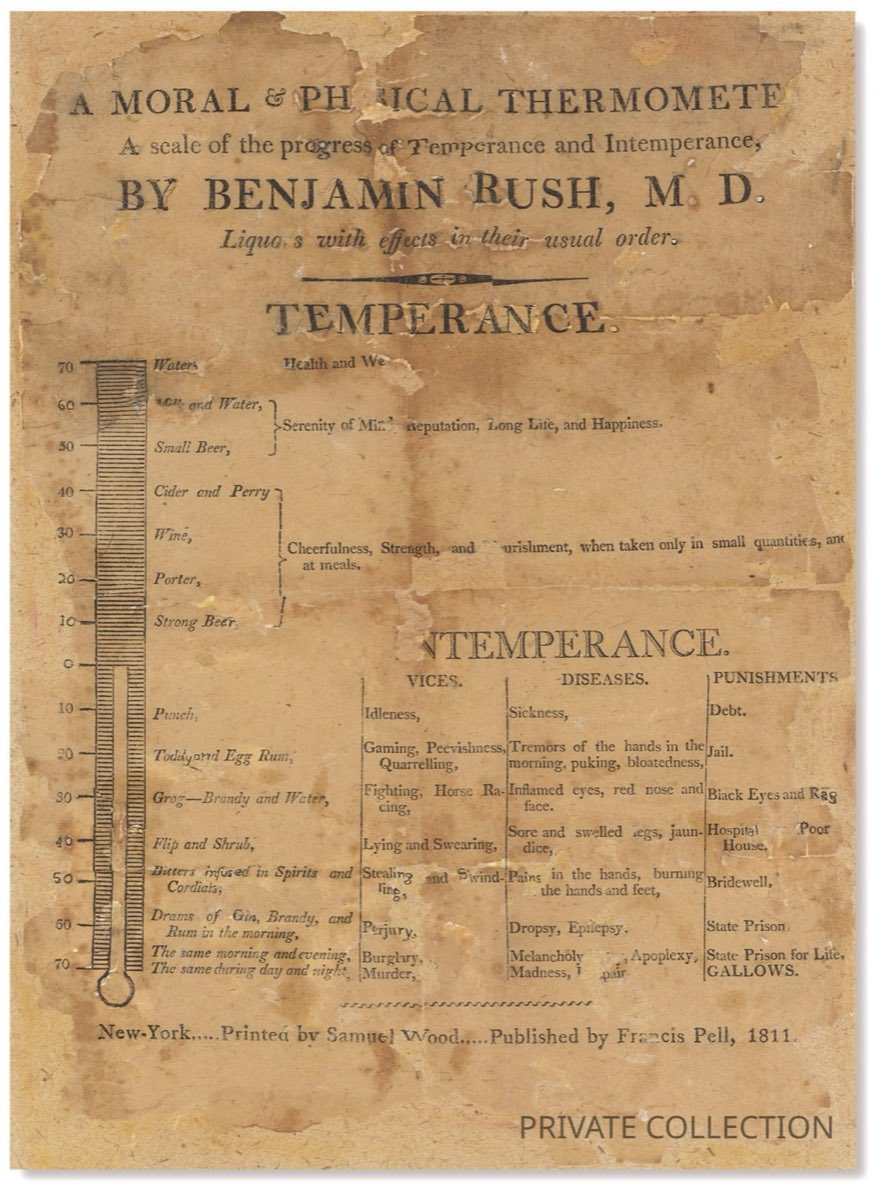
A Moral & Physical Thermometer: A Scale of the Progress of Temperance and Intemperance — Broadside
A large illustrated broadside of the Thermometer, drawn from Rush's Inquiry into the Effects of Spirituous Liquors and printed for public display in the year an anonymous pirated edition of the pamphlet also appeared in New York. Previously unrecorded; the only other broadside format known is an undated, imprintless sheet at the American Antiquarian Society. Francis Pell, the publisher, is otherwise a cipher — possibly a pseudonym, possibly the New York man of that name entangled in a $15,000 lawsuit. Water at the top, 'murder, madness, despair' and the gallows at the bottom, for the wall of a tavern or a schoolroom.