
The Shared World
Rush and Franklin in the Institutions They Built Together, 1743–1797
FRANKLIN was sixty-three when Rush came home from Edinburgh in 1769 with the letter of introduction that had sent him there, and the two men had twenty-one years left together. They were not equals and did not pretend to be. What they shared was a city, and more exactly a set of institutions that Franklin had founded and that Rush would inhabit: the Library Company, the Philosophical Society, the Hospital, the College and its medical school, and the reform societies of the 1780s that met, as often as not, in Franklin's own house. This chapter follows the two men through those rooms. It holds the objects on which both their names appear, or in which one of them finished what the other had begun.
The oldest of Franklin's institutions was the Library Company, founded in 1731 by the members of his Junto and printed for by his press ever since. Its catalogue of 1764 is a portrait of what Philadelphia read in the decade Rush was a student; the Loganian Library that James Logan — Franklin's early patron, and the translator of the Cato Major Franklin printed — left to the city was folded into it. The Philosophical Society, which Franklin proposed in 1743 and presided over from London, made Rush a member in 1768, before he had a degree; he delivered his first oration to it in 1774 and his most ambitious in 1786, and dedicated the latter to Franklin.
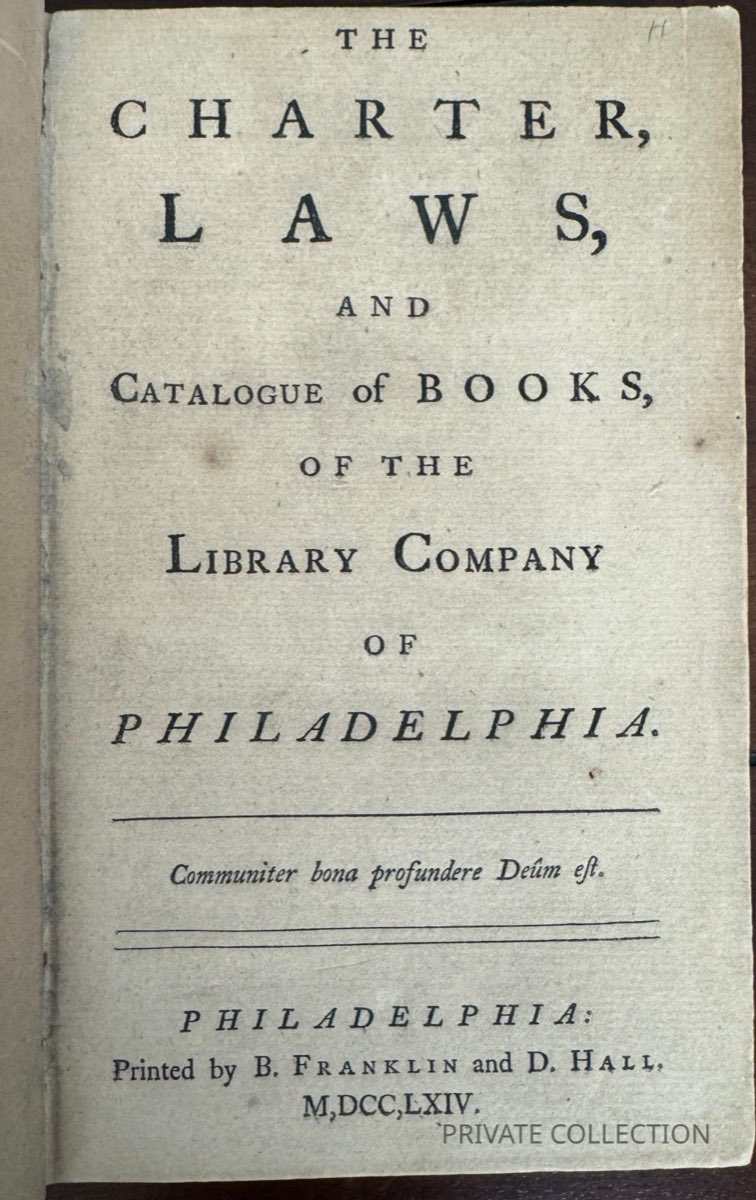
The Charter, Laws, and Catalogue of Books, of the Library Company of Philadelphia
The catalogue of the first subscription library in America, founded by Franklin in 1731 and probably the most extensive library in the colonies by the time this was printed — arranged by format, with blank leaves after each section for additions. Rush read here as a student; Franklin was the person most responsible for what was on the shelves. Miller locates over twenty copies; the last at auction were in 1976, 1934, and 1919.
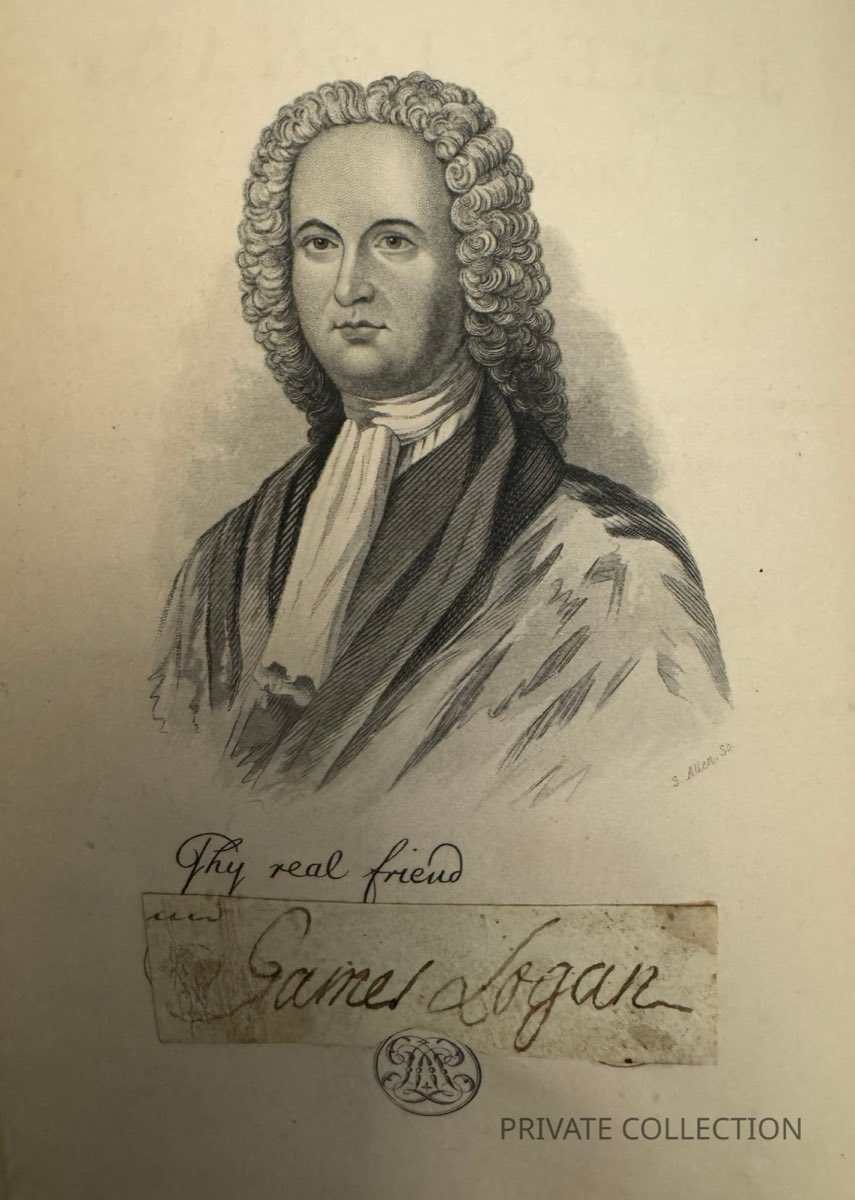
Memoirs of James Logan; A Distinguished Scholar and Christian Legislator; Founder of the Loganian Library at Philadelphia
The first life of Logan, Penn's secretary, chief justice, acting governor, and the most learned man in the province — Franklin's patron in the 1730s, whose Cicero Franklin printed in 1744 and whose library became the Loganian, the scholarly wing of the Library Company. With several of his letters first printed from manuscript.
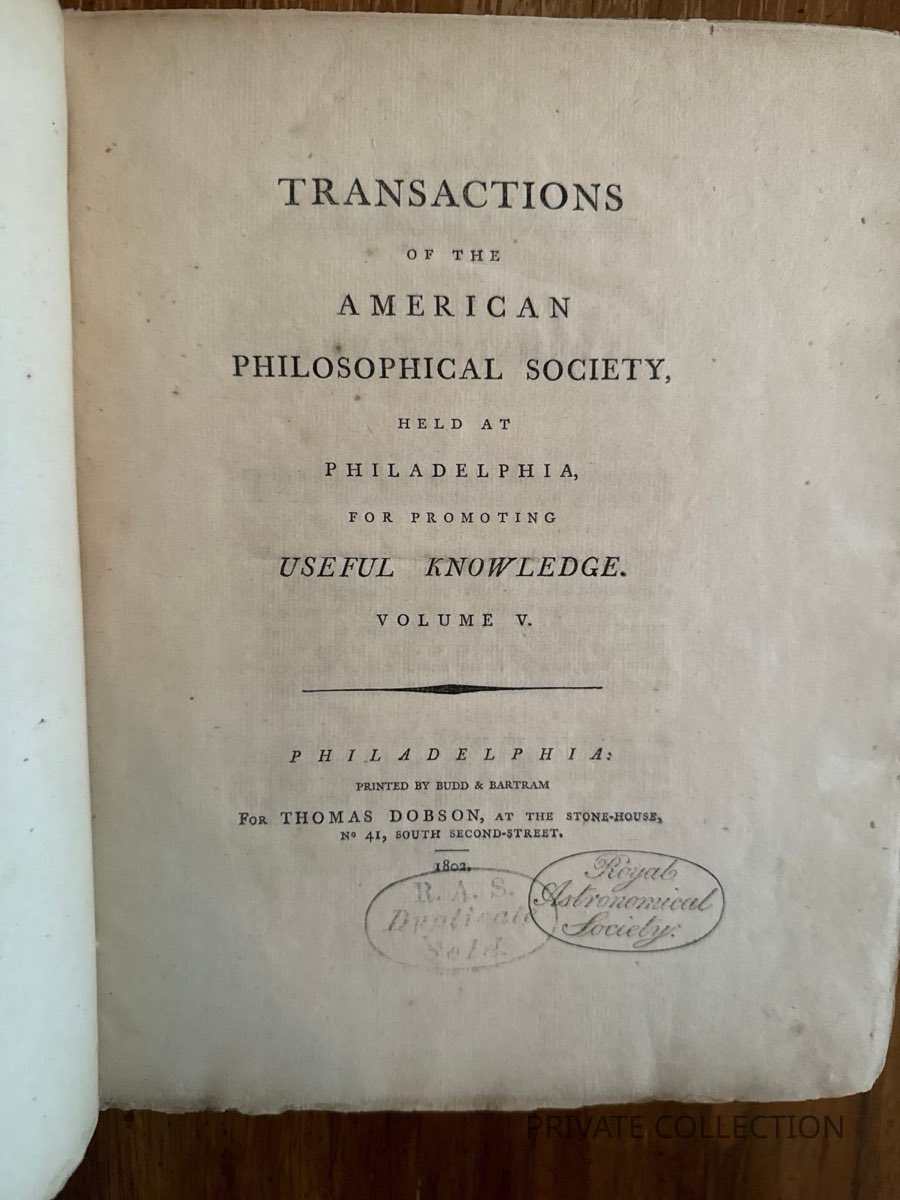
Transactions of the American Philosophical Society, Volume V
The fifth volume of the Transactions of the society Franklin founded and Rush joined at twenty-two. The first volume of 1771 had announced to Europe 'a new stage of maturity in American science'; by this volume the society was the republic's scientific establishment, and both men's names were on its rolls — Franklin's as its first president, Rush's as one of its longest-serving members.
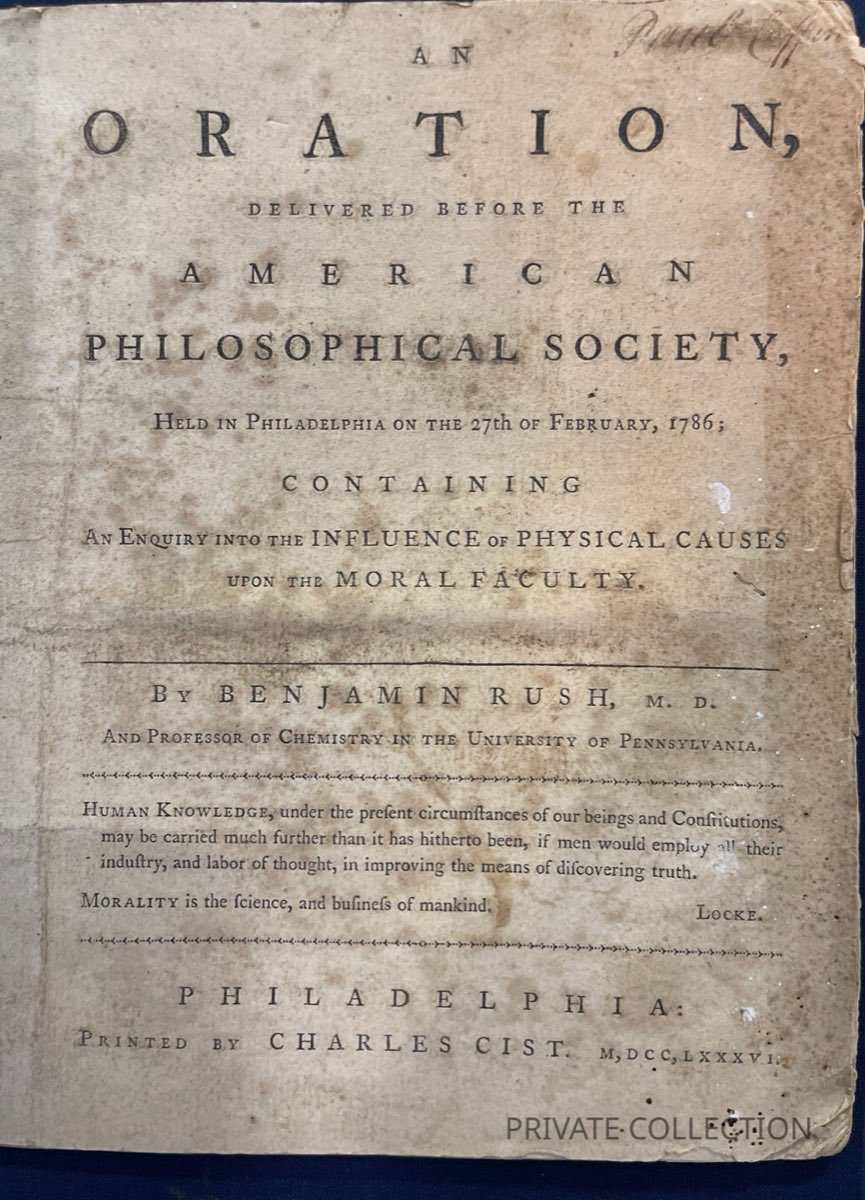
An Oration, Delivered before the American Philosophical Society … Containing an Enquiry into the Influence of Physical Causes upon the Moral Faculty
Rush's landmark oration on the physical causes of moral conduct — climate, diet, drink, hunger, idleness, pain, solitude — in which immoral behavior is traced to the body rather than to sin alone, and mental health to the same laws as bodily health. Dedicated to Franklin, the society's founder and then its president. This copy with the early signatures of Paul Coffin (1738–1821), the Buxton, Maine, Congregationalist minister. Scarce.
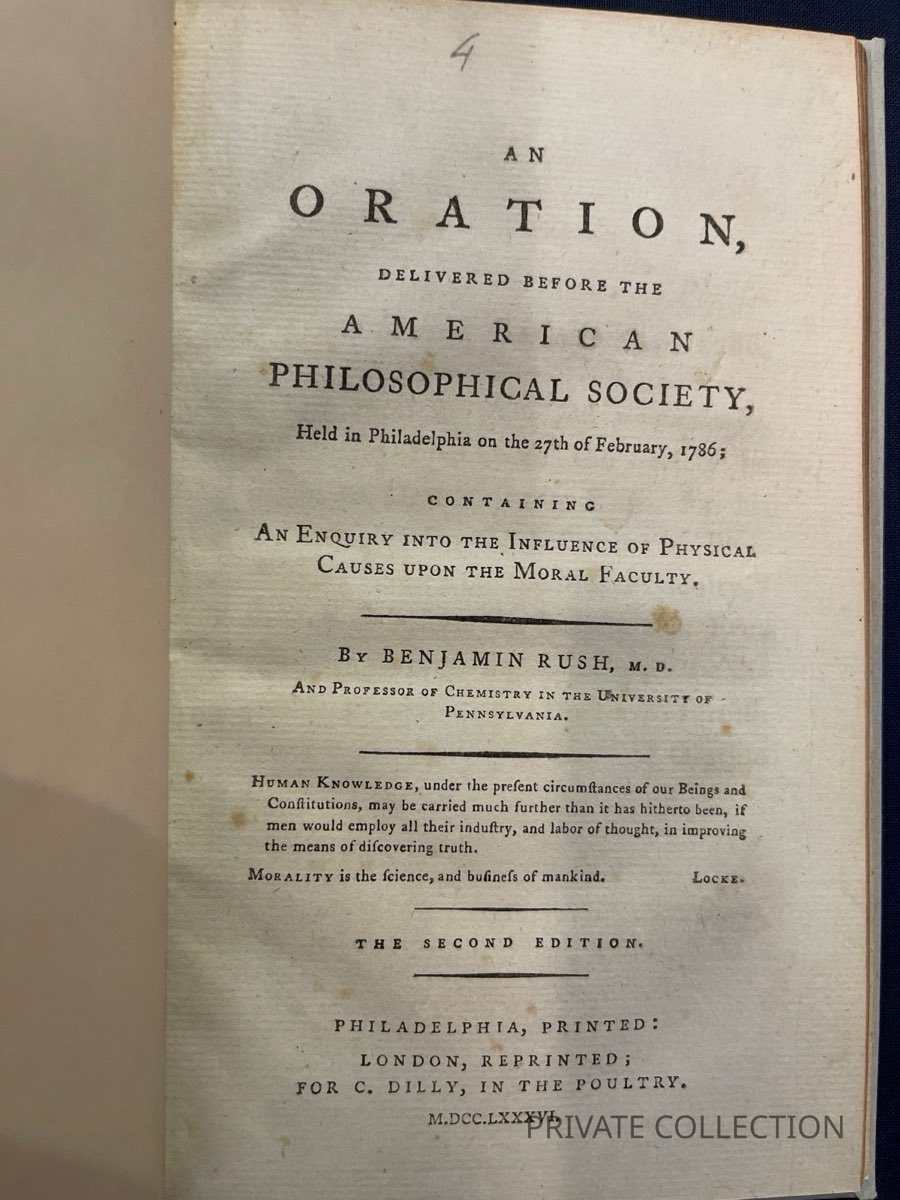
An Oration, Delivered before the American Philosophical Society … upon the Moral Faculty
The London reprint of the same year — Dilly was Rush's London publisher and Franklin's friend — which carried the dedication to Franklin and the argument that 'the disorders of the moral faculty' belonged in the physicians' nosology to a British readership. The collection holds the oration in both its Philadelphia and its London forms.
They were not equals and did not pretend to be. What they shared was a set of rooms.
The Hospital was Franklin's before it was Rush's. Franklin raised the money in 1751, printed the notes, and wrote the Some Account of 1754 that this catalog places in Chapter II; Rush joined its staff in 1783 and served until his death. The College of Philadelphia was Franklin's Academy of 1749 before it was the College of 1755, and the medical school John Morgan proposed at its commencement in 1765 — the founding document is in Chapter I — was the one that made Rush its professor of chemistry in 1769. The diploma in Chapter III, signed by Rush in 1808, is the institution Franklin chartered conferring the degree Rush taught for. And the science the two men shared was Philadelphia's own: John Bartram, Franklin's friend and fellow founder of the Philosophical Society, annotated the herbal Franklin printed in 1751; his son William's Travels of 1791 was the botanical classic of Rush's generation; and Franklin's stove, the most practical of his inventions, was still being improved for the heating of hospitals when Rush was an old man.
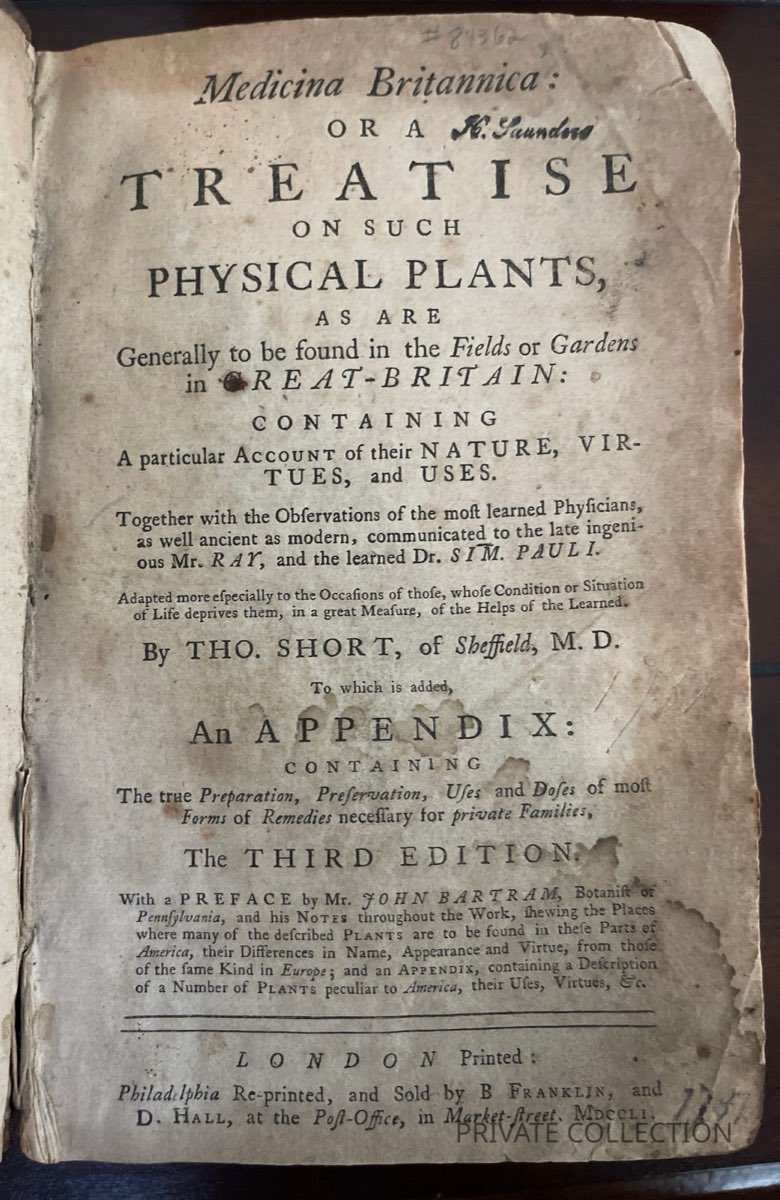
Medicina Britannica: A Treatise on Such Physical Plants as Are Generally to Be Found in the Fields or Gardens
Short's herbal in the American edition that matters: Franklin had Bartram, the greatest botanist in the colonies and a founding member of the Philosophical Society, add notes on which of the English plants grew in Pennsylvania and which American plants could replace them. The materia medica Rush would learn from Cullen, given a Philadelphia annotation by Franklin's press twenty years before Rush went to Edinburgh.
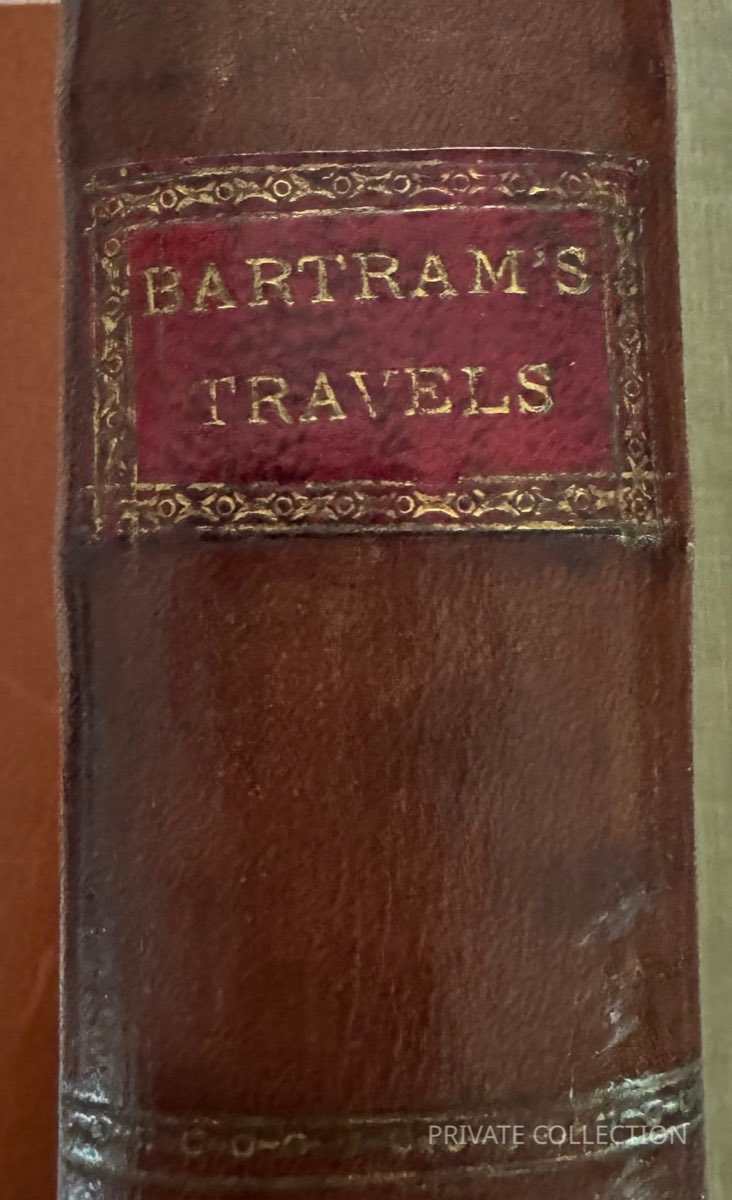
Travels through North and South Carolina, Georgia, East and West Florida
The rare first edition of the classic of southern natural history, by the son of Franklin's friend John Bartram — 'for the period, unrivalled.' Rush was Bartram's contemporary and fellow member of the Philosophical Society; the book belongs to the Philadelphia science both men practised. Contemporary calf, in a clamshell box.
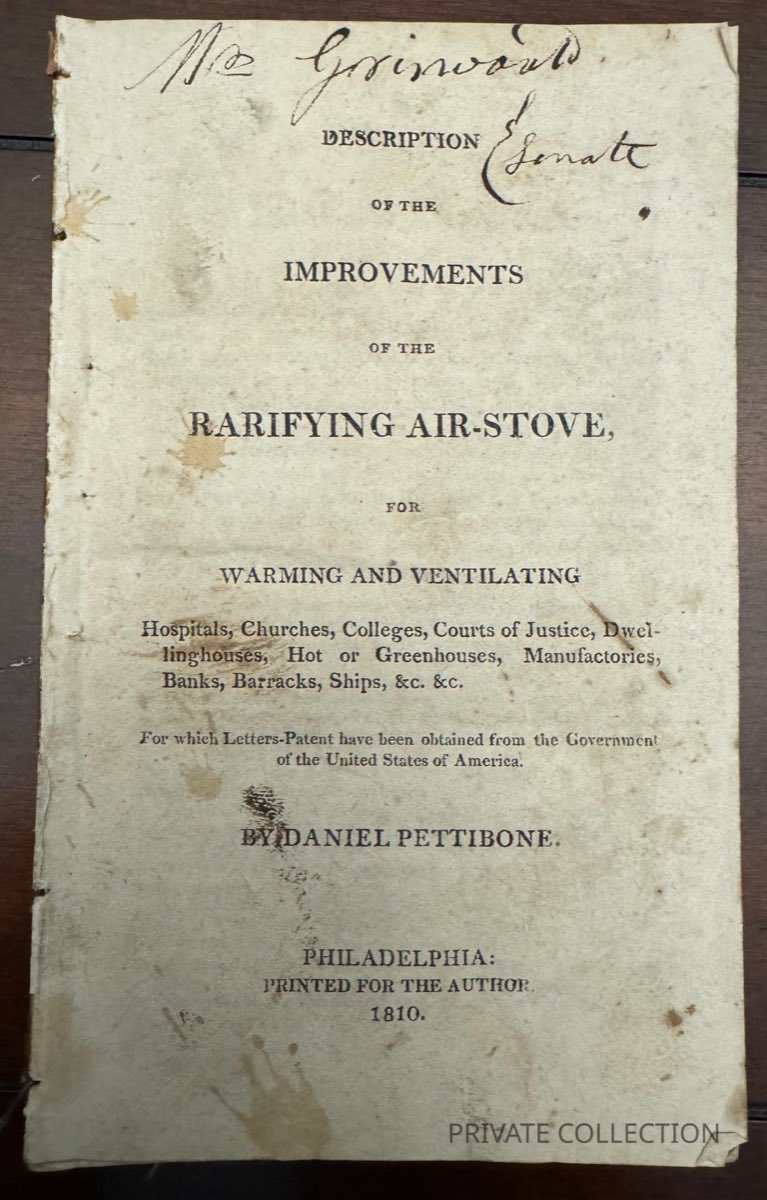
Description of the Improvements of the Rarifying Air-Stove, for Warming and Ventilating Hospitals, Churches, Colleges, Dwelling-houses, Hot or Greenhouses
The Pennsylvania fireplace of 1744, Franklin's most practical invention, carried into the next century as a ventilated heating system for the very institutions — hospitals and colleges — that Franklin had founded and Rush served. Rush, who thought bad air the cause of most fevers, had every reason to read it.
The causes the two men took up together in the 1780s are the subject of Chapters V and VI: the Pennsylvania Abolition Society, of which Franklin was president and Rush a secretary, and whose constitution both helped write; the Address upon Slave-Keeping Rush wrote in 1773 at Benezet's urging; the certificate of James Derham, the Black physician, that Rush laid before the Society in 1789; the Enquiry into the Effects of Public Punishments that Rush read in March 1787 at the Society for Political Enquiries, 'convened at the house of His Excellency Benjamin Franklin'; and the argument against the gallows for which Rush gained, in his own words, Franklin's support. The last object here is the writer whose life both men touched. Paine came to Philadelphia in 1774 with Franklin's letter of introduction; the title Common Sense was Rush's suggestion.
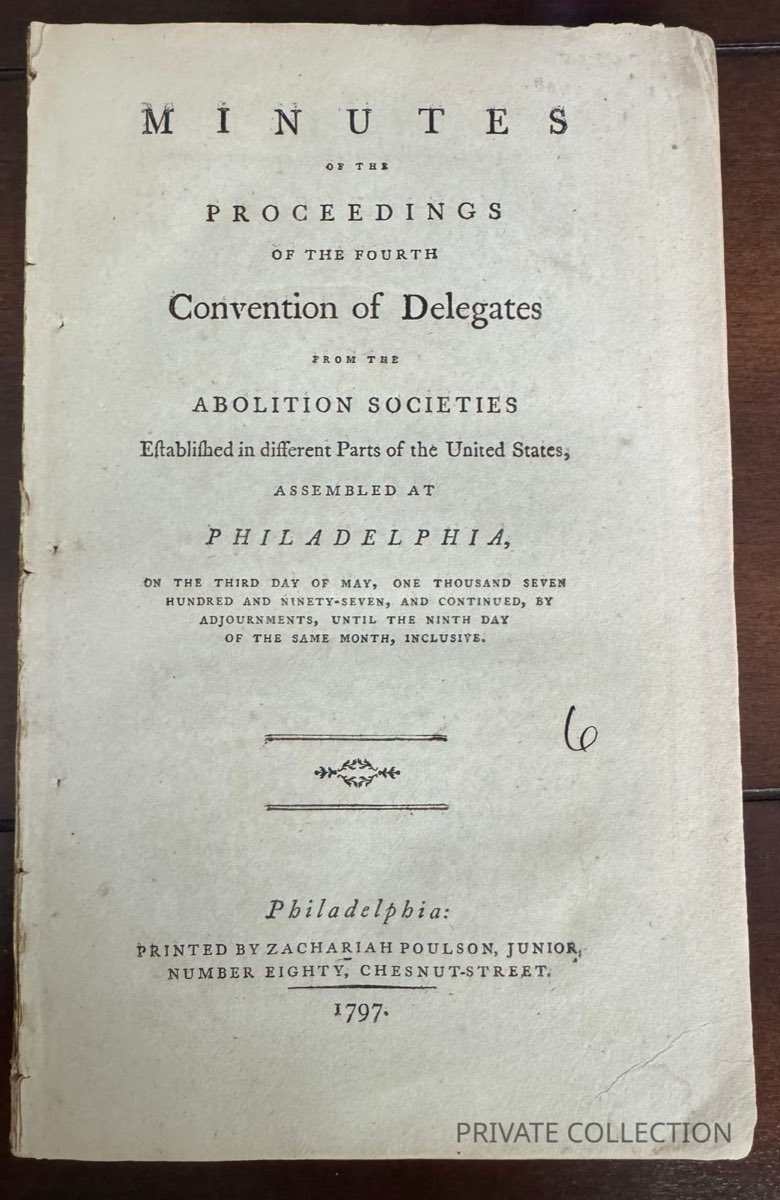
Minutes of the Proceedings of the Fourth Convention of Delegates from the Abolition Societies Established in Different Parts of the United States
The fourth national convention of the abolition societies, seven years after Franklin's death and with Rush now president of the Pennsylvania society he and Franklin had led. It condemned American participation in the foreign slave trade and, in the paternal manner of its age, urged the formerly enslaved to avoid gaming and attend the schools the convention established. Disbound; a very good, clean copy.
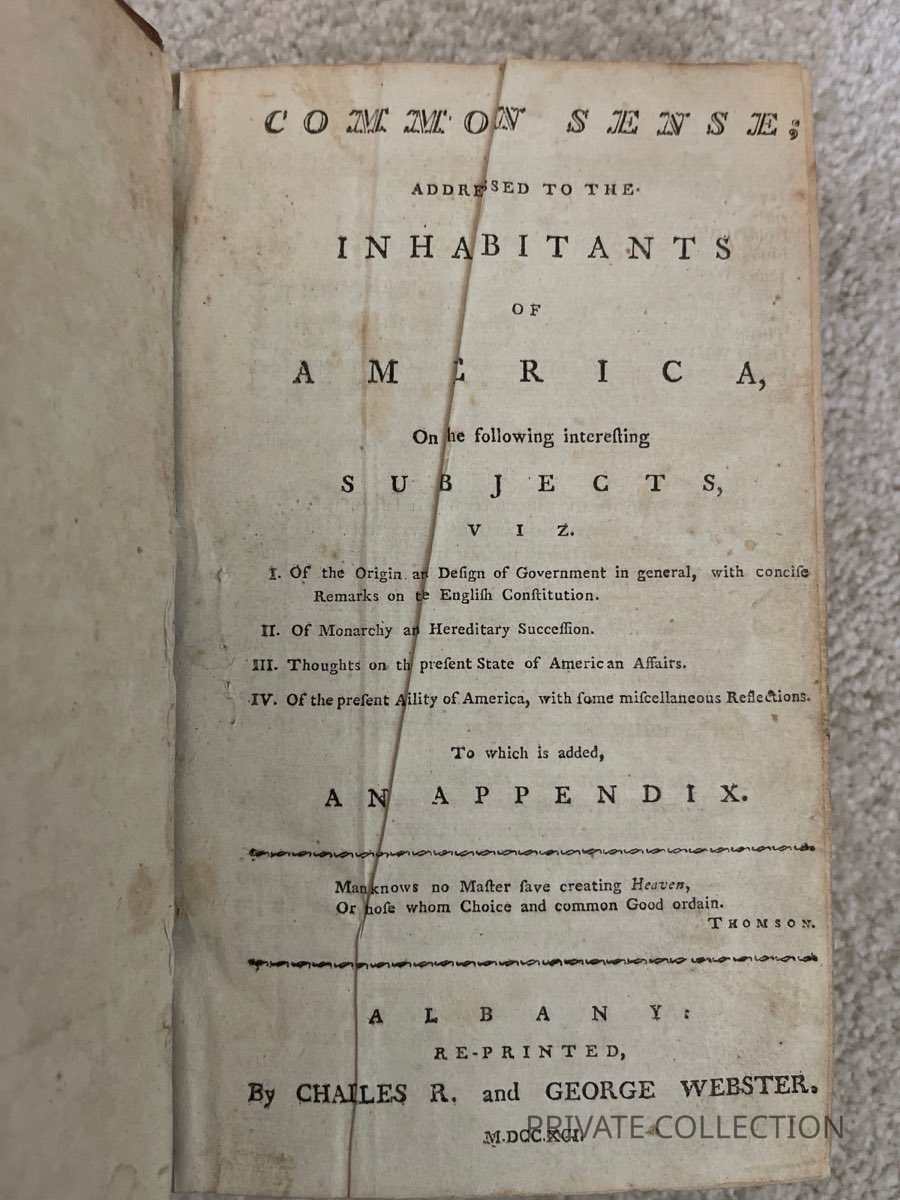
The Writings of Thomas Paine … Including Common Sense, The Crisis, and Rights of Man
Nine of Paine's works bound together in contemporary calf, among them the scarce first collected American Crisis. Paine arrived in Philadelphia in November 1774 carrying Franklin's letter of introduction; fourteen months later, with a title Rush had proposed, he published Common Sense. One book on which the mentor and the physician both left a mark.
Franklin died in April 1790. Rush wrote the Philosophical Society's memorial and, in the years that followed, put Franklin's name into nearly everything he published — the lectures, the essays, the memoir — as the man who had 'first pointed out to me the path of usefulness.' The institutions outlived them both; most are still standing. The objects in this chapter are what the two men left in them.
The institutions outlived them both. Most are still standing.