
Porcupine
Rush v. Cobbett, and the Price of a Reputation, 1794–1801
WILLIAM Cobbett arrived in Philadelphia in October 1792 with a wife, a grudge against the British army he had deserted, and no politics to speak of. He taught French to émigrés for a living. Within two years the French Revolution had made him the most ferocious Federalist in America, and under the name Peter Porcupine he began a career in print that had no equal in the 1790s for energy, invective, or nerve. His pamphlets sold by the thousand; his bookshop on Second Street hung portraits of George III in the window to provoke the Republicans; and in March 1797 he founded Porcupine's Gazette, a daily, and turned it on everyone he disliked — Jefferson, Paine, Priestley, the French, the Democratic societies, and the Philadelphia physician who had, in Cobbett's opinion, killed more Americans than the British army.
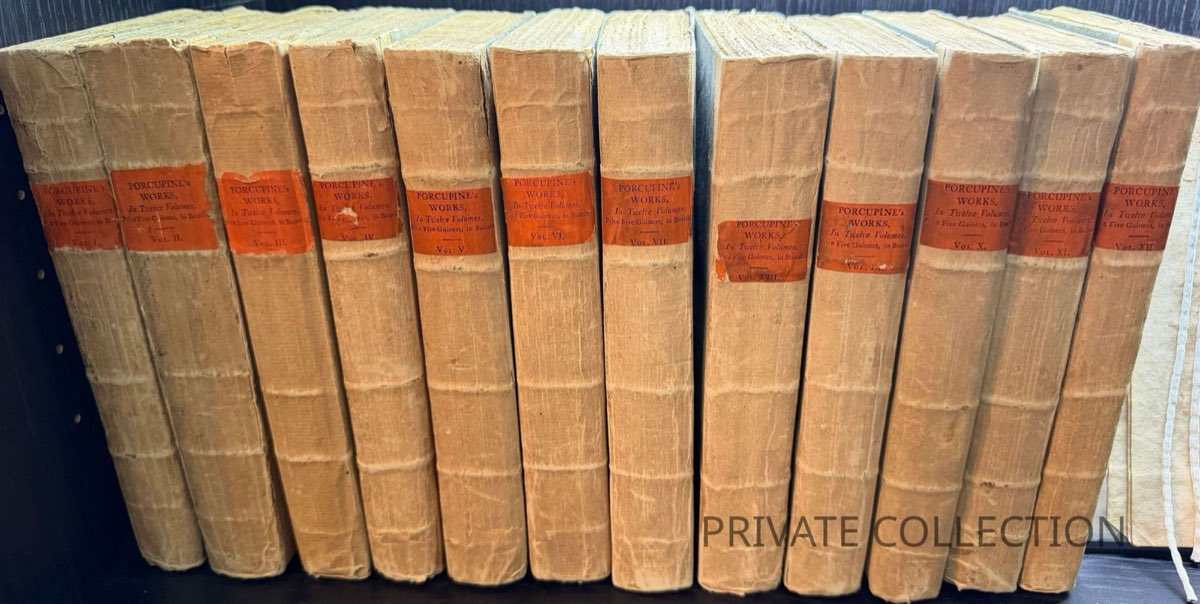
Porcupine's Works; Containing Various Writings and Selections, Exhibiting a Faithful Picture of the United States of America
The whole of Cobbett's American career — over 5,200 pages reprinting every one of his pamphlets and the best of the Gazette, with new notes to make the quarrels intelligible — assembled in London the year after he fled Philadelphia, with the stated object of proving that America's prosperity 'had not been augmented by a rebellion.' Rare in any condition; in original boards, rarer still. It is the record of the man Rush sued, compiled by the man himself.
The quarrel with Rush began with the lancet. In the yellow fever of 1793 Rush had bled his patients copiously and purged them with calomel and jalap, and had claimed to save nearly all he treated that way; in the epidemic of 1797 he did it again, and Cobbett, who had read enough medicine to be dangerous, decided the treatment was homicide. Through September and October 1797 Porcupine's Gazette called Rush 'the Pennsylvania Hippocrates,' 'Dr. Sangrado' after the bleeding quack in Gil Blas, and a 'remorseless bleeder' whose system was 'one of those great discoveries which have contributed to the depopulation of the earth.' The Republican papers defended him; twenty-six Philadelphia physicians signed a statement endorsing his method; and Rush, who had answered his medical critics in print for twenty years, decided this time not to answer at all. He went to law.
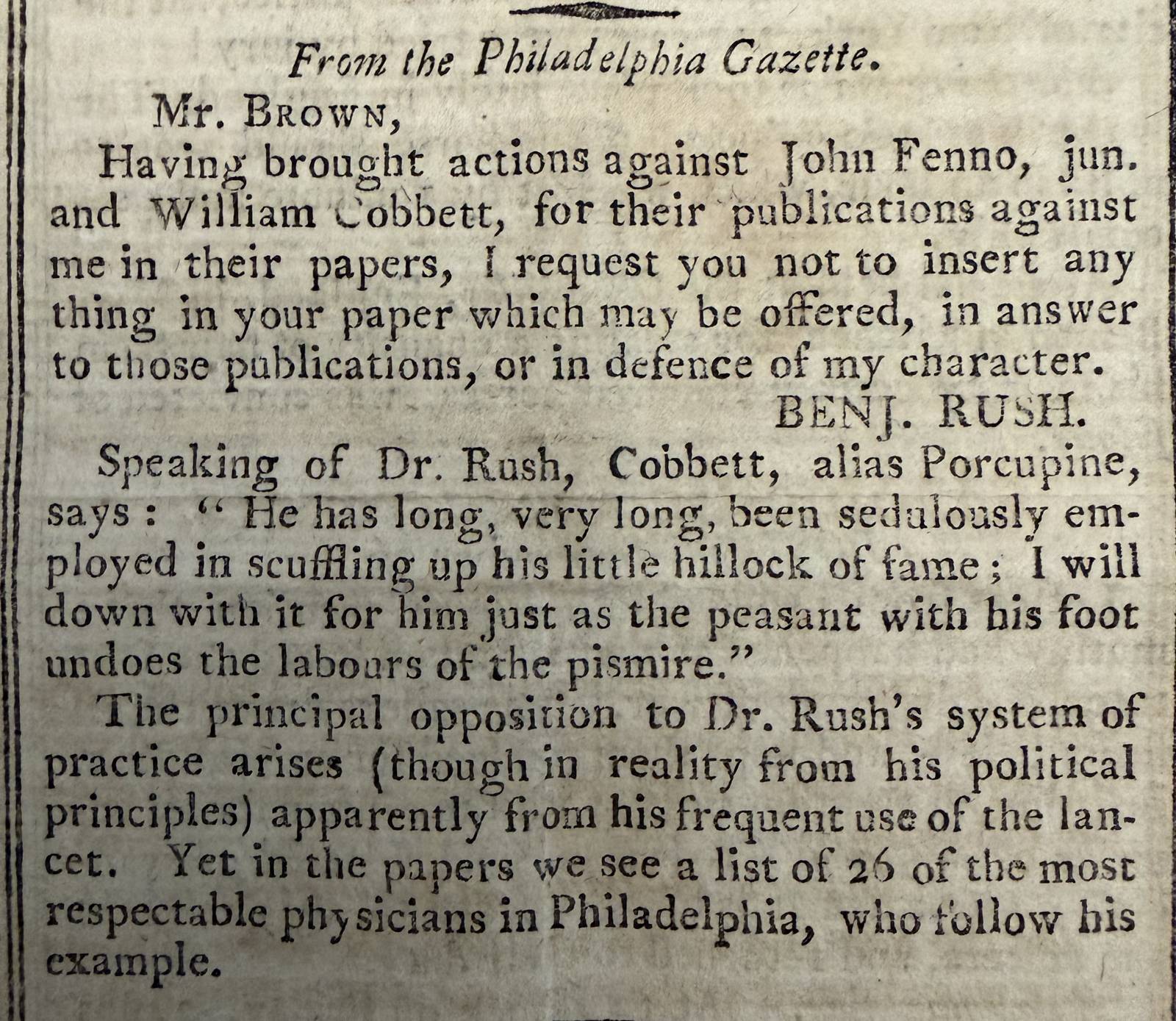
The Bee, New-London, Wednesday, October 11, 1797 — with Rush's public notice that he has sued Fenno and Cobbett
A Republican paper in Connecticut reprints, from the Philadelphia Gazette, Rush's letter to its editor: 'Having brought actions against John Fenno, jun. and William Cobbett, for their publications against me in their papers, I request you not to insert any thing in your paper which may be offered, in answer to those publications, or in defence of my character.' Below it, Cobbett's threat — 'I will down with [his little hillock of fame] just as the peasant with his foot undoes the labours of the pismire' — and the editor's note that the opposition to Rush's practice 'arises in reality from his political principles.' The suit announced, and the politics of it stated, in one column.
He decided this time not to answer at all. He went to law.
The case took two years to come to trial, and by then Cobbett had abandoned Philadelphia for New York, where the courts were friendlier and the Republican mob was not. He did not come back for the trial. It opened in the Supreme Court of Pennsylvania on Friday, December 13, 1799, before Chief Justice Edward Shippen, with Joseph Hopkinson, Moses Levy, William Lewis, and Jared Ingersoll for Rush and William Rawle, Robert Goodloe Harper, and Edward Tilghman for the absent defendant. Shippen's charge to the jury, on the law of libel and the liberty of the press, ended with 'a bold and decided opinion that the damages in the case before the court should be liberal and exemplary.' The jury was out two hours. It returned on Saturday the fourteenth with a verdict of five thousand dollars — the largest libel award in the country's history — and the courtroom, 'in a manner unprecedented in the courts in this city,' broke into applause. That same Saturday, two hundred miles to the south, George Washington died at Mount Vernon after his physicians had bled him of some five pints of blood. Cobbett would make a great deal of the coincidence.
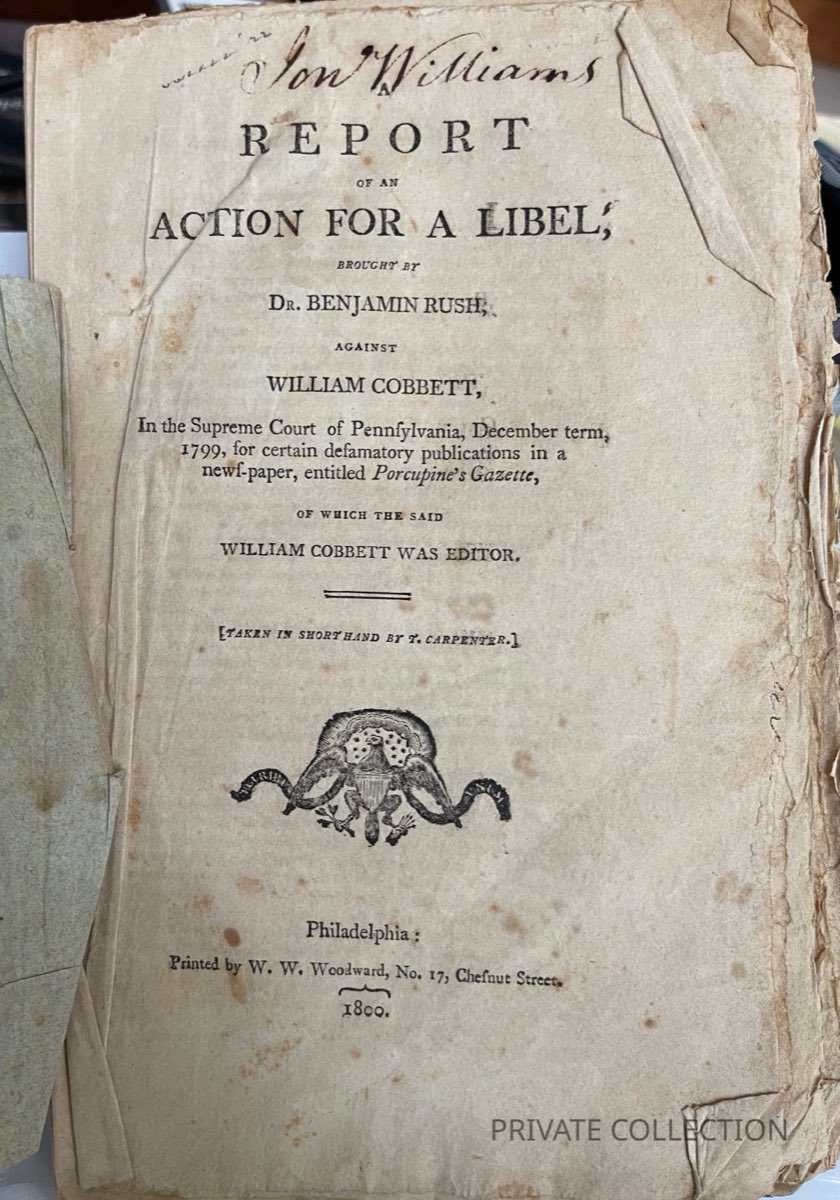
Report of an Action for a Libel, Brought by Dr. Benjamin Rush against William Cobbett, in the Supreme Court of Pennsylvania, December Term, 1799
The transcript of the trial, taken in shorthand by Thomas Carpenter: the pleadings on both sides, and Chief Justice Shippen's charge and instructions to the jury, which turned the case from a doctor's grievance into a ruling on what the press could say about a man's professional character. Cobbett is named on the title page as editor of Porcupine's Gazette; he was not in the room.
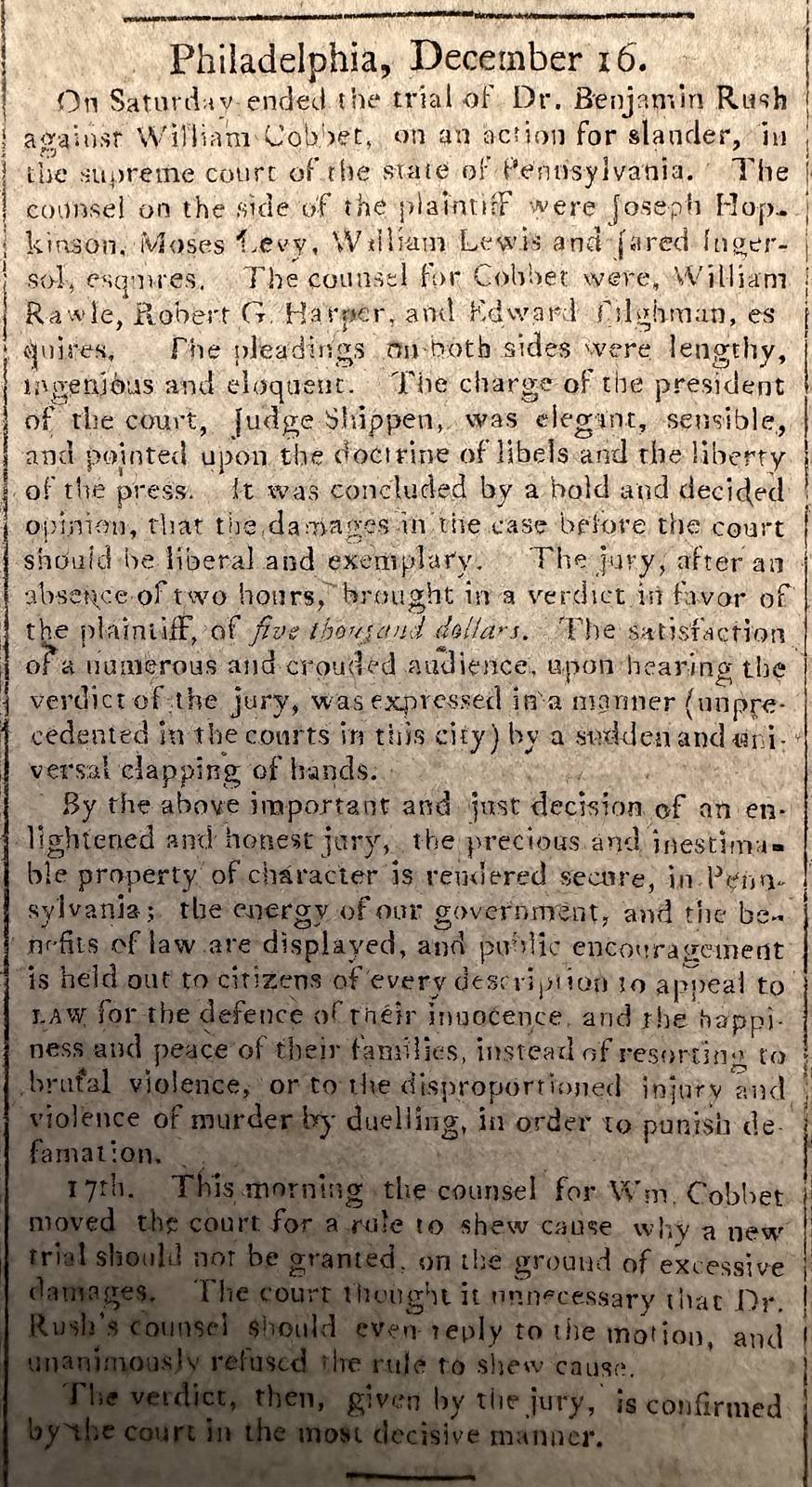
The Bee, New-London, Wednesday, December 25, 1799 — with the report of the verdict
The news as it travelled: 'Philadelphia, December 16. On Saturday ended the trial of Dr. Benjamin Rush against William Cobbet, on an action for slander … The jury, after an absence of two hours, brought in a verdict in favor of the plaintiff, of five thousand dollars.' With the report of the seventeenth that the court refused even to hear Cobbett's motion for a new trial 'on the ground of excessive damages,' and the editor's moral — that the verdict offered citizens a way to defend their character 'instead of resorting to brutal violence, or to the disproportioned injury and violence of murder by duelling.' The same issue carries the first news of Washington's death.
Cobbett paid — the judgment, the costs, and the sale of his Philadelphia stock — and then, from New York, took his revenge in the only form left to him. Between February and August 1800 he issued The Rush-Light, five numbers of the most sustained personal abuse ever printed against an American physician: Rush's bleeding, Rush's vanity, Rush's politics, Rush's part in the death of Washington, whom Cobbett said had been 'bled to death' by disciples of the Philadelphia system. It was brilliant, unfair, and unanswerable in court, because Cobbett sailed for England in June, before the last number appeared. He never returned. Rush gave the five thousand dollars, when at last it was collected, to charity.
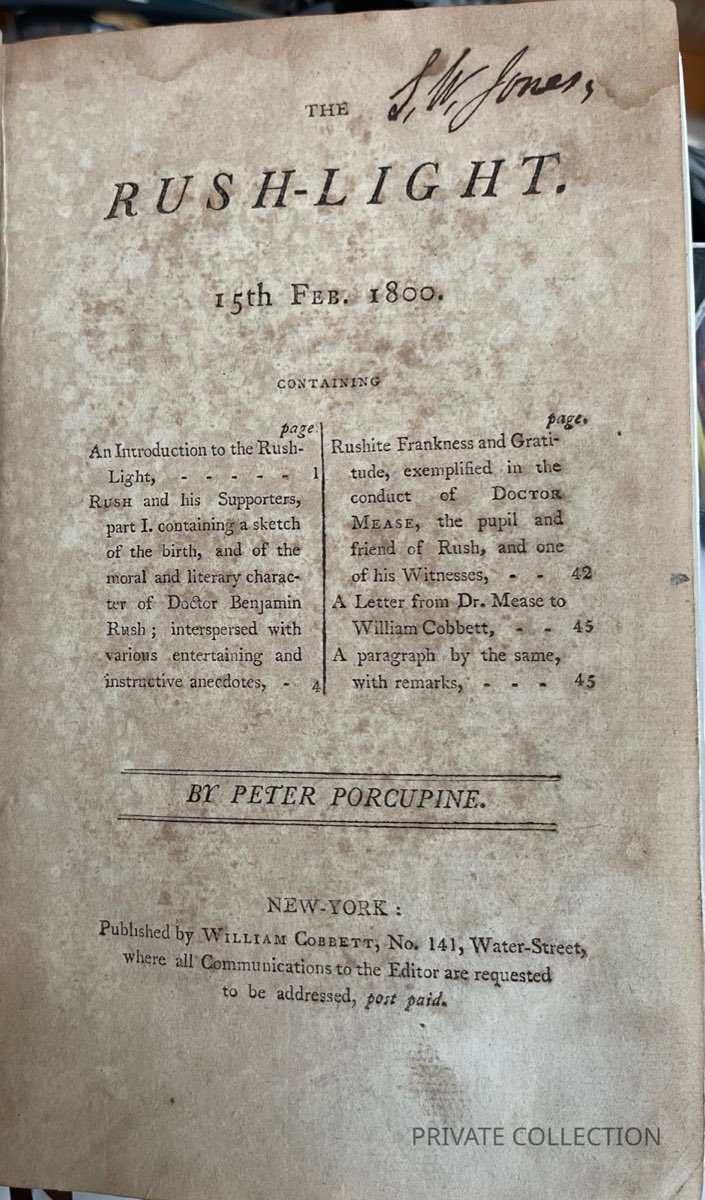
The Rush-Light, by Peter Porcupine
All five numbers of Cobbett's parting shot, published from New York after the verdict and before he sailed: the trial retried in print, with Rush as the villain, the jury as fools, and Washington's death as the proof. A complete set is uncommon. It sits in the collection beside the transcript it answers and the newspaper that reported the verdict — three sides of one argument.
It was brilliant, unfair, and unanswerable in court, because Cobbett sailed for England before the last number appeared.
Cobbett went home to become, in time, the greatest radical journalist in England, and he never revised his opinion of Rush. Rush never mentioned Cobbett in print again. The suit is remembered now less for the doctor's vindication than for what it settled about the press: that a newspaper could be made to pay, heavily, for calling a physician a killer, and that the liberty of the press, as Shippen put it to the jury, was not a liberty to destroy a man's livelihood. Both men would have preferred to be remembered for something else.