
Rush in Public Life
Orations, Controversies, and the Cobbett Affair
RUSH delivered his first oration before the American Philosophical Society in 1786, the year after Franklin returned from France to preside over the institution he had founded in 1743. The subject was the influence of physical causes upon the moral faculty — the argument that would anchor Rush's entire reform career. The APS was the most important intellectual institution in America, the forum where natural philosophy, medicine, agriculture, geography, and political science converged in the republic of letters. Rush used it as a platform for his most ambitious theoretical arguments for the next three decades.
Franklin's death in April 1790 deprived Rush of his most important patron and his most important example. Rush was present at the deathbed; he described the scene in a letter to his friend Jeremy Belknap with the precision of a physician and the grief of a son. He had known Franklin for twenty years — since the letter to Cullen had been written, since the return from Edinburgh, since the long collaboration on the Pennsylvania Hospital and the Abolition Society and the Society for Promoting Political Enquiries. Franklin's death closed a chapter in Rush's life that could not be reopened.
Rush's public life after 1790 was increasingly marked by controversy. The yellow fever epidemics of the 1790s — documented in Catalog V — generated the most sustained attack on his professional reputation that he had ever faced. But the attack that finally produced a legal confrontation came not from his medical opponents but from a journalist: William Cobbett, the English-born satirist who wrote under the name "Peter Porcupine" and who had been arguing in print since the 1797 epidemic that Rush's yellow fever treatment was killing patients faster than the disease itself.
Jeffrey Pasley, in "The Tyranny of Printers" (2001), describes the Cobbett-Rush conflict as one of the defining press controversies of the early republic — a moment when the question of whether professional reputation was legally protected from journalistic attack was tested before a Philadelphia jury and answered definitively. Cobbett had collected mortality statistics, quoted Rush's published claims against observed outcomes, and repeatedly characterized Rush's methods as quackery backed by professional authority. Rush sued for libel. The jury awarded him five thousand dollars — the largest libel verdict in American history to that point. Cobbett, unable to pay, sailed for England.
"Rush, the most popular physician of the city, thought proper to bleed and purge; to purge and bleed. The deaths were in proportion to the doses he prescribed." — William Cobbett, The Rush Light, 1800
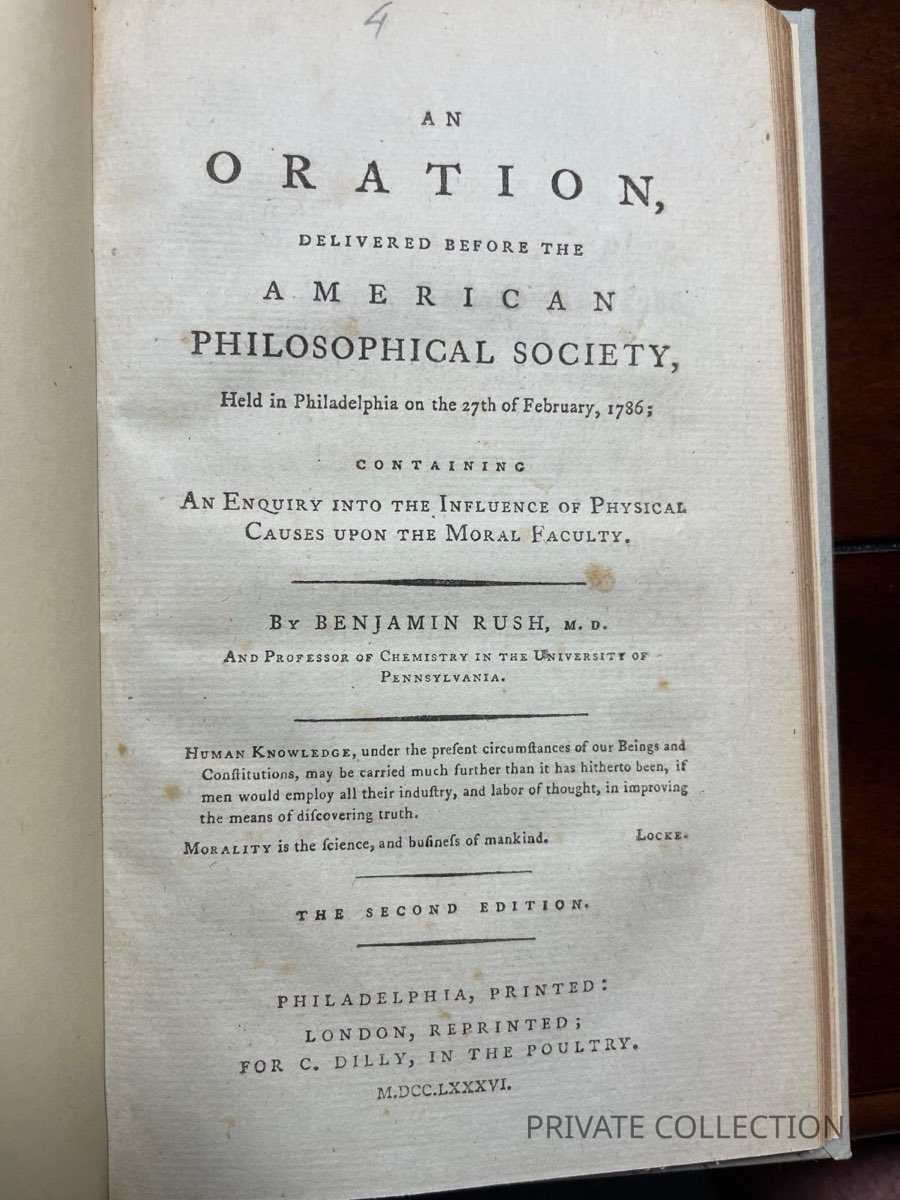
An Oration Delivered before the American Philosophical Society
Rush's first major APS oration, on the influence of physical causes upon the moral faculty — the argument that physical conditions shape moral behavior and are therefore susceptible to physical intervention. Delivered before Franklin and the full membership of the Society in 1786, this pamphlet is the theoretical foundation for the entire reform agenda: if drunkenness is a disease and vice is a physical condition, then medicine has a legitimate claim on social policy. Franklin was in the audience. The pamphlet's argument is, in a sense, the intellectual inheritance Franklin bequeathed to Rush: use natural philosophy in the service of social improvement.
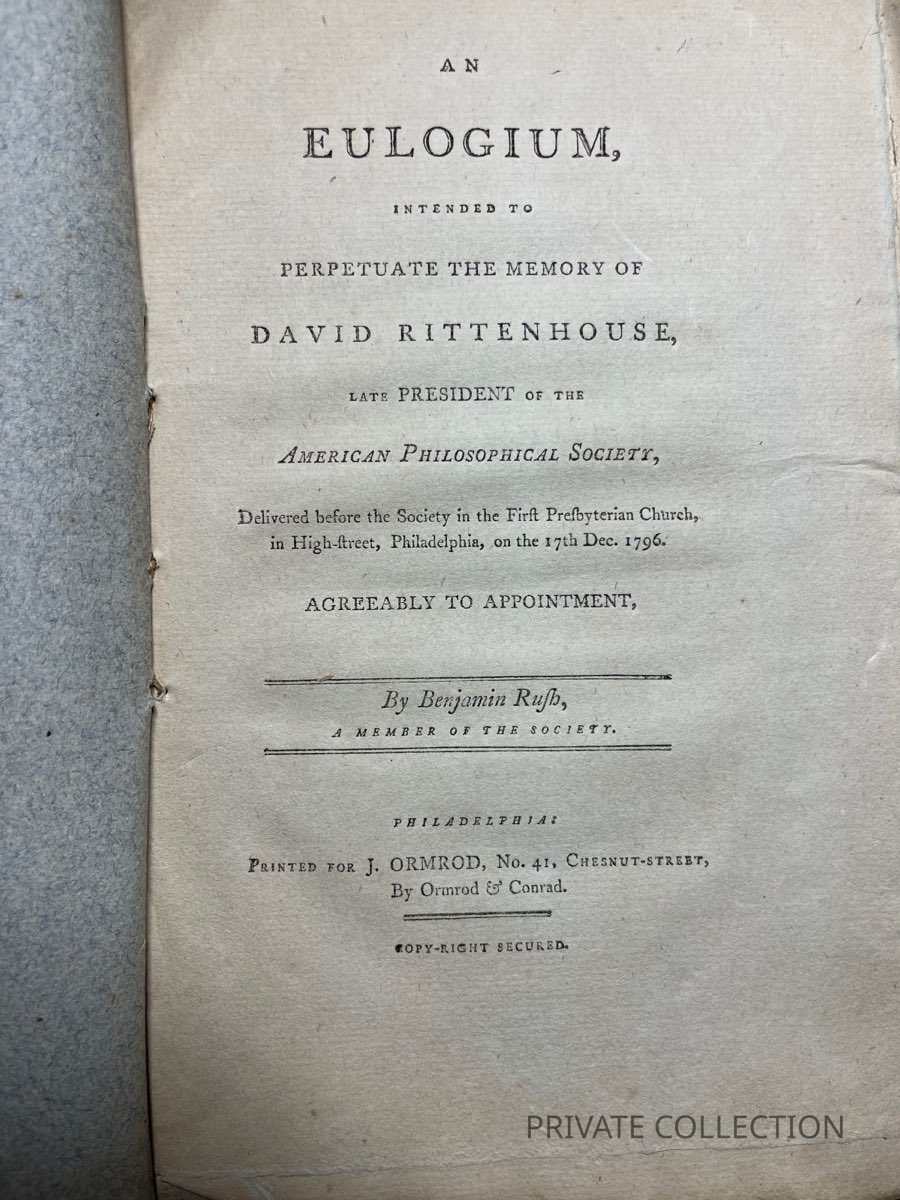
An Eulogium Intended to Perpetuate the Memory of David Rittenhouse
David Rittenhouse (1732-1796) was the astronomer and instrument maker who had been Franklin's most important scientific colleague in Philadelphia, and who after Franklin's death in 1790 became Rush's most intimate friend among the generation of Philadelphia Enlightenment figures. Rush's eulogy, delivered six years after Franklin's death and one year after Rittenhouse's, is a document of an entire world passing: the American Philosophical Society, the Pennsylvania Hospital, the networks of correspondence and collegiality that connected Franklin, Rush, Rittenhouse, Barton, and their circle. Rush is burying his generation.
Rush wrote for the magazines as readily as for the press, and the collection holds him in their pages: the Columbian and the American Museum in Philadelphia, the Massachusetts Magazine in Boston, the American Universal Magazine with a portrait engraved for it. Between them they carry the first printings of some of his most read essays — on the Pennsylvania Germans, on the climate of Pennsylvania, on the influence of the Revolution on the body — and the letter in which he laid the case of James Derham, the Black physician, before the Abolition Society.
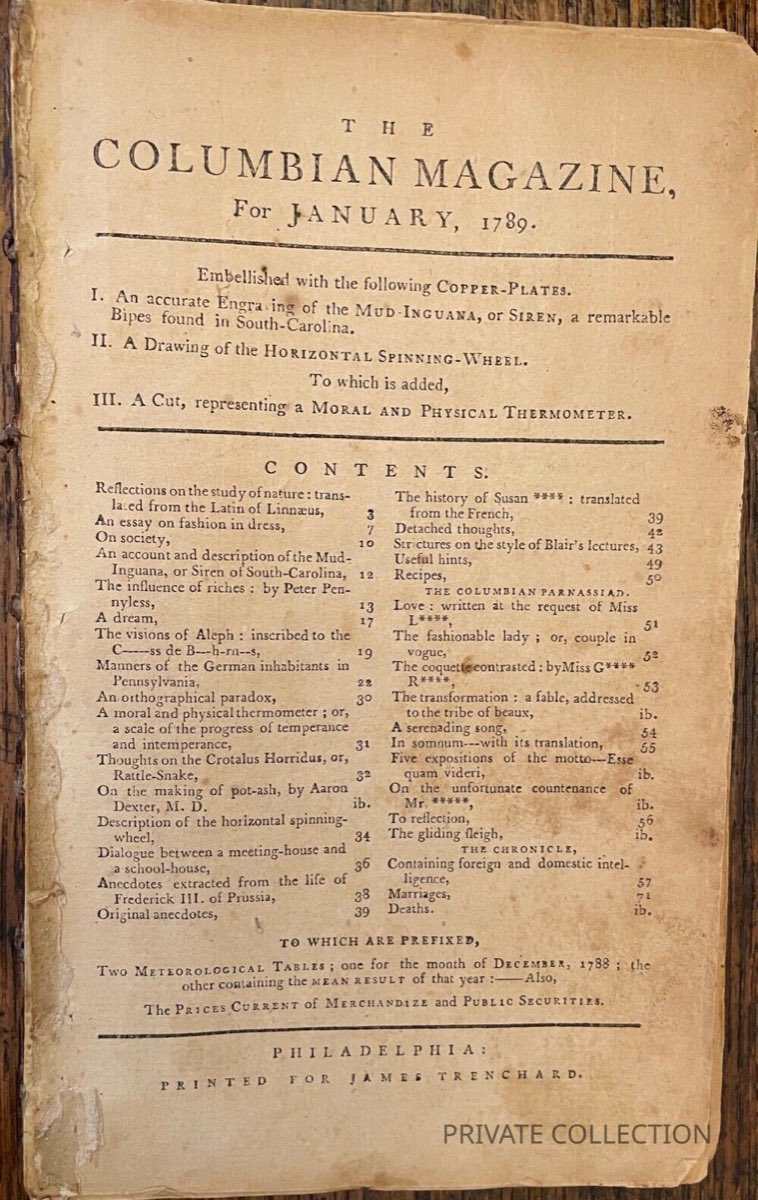
An Account of the Manners of the German Inhabitants of Pennsylvania — in The Columbian Magazine, January 1789
The first printing of Rush's tract on the Pennsylvania Germans — 'for its time uniquely sympathetic,' in Butterfield's judgment, and the first public statement by a front-rank Pennsylvanian of non-German stock on behalf of a third of the province. Rush had studied their language, admired their farming, and was at that moment founding a college for their sons at Lancaster. The same number carries the first cut of the Moral and Physical Thermometer.
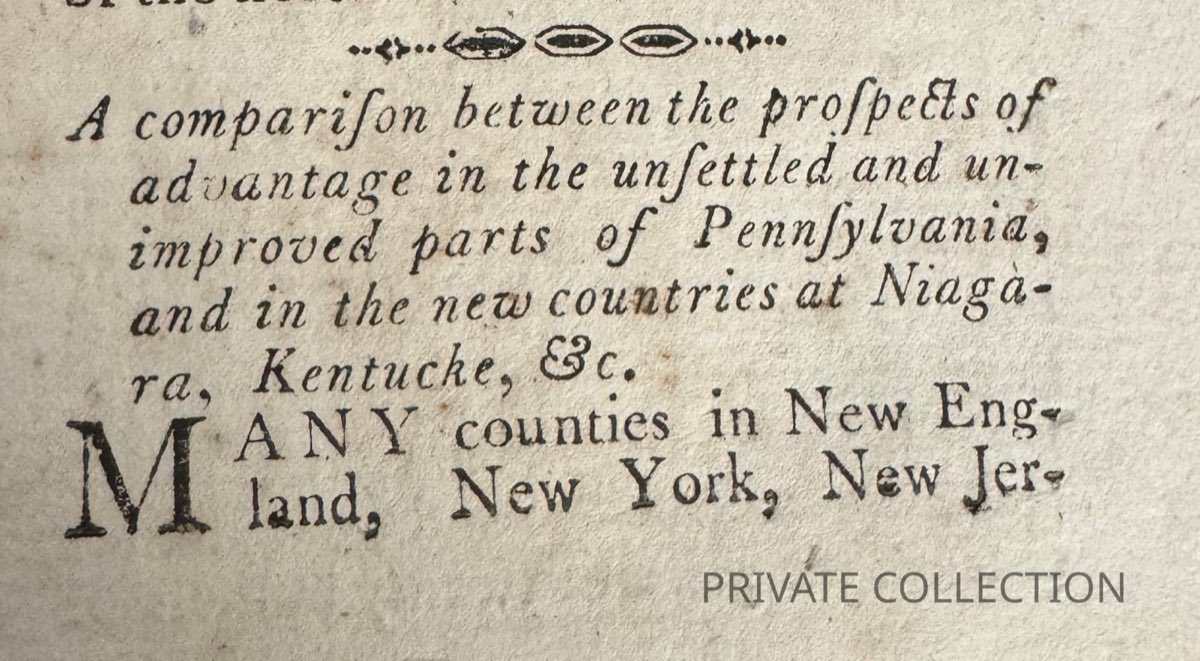
The American Museum, January 1789 — with Rush's Letter on James Derham and Thomas Fuller, and the First Part of the Rejoinder on Punishing Murder by Death
Carey's American Museum for January 1789, carrying Rush's letter to the Abolition Society on James Derham, the enslaved-born physician of New Orleans, and on Thomas Fuller, the 'African Calculator' — evidence, sent to London at the request of the abolitionists there, of the intellectual capacity of Black Americans. With the first part of Rush's rejoinder in the capital-punishment debate (Chapter IX), and an essay comparing the prospects of Pennsylvania's unsettled lands with Kentucky and Niagara.
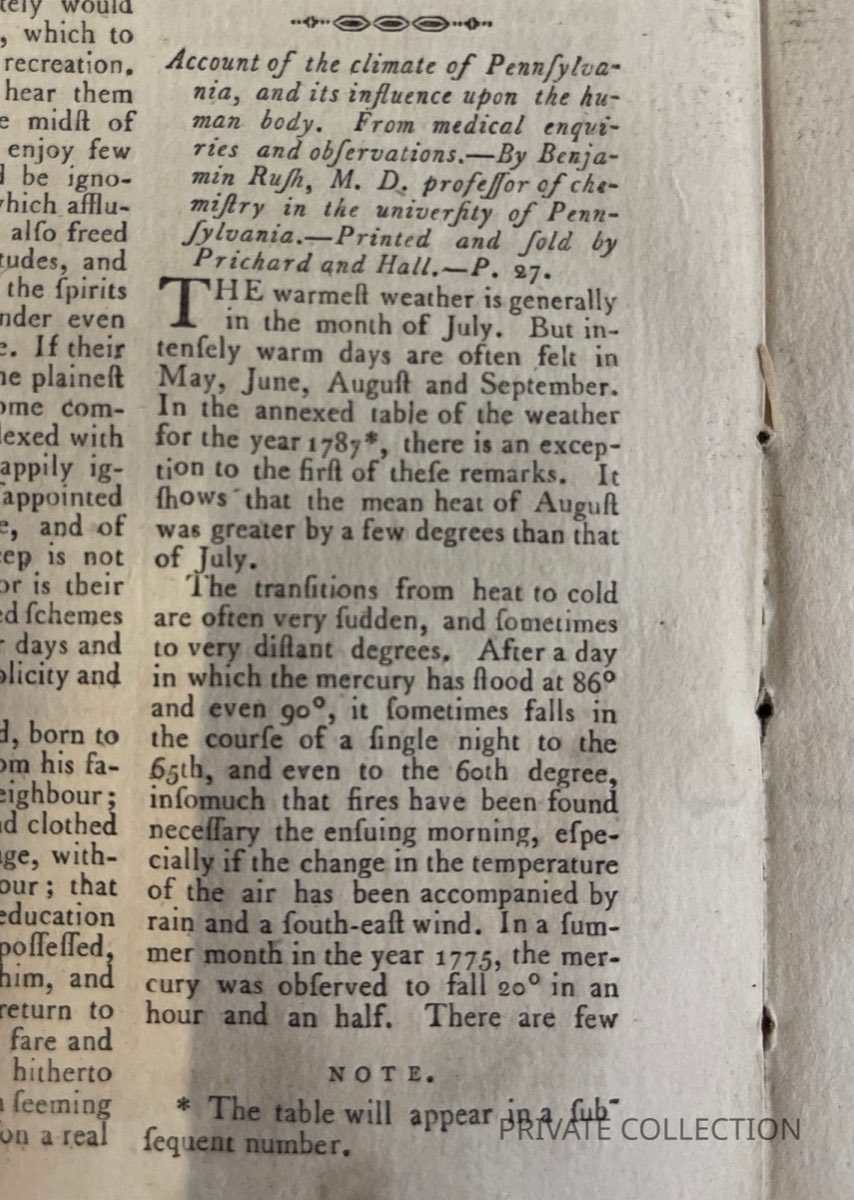
An Account of the Climate of Pennsylvania and Its Influence upon the Human Body — in The American Museum, September 1789
Rush's essay on the Pennsylvania climate — the sudden transitions from heat to cold, the mercury falling twenty degrees in an hour and a half, the fevers that followed — reprinted by Carey from the Medical Inquiries. The environmental reasoning he learned from Cleghorn (Chapter I), applied to his own city four years before the fever.
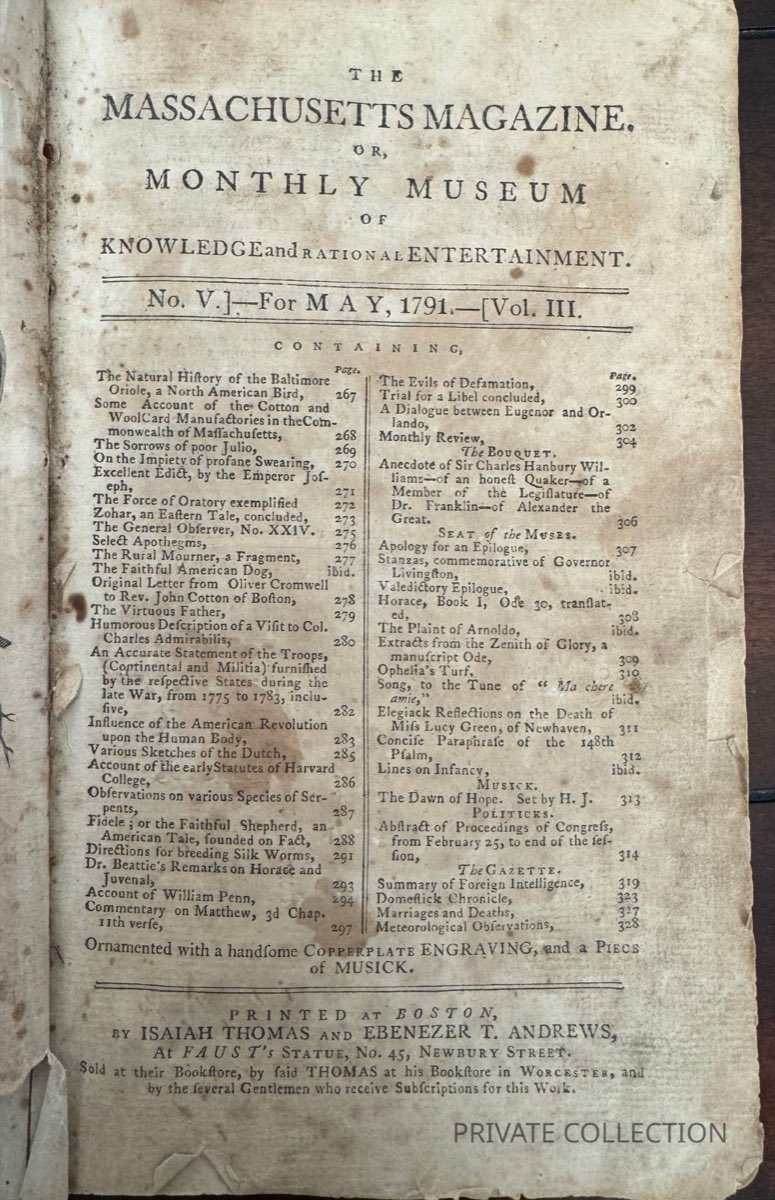
The Influence of the American Revolution upon the Human Body — in The Massachusetts Magazine, May 1791
Rush's essay on the Revolution as a medical event — the 'revolutiana' he observed in the bodies of the defeated Tories, the hysteria of the victors, the effect of liberty on longevity — in its Boston magazine printing. Politics as physiology, which was Rush's whole method.
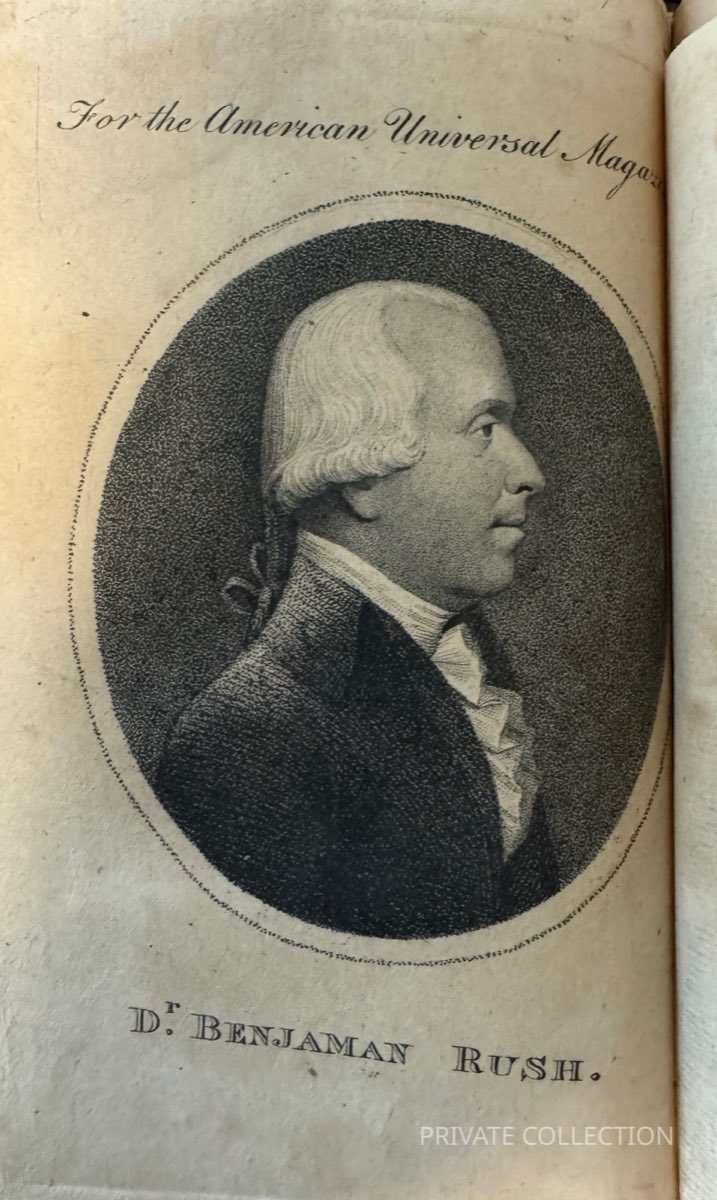
The American Universal Magazine, June 13, 1797 — with a Portrait of Dr. Rush
A number of Richard Lee's short-lived Philadelphia magazine embellished with a portrait of Rush engraved specifically for it — a likeness not otherwise seen. Issued in the summer before the fever of 1797 and the quarrel with Cobbett, when Rush was at the height of his public standing.
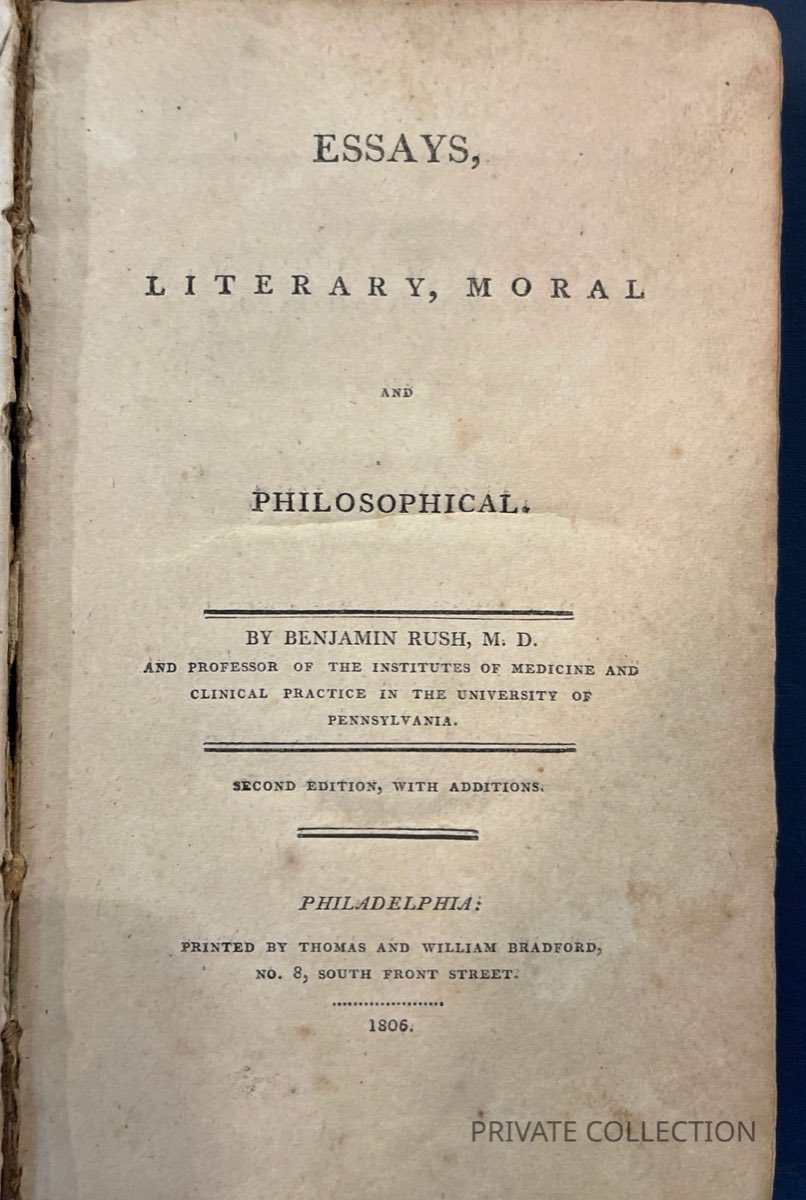
Essays, Literary, Moral, and Philosophical — Second Edition, with Additions
The second, enlarged edition of the collection in which Rush gathered his public essays — on the German inhabitants, on female education, on amusements and punishments for schools, on the Bible in schools, on the study of Latin and Greek — with the printing of some of his most important pamphlets. The public Rush, revised by himself.
Two objects belong to the family. Richard Rush, his son, became Attorney General, Secretary of the Treasury, and minister to London, and his Memoranda of the London years is one of the classics of American diplomacy; the collection's copy is inscribed by him to his brother. And in 1892 Alexander Biddle printed, in fifty sets, the letters Adams and Jefferson had written to Rush, and the letters Rush had written his wife Julia from the fever of 1793 — the private correspondence that Catalog V reads as the epidemic's most intimate record.
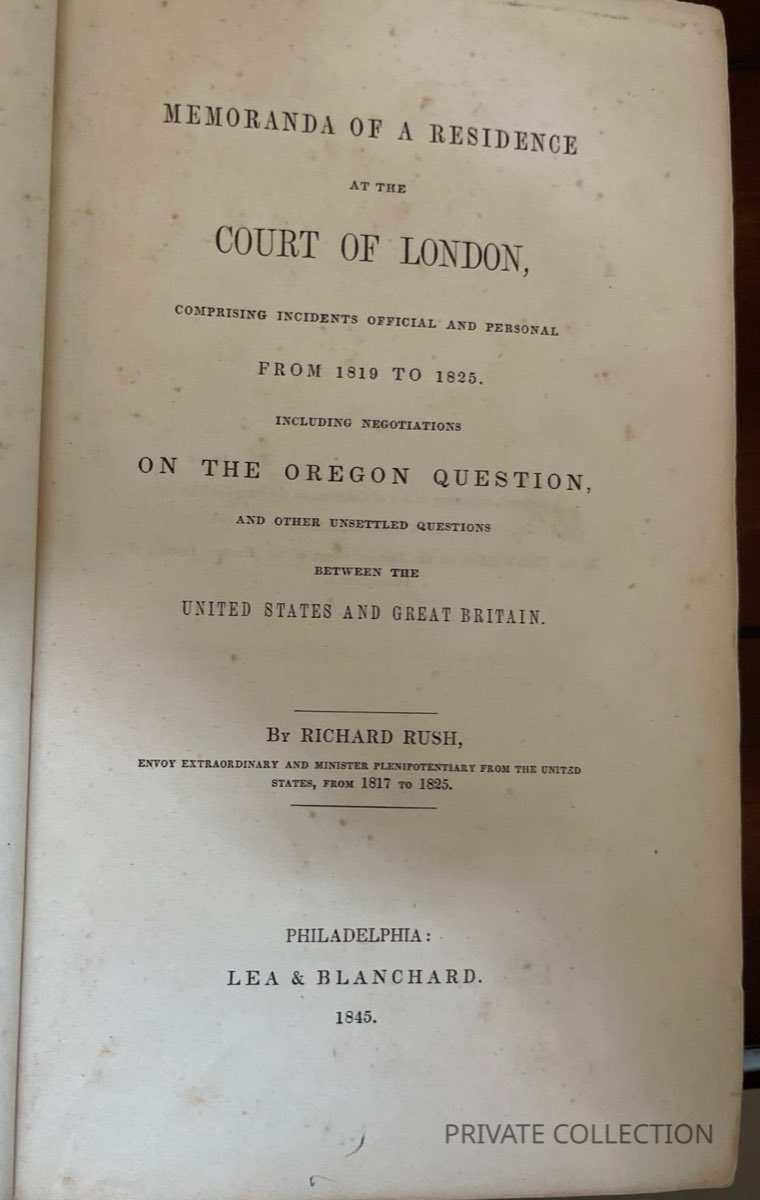
Memoranda of a Residence at the Court of London, from 1819 to 1825, Including Negotiations on the Oregon Question
Richard Rush's account of his six years as minister to Britain, with the negotiations over Oregon and the northwestern boundary — 'the diplomatic maneuvers' Howes calls it, in one of the best diplomatic memoirs of the period. Inscribed on the front free endpaper 'Samuel Rush, Esq. from his affectionate brother, R. Rush.' The next generation of the family, in public life.
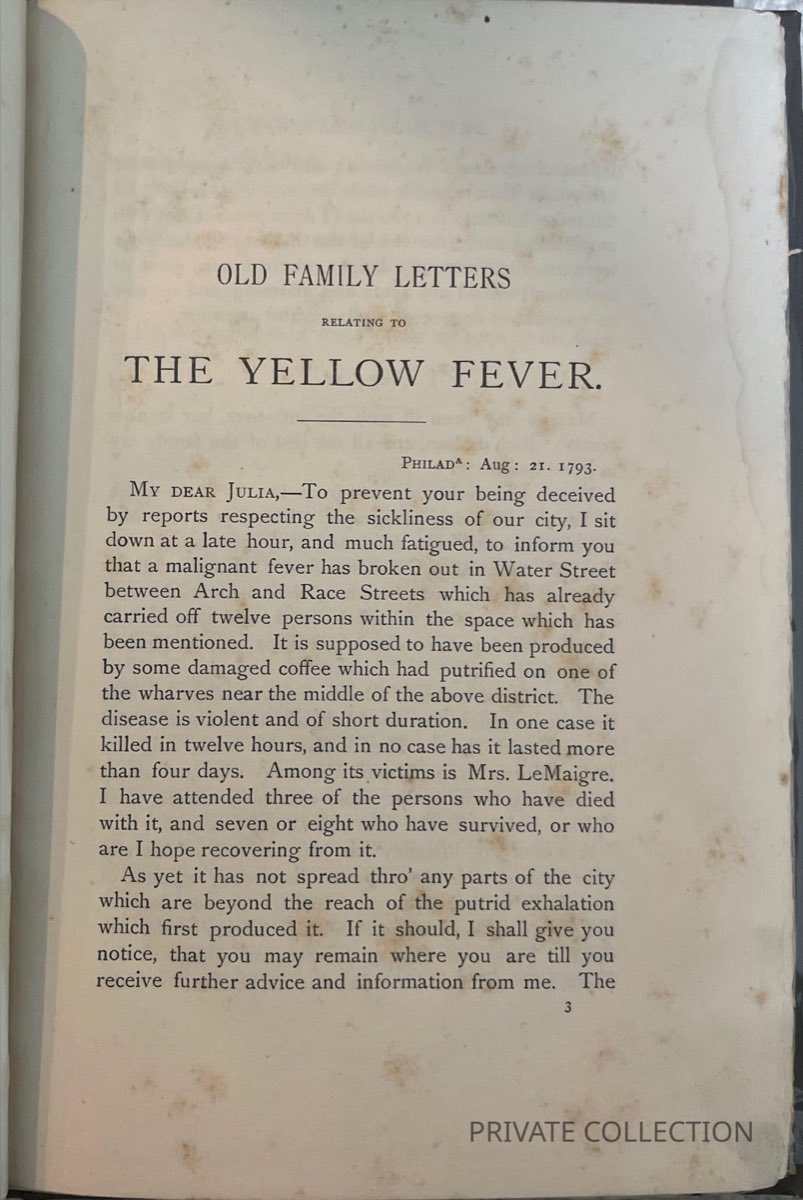
Old Family Letters: Copied from the Originals for Alexander Biddle — Series A, and Series B, Relating to the Yellow Fever
Series A: the letters John Adams and Thomas Jefferson wrote to Rush. Series B: the letters Rush wrote to his wife Julia, at Princeton, from the heart of the epidemic of 1793 — 'a malignant fever has broken out in Water Street.' One of fifty sets printed for the family, both volumes inscribed by Julia Rush on the front leaves; very scarce together. Read with the Wharton letter of October 1793 in Catalog V.
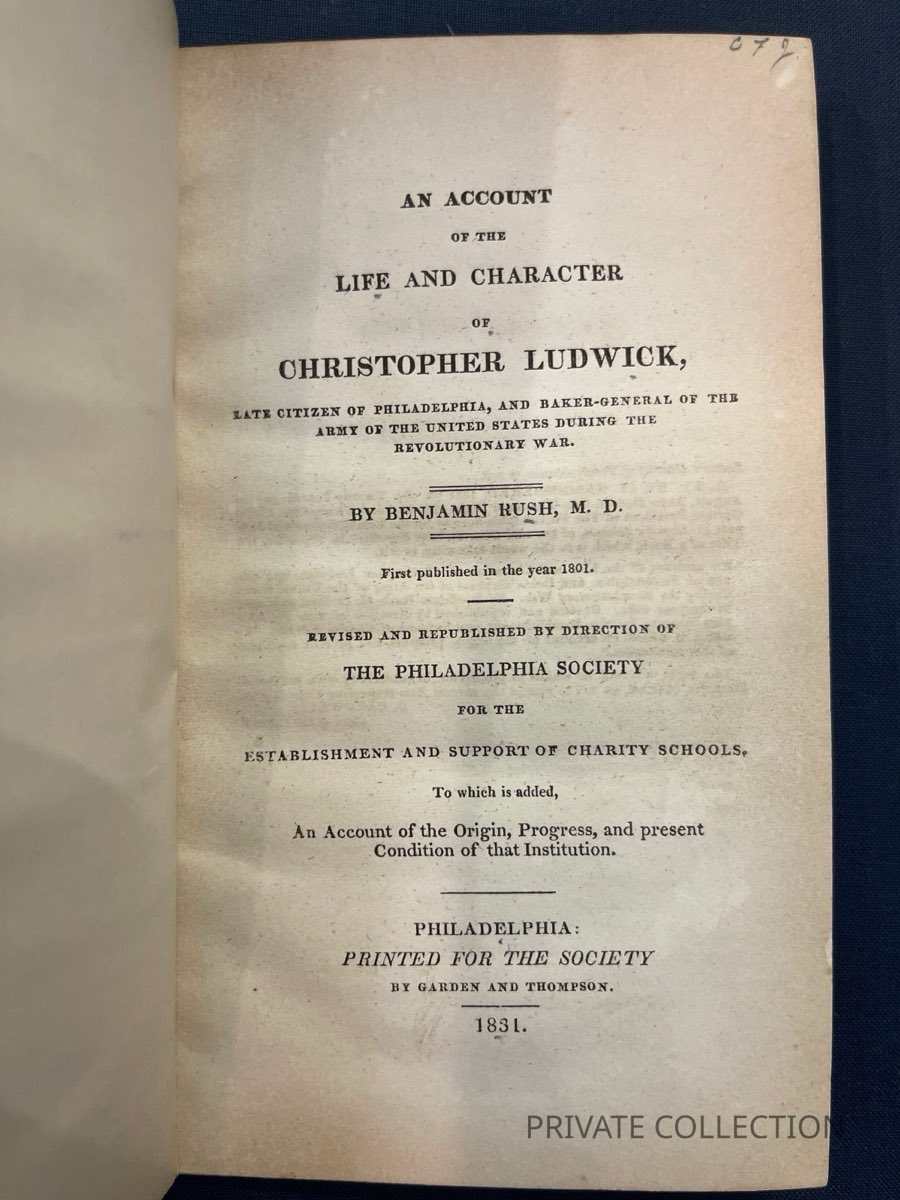
An Account of the Life and Character of Christopher Ludwick, Late Citizen of Philadelphia, and Baker-General of the Army of the United States
Rush's memoir of Christopher Ludwick, the German baker who fed Washington's army and left his estate to found free schools for poor children — revised and reissued by the charity-school society Ludwick's bequest had created, with an account of the institution. Rush the eulogist, in the service of a cause.
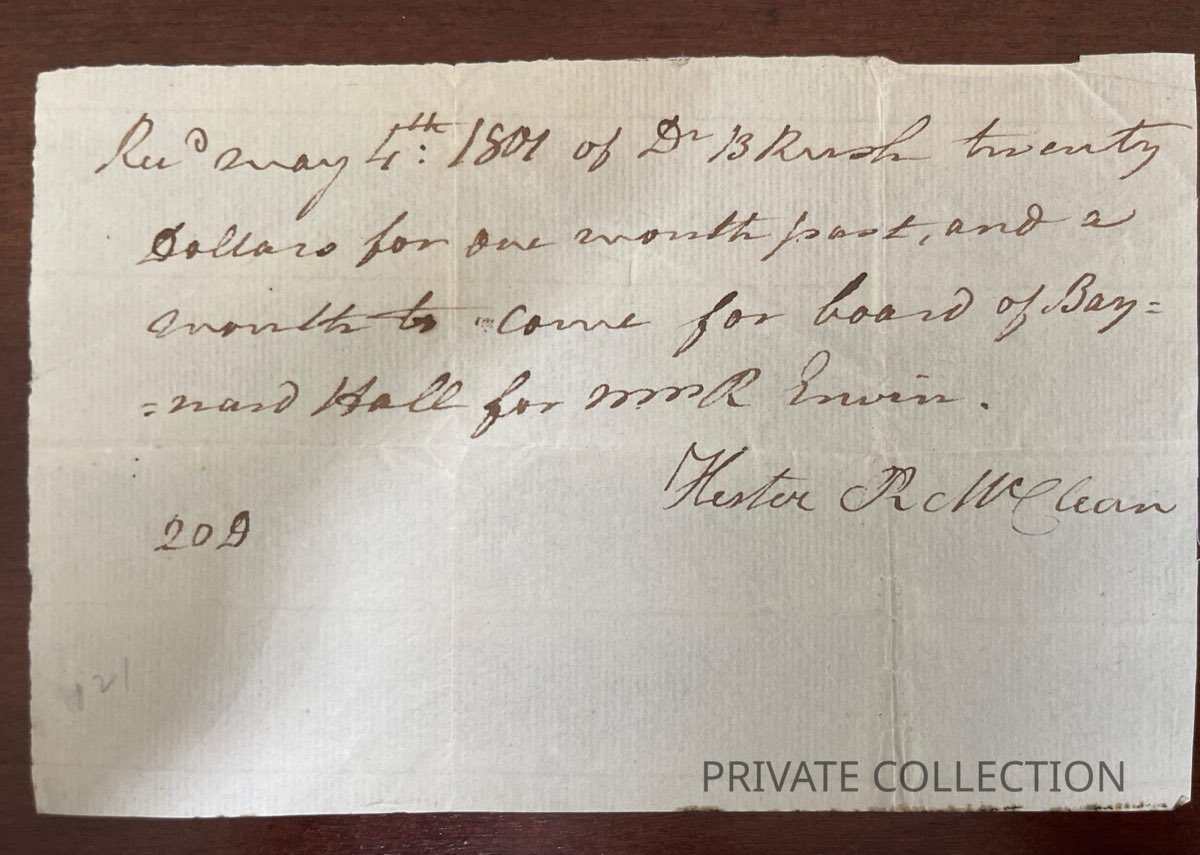
Autograph Document Signed
A document in Rush's hand, signed. The collection's entry for this piece is in preparation.
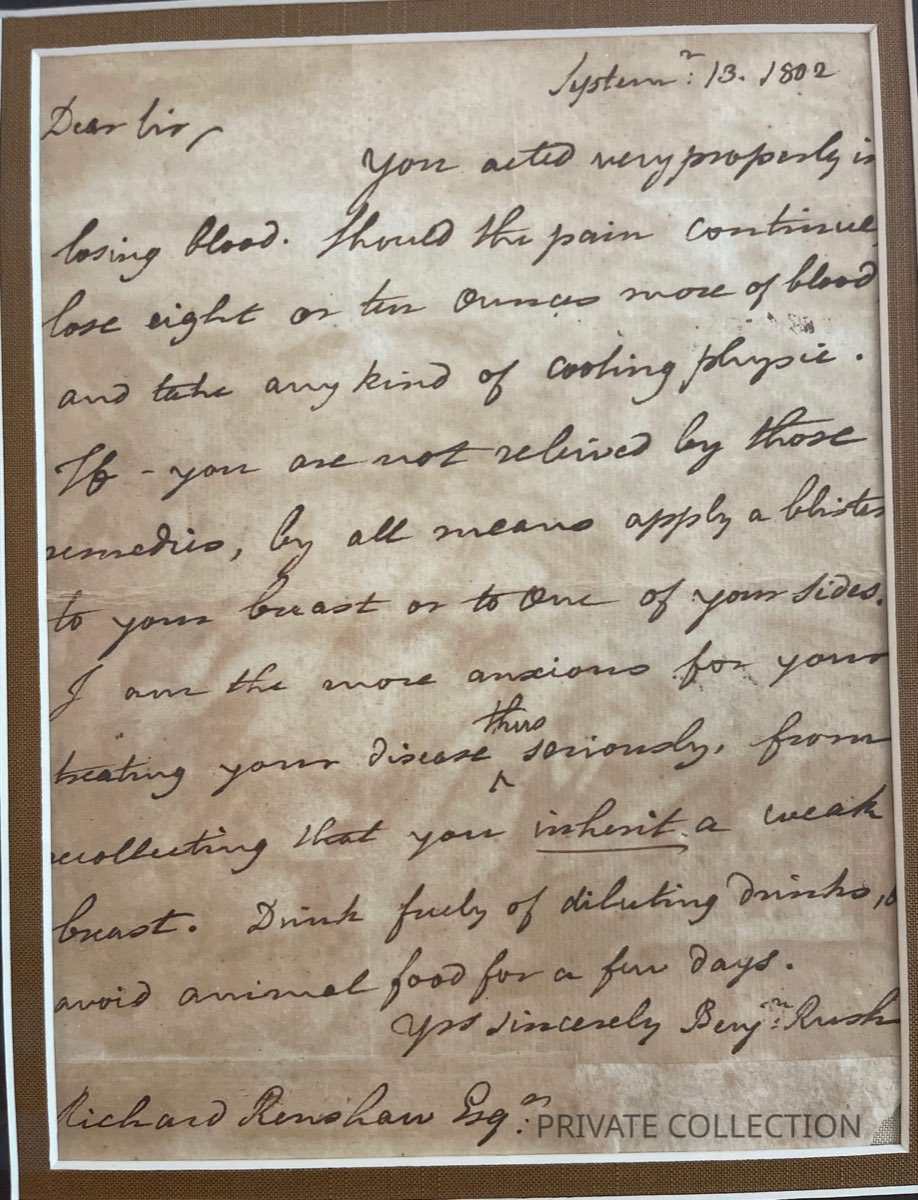
Autograph Letter Signed
A letter in Rush's hand, signed. The collection's entry for this piece is in preparation.