
King Street and the Cockpit
From the Massacre to the Privy Council, 1770–1774
THE reprieve lasted a year. The Townshend duties of 1767 taxed glass, paint, paper, and tea; the colonies resumed non-importation; and in October 1768 two regiments landed in Boston to keep the peace. On the evening of March 5, 1770, a crowd baited a sentry in King Street, the guard came out, and someone gave the order to fire. Five men died. Within weeks Paul Revere had copied Henry Pelham's drawing of the scene and issued the engraving that turned a street brawl into the Boston Massacre: soldiers firing a disciplined volley on command, an unarmed crowd, the Custom House labelled 'Butcher's Hall.' It was propaganda of genius, and the collection holds it in the form in which the twentieth century studied it.
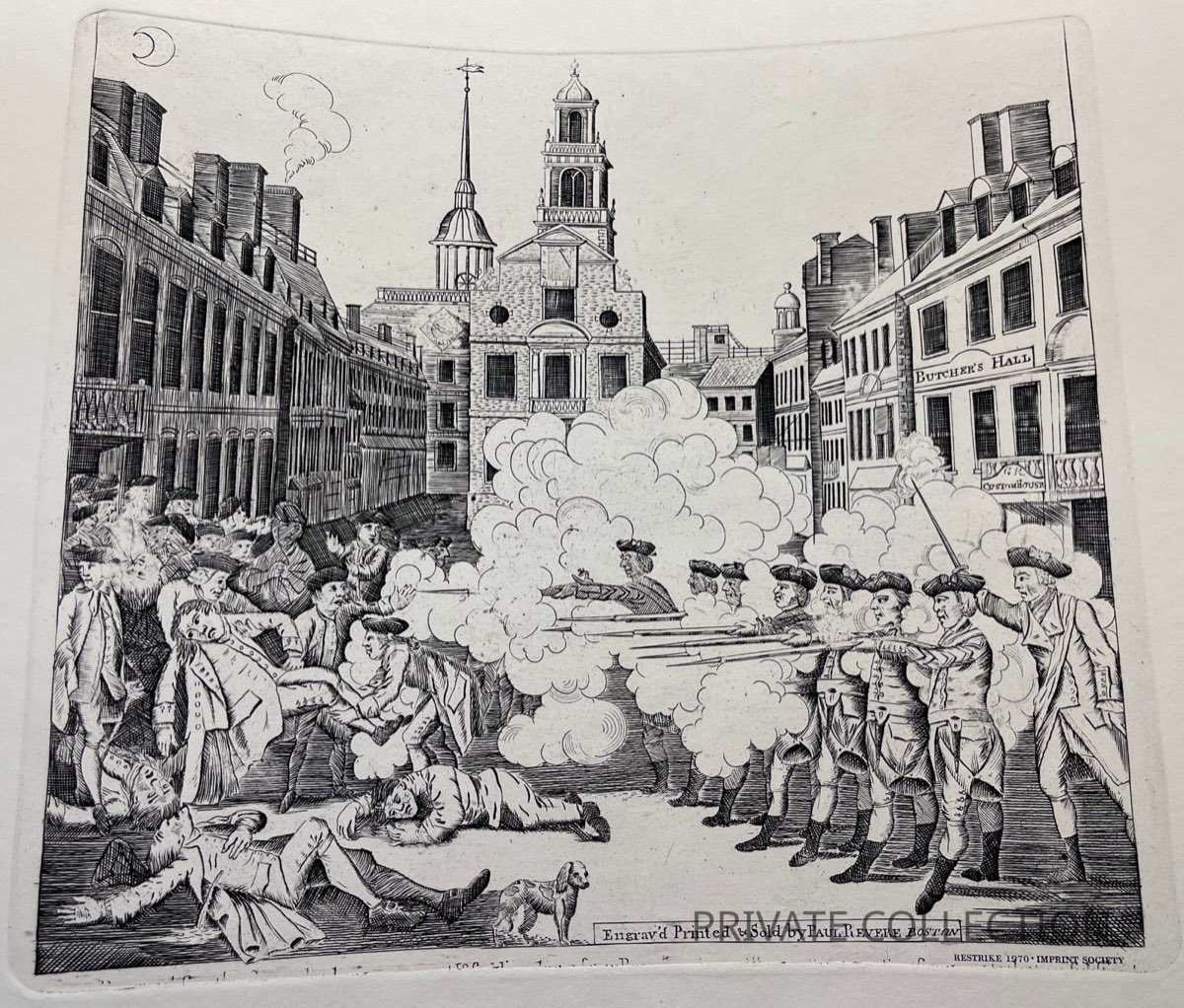
The Bloody Massacre Perpetrated in King-Street, Boston, on March 5th, 1770, by a Party of the 29th Regiment
The Imprint Society's bicentennial study of Revere's engraving, with the print reproduced as a separate plate and a note by Dr. Richard Hale. Original cloth with printed paper label. The image that carried the Massacre through the colonies, in the edition that carried it to modern readers; the collection holds it for the picture and for what the picture did.
Franklin, still in London as agent for four colonies, spent these years explaining America to a government that did not want to understand it. In 1772 he obtained, and sent to Boston, a packet of letters written by Governor Thomas Hutchinson urging the ministry to abridge the colonists' liberties. The letters were published; the Massachusetts House petitioned for Hutchinson's removal; and on January 29, 1774, Franklin was summoned to the Privy Council's chamber at Whitehall — the Cockpit — to answer for it. Solicitor General Alexander Wedderburn abused him for an hour before the assembled lords, who laughed. Franklin, in a suit of Manchester velvet, stood through it without a word. He was dismissed as deputy postmaster general two days later. He is said to have worn the same velvet suit to sign the treaty of alliance with France.
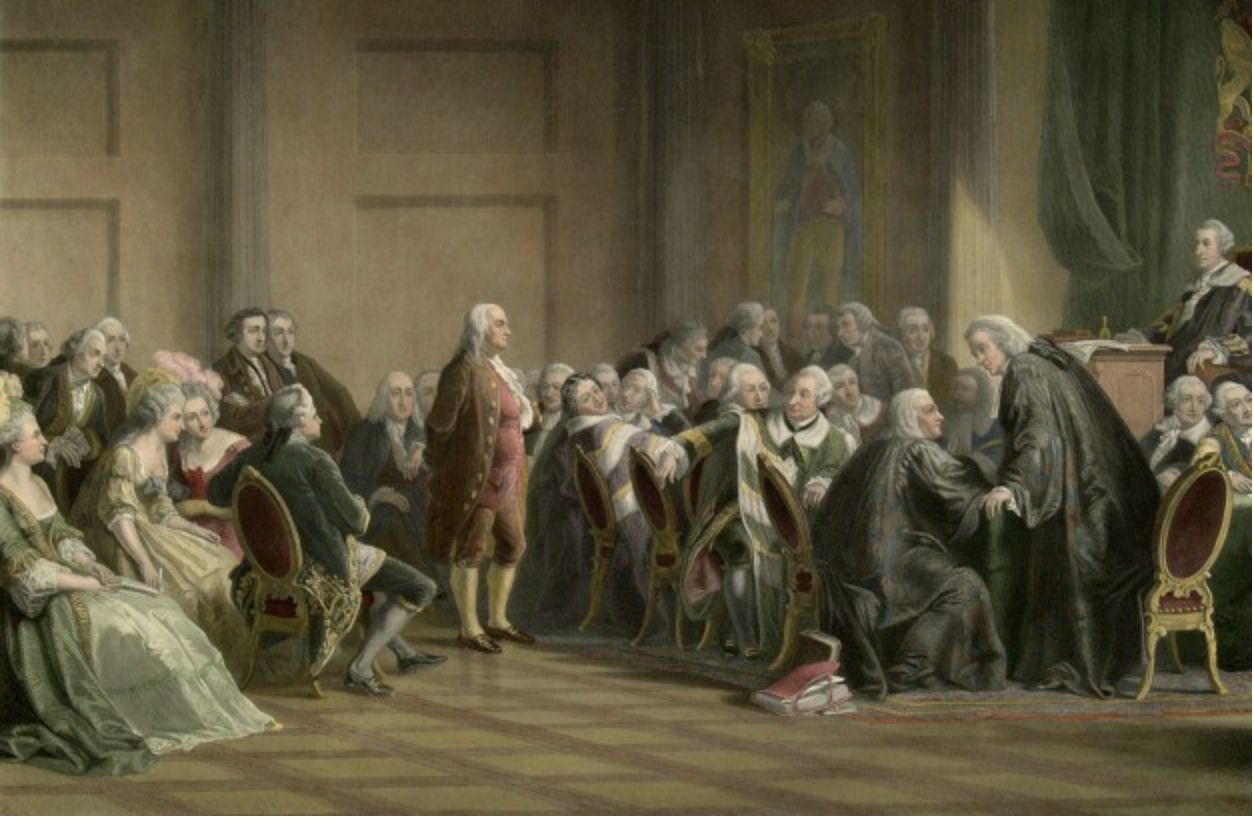
Franklin Before the Lords in Council, Whitehall Chapel, London, 1774
The Cockpit as the nineteenth century imagined it: Franklin standing at the center, composed and alone, Wedderburn gesturing from the table, Lord Gower presiding, the lords amused. Schussele's painting hangs at the Huntington; Whitechurch's engraving made it the standard image of the moment Franklin gave up on the empire. This large impression hangs in the collection between the Stamp Act material and the Declaration, which is where it belongs.
He stood through it without a word, and wore the same suit to sign the alliance with France.