
The Declaration, and the Statue
Philadelphia and New York, July 1776
ON July 2, 1776, Benjamin Franklin and Benjamin Rush — mentor and physician, seventy and thirty — sat in the Pennsylvania State House and voted for independence. On the fourth the text was adopted; that night John Dunlap set it in type on Market Street, and by the ninth it had been read to Washington's troops in New York, whose response was to pull down the gilded lead statue of George III on Bowling Green and send it to Connecticut to be cast into bullets. The collection holds the Declaration in the image the republic made of it, in the official Pennsylvania printing Dunlap made of it six years later, and in the pictures of that night in New York as Europe imagined them.
Declaration of Independence, July 4th, 1776
Trumbull's great canvas of the presentation of the Declaration — thirty-six of the figures drawn from life, painted between 1786 and 1797 and now at Yale — in Ormsby's engraving with the figural key in the lower margin. Franklin and Rush are both in it. Trumbull had been Washington's aide and West's student; this is the image of the Declaration that Americans carry.
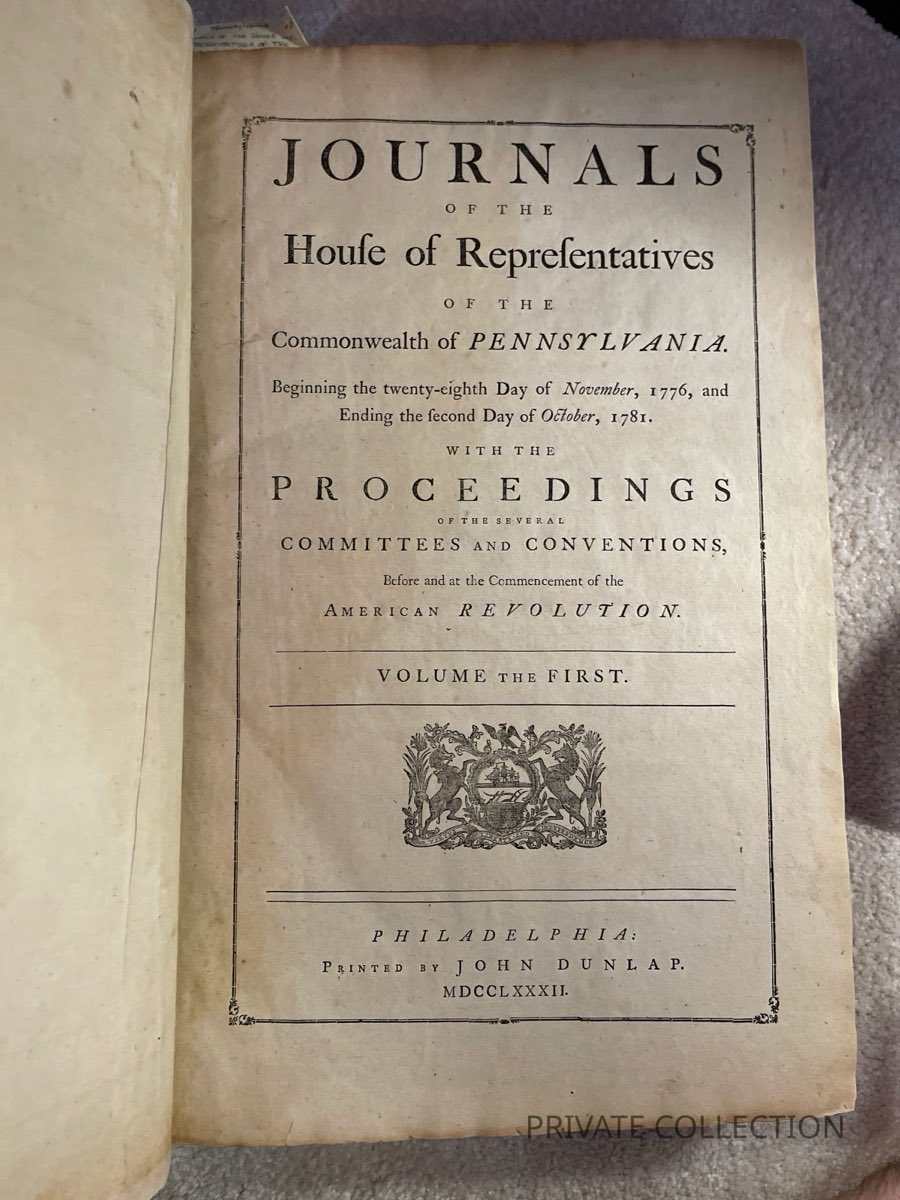
Journals of the House of Representatives of the Commonwealth of Pennsylvania. Including the Articles of Confederation and the Declaration of Independence.
The official record of the Pennsylvania Assembly containing the texts of the Declaration and the Articles as the new state received them — printed by John Dunlap, the same printer who set the original broadside of the Declaration on the night of July 4, 1776, in an edition of only 250 copies. The Pennsylvania signers included both men this collection is built around.
Europe watched the Revolution through the vue d'optique: cheap hand-colored prints made to be viewed through a lens in a peepshow box, drawn by artists who had never crossed the Atlantic and who gave New York the look of Berlin or Hanover. The collection holds three: the crowd pulling down the King's statue, the great fire of September 1776, and the royal troops marching into the city they had just taken. None is accurate. All are evidence of how much Paris and Augsburg wanted to see.
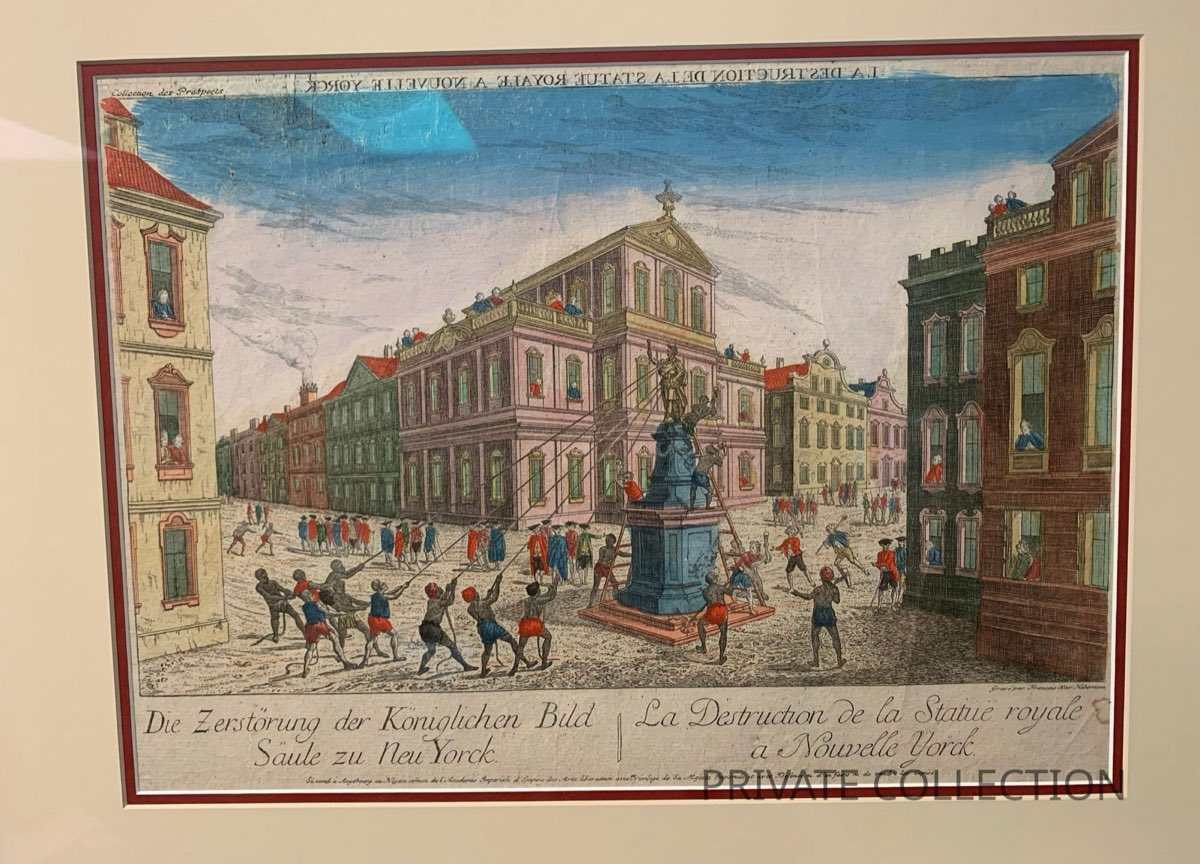
La Destruction de la Statue Royale à Nouvelle Yorck
A Parisian printmaker's imagining of the crowd pulling down the equestrian statue of George III on Bowling Green on July 9, 1776. The artist had never seen New York and gave it a European skyline; the enthusiasm is authentic. The statue's lead became 42,088 musket balls.
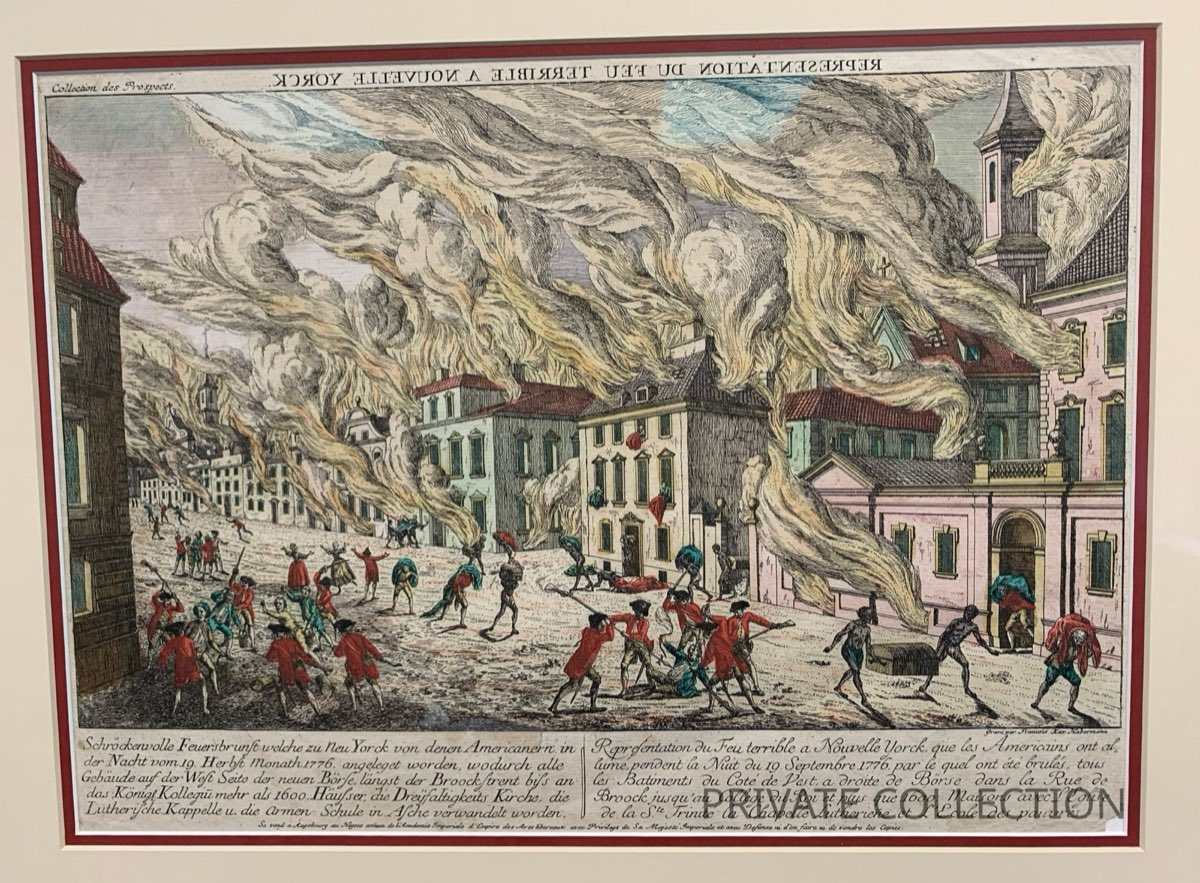
Représentation du Feu Terrible à Nouvelle Yorck
The great fire of September 21, 1776, which burned a quarter of the city a week after the British occupied it, as a European peepshow print imagined the scene — each side blamed the other, and the truth was never established.
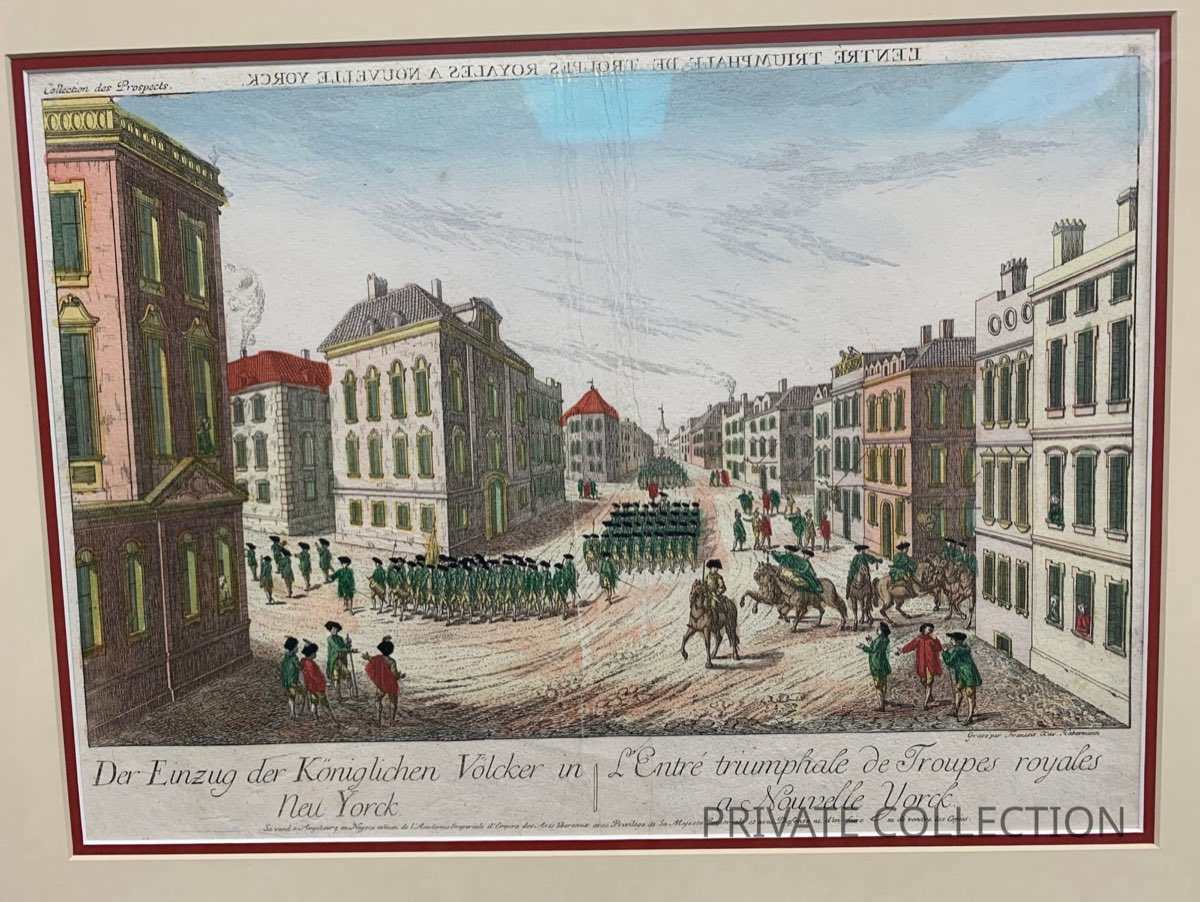
Der Einzug der Königlichen Völcker in Neu Yorck · L'Entrée Triomphale des Troupes Royales à Nouvelle Yorck
Howe's army entering New York in September 1776, in a print whose soldiers wear no red coats and march through a city that looks like Hanover. Fanciful in every particular, and evidence of how newsworthy the war was on the Continent and how distorted its remote coverage.
None is accurate. All are evidence of how much Europe wanted to see.