
The War as News
Bunker Hill, the French, and the Articles, 1775–1782
THE war reached the collection's shelves the way it reached most people who lived through it: as reports. The London Gazette for July 22–25, 1775, carried General Gage's official account of the battle on Breed's Hill with the full list of British officers killed and wounded — the first the British public knew of what a colonial militia could do to regulars. The Marquis de Chastellux, second in command of the French army in America, kept the journal that Howes called 'the first trustworthy account of life in the United States,' and dined with Washington and Jefferson on the way. And in Albany, in the summer of 1782, with the war still on, the New York legislature made the first formal call for a convention of the states to fix the Articles of Confederation.
The London Gazette, Saturday July 22 to Tuesday July 25, 1775
The official newspaper of the Crown, carrying Gage's report of the battle of June 17 and the full list of British wounded — the government's own admission of what the day had cost. Framed with the engraved view of the attack prepared for Barnard's New Complete Authentic History of England.
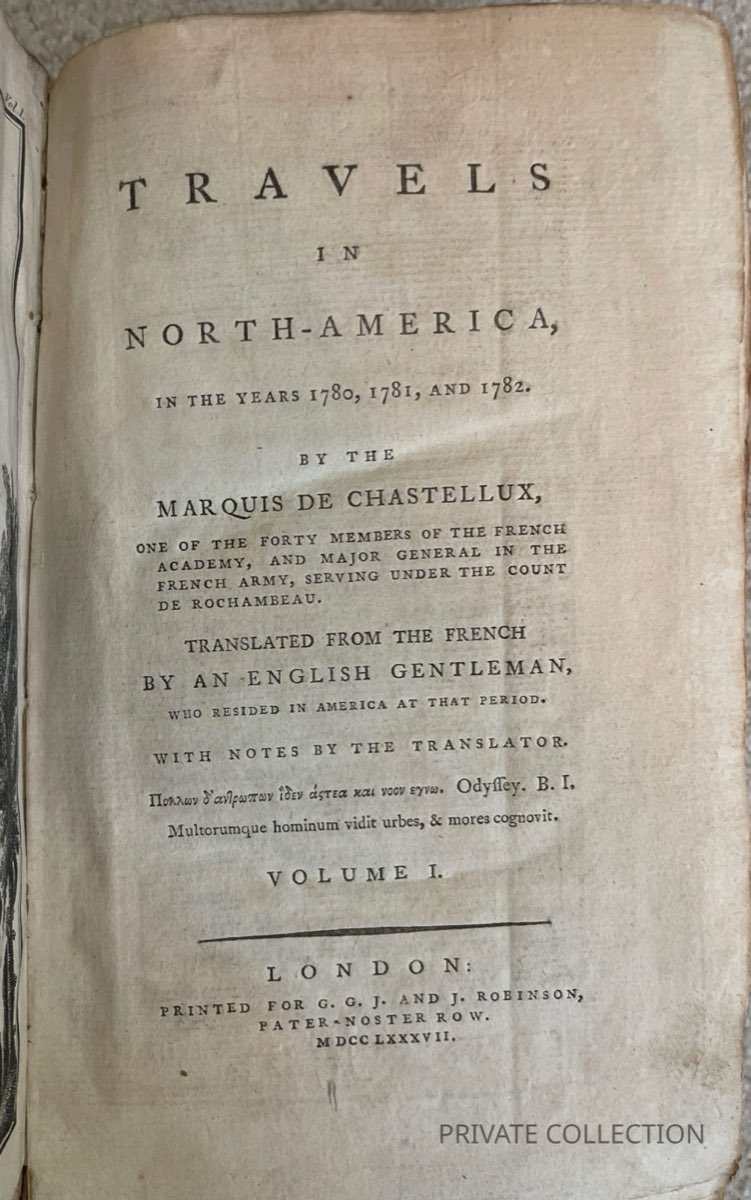
Travels in North-America, in the Years 1780, 1781, and 1782
Chastellux's journal of the French army's years in America — Connecticut, New York, New Jersey, Virginia; Washington at his table, Jefferson at Monticello — by a member of the French Academy who saw the republic being made. 'The first trustworthy account of life in the United States' (Howes).
Document Signed as Governor of New York — the Resolution Calling for a Convention of the States
New York's resolution of July 1782, introduced by General Schuyler and by most accounts drafted by Hamilton, calling for a 'Convention of the States' to give Congress the power to raise revenue — the first formal proposal for what became, five years later, the Constitutional Convention in Philadelphia. Signed by Governor Clinton, who would oppose the Constitution it produced.