
The Peace, and the Memory
Paris, 1783, and the Histories, 1795–1859
FRANKLIN had sailed for France in October 1776, three months after the Declaration, and did not come home for nine years. He negotiated the alliance that won the war and the peace that ended it, and on April 3, 1783, at Paris, he signed alone — the only American commissioner present — a treaty of amity and commerce with Sweden: the first treaty the United States made with a nation that had never been at war with Britain, and Sweden's recognition of the republic before the British peace was even concluded. The collection holds it in the official Stockholm printing.
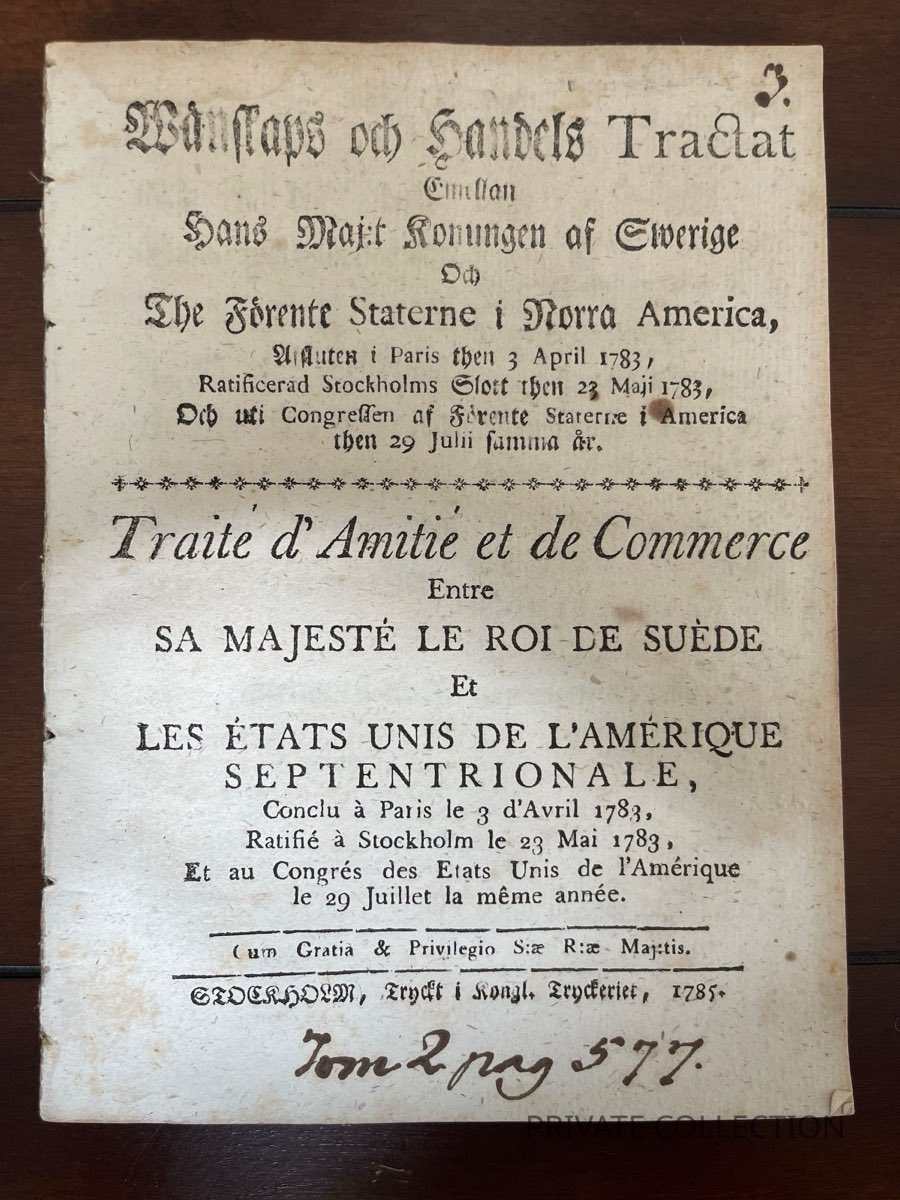
Wänskaps och Handels Tractat Emellan Hans Maj:t Konungen af Swerige och the Förente Staterne i Norra America — Treaty of Amity and Commerce between Sweden and the United States
The treaty concluded at Paris on April 3, 1783, ratified at Stockholm on May 23 and by Congress on July 29 of the same year, in the official Swedish printing. One of the first treaties made by the United States after the war, and the one in which Franklin's signature alone bound the republic.
What followed was memory, and the collection follows it through the histories the new nation wrote of itself: the History of America of 1795 in the copy of Artemas Ward, the Massachusetts general who had commanded at Bunker Hill before Washington arrived; Benjamin Trumbull's General History of 1810, a chaplain's account of the 'late memorable Revolution' as the work of divine agency; John Marshall's Life of Washington with its atlas, the first great biography; and Washington Irving's, the second, in one of a hundred and ten large-paper copies. The last object is the print of the Cockpit, made in 1859, with which the nineteenth century decided how the Revolution had begun.
The History of America, in Two Books … A Concise History of the Late Revolution
A fair copy only — lacking the maps, with a child's pencil scribbles — but with an important association: signed on the title by Artemas Ward (1727–1808), commander-in-chief of the Massachusetts forces at the siege of Boston until Washington took over, and the man in nominal command at Bunker Hill. The general reading the history he had made.
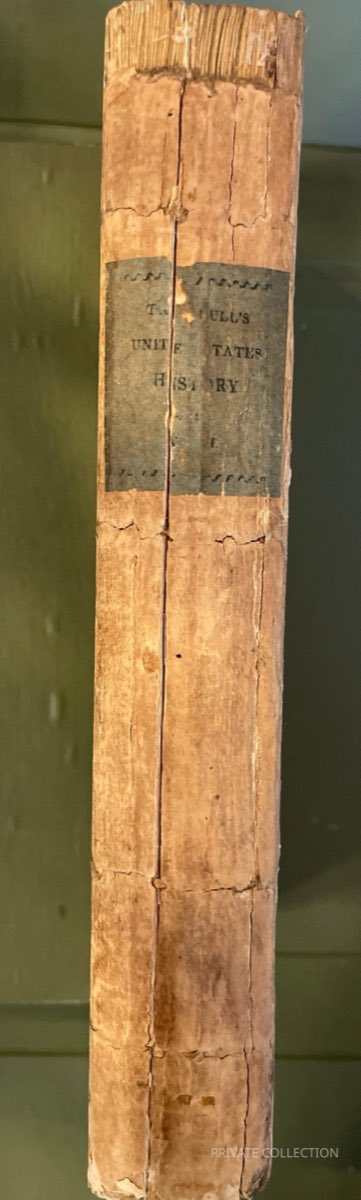
A General History of the United States of America from the Discovery in 1492 to 1792: or, Sketches of the Divine Agency … Especially in the Late Memorable Revolution
The Revolution as providence, by the Connecticut minister who served through it as a volunteer and chaplain. In original boards, in a custom slipcase.
The Life of George Washington, Commander in Chief of the American Forces … and the First President of the United States
The first great life of Washington, by the Chief Justice, with the atlas of ten maps of the campaigns and the twenty-two-page subscriber list. Marshall had served under Washington at Valley Forge; his biography, commissioned by the family, was the authorized account for half a century.
Life of George Washington
Irving's final work and magnum opus, 'the best of these works' in Boorstin's survey of the early lives, in the scarce large-paper issue extended by the publisher with portraits, views, documents, and maps.