
Rush to Physick
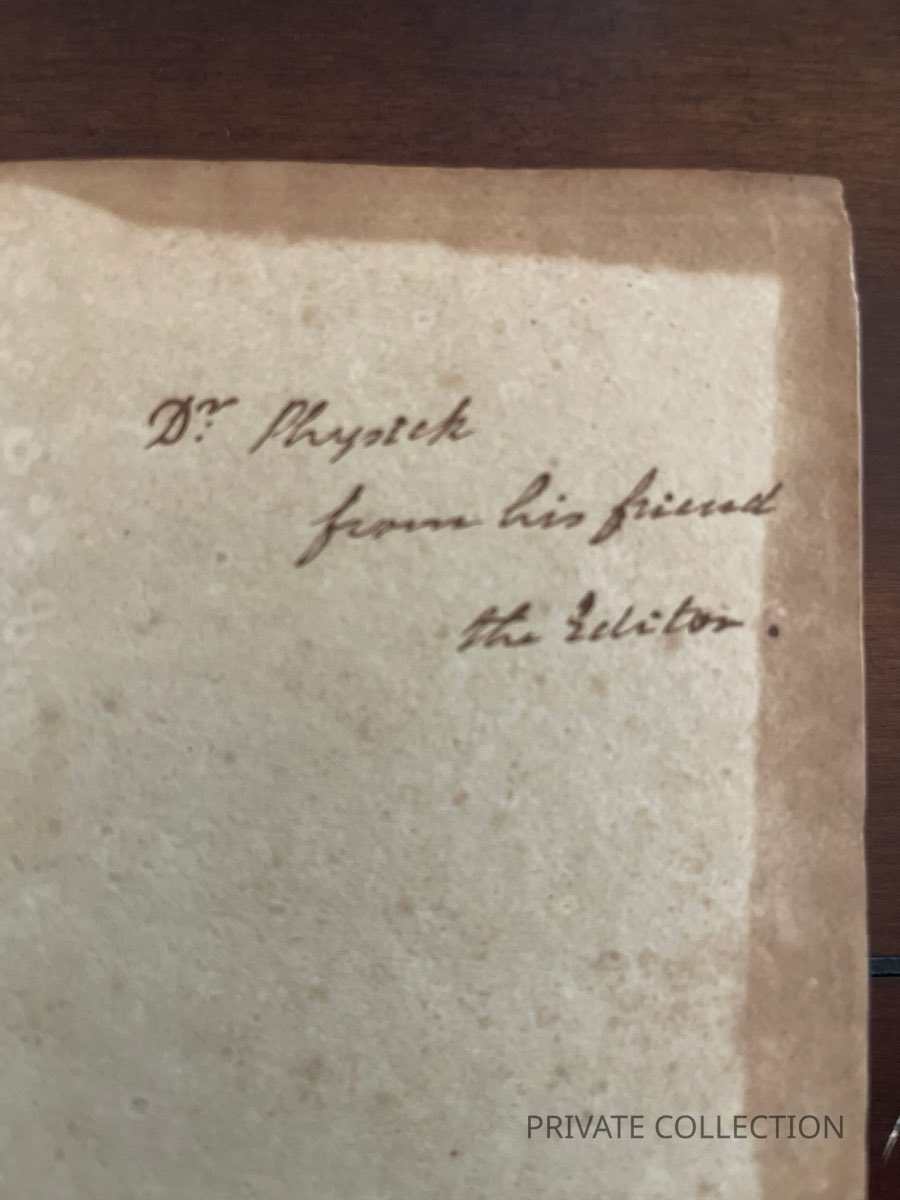
The book is George Cleghorn's account of the diseases of Minorca, the founding work of medical geography and the model for Rush's own environmental reasoning about yellow fever. The remarkable thing is not the book. It is the inscription on the front leaf: 'Dr. Physick from his friend the Editor.'
Philip Syng Physick, trained under John Hunter in London and at Edinburgh, came home to Philadelphia in 1793 and went straight into the epidemic, serving at the Bush Hill hospital and catching the fever himself. He became Rush's closest medical friend, professor of surgery at the University, and — in the phrase that has stuck to him — the father of American surgery. Here one of the two great physicians of the age gives the other the book he has just edited, in the year they shared a plague. The collection places Monroe's letter of 1811 beside it, in which a future president asks Rush to consult Physick on his daughter's case: the two men as the country saw them, a pair.
Diseases of Minorca
George Cleghorn (1716–1789) spent eleven years on Minorca in British Army service, keeping meticulous records of the connection between climate, weather, and disease — the foundational work of medical geography, and the model for the environmental reasoning by which Rush would argue that yellow fever arose from Philadelphia's own miasmatic conditions. Rush thought enough of the book to edit it for American readers, and this is his own presentation copy of that edition, inscribed on the front leaf: 'Dr. Physick from his friend the Editor.' Philip Syng Physick (1768–1837), trained under John Hunter in London and at Edinburgh, came home to Philadelphia in 1793 and went straight into the epidemic, serving at the Bush Hill hospital and catching the fever himself; he became Rush's close friend and colleague, professor of surgery at the University, and, in the phrase that has stuck to him, the father of American surgery. One of the great physicians of the age giving the founding text of medical geography to another, in the year they shared a plague: an extraordinary association.