
The Last Royal Governor
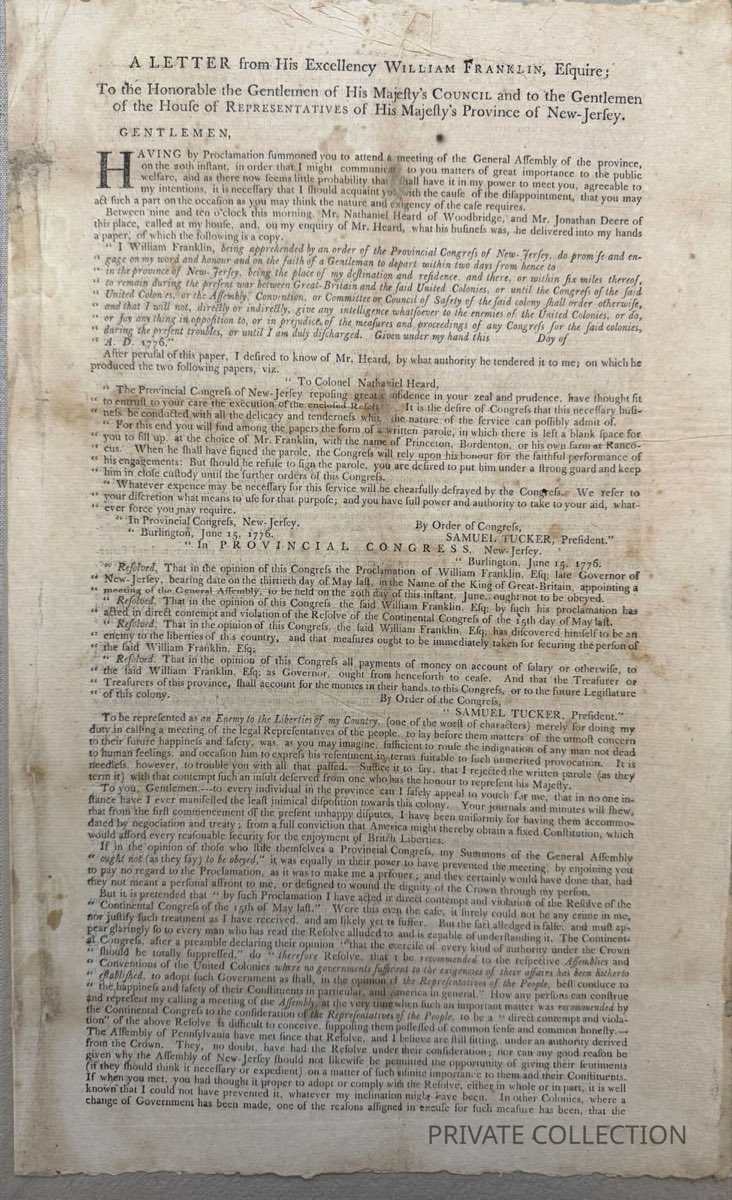
On June 15, 1776, the Continental Congress declared William Franklin 'a virulent enemy to this country.' He answered two days later, in a letter to the Council and Assembly of New Jersey which Isaac Collins printed at Burlington as a folio broadside with a postscript of June 22: the royal governor refusing to recognize a Provincial Congress he called 'an illegal assembly.' That assembly arrested him on June 26. He was in a Connecticut jail when his father signed the Declaration a week later.
Richard Smith's copy, fully untrimmed, with contemporary manuscript on the verso. The last public act of the last royal governor, and one of the two or three most important pieces of paper in the collection.
FRANKLIN, William. A Letter from His Excellency William Franklin, Esquire; To the Honorable the Gentlemen of His Majesty’s Council and to the Gentlemen of the House of Representatives of His Majesty’s Province of New-Jersey
William Franklin's reply of June 17, 1776, to the Congress's resolution of June 15 branding him a traitor, printed with a postscript of June 22 — four days before his arrest and two weeks before his father signed the Declaration. The last public act of the last royal governor. Richard Smith's copy, with contemporary ink manuscript on the verso of the last page; a few lines professionally mended affecting eleven words. One of the two or three most important pieces of paper in the collection.