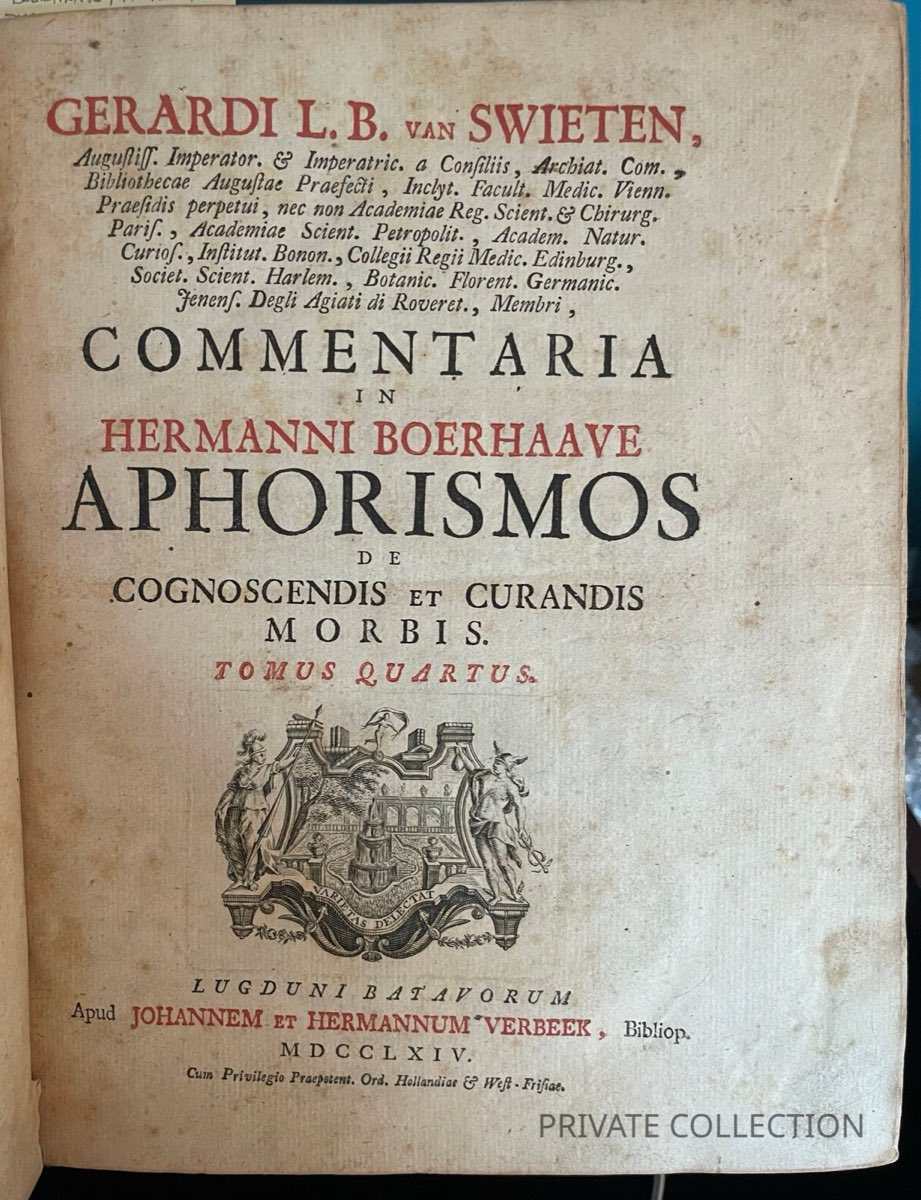
(RUSH, BENJAMIN). SWIETEN, Gerard, L.B. Van- Commentaria in Hermanni Boerhaave
BR-2022.001
With Rush's bookplate below. Rush is said to have destroyed as many of the bookplates as he could, and they are quite rare.
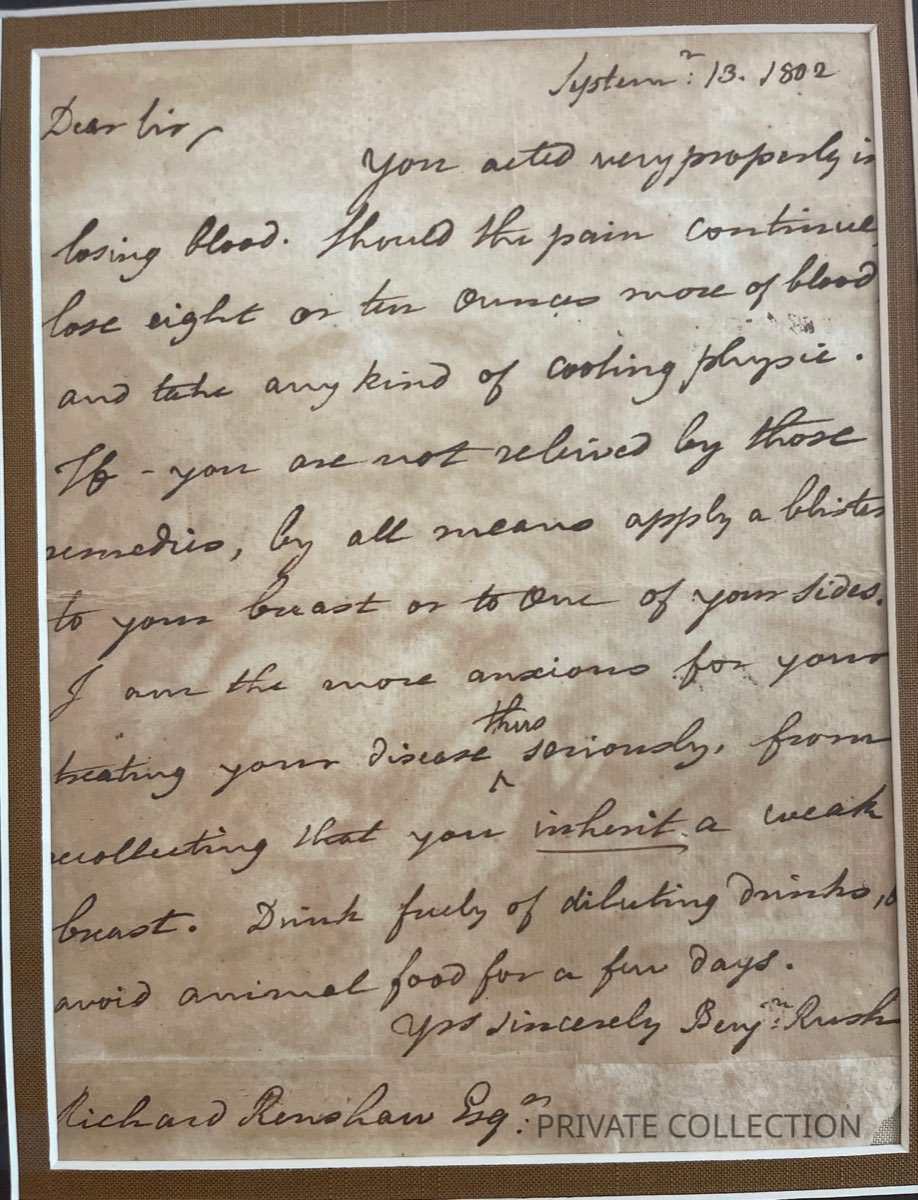
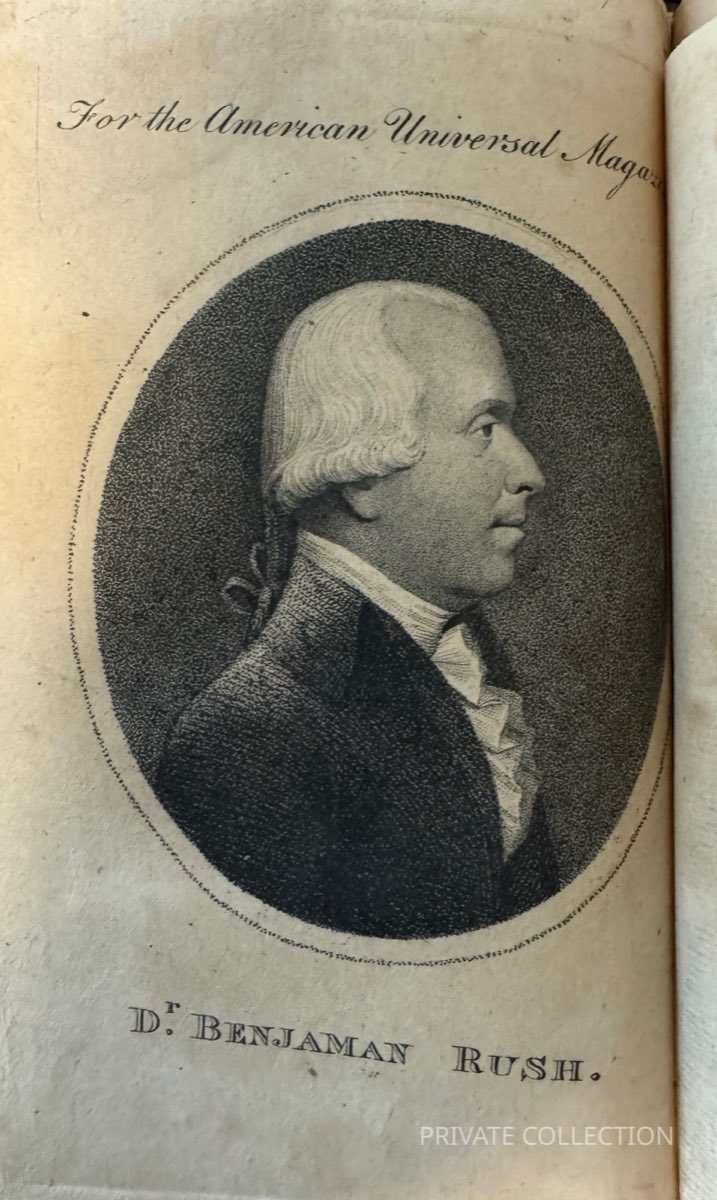
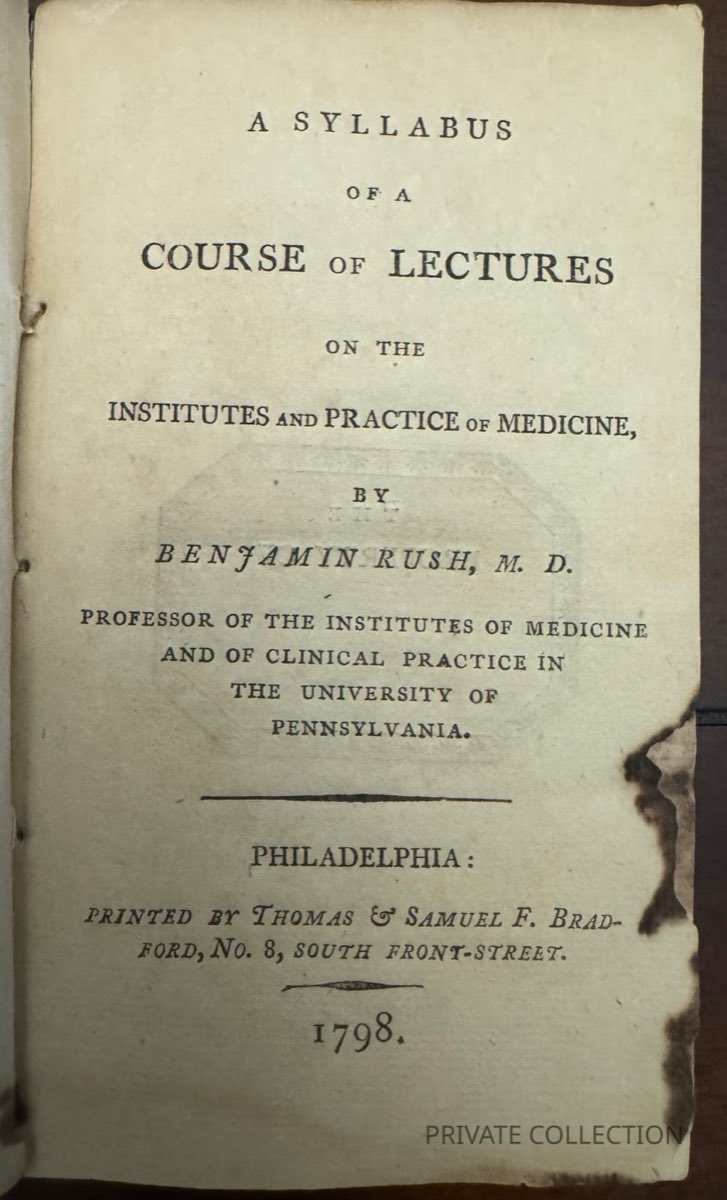
Benjamin Rush noted in his Autobiography: "I studied Dr. Boerhaave's Lectures upon physiology and pathology with the closest attention, and abridged a considerable part of Van Swieten's commentaries upon his practical aphorisms. I kept a commonplace book in which I recorded everything that I thought curious or valuable in my reading and in my master's practice." Rush valued and studied van Swieten's Commentaries. In 1773, Rush wrote to Benjamin Franklin: "I acknowledge myself much indebted to you for the Instruction contained in your last Letter. I have met with many Facts which confirm your Opinion of the Origin of Catarhs from Cloaths, Beds, Books &c. Baron Van Swieten in his last Volume of Commentaries on Dr. Boerhave's Aphorisms in treating upon Epidemic Diseases mentions with Astonishment a Disorder which was peculiar only to the students and Bookseller of the University of Alstorp in Switzerland."
The most personally significant volume in the collection's Edinburgh section. Gerard van Swieten (1700-1772) was Boerhaave's greatest student in the Netherlands and the physician who carried the Boerhaave tradition to Vienna, where he founded the famous Vienna Medical School. His Commentaria was the essential mediation of Boerhaave's Aphorisms for the Edinburgh generation. That Rush's copy bears his armorial bookplate and autograph inscription places this volume directly in the hands of the man who transmitted the Boerhaave-Cullen tradition to America. The chain: Boerhaave taught Van Swieten; Van Swieten's tradition shaped Edinburgh; Edinburgh trained Rush; Rush trained three thousand American physicians.
- Accession
- BR-2022.001
- Date
- Edinburgh, ca. 1762–1780
- Author / maker
- Van Swieten, Gerard; Rush, Benjamin (provenance)
- Inscription
- With a gift inscription from Benjamin Rush to Samuel P. Griffitts on the front pastedown, "For Dr. Samuel P. Griffitts -from his friend Benj'n. Rush. May 9th 1788. 'non donum-sed debitum (not a gift but a debt].'
- Condition
- 4to. 751pp. Contemporary calf, raised spine bands, compartments elaborate floral gilt, red morocco spine label, gilt-chamfered edges. Rebacked, original spine laid down, some scrapes to leather, lower front corner worn, light scattered foxing and toning, else a very good copy.
- References
- Garrison-Morton, 2200
- Notes
- Herman Boerhaave (1668-1738) was a Dutch philosopher, botanist, and physician, considered to be the founder of clinical teaching and of the concept of the modern teaching hospital. Boerhaave revived the Hippocratic tradition of teaching students at the patients' bedsides. He also insisted on performing autopsies in order to understand the connection between symptoms and lesions. In 1709 he became professor of botany and medicine at the University of Leiden, which he made into Europe's leading center for medical education. "Students came to Leiden from many different countries, returning with textbooks by their professor to teach his methods at home, so that Boerhaave's academic system, both in style and in organization, survived through his pupils long after death. The most remarkable example of his influence was in the medical school at Edinburgh...At one moment, in 1726, the whole medical faculty at Edinburgh consisted of Boerhaave's pupils following his teaching. Through his pupils he is the real founder of the Edinburgh Medical School, and through it of the best medical teaching in the English- speaking countries of the world.'" Grolier, One Hundred Famous Books in Medicine 39 (ref.) Gerard van Swieten (1700-1772) enrolled as a medical student at the University of Leiden, attracted by the lectures of Boerhaave. After receiving the MD degree in 1725, he established a medical practice in Leiden, which, although it soon became quite sizable, did not prevent him from continuing to attend every lecture of Boerhaave until the latter's death in 1738. Van Swieten adapted a shorthand system tomedical language, so these lecture notes reflect Boerhaave's presentation closely. Their mutual respect led Boerhaave to show his most interesting private cases to van Swieten and to express a lively interest in those ofivan Swieten. At various times Boerhaave stated that van Swieten would be the most suitable person to succeed him as a professor. Van Swieten's Commentaria is both Boerhaave's lectures and van Swieten's commentaries upon them. Swieten's Diseases Incident to Armies was an important medical work used in the American Revolution and would have been used extensively by Dr. Rush.
“(RUSH, BENJAMIN). SWIETEN, Gerard, L.B. Van- Commentaria in Hermanni Boerhaave.” The Soiferman Collection, BR-2022.001, Wynnewood, Pennsylvania. EIS LIBRIS, https://eislibris.com/objects/rush-benjamin-swieten-gerard-l-b-van-commentaria-in-hermanni-boerhaave (accessed [date]).