Anthony Newhouse DS Philadelphia November 7, 1747
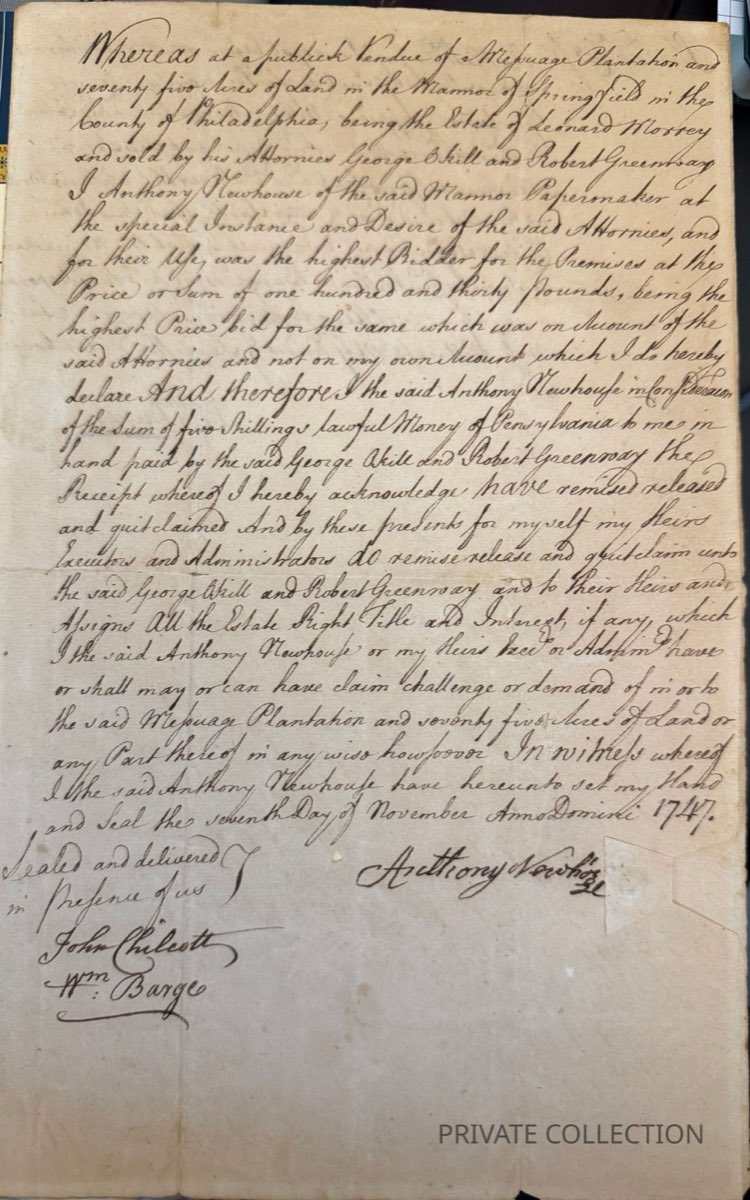
Legal document signed by "Anthony Newhouse, Papermaker" Philadelphia November 7, 1747
A legal document signed by Anthony Newhouse who was one of several papermakers in Philadelphia during Franklin's time as printer. There are extensive references to Newhouse in Franklin's account books. It is also signed by William Dewees. There were several William Dewees' of the same family, however in the context of this document this is William M. Dewees, who was then the sheriff of Philadelphia. His father and grandfather, however were both papermakers and dealth extensively with Franklin.
From "Benjamin Franklin's Philadelphia Printing" by C. William Miller, introduction pages xl and xli:
"Franklin normally depended for his main supply on papermakers closer to his printing office and hence in the late thirties relied heavily on the Dewees, especially William Dewees, Jr. The smaller share in that period came probably from the first mill built by the elder William Dewees, Klaus Rittenhouse's brother-in-law, in 1710 on a branch of the Wissahickon west of Germantown Avenue close to the dividing line between Philadelphia and Montgomery Counties. The much larger portion was laid in the mill which William, Sr., built in 1736 for his son on the west side of the Wissahickon between Wise Mill Road and Hartwell Lane. The documentation on this mill is fuller than that for the others, so that one can trace its activity with some certainty. It was a major source of printing paper for Franklin from 1736 to 1746, and possibly to 1753, when it was sold at auction.
From 1736 to 1741 William Dewees, Jr., with help from Anthony Newhouse, ran the mill. Matthias Meuris bought the mill from Dewees, May 31, 1742, and became an important Franklin supplier until he died, badly in debt, on December 28, 1746. Franklin bought seventy reams of brown paper and twenty-seven reams eight quires of printing paper at the Meuris public vendue, May 14, 1747; the mill with its forty-five acres of farm land went for £410 to Philadelphia merchant Peter Kock, a native of Karlscron, Sweden Who operated the mill for Kock until his death, November 9, 1749, and until its sale in 1753 is not known. Among the papermakers thought to have worked there in that interval are Jacob Hagy, or Haga, Frederick Bicking, or Bocking, who had been Meuris' apprentice, and Nicholas Hasselbach.
Far more important to Franklin than Meuris in the forties was Anthony Newhouse, who had been Dewees' foreman in the late thirties. His paper accounts with Franklin show him to have been a versatile artisan, producing a variety of paper. In the years 1742 to 1749 he bought 49,242 pounds of rags from Franklin and sold him hundreds of reams of paper, including mist of the paper which Franklin used in printing the Provincial currency." The flakes of mica visible in the Pennsylvania bills starting in the 1740's make it clear that Newhouse and Franklin were experimenting with the ingredients used in that particular paper in an effort to thwart counterfeiters.
On September 30, 1746, Newhouse purchased land in Whitemarsh Township, Montgomery County, along Trout Run, a tributary of the Sckuylkill River, in an area which is today called Miquon. He built a new paper mill on the site and worked it until he sold the propert to another papermaker in 1752. Meanwhile he was also renting and operating in 1748-1750 a paper mull situated on Sandy Run in the northwest corner of the old Springfield Manor now named Springfield Township, Montgomery County. The tract already had a paper mill erected onit, along with a dwelling and a lime kiln, when Jacob Colliday and his wife, on May 2, 1746 sold it to the Proprietary Receiver-General and Keeper of the Great Seal, Lynford Lardner, so perhaps it was here that Newshouse worked after Dewees sold the Germantown mill to Meurius in 1742 and before Newhouse appears in Lardner's account book entry in 1748."
From The Library Company of Philadelphia:
(https://librarycompany.org/librarycompanypapersproject/2025/09/19/history-of-share-22/)
Robert Greenway (d. 1763) acquired share number 22 of the Library Company of Philadelphia on June 5, 1736, though that transaction is not recorded in either the Library Company’s share books nor its Directors minutes. Greenway was a wine merchant and real estate investor. After ten years as a shareholder, he was appointed to serve as the Library Company’s Librarian on May 5, 1746. He would hold that role until his death seventeen years later.
By the summer of 1749, the Directors had noticed “sundry” books were missing from the library, and the next year ordered that the books should be “new numbered beginning No. 1” in each size category. Librarian Greenway was assigned the job, and was to be paid for it. He was also charged with making a new catalog of the Library Company’s holdings.
It is unclear when Greenway finished his task, but the next printed catalog that survives dates to 1757 and does indeed list a number before each title.The Directors minutes include occasional complaints about Greenway missing meetings in the 1750s, but by mid-1762, the tension is obvious. The four Directors who met on August 9, 1762 noted that Greenway had not been following the rule that the Librarian should be present at the Library Company during its open hours. The “Secretary Is desired to enquire of him whether or no it will suit his Business so to do; and if he finds it will not, to look out for some Person to whom it will be convenient, and make Report at the next Meeting.”
At the September 1762 meeting, attended by only two Directors, the Secretary noted that he had indeed brought Greenway a “Copy of the Minute made at last meeting respecting the Duty of the Librarian,” but Greenway had rebuffed him by saying that he didn’t have to listen since the previous meeting had not met quorum.
Greenway attended two more monthly meetings, in November 1762 and April 1763. However, the Directors noted in the minutes from November 14, 1763 that Greenway was deceased and a new Librarian would be needed.
Unfortunately, the Directors noted that “a great Number of Books were found missing” from the Library Company during Greenway’s tenure. The Directors enforced a rule that had been created during the previous Librarian’s tenure: that missing books were the financial responsibility of the Librarian.The Directors therefore asked Greenway’s executors “Satisfaction for the Books lost out of the Library during the time he served as Librarian.” They even provided a list of titles missing, but nothing came of this request.
When Greenway’s executor Robert Morris (1734-1806) asked to take over share #22 himself in 1768, the Directors “replied that Robert Greenway had died in the Company’s Debt to a considerable amount, they could not therefore consent to any Person’s enjoying his Share, until the said Debt was discharged.”
Greenway’s debt to the Library Company was apparently never repaid. The Library Company’s records eventually note that Greenway’s share was forfeited in May 1770.
A legal release signed by the papermaker whose mill supplied Franklin's press. Paper was the scarcest and dearest input of colonial printing, and Franklin's hold on its supply was a larger part of his fortune than any book he set.
- Date
- Philadelphia, November 7, 1747
- Author / maker
- Newhouse, Anthony