EIS LIBRIS
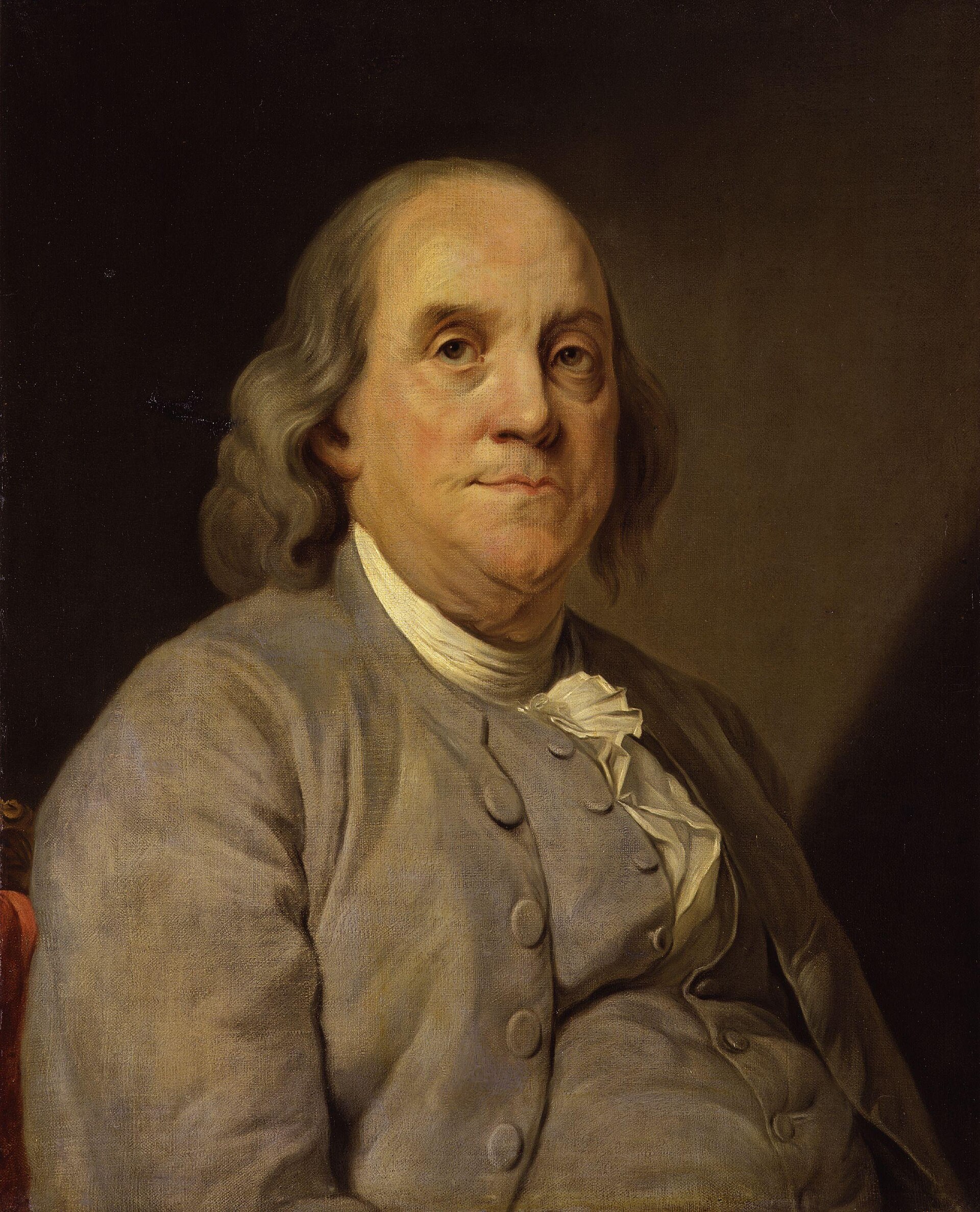
Benjamin Franklin, after Joseph Siffred Duplessis, from his portrait of 1778. National Portrait Gallery, London.

Room 4 of 10

The Electric Parlour

Philadelphia and the lightning, 1747 to 1752

Benjamin Franklin, after Joseph Siffred Duplessis, from his portrait of 1778. National Portrait Gallery, London.

In 1747 Peter Collinson, a London merchant and botanist who acted as the Library Company's agent for buying books, sent Philadelphia a gift: a glass tube, with instructions for the electrical parlour tricks then fashionable in Europe. Rubbing the tube produced a charge that would make hair stand on end or draw a spark from a knuckle. It was an amusement, and nobody yet understood what was happening.

Franklin took it up with three friends: Thomas Hopkinson, a lawyer and the first president of the American Philosophical Society; Philip Syng, a silversmith who built much of their apparatus; and Ebenezer Kinnersley, a Baptist minister who later toured the colonies lecturing on their results. Within three years the four of them had turned the amusement into a science. They showed that electricity was a single fluid rather than two, that it could be stored, moved and balanced, and that a charged body carried either more of it or less. The words they coined for what they saw are still the words we use: battery, charge, conductor, condenser, positive and negative.

Hopkinson made the observation that mattered most. A pointed conductor, he noticed, will draw a charge off silently and at a distance, where a blunt one will not. Franklin turned that into the lightning rod, and reasoned further: if lightning is the same fluid, a pointed iron rod raised on a high building should draw it down safely. He proposed the experiment in the letters Collinson printed in London in 1751. The French tried it first, at Marly outside Paris in May 1752, and it worked. Franklin flew his kite that June.

Collinson read the letters to the Royal Society, which was unimpressed, and then had them printed as a pamphlet in 1751, which changed everything. The king of France sent his compliments. Harvard and Yale gave the Philadelphia printer honorary degrees. The Royal Society, reconsidering, gave him its Copley Medal in 1753 and its fellowship in 1756. No American before him had been famous in Europe for anything.

The effect on his life was total. A tradesman printer became, within five years, a fellow of the Royal Society and the most famous natural philosopher in the English-speaking world, and it was as a philosopher rather than a printer that Europe received him for the next forty years. This room holds the books that carried the news, in English, French, German and Italian, and one small volume that puts a particular man at the table.

Franklin's science was never separate from his city. The stove was designed to heat Philadelphia houses; the lightning rod went up first on the Academy and the State House; the Philosophical Society met in the same rooms as the Library Company. The same habit of mind, observe, test, publish, followed him out of the laboratory and into the Assembly, where it would prove far more dangerous.

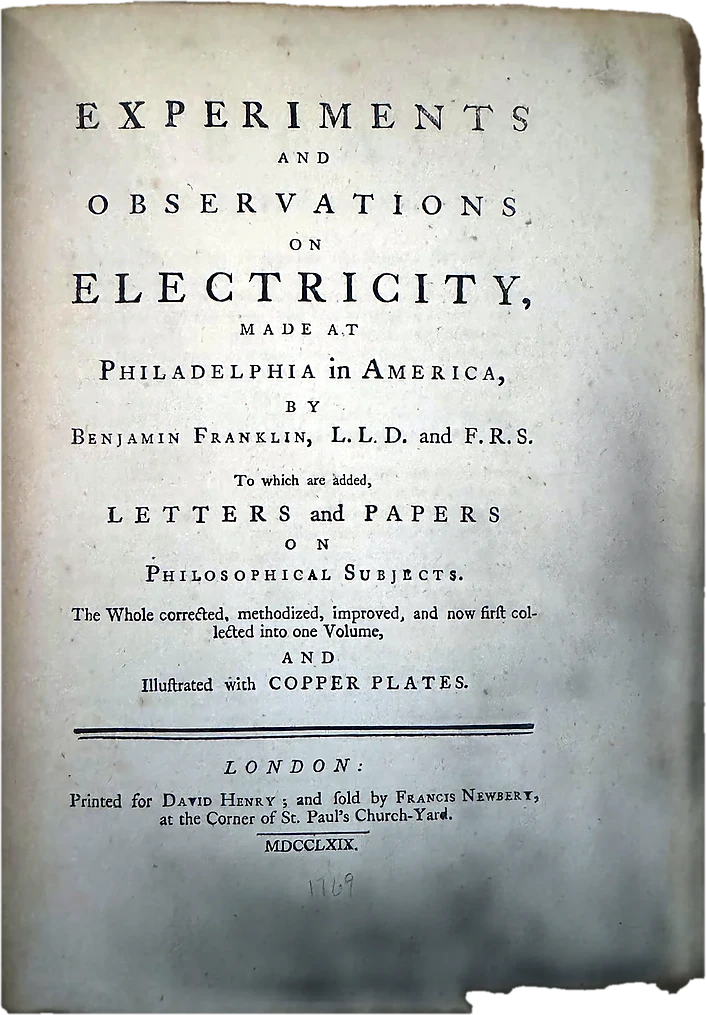
Experiments and Observations on Electricity

Experiments and Observations on Electricity, Made at Philadelphia in America
BF-2024.053

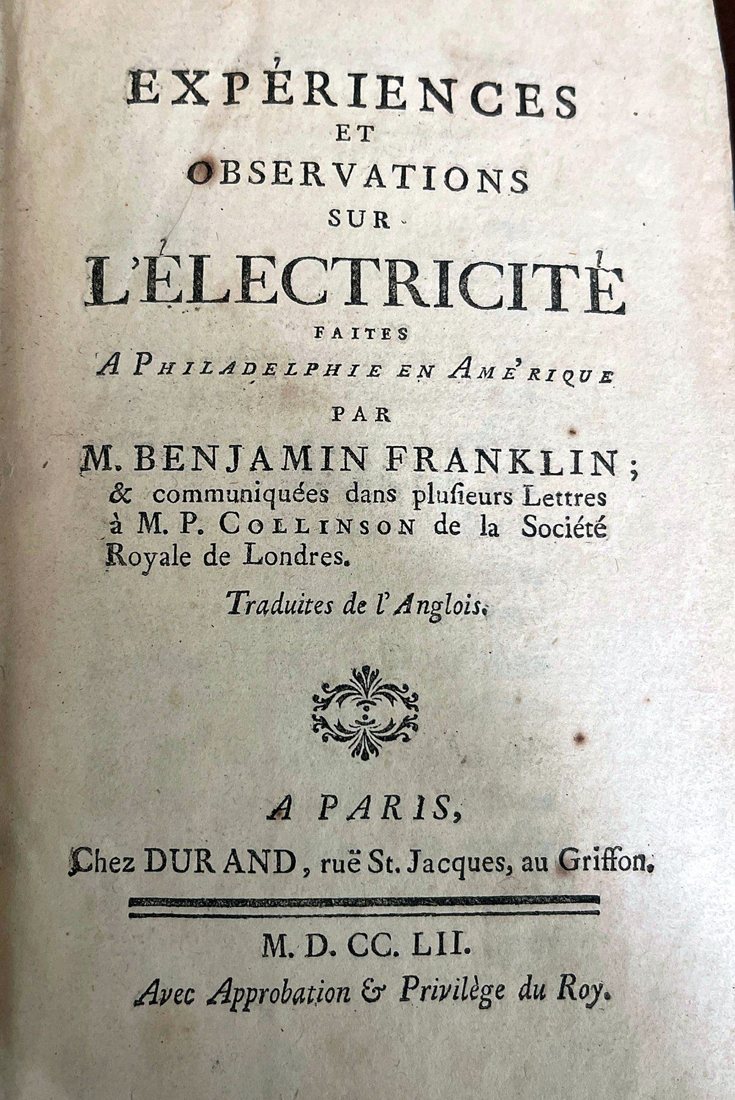
Expériences et Observations sur l'Électricité faites à Philadelphie en Amérique

Experiences et observations sur electricite Faites a philadelphie en Amerique

1752
BF-2021.002

Expériences et observations sur l'électricité, Paris 1752. The French translation through which Buffon and Dalibard learned of the sentry-box experiment and performed it at Marly before Franklin flew his kite.

Read the full entry · 2 photographs

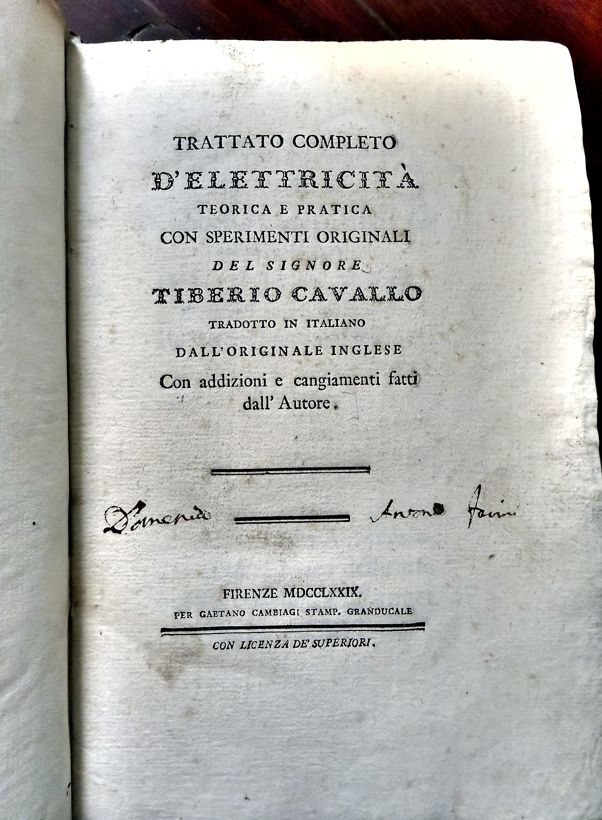
Trattato Completo d'Elettricità Teorica e Pratica con Sperimenti Originali del Signore Tiberio Cavallo

Trattato Completo d'Elettricità Teorica e Pratica con Sperimenti Originali del Signore Tiberio Cavallo


BF-2025.113

Tiberio Cavallo, Trattato Completo d'Elettricita Teorica e Pratica, con Esperimenti Originali, translated into Italian, 1779. Cavallo was a Neapolitan in London and a fellow of the Royal Society; his treatise is the standard European survey of the subject Franklin had opened, and it carried the Philadelphia experiments into a fourth language.

Read the full entry

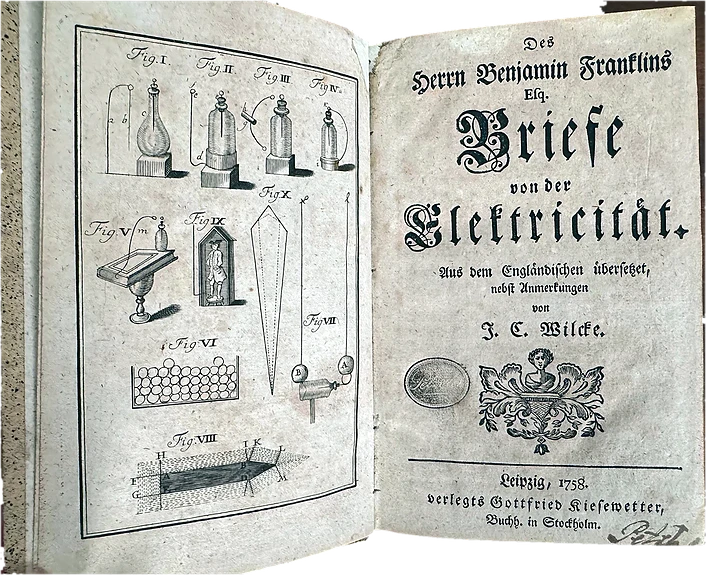
Des herrn Benjamin Franklins Esq Briefe von de Elektricitat

Des herrn Benjamin Franklins Esq Briefe von de Elektricitat


BF-2024.038

The German translation of the electrical letters, Leipzig 1758, with the translator's annotations. Franklin's theory reached the German universities through this edition, and it was in Germany that the lightning rod met its most determined theological resistance and its most careful experimental confirmation.

Read the full entry · 3 photographs

The Dispensary

The Dispensary

1706
MISC-2021.008

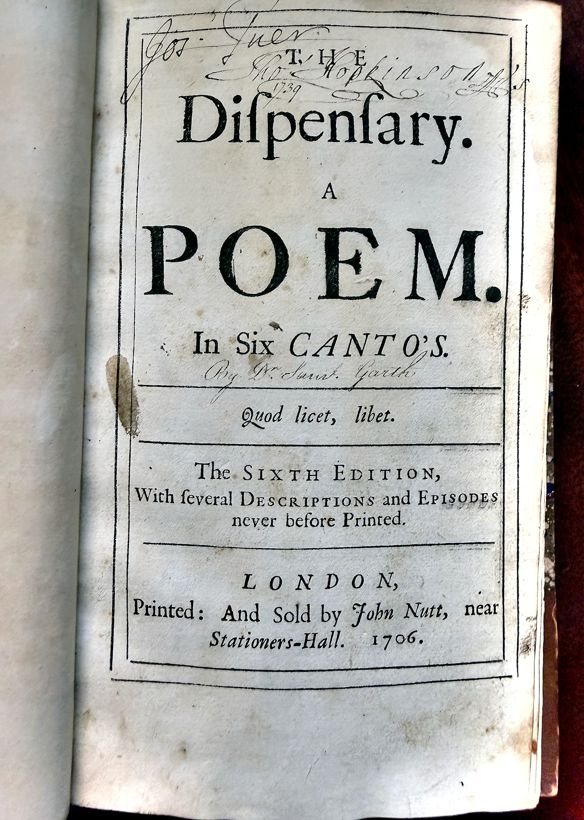
Samuel Garth's The Dispensary, the sixth edition of 1706, signed three times by Thomas Hopkinson, in 1732 and 1739, and once by his son Francis. Hopkinson was Franklin's partner in the electrical work and the man who first noticed what a pointed conductor does. This is his book, in his hand, and it is the one small volume in the room that puts a particular man at the table.

Read the full entry · 4 photographs

A Magic Square of Squares

A Magic Square of Squares


BF-2023.004

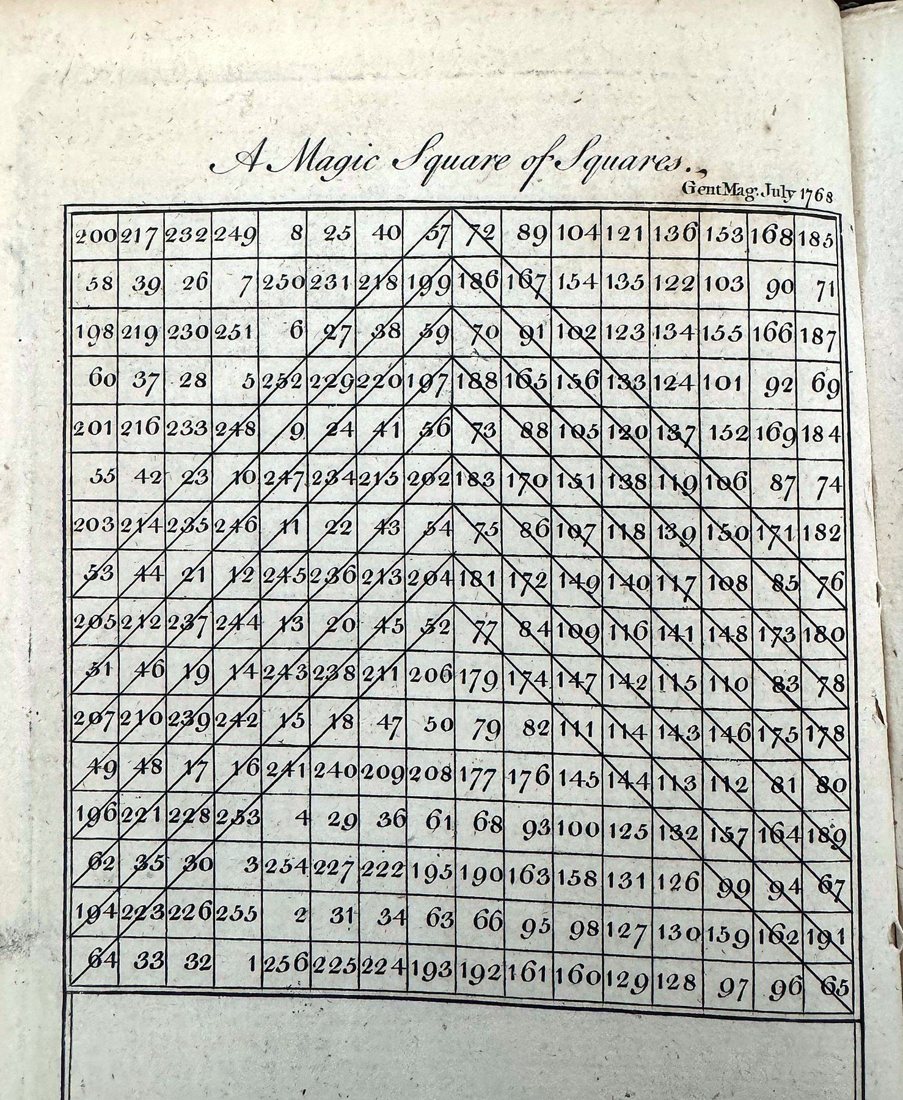
The larger of Franklin's two magic squares, a sixteen-by-sixteen array in which every row, column and bent diagonal sums to 2,056, which he called "the most magically magical of any magic square ever made by any magician." He had constructed it as a young clerk of the Assembly to relieve the tedium of debates. First published in Ferguson's Tables and Tracts, London 1767.

Read the full entry · 2 photographs

Benjamin Loxley’s promissory note to the Pennsylvania Hospital, 1 January 1752

Collection Highlight

The key on the kite string

Benjamin Loxley's promissory note to the Pennsylvania Hospital, 1 January 1752
No. 82 in the founders' book

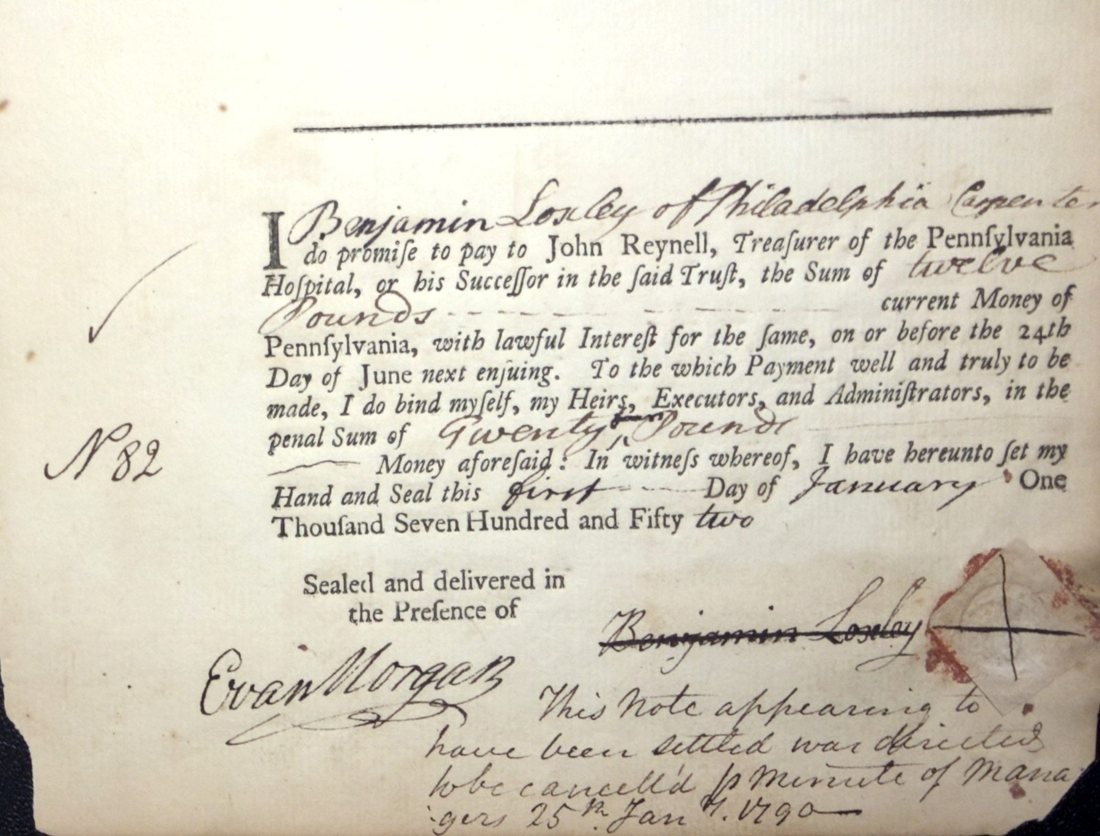
Benjamin Loxley, carpenter, promises John Reynell, Treasurer of the Pennsylvania Hospital, twelve pounds with lawful interest by the twenty-fourth of June next ensuing, binding himself in the penal sum of twenty pounds. Signed and sealed on the first of January 1752, witnessed by Evan Morgan.

Loxley was a master carpenter who worked on the State House, built Carpenters' Hall, and made apparatus for the electrical experiments in this room. Family and city tradition holds that the key tied to the kite string that June was the front door key of his own house, on the court off Arch Street that still carries his name. No document proves it, and the tradition has been told the same way for two centuries.

He signed this note six months before the kite. It sat in the Treasurer's book for thirty-eight years. At the bottom, in a later hand: "This Note appearing to have been settled was directed to be cancell'd p Minute of Managers 25th Jan 1790." Franklin died three months after that minute.

The Founders' Book, No. 82

Mesmerism: a sammelband of eleven pamphlets

Mesmerism: a sammelband of eleven pamphlets

Various imprints, 1784 to 1785
BF-2026.003

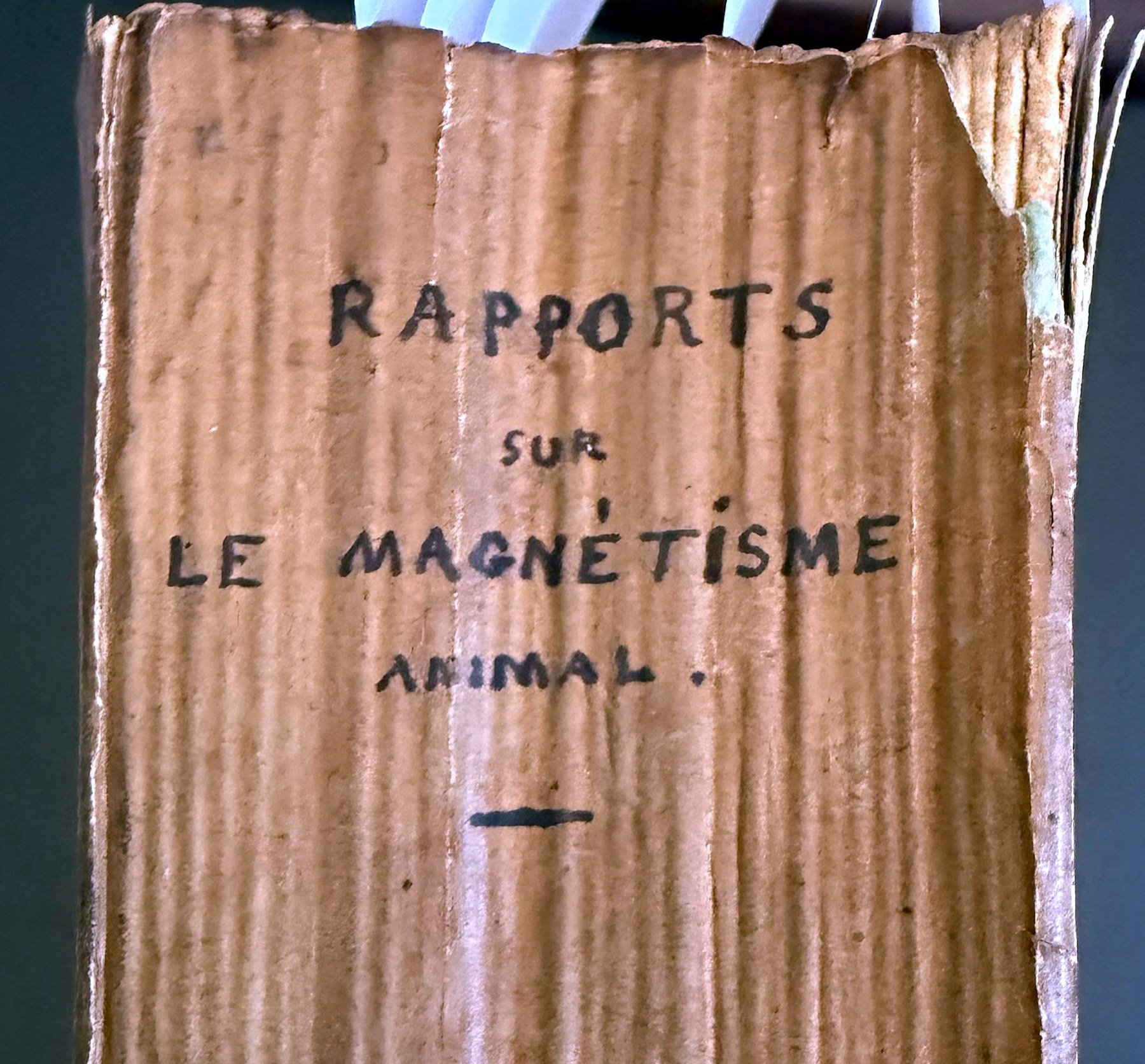
In 1784 Louis XVI appointed two commissions to examine Franz Mesmer's animal magnetism, the theory that a magnetic fluid healed through currents like those of electricity. The first was drawn from the Paris Faculty of Medicine and the Royal Academy of Sciences and chaired by Franklin, then the American minister in France.

The Franklin commission tested patients of Mesmer's disciple Charles d'Eslon at Franklin's house at Passy and found that the cures could be explained by the power of suggestion, one of the first scientific demonstrations of the placebo effect. The commission of the Royal Society of Medicine reached its own report, and both went to the king in August. These eleven pamphlets, in their original wrappers, are the controversy as Paris read it.

Read the full entry · 8 photographs

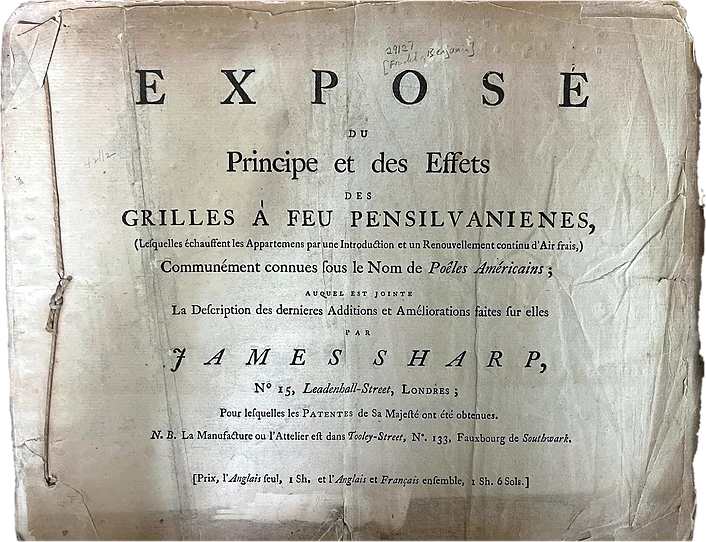
Exposé du Principe et des Effets des Grilles à Feu Pensilvaniennes

Exposé du Principe et des Effets des Grilles à Feu Pensilvaniennes

London: James Sharp, [1785]. First edition, in French and English
BF-2023.056

The Pennsylvania fireplace, sold in Europe. James Sharp of Leadenhall Street published this account of the stove-grates "commonly known under the name of American stoves," drawing on Franklin's own Account of the New Invented Pennsylvanian Fire-Places of 1744 and adding the improvements Sharp had made since. Three plates show the grate in section and in place.

Franklin never patented the stove. He wrote that as we enjoy great advantages from the inventions of others, we should be glad of an opportunity to serve others by any invention of ours, and he gave the design away. Sharp is what happened next. The same habit of mind that drew lightning down a kite string had already been applied to the problem of heating a room, and both crossed the Atlantic under Franklin's name. Worldcat locates six copies.

Read the full entry · 6 photographs

Further Reading

Where the story of this room is told at length.

The Cast of This Room

The people whose names are on the objects in this room. Each opens a short life in the Dramatis Personae, with the institutions that person belonged to and every other object in the collection that carries the name.

Benjamin FranklinBenjamin RushThomas HopkinsonThomas DobsonThomas CadwaladerBenjamin Smith BartonPeter CollinsonJoseph PriestleyFrancis HopkinsonThomas Jefferson