EIS LIBRIS
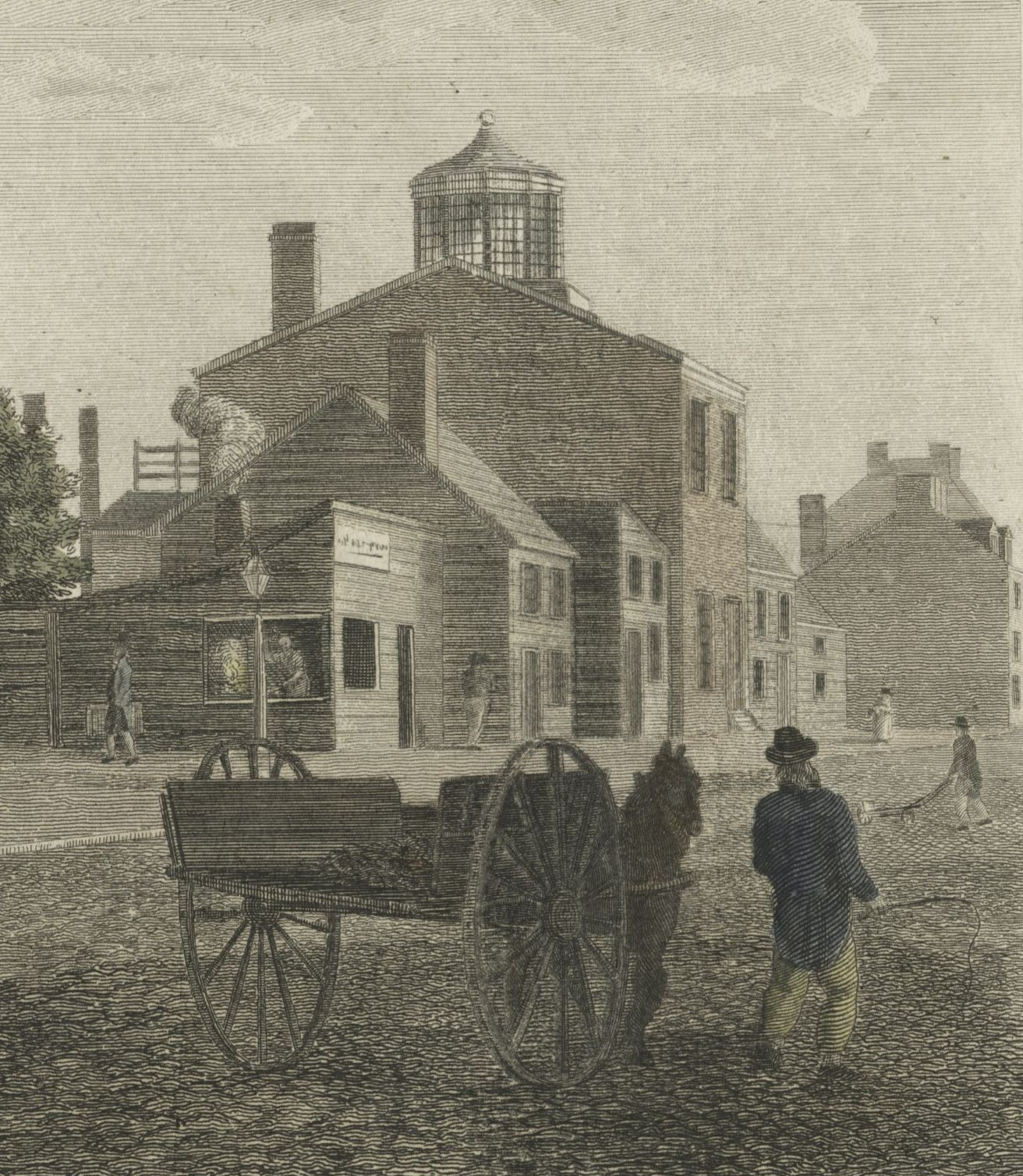
Surgeons' Hall in Fifth Street, where the medical lectures were held from 1765 to 1801. From Birch's Views, 1799.

Room 7 of 10

Edinburgh to Philadelphia

The making of a physician, 1760 to 1813

Surgeons' Hall in Fifth Street, where the medical lectures were held from 1765 to 1801. From Birch's Views, 1799.

Before 1765 there was no medical school in the American colonies. A young man who wanted to be a physician read with an established practitioner for three or four years, watched what he did, ground his powders, and then set up on his own. The ambitious crossed the Atlantic. They went to Edinburgh, where Alexander Monro taught anatomy and William Cullen taught the theory and practice of physic to the largest medical class in Europe, or to London for the hospitals and the dissecting rooms, and came home with a degree that almost nobody else in America had.

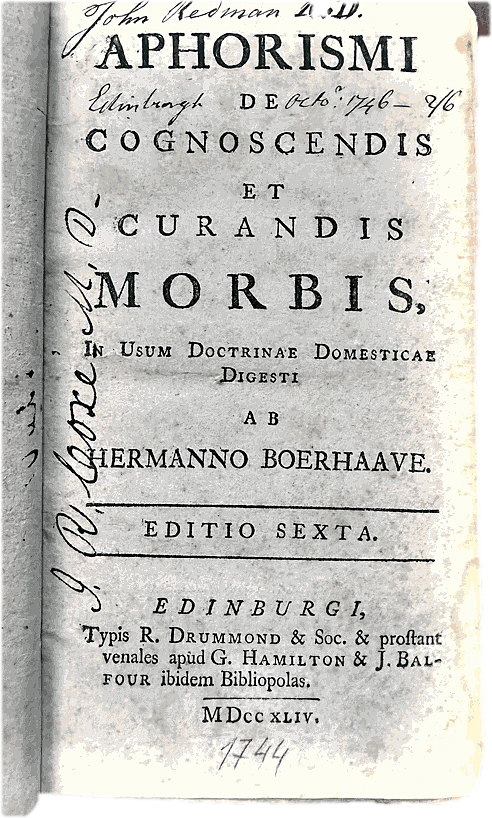
What they were taught descended from one man. Hermann Boerhaave, who taught at Leiden in Holland until his death in 1738, had compressed the whole of medicine into about fifteen hundred numbered aphorisms so that a student could carry the system in his head. Boerhaave taught the men who founded the Edinburgh school; Edinburgh taught the Americans. The line runs Leiden, Edinburgh, Philadelphia, and this room begins with two books that can be placed exactly on it: John Redman's own copies of Boerhaave, one bought in Edinburgh in 1746, signed and dated by him.

Redman came home to Philadelphia in 1751 and became the most influential teacher of his generation, taking pupils into his shop in the old way. John Morgan read with him, went to Edinburgh, and came back in 1765 with a plan, which he delivered as a public address to the trustees of the College of Philadelphia. The first medical school in the colonies opened that autumn. Benjamin Rush, who had also served his apprenticeship with Redman, sailed for Edinburgh a few weeks later, took his degree under Cullen in 1768, and returned in 1769 to the chair of chemistry, the first in America.

Rush sailed with a letter of introduction from Franklin to William Cullen, the most eminent physician in Britain. Franklin was sixty and the most famous American alive; Rush was twenty-one, with talent, ambition and no connections. The letter was everything. It has never been located, and everything in this collection is its consequence. Rush wrote afterwards that he "owed more to Dr. Cullen than to any other teacher."

He taught for forty-four years, and something over three thousand students passed through his lectures. What he taught them was Cullen's system pushed a good deal further than Cullen would have gone: that disease came down to one cause, excessive action in the blood vessels, and that the cure was to reduce it by bleeding and purging. His lecture tickets, his printed syllabus, his students' notebooks and the theses they wrote under him are the everyday equipment of that education, and they are what this room is made of.

He came home as Cullen's apostle and taught his system for twenty years. When Cullen died in 1790 Rush delivered his eulogy before the College of Physicians and called himself his disciple. Then, in the fevers of the 1790s, he changed his mind about all of it. There was, he decided, "but one fever in the world," and a nosology of many diseases taught students to withhold the lancet while they looked for distinctions that did not exist. He never renounced the man. What he renounced was the system, and in its place he built one that was simpler, bolder, and, in the judgment of the century that followed, more dangerous than anything Cullen had taught him.

Boerhaave, Aphorismi de Cognoscendis et Curandis Morbis

BOERHAAVE, Hermann. Aphorismi de Cognoscendis et Curandis Morbis, in Usum Doctrinae Domesticae Digesti
BR-2025.999

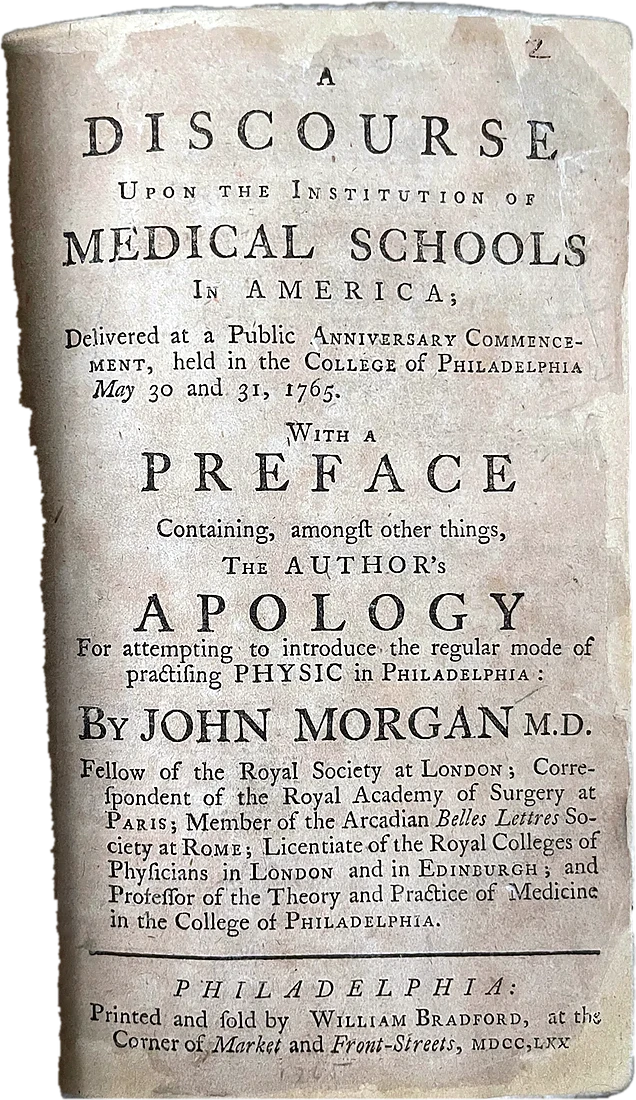
A discourse upon the institution of medical schools in America; delivered at a public anniversary commencement, held in the College of Philadelphia May 30 and 31, 1765

A discourse upon the institution of medical schools in America; delivered at a public anniversary commencement, held in the College of Philadelphia May 30 and 31, 1765

1765
BR-2024.019

John Morgan, A Discourse upon the Institution of Medical Schools in America, delivered at the public commencement in Philadelphia, May 1765. The founding document of American medical education, printed in the year Rush sailed for Edinburgh.

Read the full entry · 6 photographs

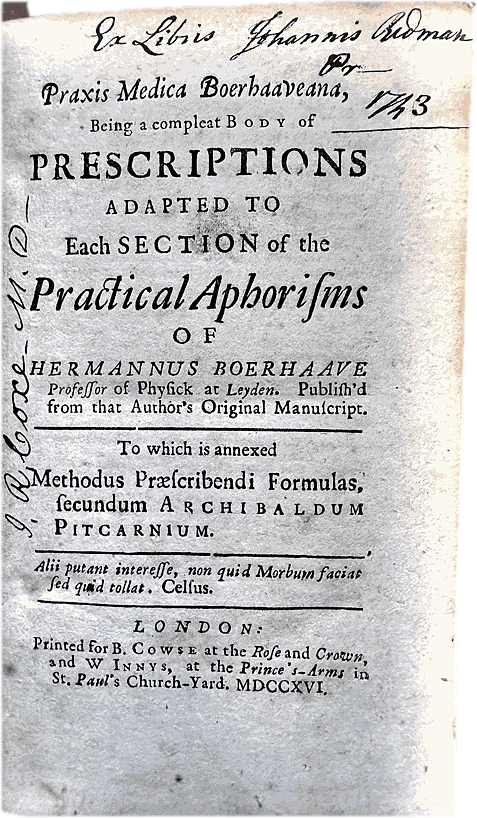
Boerhaave, Praxis Medica Boerhaaveana

Boerhaave, Praxis Medica Boerhaaveana

1716
BR-2025.998

The companion volume: a complete body of prescriptions keyed section by section to Boerhaave's aphorisms, London 1716, inscribed “Ex Libris Johannis Redman” and dated 1743. Theory in one book, practice in the other, both in the library where Rush served five years.

Read the full entry

Boerhaave, Aphorismi de Cognoscendis et Curandis Morbis

Boerhaave, Aphorismi de Cognoscendis et Curandis Morbis

Edinburgh: R. Drummond, 1744. Sixth edition
BR-2025.999

Boerhaave's Aphorisms compressed the diagnosis and treatment of disease into about fifteen hundred numbered propositions, so that a student could carry the system in his head. He taught it at Leiden to the men who founded the Edinburgh school, and Edinburgh taught it to the Americans. This copy is a dated link in that chain.

John Redman bought it at Edinburgh in the mid-1740s, took his doctorate at Leiden in 1748, and came home in 1751 to become the most influential preceptor in Philadelphia. John Morgan read medicine with him, and so did Caspar Wistar. From 1761 to 1766 so did Benjamin Rush, who left Redman's shop for Edinburgh and came back to teach the system from a chair of his own. Whether Rush handled this volume cannot be proved. It is Redman's working book, and it was in the room where Rush served his five years.

Read the full entry

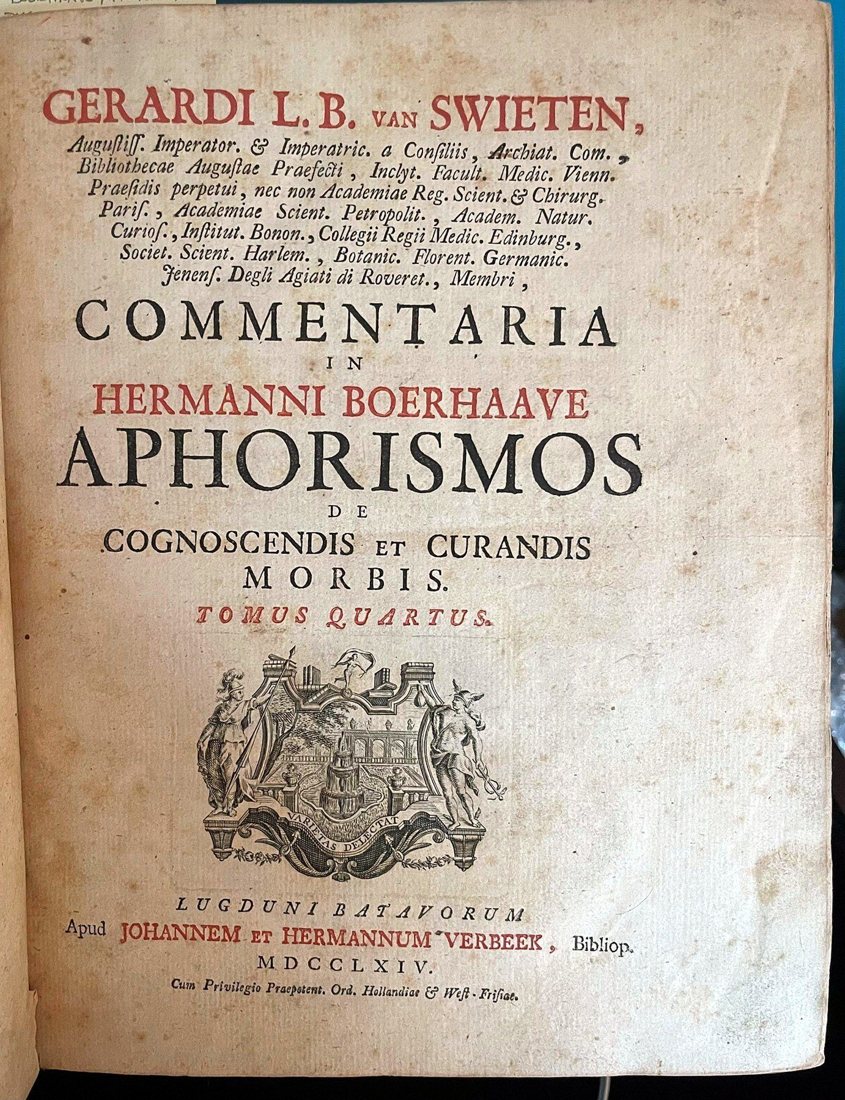
Van Swieten, Commentaria in Hermanni Boerhaave Aphorismos: Rush's copy

Van Swieten, Commentaria in Hermanni Boerhaave Aphorismos: Rush's copy

1764
BR-2022.001

Rush's own volume of van Swieten's commentaries on Boerhaave, with his armorial bookplate and his gift inscription of May 9, 1788, to his student Samuel Powel Griffitts: "Non donum sed debitum," not a gift but a debt. Rush is said to have destroyed as many of his bookplates as he could find, and they are very rare; this one survived because he gave the book away before he changed his mind. Leiden, Edinburgh, Philadelphia; Boerhaave, van Swieten, Cullen, Rush, Griffitts. The collection was built to show that chain. This is the link that holds it.

Read the full entry · 4 photographs

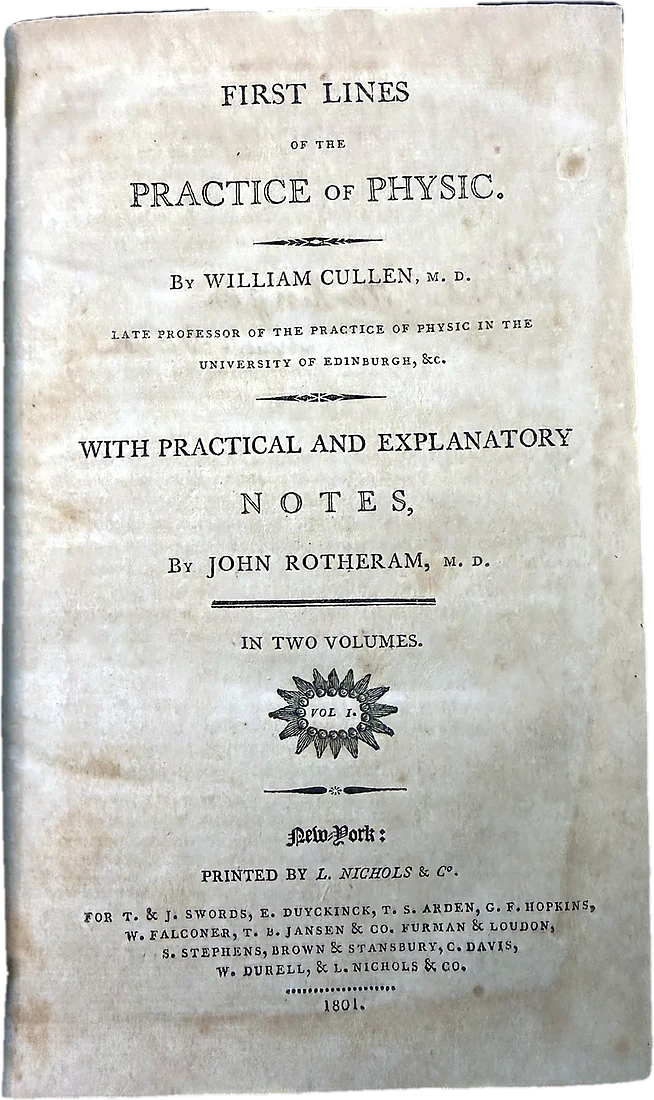
Cullen, William. First Lines of the Practice of Physic

Cullen, William. First Lines of the Practice of Physic


BR-2026.008

Cullen's textbook, the system Rush carried home from Edinburgh, in the copy of Bushrod Washington, with his ownership signature "Bush. Washington, Mount Vernon" on both title pages and a family receipt of 1805 tipped in. Washington's nephew and heir, and an Associate Justice of the Supreme Court, kept Rush's master on the shelf at Mount Vernon. The President's own physicians had been blamed for bleeding him to death on Rush's principles two years before this edition.

Read the full entry · 6 photographs

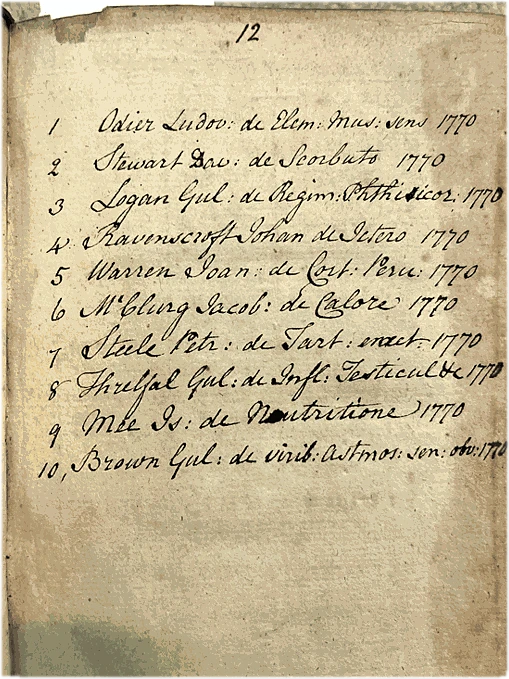
Ten Edinburgh medical dissertations of 1770, bound by George Logan

Sammelband of 10 Medical Dissertations issued in Edinburgh, 1770

1770
1770.DISSERTATIONS

George Logan of Philadelphia took his Edinburgh degree in 1770, two years after Rush, and bound the dissertations of his year together. Rush's name is among the Americans who passed through Cullen's lecture room in those years, and the volume is the company he kept there. Ten dissertations on fever, materia medica and clinical observation: what a Philadelphia student brought home in his trunk.

Read the full entry · 12 photographs

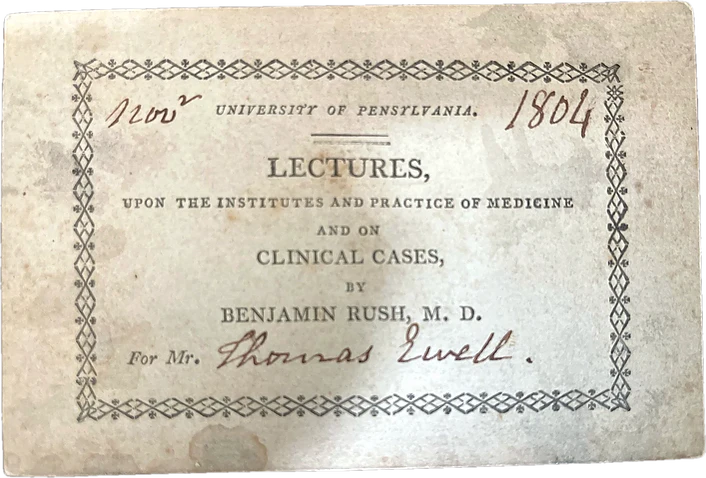
Rush Lecture Ticket

Rush Lecture Ticket

1804
BR-2023.047

Lecture tickets were the currency of early American medical education: a token entitling the holder to one course of lectures, bought from the professor and signed by him. This ticket of 1804 dates from the last decade of Rush's teaching, when his methods were at once most refined and most embattled.

Read the full entry

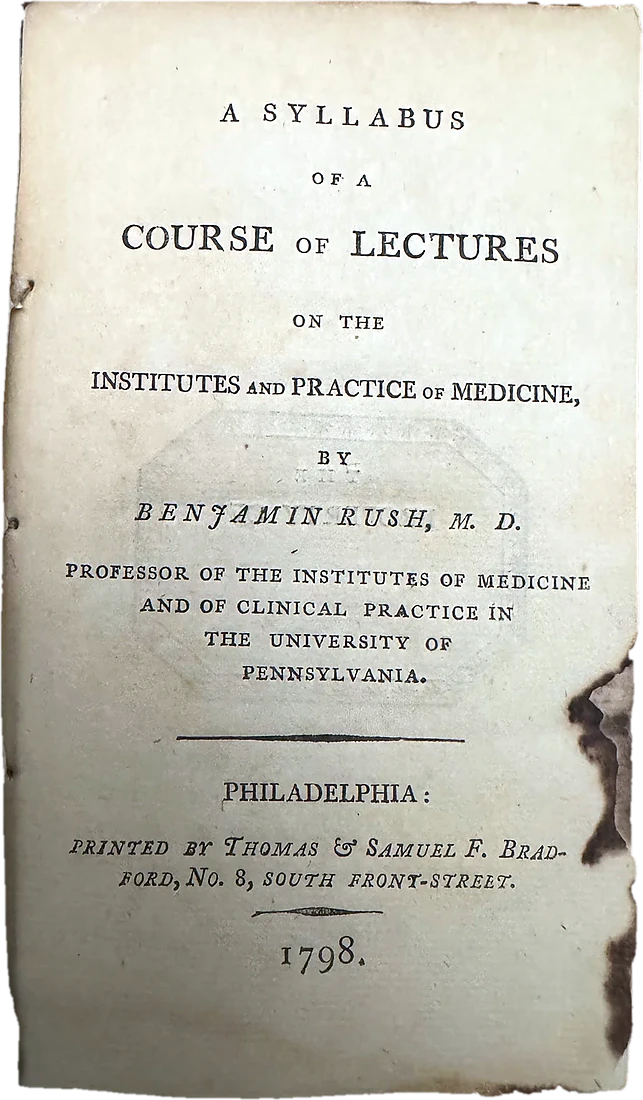
A Syllabus of a Course of Lectures on the Institutes and Practice of Medicine

A Syllabus of a Course of Lectures on the Institutes and Practice of Medicine


BR-2024.014

Written and printed by Rush for his own lecture class at the University of Pennsylvania, 1798. Probably fewer than fifty were printed; Evans lists nine copies, WorldCat seventeen, and the last to reach the market was in 1980. Three chapters on pathology, with particular attention to the diseases of women, children and the Black population.

Read the full entry · 5 photographs

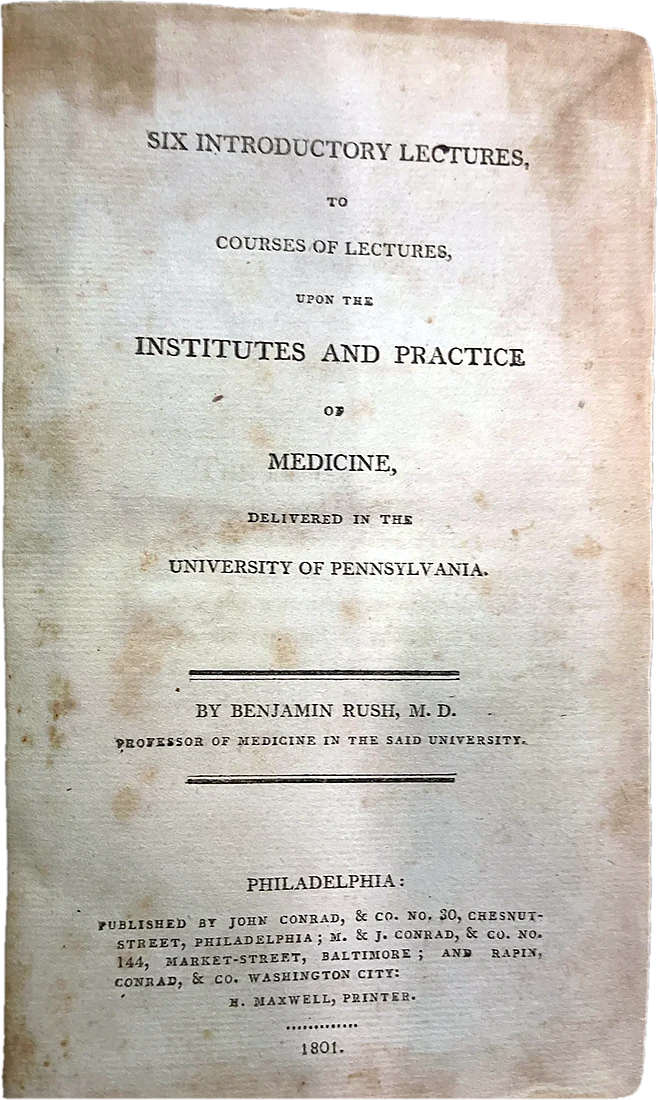
Six Introductory Lectures..With Contemporary Notes

Six Introductory Lectures..With Contemporary Notes

1801
BR-2022.030

A student's hand running alongside Rush's printed text, annotating, questioning and occasionally pushing back. The lecturer's voice and the student's response on the same page. The lectures themselves are Rush at his most programmatic: read widely, observe carefully, think independently, and never defer to European authority simply because it is European.

Read the full entry · 12 photographs

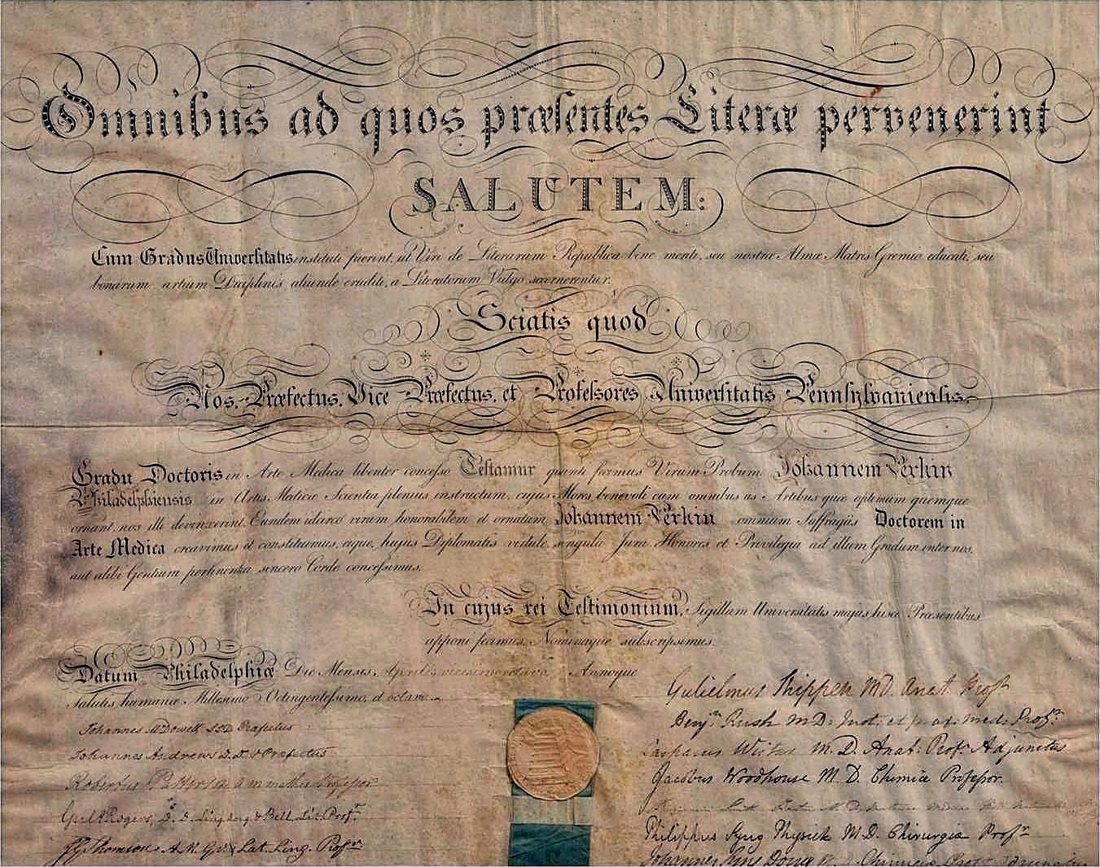
Signed Diploma University of PA

Signed Diploma University of PA


BR-2023.039

Rush signed thousands of diplomas over forty years, and the physicians who received them practiced from Georgia to Ohio, carrying his theories and his moral commitments into every corner of the republic. This one is signed by Rush and twelve of his colleagues. The diploma is a certificate of transmission: the moment the chain of teaching became official.

Read the full entry · 4 photographs

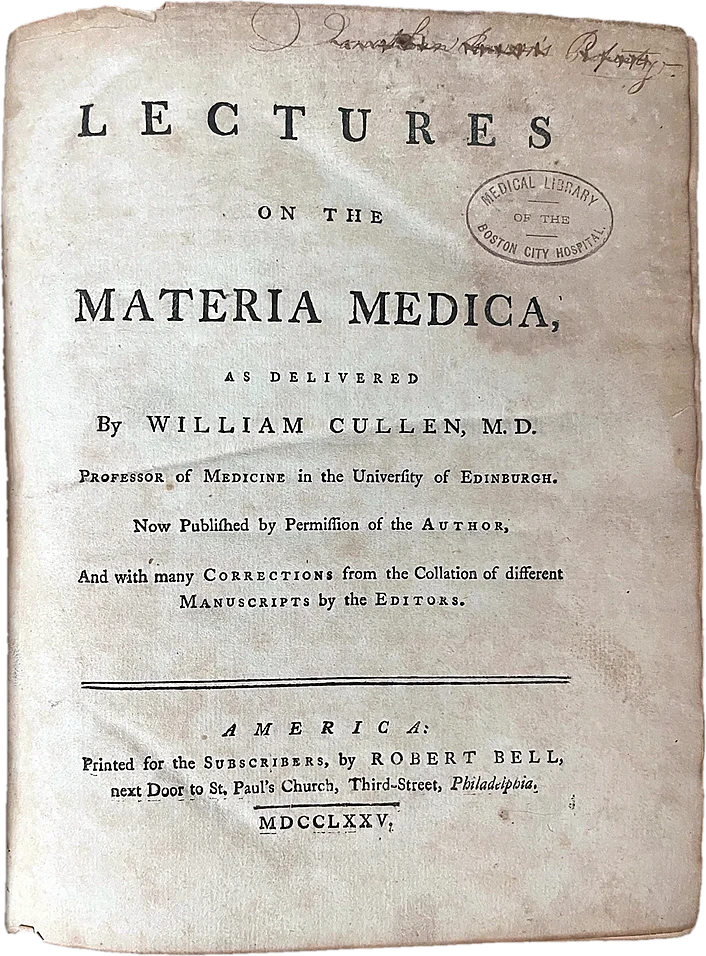
William Cullen, Lectures on the Materia Medica

William Cullen, Lectures on the Materia Medica

1775
BR-2021.004

Cullen was the dominant medical teacher in the English-speaking world in the second half of the century and Rush's most important intellectual formation. His lectures on the materia medica are the pharmacology of the system Rush absorbed and passed to three thousand American students. Rush's yellow-fever treatment, the calomel and jalap "double barrel," is a Cullenite remedy pushed to its limit.

Read the full entry · 5 photographs

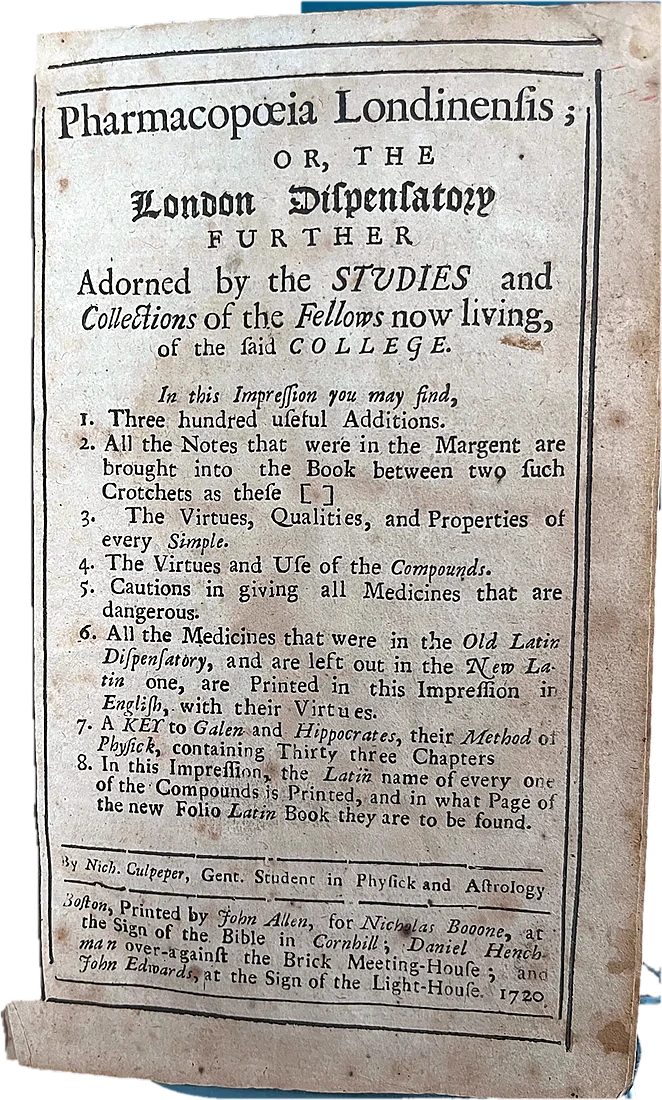
Pharmacopoeia Londinensis; or, The London Dispensatory

Pharmacopoeia Londinensis; or, The London Dispensatory

1720
MED-2022.024

Culpeper's London Dispensatory in its first American edition, Boston 1720: what was actually in the bottles on a physician's shelf a generation before Rush. Rare in the trade; four copies can be traced at sale.

Read the full entry · 2 photographs

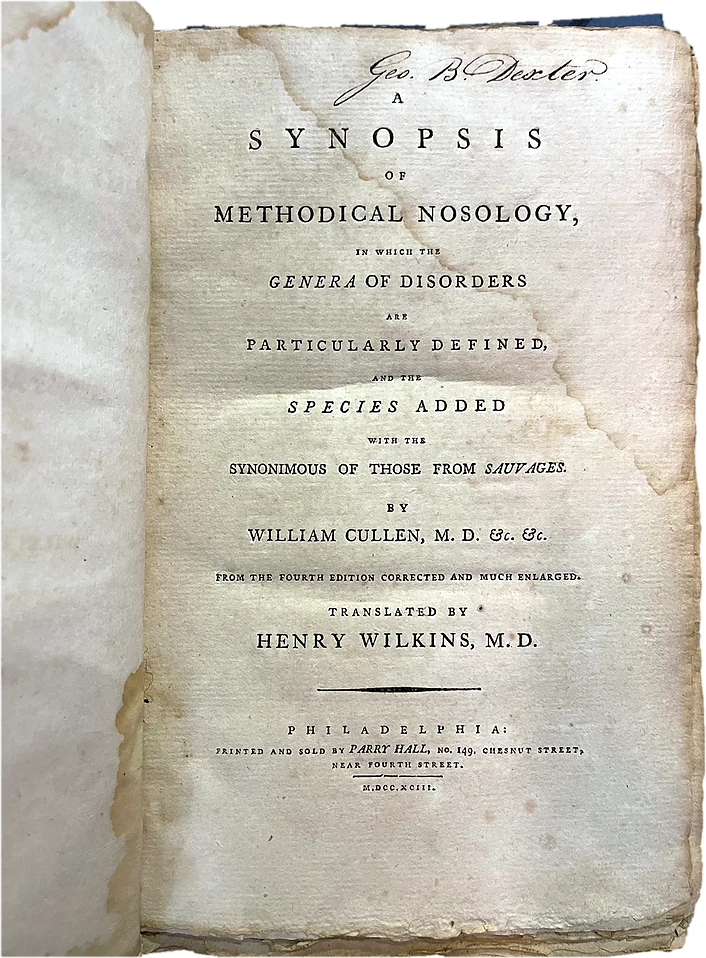
A Synopsis of Methodical Nosology

William Cullen, A Synopsis of Methodical Nosology

Philadelphia: Parry Hall, 1793
BR-2024.015

Cullen's classification of diseases in its Philadelphia edition of 1793, the book Rush taught from and the book he turned against. This copy belonged to George B. Dexter, a University of Pennsylvania graduate who practised in Nova Scotia, with his signature and annotations: a student of Rush's school reading the system Rush was in the act of repudiating.

Read the full entry · 3 photographs

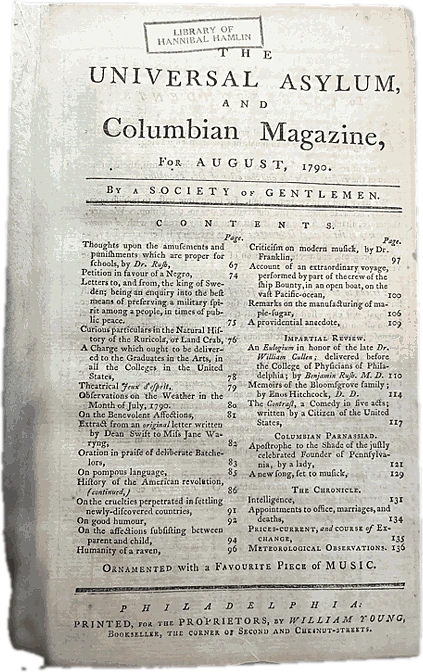
Benjamin Rush, An Eulogium in Honor of the Late Dr. William Cullen, Philadelphia 1790

An Eulogium in Honor of the Late Dr. William Cullen

Delivered before the College of Physicians, 9 July 1790. Philadelphia: printed by Thomas Dobson, 1790
BR-2023.054

Cullen died in February 1790, and in July the College of Physicians had Rush deliver his eulogy and ordered it printed. Cullen, he told the company, was the preceptor of many of us, and though he shone in a distant hemisphere, many of the rays of his knowledge had fallen on this quarter of the globe.

What he praises is the system he was about to dismantle: a complicated nosology, a distrust of the healing powers of nature, and a confidence in special remedies for each species of disease. Three years later the fever was in the city and he had decided there was but one fever in the world. This is the inventory of what he would reject, written by the man who owed it everything.

The title page is signed by Nathaniel Potter, one of Rush's own students, with the price of one shilling and sixpence beside it. Cullen taught Rush; Rush taught Potter; and here is the debt being paid, in the next pupil's hands.

Read the full entry · 3 photographs

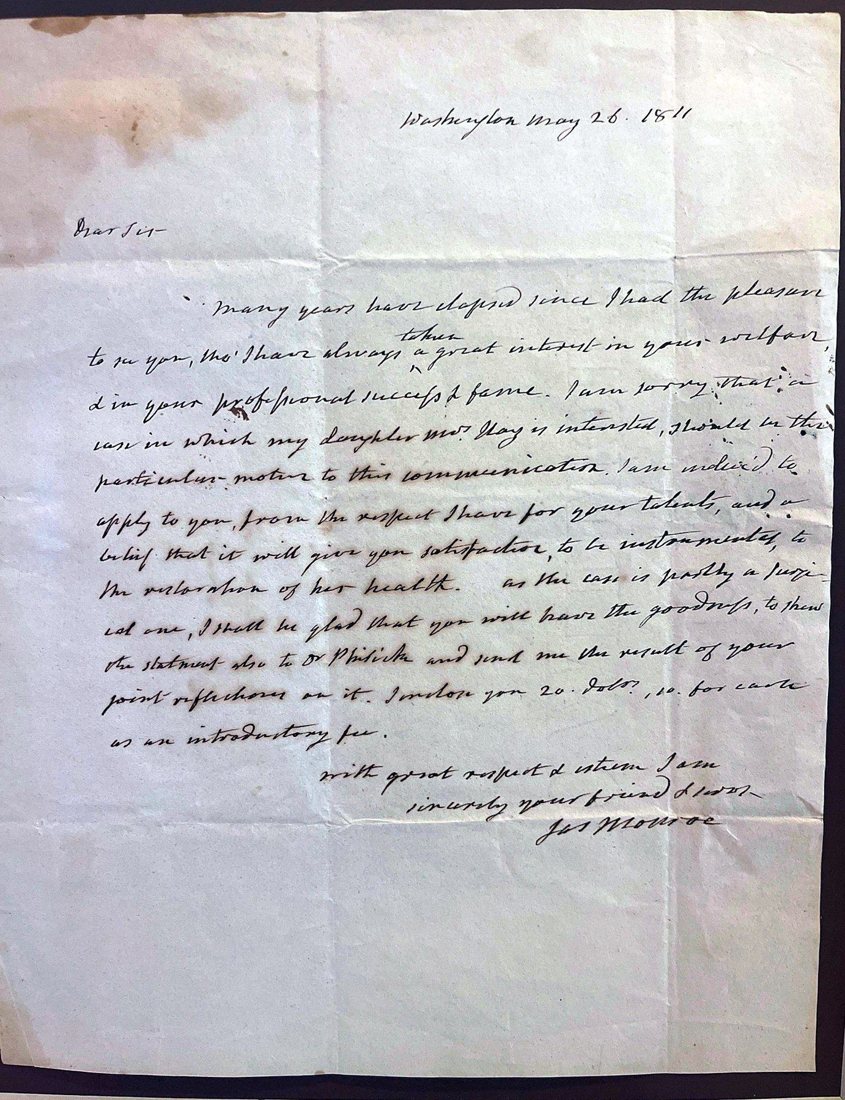
James Monroe/Benjamin Rush

James Monroe to Benjamin Rush

Autograph letter signed, Washington, 26 May 1811
Docketed by Rush, "James Monroe, Medical"
BR-2022.019

The Secretary of State writes to the physician about his daughter. Many years had passed since they last met, Monroe says, but he had always taken a great interest in Rush's professional fame, and the case of his daughter, Mrs. Hay, is his reason for writing. He asks Rush to show the statement of it to Dr. Physick as well and to send him their opinion, and he encloses twenty dollars as an introductory fee. Rush docketed it "James Monroe, Medical" and filed it with the rest.

This is what the diploma and the lecture tickets in this room finally amounted to. Rush taught three thousand physicians, and he was still the one the founders consulted when the patient was their own child. Physick, whom Monroe names, had been one of those students. Free-franked and signed by Monroe, five years before he was elected president.

Read the full entry · 2 photographs

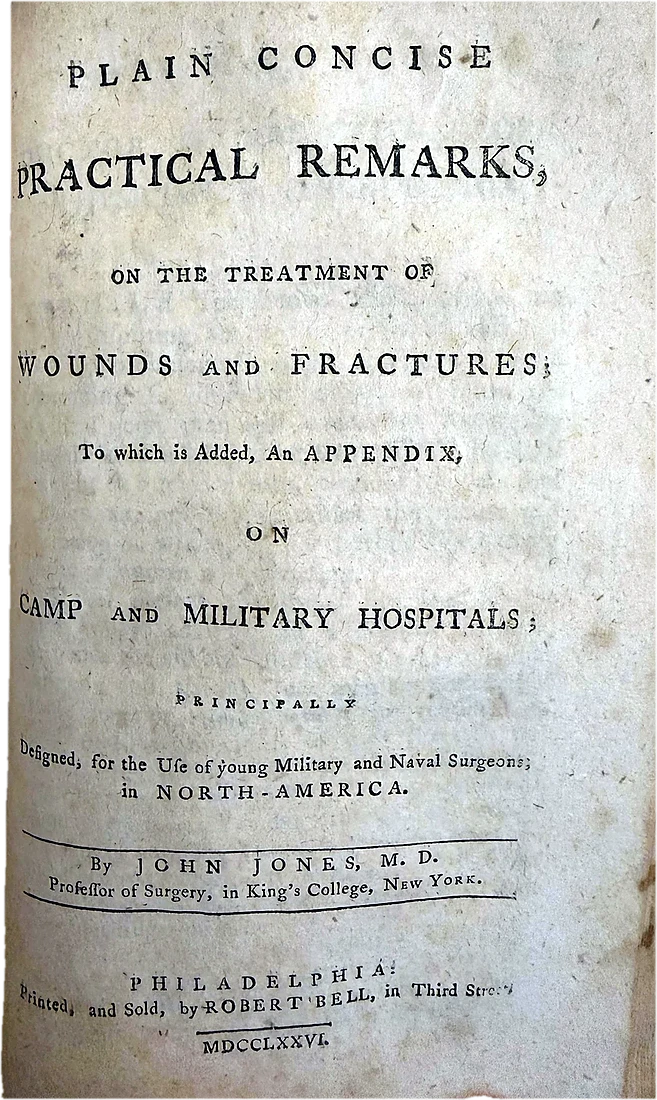
John Jones, Plain Concise Practical Remarks on the Treatment of Wounds and Fractures, Philadelphia: Robert Bell, 1776

Van Swieten's Diseases Incident to Armies, bound with John Jones on wounds and fractures

Philadelphia: printed by Robert Bell, 1776
MED-2025.020

Two books for the army that had just been raised, printed in Philadelphia in the year of the Declaration by Robert Bell, the printer of Common Sense, and bound together as he issued them. Bell hoped in his preface that they would help preserve the lives of the citizens of America who, as soldiers and sailors, were then contending for the mighty prize of freedom.

The second is the one that matters most. John Jones, professor of surgery at King's College in New York and later physician to both Franklin and Washington, wrote his Plain Concise Practical Remarks for the surgeons of the Continental army, men who in many cases had never treated a gunshot wound. It is the first surgical work written and published in America. Jones attended Franklin in his last illness and was at his bedside when he died.

Van Swieten's compilation on military medicine, translated from the Latin, comes first in the volume, with an appendix on gunshot wounds, directions for sea surgeons in engagements, and preventives of the scurvy at sea. The two are in contemporary calf, with a contemporary ownership signature on the first title page.

Read the full entry · 4 photographs

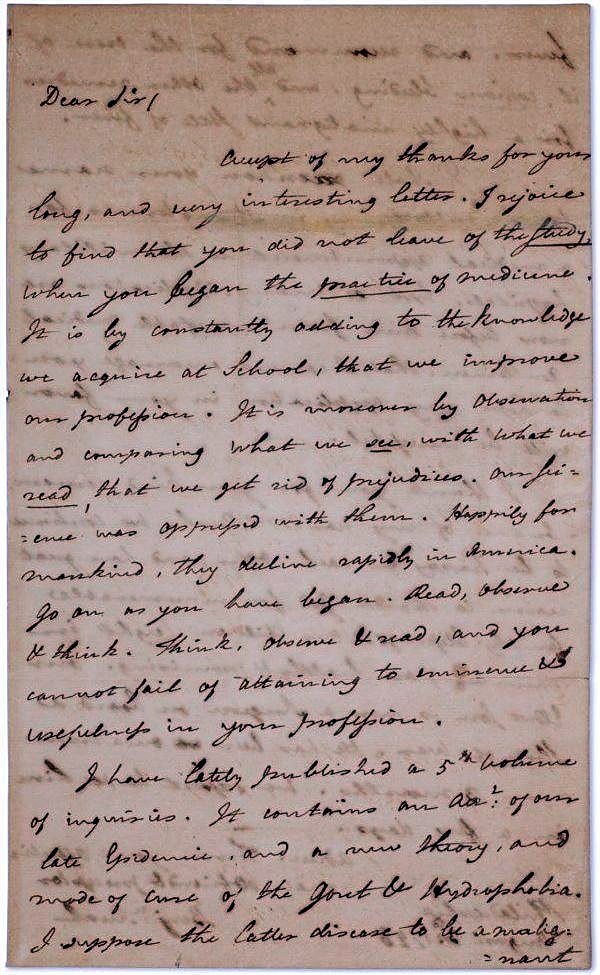
Benjamin Rush, autograph letter signed, August 2, 1798

"Read, observe, and think"

Autograph letter signed to a former pupil, Philadelphia, 2 August 1798
BR-2026.002

Rush answers a former student who has begun to practise and has written him a long letter about it. He rejoices that the young man did not leave off study when he began the work: it is by constantly adding to the knowledge we acquire at school that we improve the profession, and by observing and comparing what we see with what we read that we get rid of prejudices. Our science was oppressed with them, he writes, and happily for mankind they decline rapidly in America. Then the charge itself: "Go as you have began. Read, observe, and think. Think, observe, and read, and you cannot fail of attaining to eminence and usefulness in your profession."

He kept that rule all his life and set it down in his autobiography as the one he had followed, and the College of Physicians cut it on the reverse of the Sydenham medal. This room is about the making of a physician. Here is the instruction in his own hand, sent to one of the three thousand who sat in his lecture room, signed "your affectionate friend and preceptor."

The rest is the summer of 1798. He reports the fifth volume of his Inquiries, lately published, with his account of the late epidemic and a new theory of gout and hydrophobia, which he took to be a malignant fever and would treat with copious bleeding. He promises to put the young man's name to James McHenry, the Secretary of War, for a place in the military hospitals, and warns that the applications are already many. And he writes of his family: eight children, healthy and promising, and his eldest son a surgeon aboard a sloop of war, three months at sea and expected home within days. That was John Rush, who would spend the last twenty-seven years of his life in the Pennsylvania Hospital.

Read the full entry, with the transcription

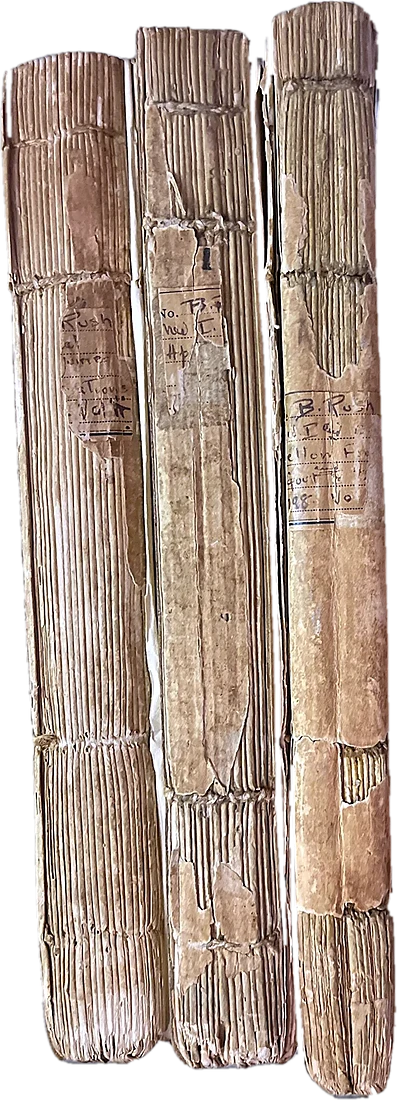
Medical Inquiries and Observations. To Which Is Added an Appendix, Containing Observations on the Duties of a Physician, and the Methods of Improving Medicine.

Medical Inquiries and Observations

Five volumes, London and Philadelphia, 1789 to 1798, in the original boards
BR-2023.026

Rush's life work, as it was issued: the first English edition of volume one, printed for Dilly in London in 1789, then volumes two to five from Thomas Dobson's press in Philadelphia, ending with the yellow fever of 1797, the gout and hydrophobia. Between them lie his accounts of the fevers of 1793, 1794 and 1797, his inquiry into the proximate cause of fever, and his defence of bloodletting.

The set is uncut in the original paper-covered boards with the printed spine labels, which is how a Philadelphia bookseller sold them and how almost no set survives. Most were bound in calf within a year of purchase. To see them as Rush's own students bought them, board by board across a decade, is to see a theory being built in public, volume by volume, while the city argued with him.

Read the full entry · 3 photographs

Further Reading

Where the story of this room is told at length.

The Cast of This Room

The people whose names are on the objects in this room. Each opens a short life in the Dramatis Personae, with the institutions that person belonged to and every other object in the collection that carries the name.

Benjamin FranklinBenjamin RushWilliam BradfordThomas DobsonJohn RedmanWilliam Shippen Jr.John MorganHerman BoerhaaveGerard van SwietenWilliam CullenCaspar WistarPhilip Syng PhysickBenjamin Smith BartonGeorge WashingtonThomas Jefferson