
Franklin & Hall
The Partnership Years, 1748–1766
DAVID Hall was a Scot, trained in Edinburgh and London, sent to Franklin in 1744 by the London printer William Strahan, and he ran the shop for eighteen years while his senior partner discovered electricity, founded an academy, organized a militia, sat in the Assembly, and went to London twice. The imprint 'B. Franklin and D. Hall' is on the almanacs, the session laws, the Quaker reprints, the hospital paper, and the land forms of the middle decades of the century — the press at the height of its output, run by the man Franklin trusted with it.
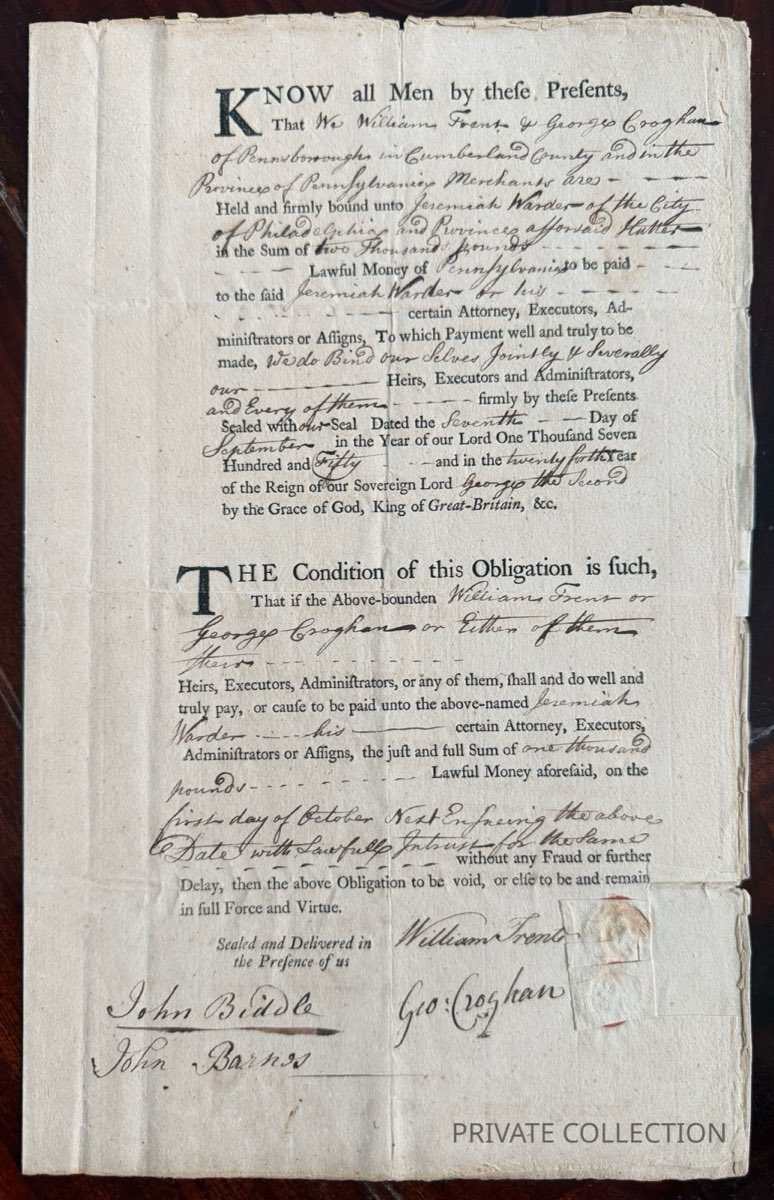
Bond and Judgment of William Trent and George Croghan to Jeremiah Warder
A Franklin bond form by which Trent and Croghan, 'merchants' of Pennsborough in Cumberland County, bind themselves to the Philadelphia hatter Jeremiah Warder, signed and sealed by both. Trent would build the fort at the Forks of the Ohio that the French took and renamed Duquesne; Croghan was the greatest Indian trader of his age. The press at the service of the frontier.
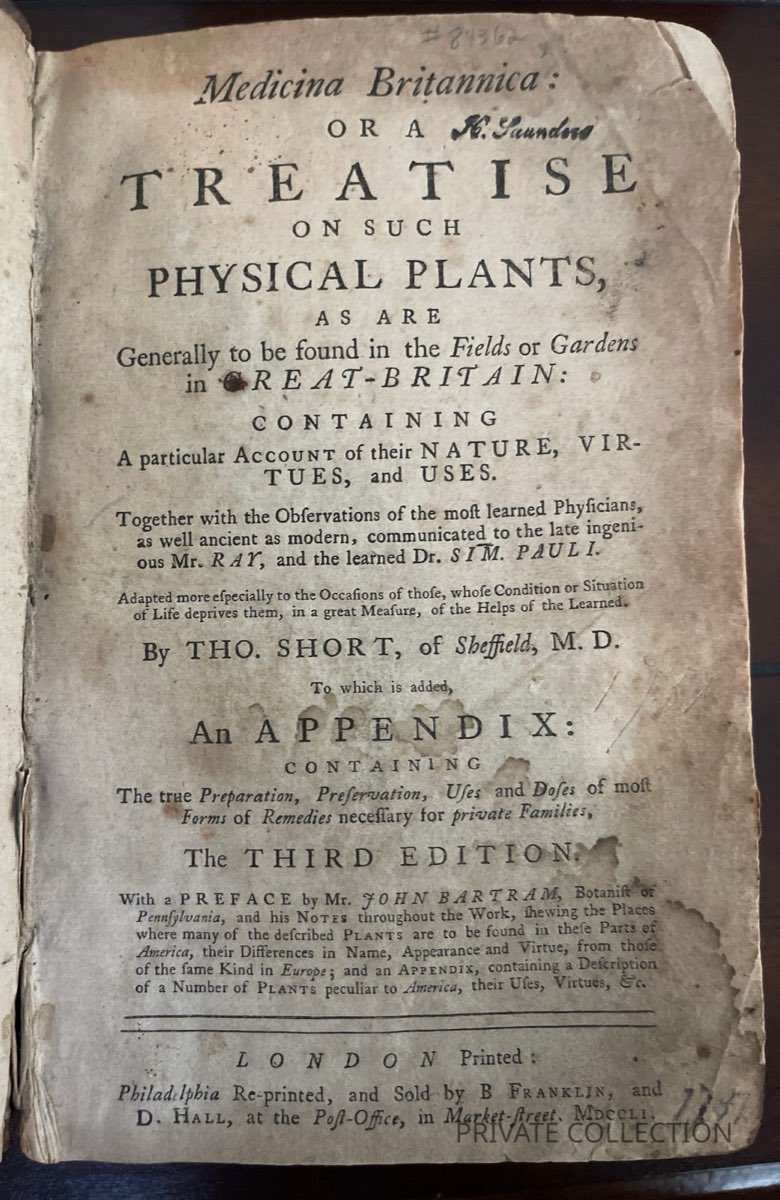
Medicina Britannica: A Treatise on Such Physical Plants as Are Generally to Be Found in the Fields or Gardens
Short's herbal in the American edition that matters: Franklin had John Bartram, the greatest botanist in the colonies, add notes on which of the English plants grew in Pennsylvania and which American plants could replace them. Medicine, botany, and the press on one title page.
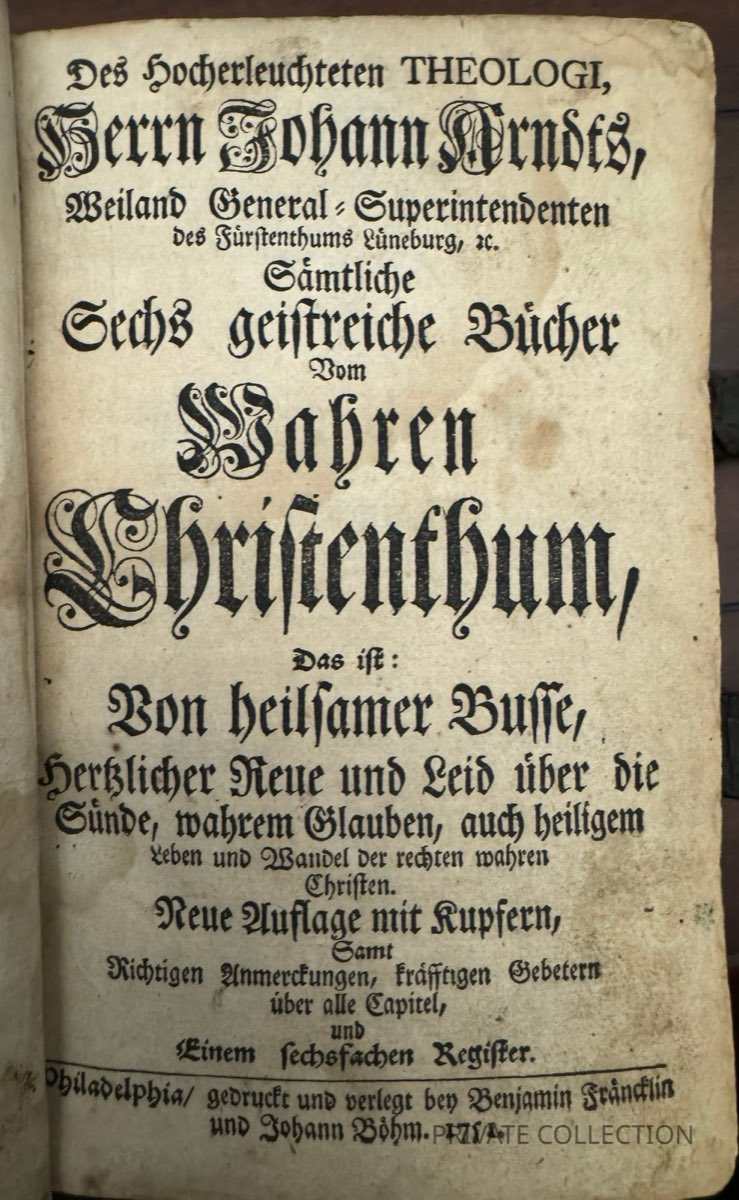
Des Hocherleuchteten Theologi … [Arndt's True Christianity]
Arndt's Wahres Christenthum in over 1,350 pages with sixty-four engravings — one of the most ambitious German books printed in colonial America, for a province that was by then a third German-speaking. Franklin's public view of the Germans was uneasy; his ledgers were not.
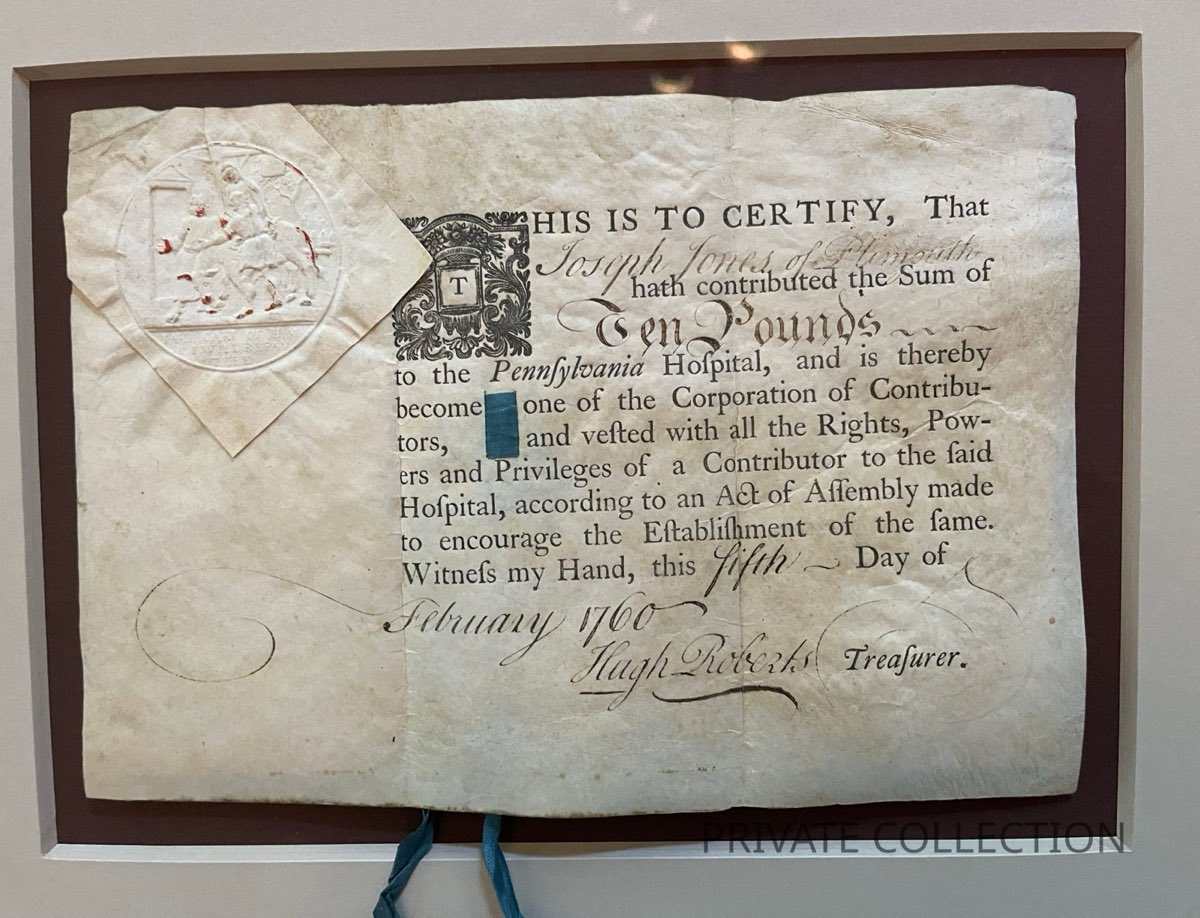
Pennsylvania Hospital Contributor's Certificate, Issued to Joseph Jones
The certificate acknowledging a contribution of ten pounds to the hospital Franklin had raised the money for and whose founding notes his press had printed (Catalog II). Not to be confused with the common Miller 598: Miller locates only five copies of this form.
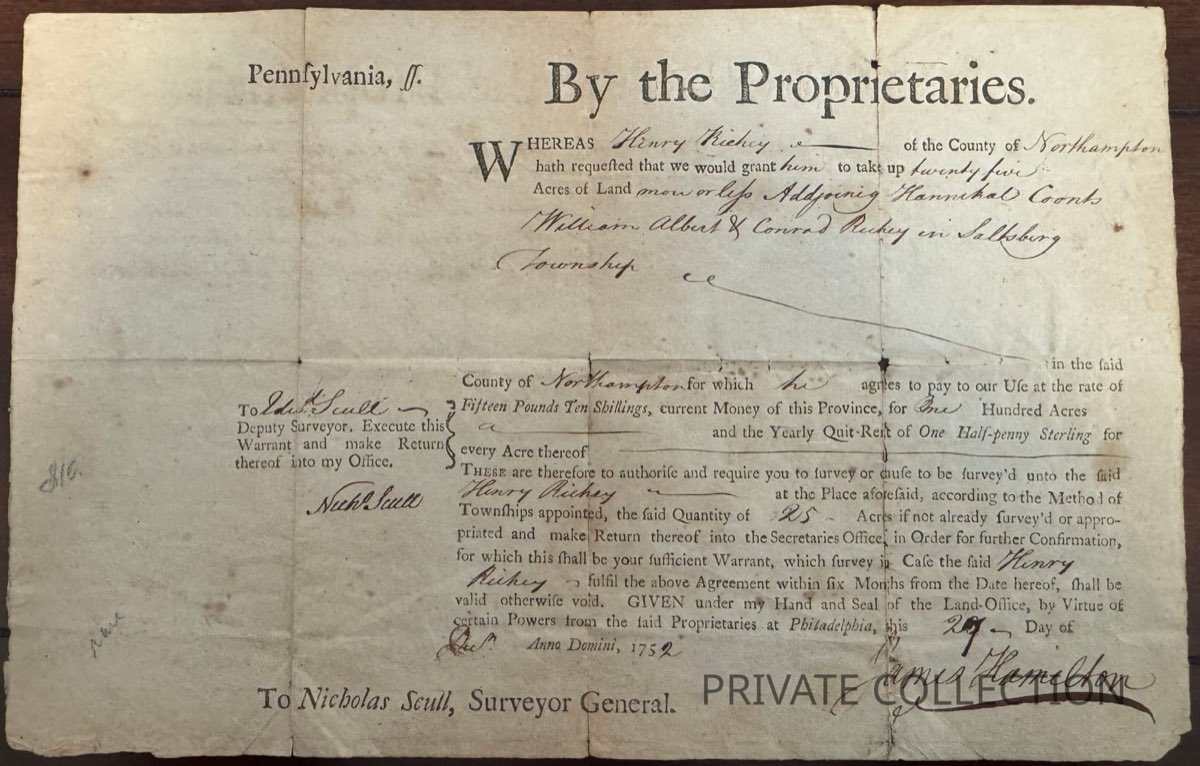
By the Proprietaries. To Nicholas Scull, Surveyor General (Land Warrant)
The warrant form addressed to Scull, Franklin's friend and fellow member of the Junto, who was Surveyor General from 1748 to 1761, here leasing a hundred acres in Northampton County to Henry Richey with the survey in manuscript on the verso. Signed by Lieutenant-Governor Hamilton, whose military commission of 1763 appears below.
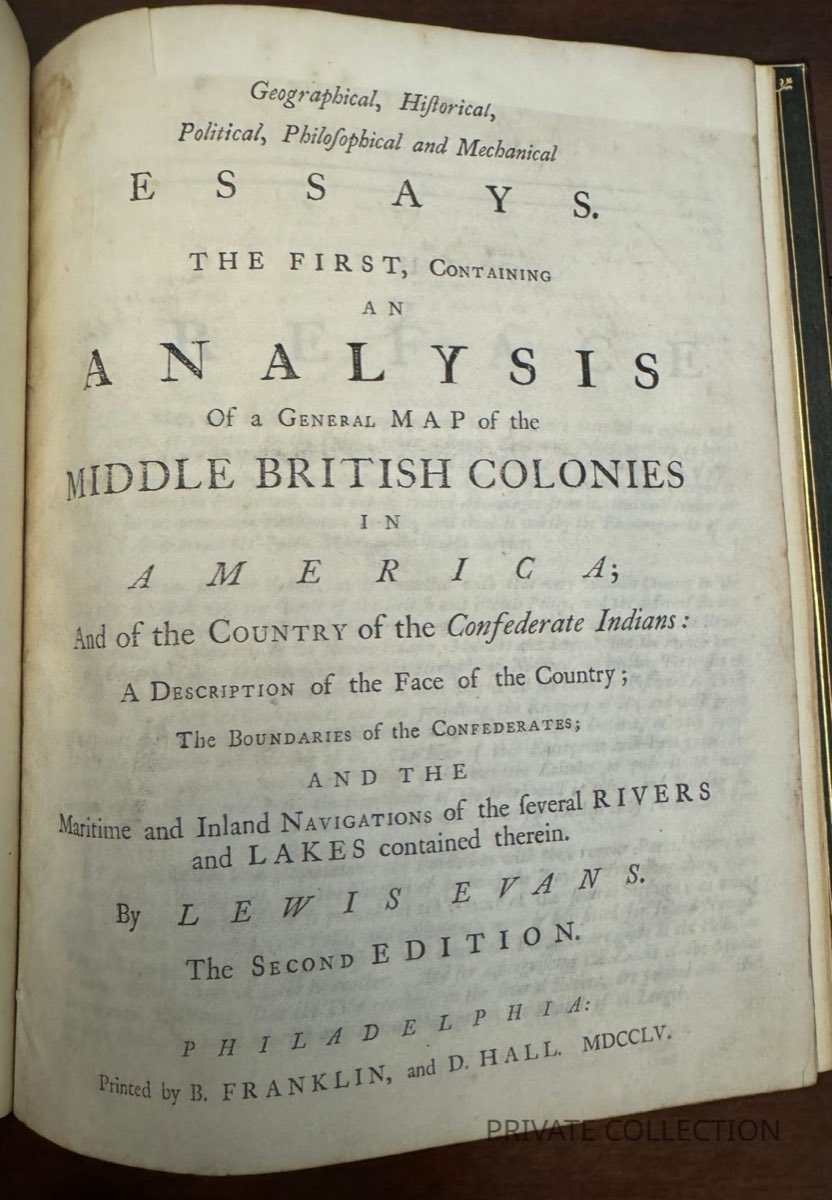
[Analysis of] A General Map of the Middle British Colonies in America
The pamphlet accompanying the most important map of the middle colonies before the Revolution, printed by Franklin, who probably secured the Boston engraver James Turner for the plate. Dedicated to Thomas Pownall, who financed it and reissued it in 1776 for Evans's orphaned daughter. Evans's next pamphlet accused Governor Morris of collusion with France and landed him in a New York jail, where he died in 1756.
Almanacs were the bread of a colonial press. Every household bought one, every year.
Almanac printing was, except for the Gazette, the most lucrative part of the business, and Poor Richard was its crown. The collection holds four Poor Richards of the partnership years and one of the pocket almanacs — smaller, cheaper, carried in the coat and worn out, so that Miller can locate only six copies. The 1761 almanac carries the essay on smallpox inoculation with which this catalog's story began in Boston forty years earlier: Franklin had lost his son Francis to the disease in 1736 and never forgave himself for the delay.
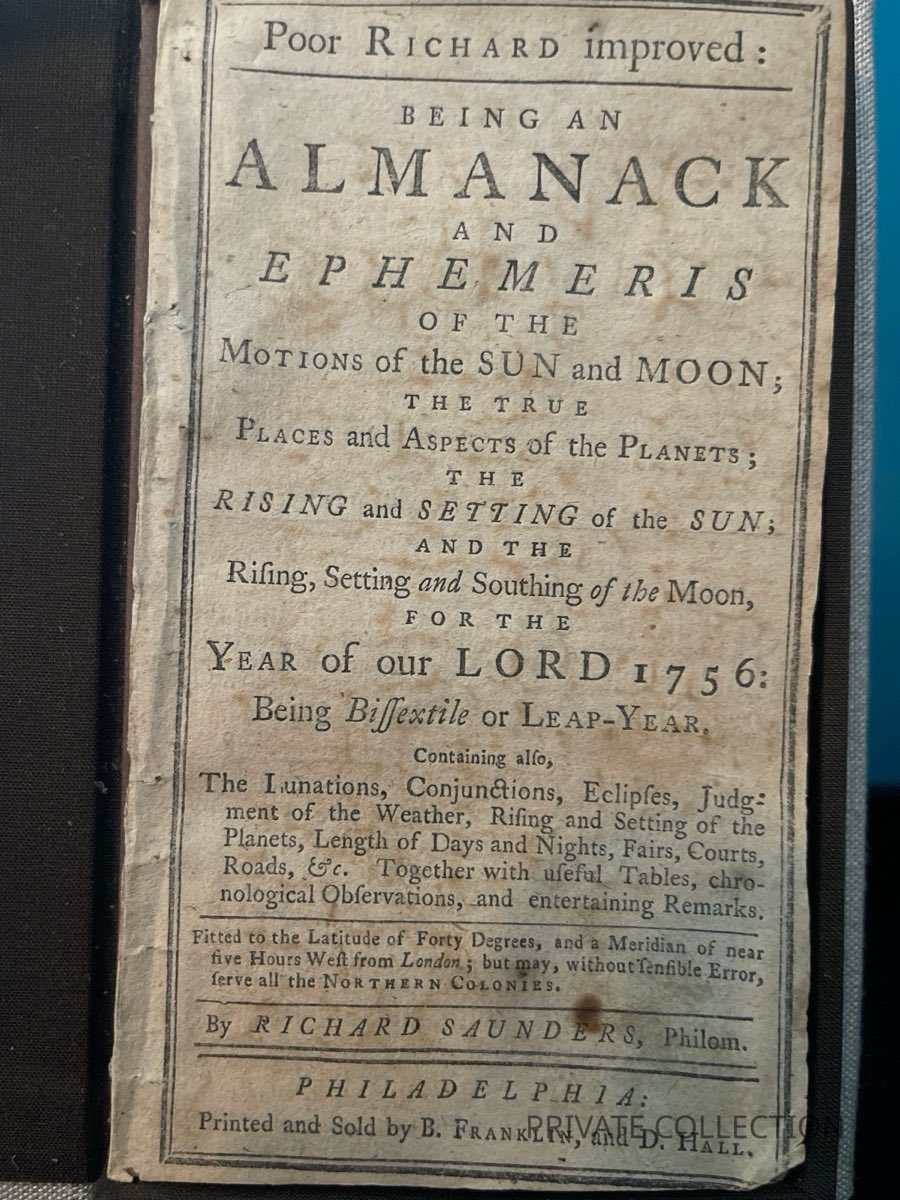
Poor Richard Improved, 1756
The almanac in the enlarged 'Improved' form Franklin adopted in 1748, with essays and tables beside the calendar. Issued in the autumn Braddock's army was destroyed on the Monongahela and Franklin was organizing the province's defence — which the almanac, serenely, does not mention.
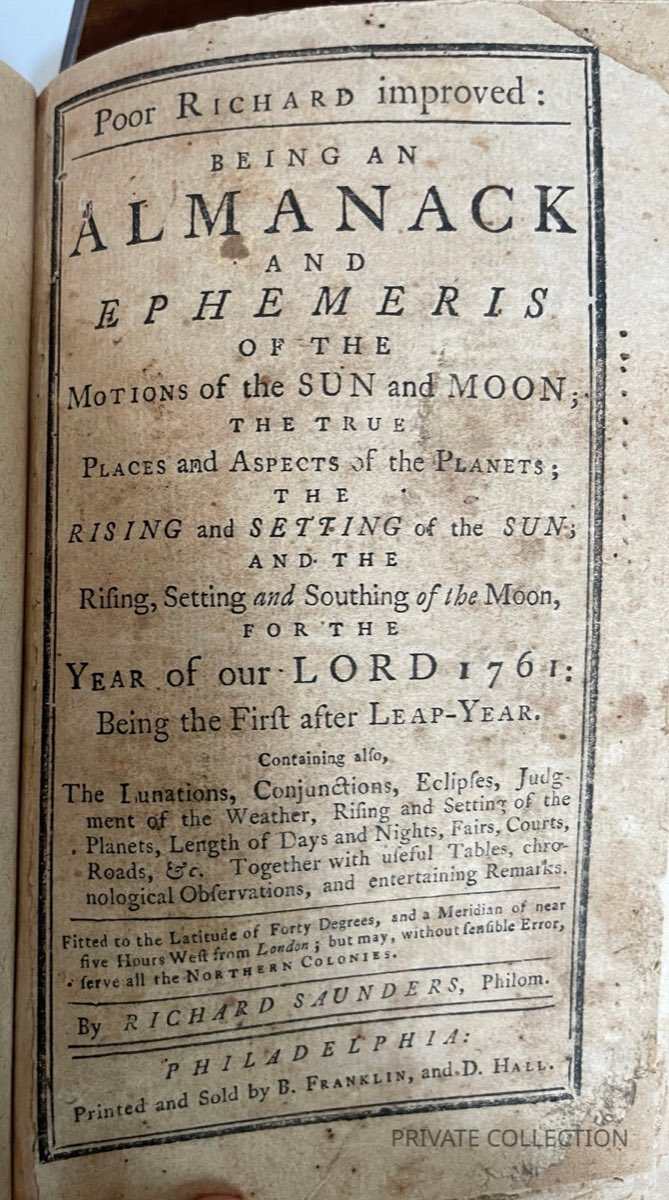
Poor Richard's Almanack, 1761
With an essay on pages 2–5 on smallpox and its treatment by inoculation — 'of all the Improvements, none have been found equal' to it. The apprentice who set Douglass's pamphlets against inoculation in 1722 put the case for it into every farmhouse in Pennsylvania in 1761.
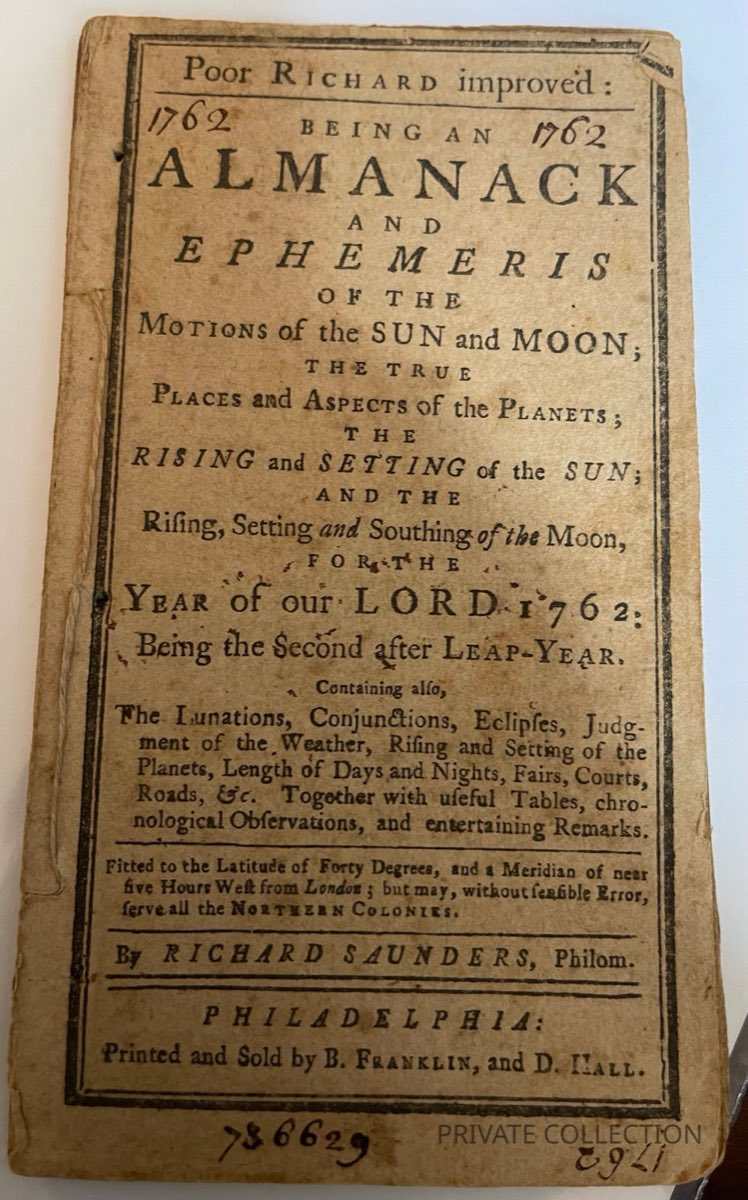
Poor Richard Improved, 1762
The almanac for 1762, the year Franklin returned from his first London mission to find the partnership prospering and the province at war on its frontier.
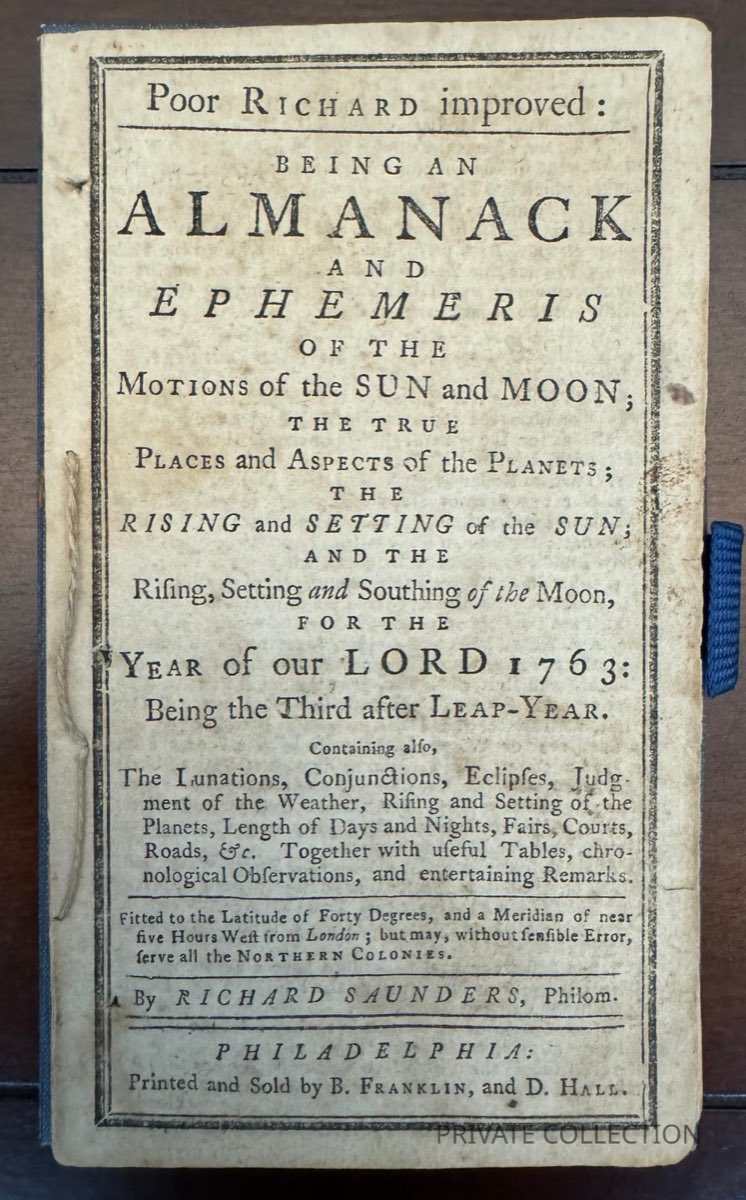
Poor Richard Improved, 1763
One of the finest surviving examples of Franklin's almanac: original stitching intact, with very little of the folding, foxing, and soiling that almost every almanac shows, in a custom slipcase and chemise. Almanacs were made to be used up; this one was not.
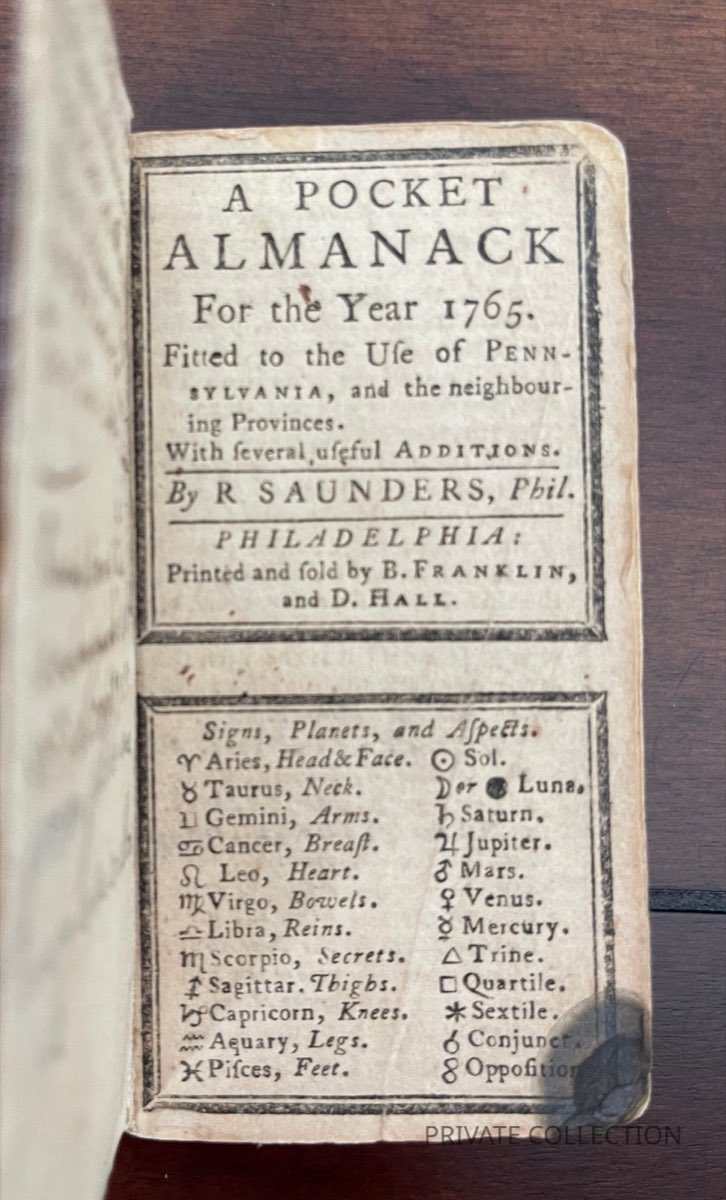
Pocket Almanac for the Year 1765, Fitted to the Use of Pennsylvania and the Neighbouring Provinces
Franklin's pocket almanacs carried the same tables as Poor Richard in a format made to be carried, and were worn out accordingly: Miller locates six copies. First advertised for sale on 1 November 1764, with eight blank leaves for the owner's own memoranda.
The Quaker Meeting remained the press's steadiest patron. The overseers sent Franklin & Hall a stream of London and Dublin pamphlets to reprint — Barclay and Pike on discipline, Hall's Mite, Rutty against the libertines — and in 1760 Anthony Benezet, the schoolmaster who was the conscience of Quaker Philadelphia, had the shop issue a collection of devotional tracts that included, quietly, an argument against the slave trade.
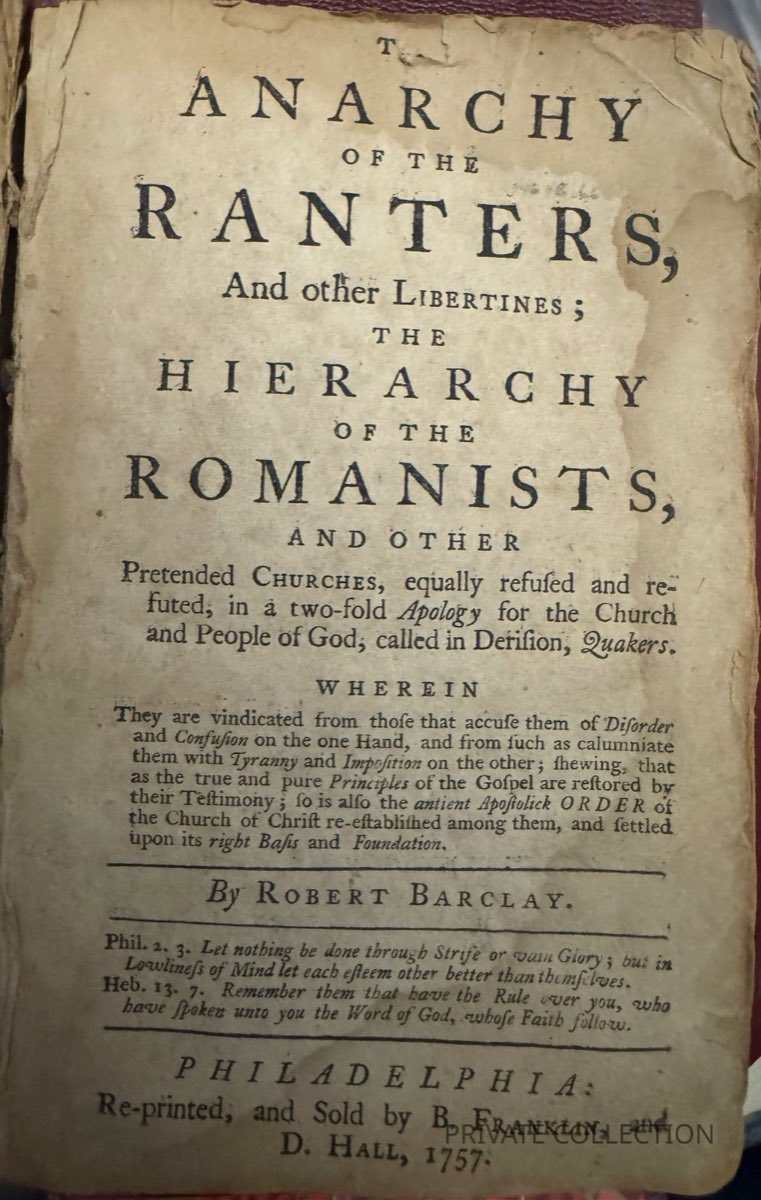
The Anarchy of the Ranters and Other Libertines … [with] Pike, An Epistle to the National Meeting of Friends
Barclay's defence of Quaker order, reprinted at the direction of the overseers of the press, with Pike's epistle on discipline. The collection holds Pike separately as well, in a copy from the library of Joseph Mickle Fox, the great collector of Franklin printing, with his gilt initials.
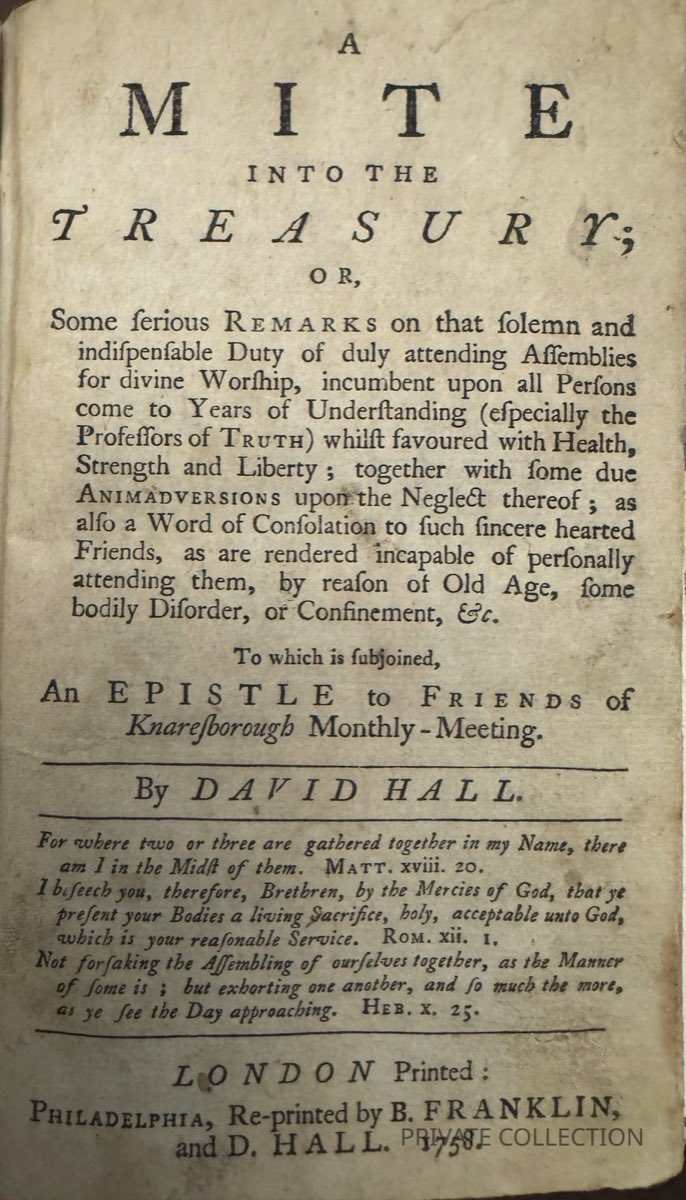
A Mite into the Treasury
A Quaker devotional work first issued by Luke Hinde, the Friends' printer in London, in 1756, and reprinted by a Philadelphia shop whose junior partner shared the author's name. In later leather-backed marbled boards.
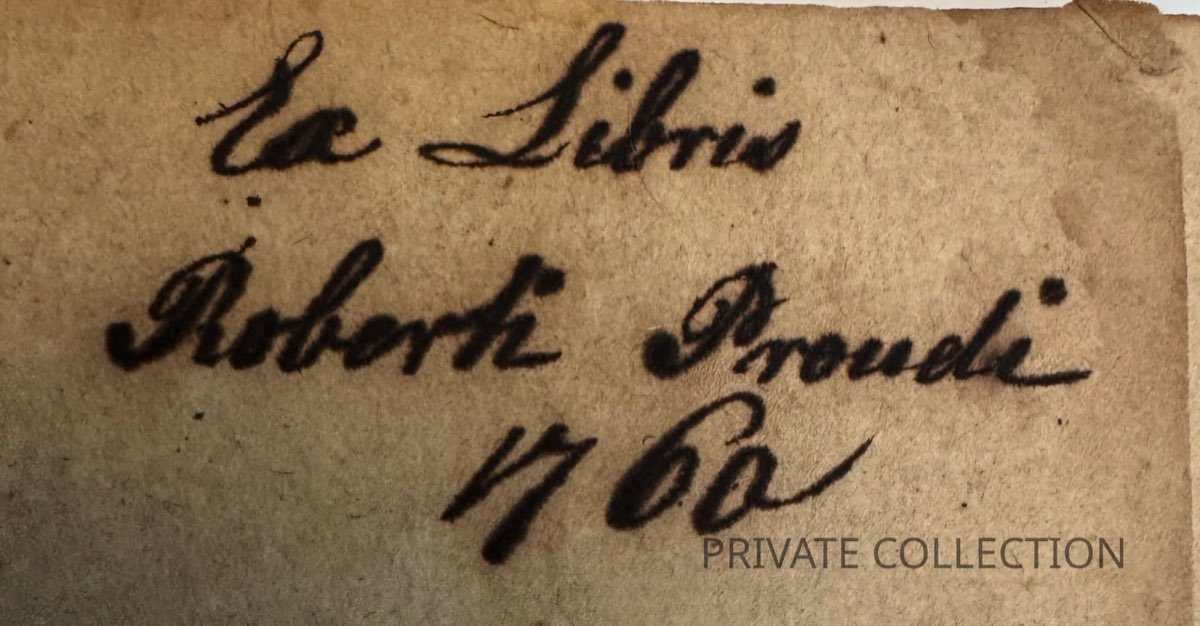
The Liberty of the Spirit and of the Flesh Distinguished
A Quaker address to 'those captives in spirit … commonly called libertines.' This copy is from the library of Robert Proud, the schoolmaster and historian whose History of Pennsylvania the collection also holds.
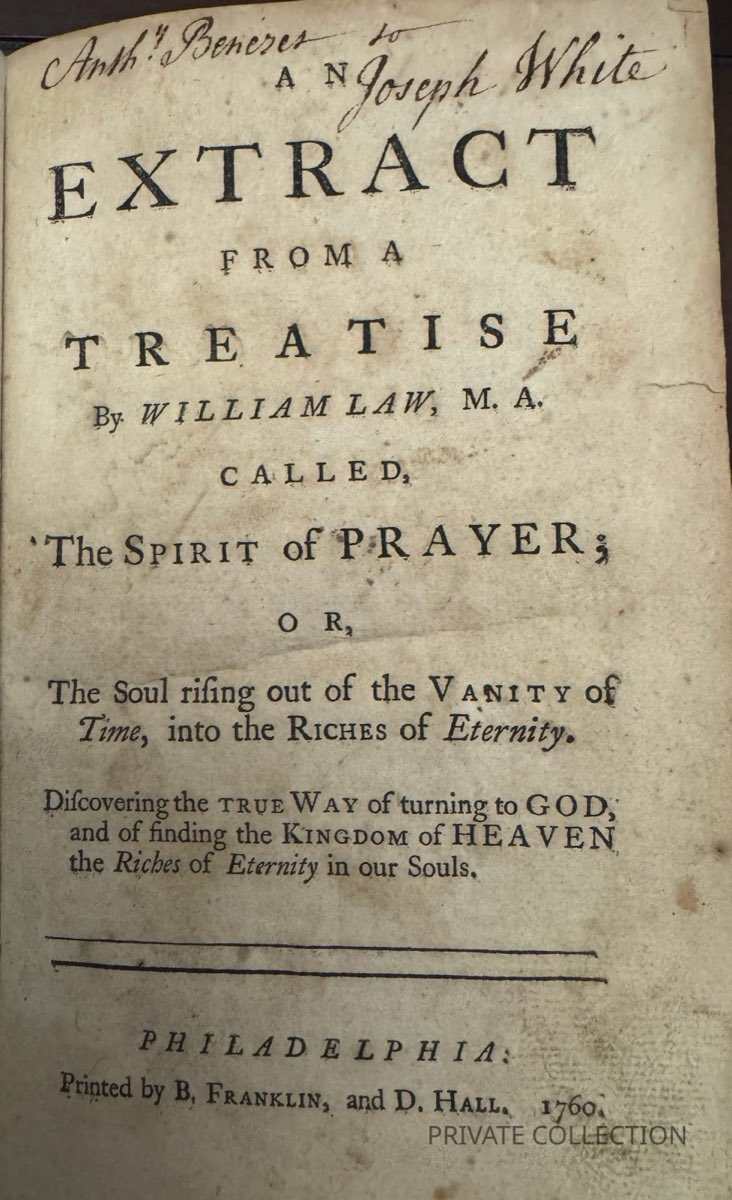
An Extract from a Treatise by William Law, Called The Spirit of Prayer
Benezet's extract from the English mystic, printed for the Quaker schools. Benezet taught free Black children, converted Rush to the antislavery cause, and in time converted Franklin.
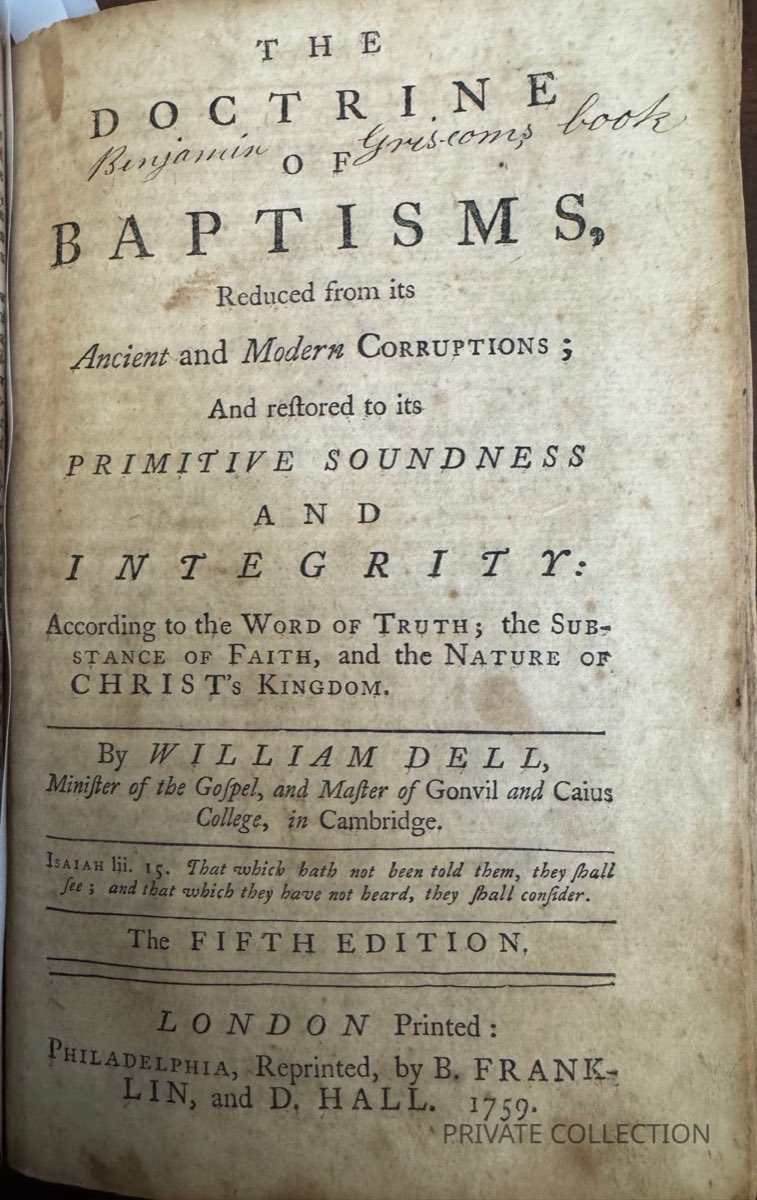
A Collection of Devotional Tracts
Benezet's collection, including Observations on the Enslaving, Importing, and Purchasing of Negroes — the antislavery argument in a devotional wrapper, from the press of a man who still owned slaves. Lacks the title page.
The last years of the partnership produced some of its rarest paper. In the summer of 1763, at the outbreak of Pontiac's War, the shop printed the commissions by which the province raised companies against the frontier raids; one survives in the collection, wholly unrecorded, with the provincial seal. In 1764 it printed the catalogue of the Library Company, the institution Franklin had founded in 1731 and stocked ever since. And in 1765, while Franklin argued the Stamp Act down in London, it printed the session laws and the naturalization certificates of a province that had never been more British and would not be for much longer.
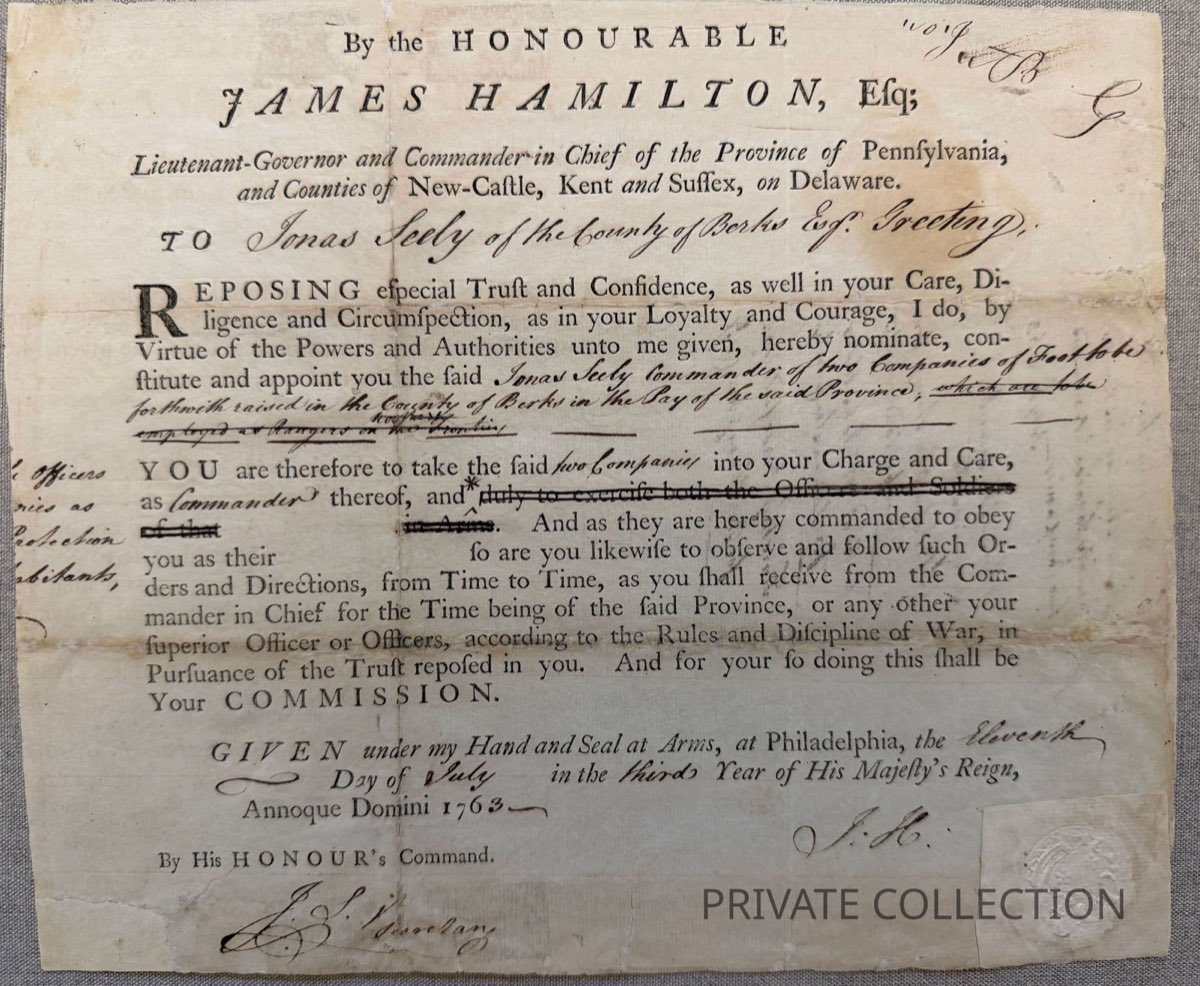
By the Honourable James Hamilton, Esq., Lieutenant-Governor … Commission to Jonas Seely to Raise and Command Two Companies
A wholly unrecorded Franklin printing: a commission issued in July 1763 to Jonas Seely of Berks County, a French and Indian War captain, to raise two companies of foot against Pontiac's raids. Seely and six men fought eight warriors that September. A variant of Miller 741, with the seal intact.
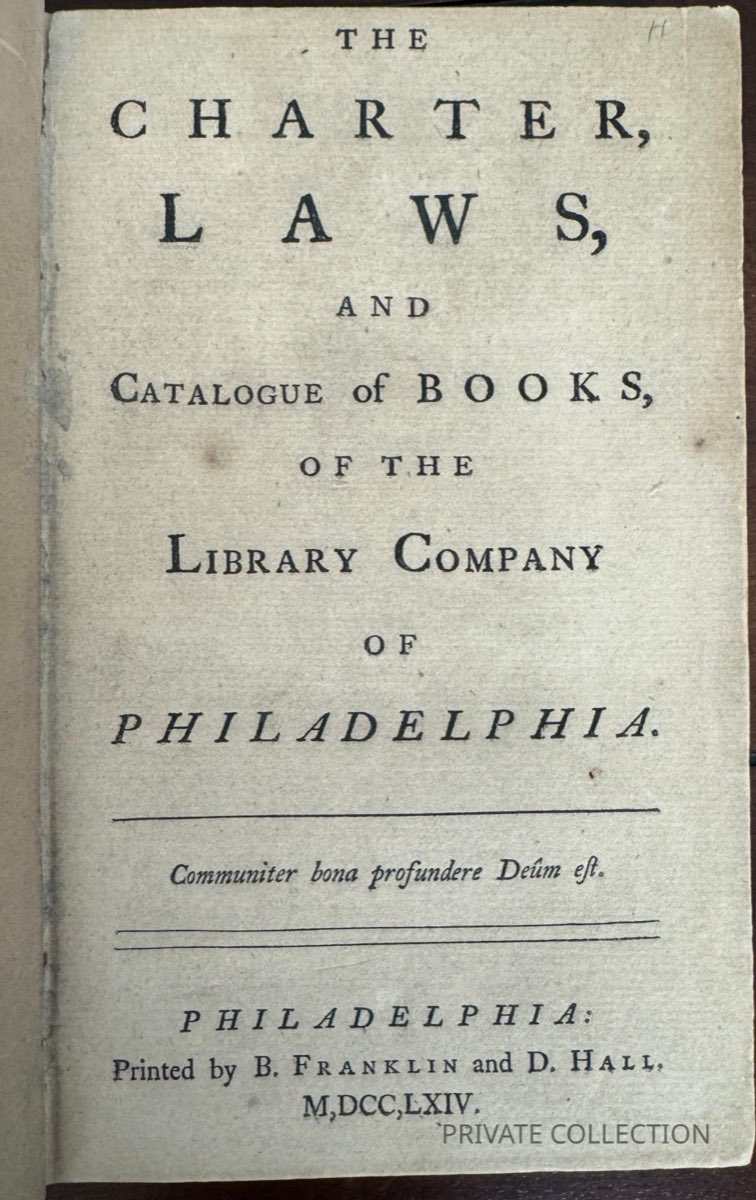
The Charter, Laws, and Catalogue of Books, of the Library Company of Philadelphia
The catalogue of what was probably the most extensive library in colonial British America, arranged by format — folio, quarto, octavo, duodecimo — with blank leaves after each section for additions. Franklin was the Company's founder and the person most responsible for its contents. Miller locates over twenty copies; the last at auction were in 1976, 1934, and 1919.
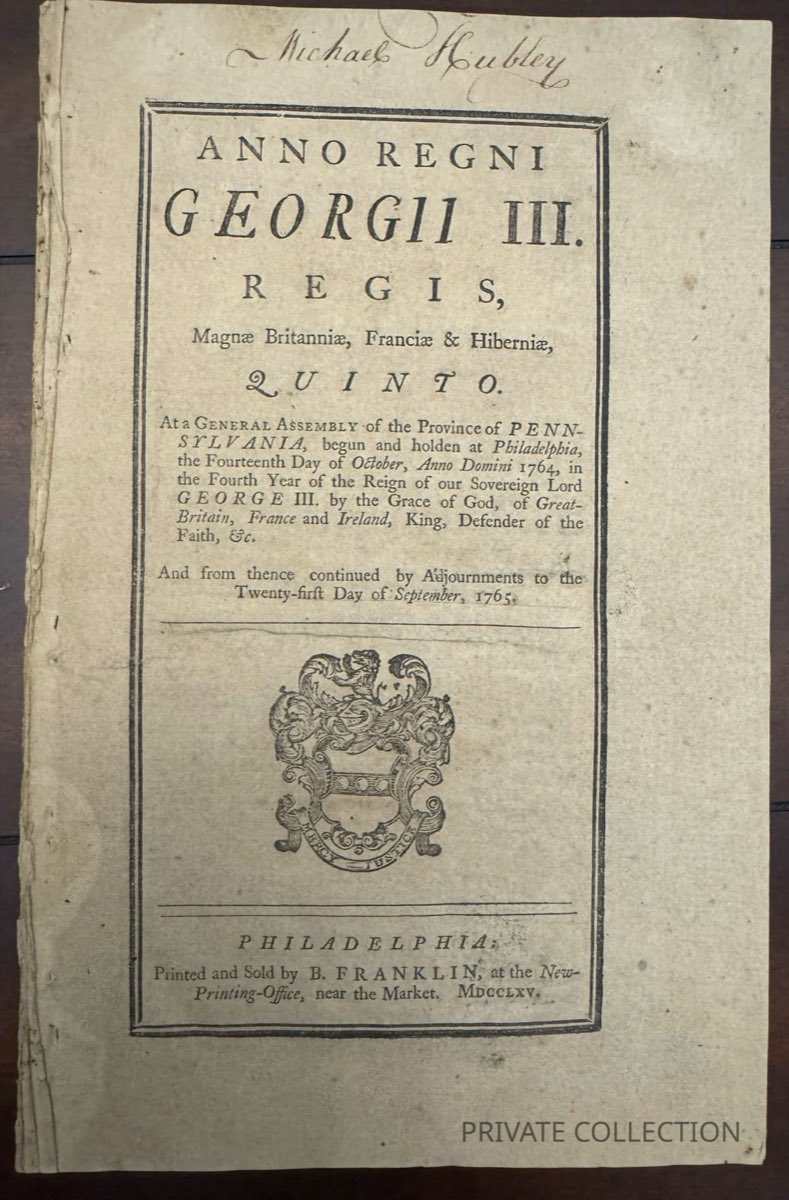
Anno Regni Georgii III … At a General Assembly of the Province of Pennsylvania, 1765
Session laws of 1765 — a night watch for Lancaster, a bridge over Skippack Creek, relief for insolvent debtors — printed during the Stamp Act crisis by a press whose senior partner was in London arguing the Act down. Miller locates nine copies.
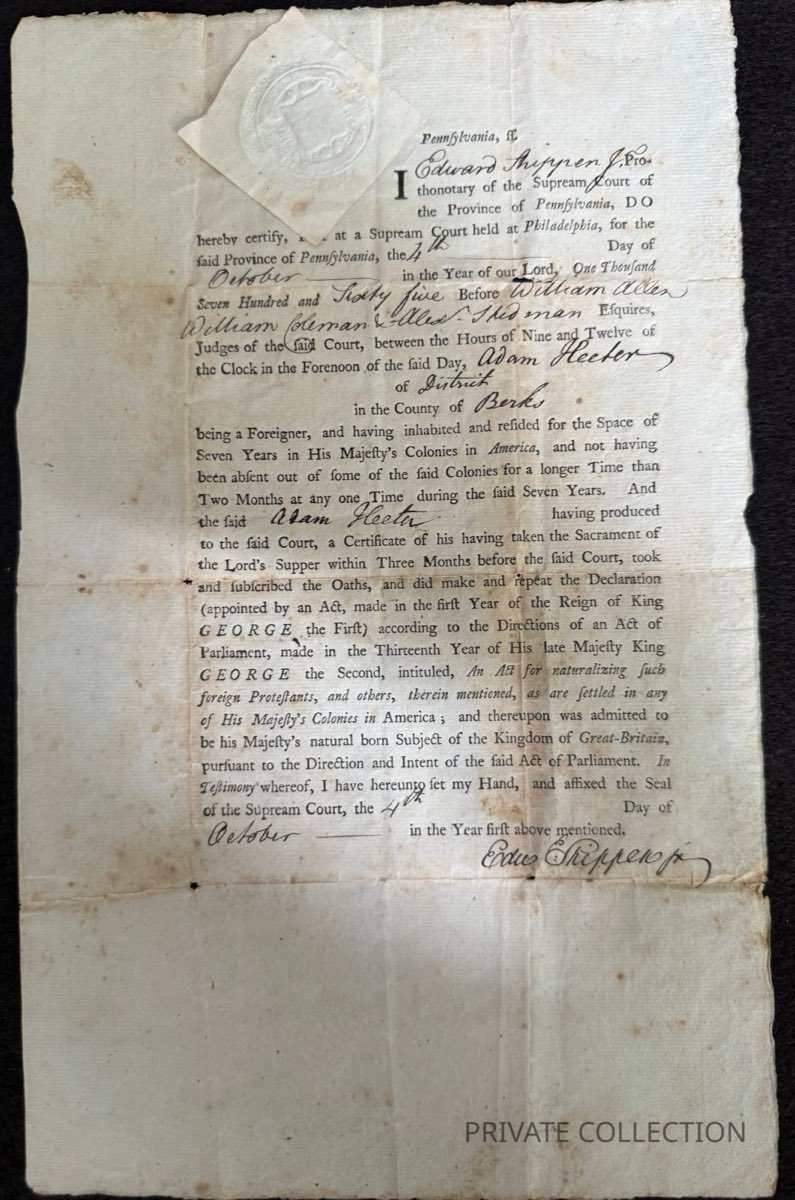
Certificate of Naturalization and Oath of Allegiance
The printed form by which a foreign Protestant became a British subject under the Act of 1740, on certifying that he had taken the sacrament within three months and sworn the oaths. This copy is signed by Edward Shippen, Jr. — later chief justice of Pennsylvania and father-in-law of Benedict Arnold — three weeks before the Stamp Act was to take effect.
Hall bought Franklin out in 1766, and the imprint became 'D. Hall,' then 'Hall and Sellers.' Franklin, in London, drew his share of the profits and did not look back. He had been a printer in Philadelphia for thirty-eight years.